
2. A quantity of wool of twenty eight pounds, or two stone.
3. A fox.
TODAS. See Nílgiri Hills, vol. xvii. p. 509.
TODLEBEN, or Totleben, Eduard Ivanovich (1818— 1884), Russian general, was born at Mittau, in Courland, on May 20, 1818. His parents, who seem to have been of German descent, were of the mercantile class, and he himself was intended for commerce, but a strong instinct led him to seek the career of a military engineer. He entered the school of engineers at St Petersburg in 1835, and passed from that into the army in 1838. In 1847 and the two following years he was employed, as captain of engineers, in the campaigns against Schamyl in the Caucasus, where he directed the siege operations against the principal mountain fortresses. On the outbreak of war between Russia and the Porte in 1853, he was placed at the head of the staff of General Schilder-Schuldner, by whom Silistria was besieged. This general being wounded, Todleben acted in his place until the siege was raised. He was then transferred to the Crimea. Sebastopol, while strongly fortified toward the sea, was almost unprotected on the land side. Todleben, though still only of colonel’s rank, became the animating genius of the defence. By his advice the fleet was sunk, in order to blockade the mouth of the harbour, and the deficiency of fortifications on the land side was made good before the allies could take advantage of it. The construction of earthworks and redoubts was carried on with extreme rapidity, and to these was transferred, in great part, the artillery that had belonged to the fleet. In whatever direction the besiegers drew their lines, there Todleben met them with counterworks, until, with the arrival of heavy Russian reinforcements, the besiegers almost became the besieged. It was in these improvised operations by means of earthworks that Todleben’s peculiar power and originality showed itself; ...he was not a great military leader in the wider sense, nor was he the creator of a great permanent system of defence like Vauban. But for the special problems of Russian warfare, both in 1854 and at a later epoch, he was exactly the man wanted. Until June 1855 he conducted the operations of defence at Sebastopol in person; he was then wounded in the foot, and at the operations which immediately preceded the fall of the fortress he was not present. When he recovered from his wounds he was employed in strengthening the fortifications at the mouth of the Dnieper, and also those of Cronstadt. In 1856 he visited England, where his merits were well understood. In 1860 he was appointed assistant to the grand-duke Nicholas, and he became subsequently chief of the department of engineers. For reasons which are not known he was given no command when war with Turkey began in 1877. It was not until the disasters before Plevna had heaped discredit upon the incompetent leaders of the Russian army that the soldier of Sebastopol was called to the front. Todleben saw that Plevna could not be taken by assault, and that it would be necessary to reduce it by drawing works round Osman Pasha, and cutting him off from communication with the other Turkish commanders. In due time Plevna fell. Todleben then undertook the siege of the Bulgarian fortresses. After the conclusion of preliminaries of peace, he was placed in command of the whole Russian army, and became responsible for the government and administration of the occupied districts. In the discharge of these duties he is said to have distinguished himself by his combined firmness and good temper in dealing both with Turkish authorities and with the native population. He received the highest military honours and commands when the war was over, and became governor of Odessa. But his health was broken; and after much suffering he died at a German watering-place in June 1884. He was buried with great solemnity at Sebastopol.
TODMORDEN, a market-town of England, partly in Lancashire but chiefly in the West Riding of Yorkshire, stands on the Calder, on the Rochdale Canal, and on the Lancashire and Yorkshire Railway, 13 miles west of Halifax, 9 north of Rochdale, and 207∣ north-north-west of London. It lies in three valleys amidst scenery originally romantic, and still in part retaining that characteristic. The townhall (1875) bridges the counties boundary, the Calder, enabling the magistrates to exercise jurisdiction in both counties. Of the other buildings, the Unitarian church, the market-hall, the free endowed school, and the Unitarian free school may be mentioned. A bronze statue has been erected to John Fielden, to whose energy in developing the cotton manufacture the town owes much of its prosperity. The staple industry is the spinning and weaving of cotton, and there are also foundries and machineworks. The population of the township of Todmorden and Walsden (area 7007 acres) in 1871 was 9333, and in 1881 it was 9237. In addition to this (situated wholly in Yorkshire), the urban sanitary district includes parts of Langfield and Stansfield in Yorkshire, and of Cliviger in Lancashire, the total area being 15,690 acres, with a population in 1871 of 21,764, and in 1881 of 23,862.
As early as the reign of Edward HI. Todmorden was in the possession of the Radcliffes, a branch of the Radcliffes of Radcliffe Tower, but it was sold by them about the close of the 17th century. Todmorden Hall is an interesting old building of various dates.
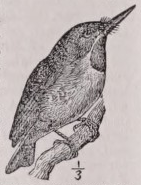
TODY, Pennant’s rendering (Gen. Pirds, pp. 15, 61) through the French Todier of Brisson (Ornithologie, iv. p. 528) of the somewhat obscure Latin word Todus , talis, cum todillis [todinis] crusculis”; but the passage is held by scholars to be corrupt. Among naturalists Gesner in 1555 gave currency (Hist. Animalium, iii. p. 719) to the word as a substantive, and it is found in Levins’s Manipulus Vocabulorum of 1570 (ed. Wheatley, 1867, col. 225) as the equivalent of the English “Titmouse.” Ducange allows the existence of the adjective todinus. Stephanus suggests that todi comes from τυτθo ἰ , but his view is not accepted. The verb todere may perhaps be Englished to “toddle”! ] not unhappily applied in 1756 by Patrick Browne (Civ. and Hat. Hist. Jamaica, p. 476) to a little bird remarkable for its slender legs and small feet, the “Green Sparrow” or “Green Humming-Bird” of Sloane (Voyage, ii. p. 306). The name, having been taken up by Brisson (loc. cit.) in 1760, was adopted by Linnaeus, and has since been recognized by ornithologists as that of a valid genus, though many species have been referred to it which are now known to have no affinity to the type, the Todus viridis of Jamaica, and accordingly have since been removed from it. The genus Todus was at one time placed among the Muscicapidae (cf. Flycatcher, vol. ix. p. 351); but Dr Murie’s investigations (Proc. Zool. Society, 1872, pp. 664-680, pl. Iv.) have conclusively proved that it is not Passerine, and is nearly allied to the Momotidae (cf. Motmot, vol. xvii. p. 3) and Alcedinidae (cf. Kingfisher, vol. xiv. p. 81), though it should be regarded as forming a distinct Family Todidae, peculiar to the Greater Antilles, each of which islands has its own species, all of small size, the ...largest not exceeding four inches and a half in length.
Of the species already named, T. viridis, Mr Gosse (Ä Jamaica, pp. 72-80) gives an interesting account, “Always conspicuous from its bright grass-green coat and crimson-velvet gorget, it is still a very tame bird; yet this seems rather the tameness of indifference than of confidence; it will allow a person to approach very near, and, if disturbed, alight on another twig a few yards distant .... commonly it is seen sitting patiently on a twig, with the head drawn in, the beak pointing upwards, the loose plumage puffed out, when it appears much larger than it is. It certainly has an air of stupidity when thus seen. But this abstraction is more apparent than real; if we watch it, we shall see that the oddlooking grey eyes are glancing hither and thither, and that ever and anon the bird sallies out upon a short feeble flight, snaps at something in the air, and returns to his twig to swallow it.” Mr Gosse goes on to describe the engaging habits of one that he for a short time kept in captivity, which, when turned into a room, immediately began catching all the insects it could, at the rate of about one a minute. The birds of this Family also shew their affinity to the Kingfishers, Motmots, and Bee-eaters by burrowing holes in the ground in which to make their nest, and therein laying eggs with a white translucent shell. The sexes differ little in plumage.
All the four species of Todus, as now restricted, present a general similarity of appearance, and, it may be presumed, possess very similar habits. The genus has been monographed by Mr Sharpe (His, 1874, pp. 344-355); but he was unfortunately misled by an exceptionally bright-
coloured specimen to add a fifth and bad species to those that exist—and even these, by some ornithologists, might be regarded as geographical races. The Cuban form is T. multicolor·, that of Hispaniola is T. subulatus or dominicensis ; and that of Porto Rico, originally named in error T. mexicanus, has since been called hypochondriacus. Apart from their structural peculiarities, one of the chief points of interest attaching to the Todidae is their limitation, not only to the Antillean Sub-region, but, as is now believed, to its greater islands. (a. n.)