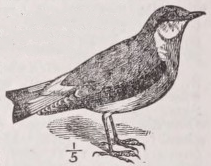
WHEATEAR, as a bird’s name perhaps of doubtful meaning, though Taylor, the “water poet” (d. 1654), in whose writings it seems first to occur, and Willughby explain it (in the words of Ray, the latter’s translator) as given “because [in] the time of wheat harvest they wax very fat.” It would seem also from this author to have been originally the local name for the species in Sussex, on the South Downs of which county its capture in a very simple kind of trap has been the occupation of many generations of shepherds, who thereby have made an excellent trade, since Wheatears in their proper season, from the end of July till towards the end of September, are justly esteemed for the table and fetch a price that for many years has been continually rising owing to the failing supply, which is chiefly due to the bringing under tillage of so much of the sheep-walk, heath, down, and other open country that was formerly in a natural condition....
The Wheatear, the Saxicola oenanthe of ornithologists, is one of the earliest migrants of its kind to return to its home, often reaching England at the end of February and almost always by the middle of March. The cock bird, with his bluish grey back and light buff breast, set off by black ear-coverts, wings, and part of the tail, is rendered still more conspicuous by his white rump as he takes short flights in front of those who disturb him, while his sprightly actions and gay song harmonize so well with his delicately-tinted plumage as to render him a welcome object to all who delight in free and open country. When alarmed both sexes have a sharp monosyllabic note that sounds like chat ; and this has not only entered into some of the local names of this species and of its allies, but has caused all to be frequently spoken of as “Chats.” The nest is constantly placed under ground; the bird takes advantage of the hole of some other animal, or the shelter of a clod in a fallowfield, or a recess beneath a rock. A large amount of soft materials is therein collected, and on them from 5 to 8 pale blue eggs are laid. The Wheatear has a very wide range throughout the Old World, extending in summer far within the Arctic Circle, from Norway to the Lena and Yana valleys, while it winters in Africa beyond the Equator, and in India. But it also breeds regularly in Greenland and some parts of North America. Its reaching the former and the eastern coast of the latter, as well as the Bermudas, may possibly be explained by the drifting of individuals from Iceland; but far more interesting is the fact of its continued seasonal appearance in Alaska without ever showing itself in British Columbia or California, and without ever having been observed in Kamchatka, Japan, or China, though it is a summer resident in the Tchuktchi peninsula. Hence it would seem as though its annual flights across Bering’s Strait must be in connexion with a migratory movement that passes to the north and west of the Stanovoi range of mountains, for Mr Nelson’s suggestion {Cruise of the Corwen, pp. 59, 60) of a northwest passage from Boothia Felix, where Ross observed it, is less likely.
More than 60 other species more or less allied to the Wheatear have been described, but probably so many do not really exist. Some 8 are included in the European fauna; but the majority are inhabitants of Africa. Several of them are birds of the desert; and here it may be remarked that, while most of these exhibit the sandcoloured tints so commonly found in animals of like habitat, a few assume a black plumage, which, as explained by Canon Tristram, is equally protective, since it assimilates them to the deep shadows cast by projecting stones and other inequalities of the surface.
Of other genera closely allied to, and by some writers included in, Saxicola there is only need here to mention Pratincola, which comprises among others two well-known British birds, the Stonechat and Whinchat, P. rubicolα and P. ηιbetra, the latter a summermigrant, while the former is resident as a species, and the black head, ruddy breast, and white collar and wing-spot of the cock render him a conspicuous object on almost every furze-grown common or heath in the British Islands, as he sits on a projecting twig or flits from bush to bush. This bird has a wide range in Europe, and several other species, more or less resembling it, inhabit South Africa, Madagascar, Réunion, and Asia, from some of the islands of the Indian Archipelago to Japan. The Whinchat, on the other hand, much more affects enclosed lands, and with a wide range has no very near ally.
Placed near these forms by nearly all systematists is the group containing the Australian genus Petraeca, containing about a dozen species,—the “Robins,” so called of the colonists, some of them remarkable for their bright plumage; and possibly allied to them, as indeed is generally thought, with 5 or 6 species peculiar to New Zealand, are the genera Miro and Myiomoira. But Prof. Parker has seen in the osteology of the first inferior characters which appear to him to separate them from their presumed colleagues, and, as stated before (Ornithology, vol. xviii. p. 48), he terms them “Struthious Warblers.” Like so many other forms from the same countries, they probably preserve the more generalized structure of earlier and lower types, and should possibly be distinguished as a separate sub-family Petraecinae.
All the birds mentioned in this article form the group Saxicolinae of most authors. Some, however, have raised them to the rank of a distinct Family Saxicolidae (cf. Warbler) ; and Mr Sharpe (Cat. Birds Brit. Mus., iv. pp. 164-199) has placed Petraeca and Pratincola in the Family Muscicapidae. (a. n.)