
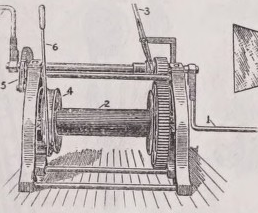
A windlass; or an instrument with which to turn or strain something forcibly; as a winch to strain the cord of a bedstead, or to turn a wheel.
WINCHESTER, a city, and a parliamentary and municipal borough, of Hampshire, England, is situated on the river Itchen, 66 miles south-west of London by the London and South Western Railway. The Caer Gwent (White City) of the Britons and Venta Belgarum of the Romans, Winchester was a town of much importance in early times, mainly on account of its central position on the Roman high roads in the south of England. Temples to Apollo and Concord stood within the precincts of the present cathedral close; but in the 3d century the place is said to have become one of the chief centres of the early Celtic Christians. The Saxon invaders at the end of the 5th century treated the Roman name Venta as if it were a feminine substantive, and, transforming it into “Winte,” called the town Winte-ceaster, “the City of the Winte;” hence the modern name Winchester. Throughout the Saxon period the city was one of the highest importance: early in the 6th century it became the capital of Wessex; and the kings of Wessex were crowned and usually buried in the cathedral. Even after the formation of the united kingdom of Anglia by Egbert, the great witan was still held in Winchester. It was also one of the chief centres for the coining of money under the pre-Norman kings: in the time of Athelstan it contained six mints, while London possessed only three. Even after the Norman Conquest many sovereigns were crowned and many parliaments held here; the celebrated Statutes of Winchester were passed in a parliament held in 1285. The city continued to be a favourite royal residence, and Henry II. rebuilt the palace on a larger scale. This same king gave it its first regular charter of incorporation (1184). In the Middle Ages Winchester was famed for its wool trade and textile fabrics; in the 14th ...century it was the chief wool mart of England and had an extensive trade with France, Belgium, and Holland. In the 15th century its prosperity began to decline. In Cromwell’s time the city suffered severely from a siege, during which Winchester Castle was dismantled. Charles II. began to build a palace on the site of this fortress, after designs by Sir Christopher Wren, but the death of the king prevented the work from being completed.
The first Christian church at Winchester is said to have been destroyed during the persecution of Aurelian, and rebuilt in 293. It was again burned by the Saxons in 495. St Swithun held the episcopate from 852 to 862, and enlarged the cathedral. The foundations of the adjacent abbey church of Hyde, in which some of the Saxon kings were buried, were discovered in 1886 close to the north side of the cathedral nave. The cathedral church was at one time associated with a priory of secular canons, but St Ethelwold, bishop from 963 to 984, suppressed the secular foundation and built a Benedictine abbey in its place. A wholly new cathedral was begun by Bishop Walkelin (1070-98), and in 1093 the eastern portion was consecrated jointly to St Peter, St Paul, and St Swithun. The two Norman transepts and the low central tower still exist, as does also the very curious early crypt, east of the crossing. This is a low vaulted structure partly supported by a central row of columns; it has an apsidal termination, and is surrounded by an ambulatory, out of which a second smaller apse extends eastwards,—apparently a survival of the “confessio” of the earlier cathedral. The whole of the Norman nave was pulled down and rebuilt on a more magnificent scale by William of Wykeham at the end of the 14th century; the work was completed after his death by means of a large bequest. The choir was also remodelled in the 14th century and again much altered by Bishop Fox (1501-28).
In plan Winchester cathedral consists of a nave, two transepts, choir, and retro-choir, all with aisles. A large lady chapel extends still further eastwards. The length of the whole building is no less than 546 feet, thus being greater than that of any other church in England, with the exception of St Albans, which measures about the same length. One of its chief beauties is the magnificent teredos behind the high altar; this consists of a lofty wall, the full width of the choir, pierced by two processional doors, and covered with tiers of rich canopied niches, which once contained colossal statues. A cross of plain ashlar stone in the centre shows where an immense silver crucifix was once attached; and a plain rectangular recess above the altar once contained a massive silver-gilt retable, covered with cast and repoussé statuettes and reliefs, an elaborate work of the most costly magnificence. A second stone screen, placed at the interval of one bay behind the great reredos, served to enclose the small chapel in which stood the magnificent gold shrine, studded with jewels, the gift of King Edgar, which contained the body of St Swithun. In the choir is the plain tomb of William II., and under many of the arches of the nave and choir are a number of very elaborate chantry chapels, each containing the tomb of its founder. Some of these have fine recumbent effigies, noble examples of English mediaeval sculpture; the most notable are the monuments of Bishops Edingdon, Wykeham, Waynflete, Cardinal Beaufort, Langton, and Fox. The font of black marble is an interesting example of 11th-century art; its sides are covered with curious reliefs representing scenes from the life of St Nicholas. A good deal of very magnificent 14th-century stained glass still exists at Winchester.
Winchester College was built from 1387 to 1393 by William of Wykeham (q.v.). The foundation of the school consisted of a warden, ten fellows, three chaplains, seventy scholars, and sixteen choristers. Its fine chapel, hall, cloister, and other buildings still exist in good preservation. About a mile distant from the town stands the hospital of St Cross, founded in 1136 by Henry de Blois, bishop of Winchester, to provide board and lodging for 13 poor men and a daily dinner for 100 others. It was enlarged and mostly rebuilt by Cardinal Beaufort, 1405-47. The buildings are still in a good state of preservation, including the simple but very stately cruciform chapel, built about the year 1180, which in plan resembles a fine parochial church. The whole place has been much injured by so-called “restoration.”
Winchester suffered greatly in the plague of 1666, and its population was much reduced. At present its prosperity chiefly depends on the presence of the cathedral, the college, and its barracks, which accommodate about 2000 men. The city has several good schools and the usual public and charitable institutions. From the 23d year of Edward I. it returned two members to parliament until 1885, when it lost one member. The population of the municipal and parliamentary borough (area 1032 acres) was 16,366 in 1871 and 17,780 in 1881. (j. h. μ.)
WINCHESTER, a city and the county seat of Frederick county, Virginia, United States, is situated in the Shenandoah valley, about 700 feet above sea-level, and on a branch of the Baltimore and Ohio Railroad. It lies about 67 miles west-north-west of Washington. The surrounding country is rich and fertile, devoted to agriculture and cattle-raising, for which Winchester serves as a centre of supply and distribution. The city has manufactories of shoes, furniture, gloves, &c., and some iron foundries and tanneries. The population in 1880 was 4958 (1517 coloured). In 1888 it was estimated at over 5000.
Winchester was laid out as a town in 1752 and incorporated in 1779. It has had a very slow growth, and during the Civil War it suffered severely from the armies of both combatants.