
1. A dragnet for taking oysters, etc.
2. A mixture of oats and barley sown together.
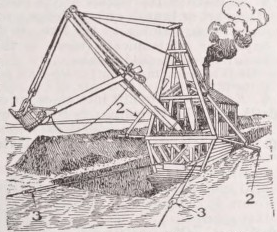
DREDGE, The Naturalist’s, an implement constructed on the general plan of the common oyster-dredge, and used by naturalists for obtaining specimens of the animals living on the bottom of the sea at greater or less depths, for the purpose of determining their structure and zoological relations, and ascertaining their geographical distribution. The instrument usually employed in this and other northern countries for dredging oysters and clams is a light frame of iron about 5 feet long by a foot or so in width, with a scraper like a narrow hoe on one side, and a suspending apparatus of thin iron bars which meet in an iron ring for the attachment of the dredge-rope on the other. From the frame is suspended a bag about 2 feet in depth of iron chain netting, or of wide-meshed hempen-cord netting, or of a mixture of both. Naturalist dredgers at first used the oyster dredge, but it is scarcely suitable for scientific purposes. Having a scraper on one side only, it is liable in a current, in deep water, or in unskilled hands, to fall on its back and consequently to come up empty, the scraper not having come into play. Oyster dredgers are not allowed to take oysters below a certain size, and the commercial dredge is so contrived as to allow all small bodies to fall through, and, as many of these are of the highest interest to the naturalist, his object is thus in a great measure defeated....
The remedy for these defects is to have a scraper on each side, with the arms attached in such a way that one or other of the scrapers must reach the ground in whatever position the dredge may fall; and to have the dredge-bag deeper in proportion to the size of the frame, and of a material which is only sufficiently open to allow the water to pass freely through, with the openings so distributed as to leave a part of the bag close enough to bring up the finest mud.
The late Dr Robert Ball of Dublin devised the modification which has since been used almost universally by naturalists in this country and abroad under the name of “Ball’s Dredge” (fig. 1). The dredges on this pattern, used in Britain for ten years after their first introduction, about the year 1838, were usually small and rather heavy—not more than 12 to 15 inches in length, by 4 or 4∣ inches in width at the mouth. Two scrapers, the length of the dredge-frame, and 1∣ to 2 inches wide, were set at an angle of about 110° to the plane of the dredge’s mouth, so that when the dredge was gently hauled along it took hold of the ground and secured anything loose on its surface,
Latterly Ball’s dredges of considerably larger size have been used. Perhaps the most convenient form for dredging from a row boat or a yawl is that represented in the figure. The frame is 18 inches long, and its width is 5 inches. The scrapers are 3 inches wide, and these are so set that the distance across between their scraping edges is 7⅜ inches. The ends of the frame connecting the scrapers are round bars of iron five-eighths of an inch in diameter, and from these bars two curved arms of round iron of the same thickness, dividing beneath into two branches, which are attached to the ends of the cross-bars by eyes allowing the arms to fold down over the dredge-mouth, meet in two heavy eyes at a point 18 inches above the centre of the frame. The total weight of the dredge frame and arms is 20 lb; it ought to be of the best Lowmoor or Swedish wrought iron.
The thick inner edges of the scrapers are perforated by round holes at distances of about an inch, and through these strong iron rings about an inch in diameter are passed, and two or three similar rings run on the short rods which form the ends of the dredge-frame. A light iron rod, bent to the form of the dredge opening, usually runs through these rings, and to this rod and to the rings the mouth of the dredge-bag is securely attached by stout cord or strong copper wire. The dredge-bag for a dredge of this size should be about 2 feet deep; and probably the most suitable material is hand-made netting of very strong twine, the meshes half an inch to the side, the inter-spaces contracting to a third of an inch across when the twine is thoroughly soaked. So open a network would let many of the smaller things through, and to avoid this, and at the same time to give free egress to the water, the bottom of the bag, to the height of about 6 inches, is lined with “bread-bag,” a light open kind of canvas. It may be said that in such a dredge many valuable small objects may be washed through the meshes of the upper part of the dredge along with the mud and thus lost; but, on the other hand, if the bag be very close it is apt to get filled up with mud at once, and to collect nothing more.
For work round the coasts of Europe, at depths attainable from a row-boat or yawl, probably the best kind of line is bolt-rope of the best Russian hemp, not less than 1⅜ inches in circumference, containing eighteen to twenty yarns in three strands. Each yarn should bear nearly a hundred weight, so that the breaking strain of such a rope ought to be about a ton. Of course it is never voluntarily exposed to such a strain, but in shallow water the dredge is often caught among rocks or coral, and the rope should be strong enough in such a case to bring up the boat, even if there were some little way on. It is always well, when dredging, to ascertain the approximate depth with the lead before casting the dredge; and the lead ought always to be accompanied by a registering thermometer, for the subsequent haul of the dredge will gain greatly in value as an observation in geographical distribution, if it be accompanied by an accurate note of the bottom-temperature. For depths under 100 fathoms the amount of rope paid out should be at least double the depth; under 30 fathoms, where one usually works more rapidly, it should be more nearly three times; this gives a good deal of slack before the dredge if the boat be moving very slowly, and keeps the lip of the dredge well down. When there is anything of a current, from whatever cause, it is usually convenient to attach a weight, varying from 14 lb to half a hundred weight, to the rope 3 or 4 fathoms in front of the dredge. This prevents in some degree the lifting of the mouth of the dredge; if the weight be attached nearer the dredge it is apt to injure delicate objects passing in.
In dredging in sand or mud, the dredge-rope may simply be passed through the double eye formed by the ends of the two arms of the dredge-frame; but in rocky or unknown ground it is better to fasten the rope to the eye of one of the arms only, and to tie the two eyes together with three or four turns of rope-yarn. This stop breaks much more readily than the dredge-rope, so that if the dredge get caught it is the first thing to give way under the strain, and in doing so it often alters the position of the dredge so as to allow of its extrication.
The dredge is slipped gently over the side, either from the bow or from the stern—in a small boat more usually the latter—while there is a little way on, and the direction which the rope takes indicates roughly whether the dredge is going down properly. When it reaches the ground and begins to scrape, an experienced hand upon the rope can usually detect at once a tremor given to the dredge by the scraper passing over the irregularities of the bottom. The due amount of rope is then paid out, and the rope hitched to a bench or rollock-pin. The boat should move very slowly, probably not faster than a mile an hour. In still water or with a very slight current the dredge of course anchors the boat, and oars or sails are necessary; but if the boat be moving at all it is all that is required. It is perhaps most pleasant to dredge with a close-reefed sail before a light wind, with weights, against a very slight tide or current; but these are conditions which cannot be commanded. The dredge may remain down from a quarter of an hour to twenty minutes, by which time, if things go well, it ought to be fairly filled. In dredging from a small boat the simplest plan is for two or three men to haul in, hand over hand, and coil in the bottom of the boat. For a large yaul or yacht, and for depths over 50 fathoms, a winch is a great assistance. The rope takes a couple of turns round the winch, which is worked by two men, while a third hand takes it from the winch and coils it down.
The dredge comes up variously freighted according to the locality, and the next step is to examine its contents and to store the objects of search for future use. In a regularly organized dredging expedition a frame or platform is often erected with a ledge round it to receive the contents of the dredge, but it does well enough to capsize it on an old piece of tarpauling. There are two ways of emptying the dredge; we may either turn it up and pour out its contents by the mouth, or we may have a contrivance by which the bottom of the bag is made to unlace. The first plan is the simpler and the one more usually adopted; the second has the advantage of letting the mass slide out more smoothly and easily, but the lacing introduces rather a damaging complication, as it is apt to loosen or give way. Any objects visible on the surface of the heap are now carefully removed, and placed for identification in jars or tubs of sea-water, of which there should be a number secured in some form of bottle basket, standing ready. The heap should not be much disturbed, for the delicate objects contained in it have already been unavoidably subjected to a good deal of rough usage, and the less friction among the stones the better.
Close to the place where the dredge is emptied there ought to be a tub about 2 feet in diameter and 20 inches deep, provided with a set of sieves so arranged that the lowest sieve fits freely within the bottom of the tub, and the three remaining sieves fit freely within one another, (fig. 2.) Each sieve has a pair of iron handles through which the hand can pass easily, and the handles of the largest sieve are made long, so that the whole nest can be lifted without stooping or putting the arms into the water. The upper smallest sieve is usually deeper than the others; it is made of a strong open net of brass wire, the meshes half an inch to a side. The second sieve is finer, the meshes a quarter of an inch to a side; the third is finer still; and the fourth is so close as only to allow the passage of mud or fine sand. The sieves are put into the tub, and the tub filled up to the middle of the top sieve with seawater. The top sieve is then filled with the contents of the dredge, and the set of sieves are gently moved up and down by the handles of the bottom sieve in the water. It is of great importance not to give a rotatory motion to the sieves in this part of the process, for this is very ruinous to fragile organisms; the sieves should be gently churned up aud down, whether singly or together. The result is that the rougher stones and gravel and the larger organisms lire washed and retained in the upper sieve; the fine mud or sand passes through the whole of the sieves and subsides to the bottom of the tub; while the three lower sieves contain, in graduated series, the objects of intermediate size. The sieves are examined carefully in succession, and the organisms which they contain are gently removed with a pair of brass or bone forceps into the jars of sea-water, where their movement and their natural colours may be observed, or placed at once in bottles of strong or weak spirit of wine or dried, according to the object for which they have been collected.
The scientific value of à dredging depends mainly upon two things,—the care with which the objects procured are preserved and labelled for future identification and reference, and the accuracy with which all the circumstances of the dredging—the position, the depth, the nature of the ground, the date, the bottom-temperature, &c. —are recorded. Every specimen, whether dry or in spirit, should be labelled at once with the number under which this particular dredging is entered in the dredger’s note book.
Up to the middle of last century the little that was known of the inhabitants of the sea beyond low-water mark seems to have been gathered almost entirely from the objects found thrown on the beach after storms, and from chance captures on lead-lines, or by fishermen on their long lines, aud in trawls and oyster and clam dredges. The naturalist’s dredge does not appear to have been used for investigating systematically the fauna of the bottom of the sea until it was employed by Otho Frederick Müller in the researches which afforded material for the publication, in 1779, of his admirable Descriptions and History of the rarer and less known Animals of Denmark, and Norwdy. In the preface to the first volume Müller gives a quaint description and figure of a dredge (fig. 3) not very unlike that used by Hall and Forbes, only the mouth of the dredge was square, a form which, unless used with great caution, gives fatal facilities for “washing out” in the process of hauling in.
At the Birmingham meeting of the British Association in 1839 an important committee was appointed “for researches with the dredge with a view to the .investigation of the marine zoology of Great Britain, the illustration of the geographical distribution of marine animals, and the more accurate determination of the fossils of the Pliocene period.” Of this committee Edward Forbes was the ruling spirit, and under the genial influence of his contagious enthusiasm great progress was made during the next decade in the knowledge of the fauna of the British seas, and many wonderfully pleasant days were spent by the original committee and by many others who from year to year were “added to their number.” Every annual report of the British Association contains communications from the English, the Scottish, or the Irish branches of the committee; and in 1850 Edward Forbes submitted its first general report on British marine zoology. This report, as might have been anticipated from the eminent qualifications of the reporter, was of the highest value; and, taken along with his remarkable memoirs previously published, “On the Distribution of the Mollusca and Radiata of Aegean Sea,” and “On the Zoological Relations of the existing Fauna and Flora of the British Isles,” may be said to mark an era in the progress of human thought.
The dredging operations of the British Association committee were carried on generally under the idea that at the 100-fathom line, by which amateur work in small boats was practically limited, the zero of animal life was approached—a notion which was destined to be gradually undermined, and finally overthrown. From time to time, however, there were not wanting men of great skill and experience to maintain, with Sir James Clark Ross, that “from however great a depth we may be enabled to bring up mud and stones of the bed of the ocean we shall find them teeming with animal life.” Samples of the seabottom, procured with great difficulty and in small quantity from the first deep soundings in the Atlantic, chiefly by the use of Brooke’s sounding machine, an instrument which by a neat contrivance disengaged its weights when it reached the bottom, and thus allowed a tube, so arranged as to get filled with a sample of the bottom, to be recovered by the sounding line, were eagerly examined by miscroscopists; and the singular fact was established that these samples consisted over a large part of the bed of the Atlantic of the entire or broken shells of certain Foraminifera. Dr Wallich, the naturalist to the “Bulldog” sounding expedition under Sir Leopold M i Clintock, reported that star-fishes, with their stomachs full of the deep-sea Foraminifera, had come up from a depth of 1200 fathoms on a sounding line; and doubts began tobe entertained whether the bottom of the sea was in truth a desert, or whether it might not present a new zoological region open to investigation and discovery, and peopled by a peculiar fauna suited to its special conditions.
In the year 1868, while the question was still undecided, two testing investigations were undertaken independently. In America Count L. F. Fourtales, one of the officers employed in the United States Coast Survey under Professor Pierce, commenced a series of deep dredgings across the Gulf Stream off the coast of Florida, which were continued in the following year, and were productive of most valuable results; and in Great Britain the Admiralty, on the representation of the Royal Society, placed the “Lightning,” a small gun vessel, at the disposal of a small committee to sound and dredge in the North Atlantic between Shetland and the Faroe Islands.
In the “Lightning,” with the help of a “donkeyengine” for winding in, dredging was carried on with comparative ease at a depth of 600 fathoms, and at that depth animal life was found to be still abundant. The results of the “Lightning’s” dredgings were regarded of so great importance to science that the Royal Society pressed upon the Admiralty the advantage of continuing the researches, and accordingly, during the years 1869 and 1870, the gun-boat “Porcupine” was put under the orders of a committee consisting of Dr Carpenter, F.R.S., Dr Gwyn Jeffreys, F.R.S., and Professor Wyville Thomson, F.R.S., one or other of whom superintended the scientific work of a series of dredging trips in the North Atlantic to the north and west of the British Islands, which occupied two summers.
In the “Porcupine,” in the summer of 1869, dredging was carried down successfully to a depth of 2435 fathoms, upwards of two miles and a half, in the Bay of Biscay, and the dredge brought up well-developed representatives of all the classes of marine invertebrates. During the cruises of the “Porcupine” the fauna of the deep water off the western coasts of Great Britain and of Spain and Portugal was tolerably well ascertained, and it was found to differ greatly from the fauna of shallow water in the same region, to possess very special characters, and to show a very marked relation to the faunae of the earlier Tertiary and the later Cretaceous periods.
In the winter of 1872, as a sequel to the preliminary cruises of the “Lightning” and “Porcupine,” by far the most considerable expedition in which systematic dredging had ever been made a special object left Great Britain. H.M.S. “Challenger,” a corvette of 2306 tons, with auxiliary steam working to 1234 horse-power, was despatched to investigate the physical and biological conditions of the great ocean basins.
The “Challenger” was provided with a most complete and liberal organization for the purpose; she had powerful deck engines for hauling in the dredge, workrooms, laboratories, and libraries for investigating the results on the spot, and a staff of competent naturalists to undertake such investigations and to superintend the packing and preservation of the specimens reserved for future study.
In these deep-sea dredgings it was frequently found that, while few objects of interest were brought up within the dredge, many echinoderms, corals, and sponges came to the surface sticking to the outside of the dredge, and even to the first few fathoms of the dredge-line. This suggested many expedients, and finally a long transverse iron bar was attached to the bottom of the dredge-bag, and large bunches of teazed-out hemp were fastened to the free ends of the bar (fig. 4). The “hempen-tangles” are now regarded as an essential part of the dredge, nearly as important as the dredgebag, and often much...