CUNARD, Sir Samuel (1787-1865), baronet,· civil engineer, founder of the Cunard line of Atlantic steam-ships, was born at Halifax, Nova Scotia, in 1787. He was the son of a merchant, and was himself trained for the pursuits of commerce, in which, by his abilities and enterprizing spirit, he attained a conspicuous position. When, in the early years of steam navigation, the English Government made known its desire to substitute steam vessels for the sailing ships then employed in the mail service between England and America, Canardheartily entered into the scheme, came to England, and accepted the Government tender for carrying it out. A company was formed, the members of which were Canard, Messrs Burns of Glasgow, and Messrs Maclver of Liverpool, these two firms being then proprietors of rival lines of coasting steamers between Glasgow and Liverpool. For the first contract with the Government four steam-vessels were built, and the first voyage was successfully made by the “Britannia” from Liverpool to Boston, U.S., between July 4 and 19, 1840. Such was the small beginning of an undertaking which in the course of thirty-seven years has grown into one of the vastest of private enterprizes, and may even rank in importance, as to the extent of interests involved in it, and the number of hands employed, with railway and other public companies. In 1852 the company began to substitute iron screw steamers for the wooden vessels with paddlewheels in use up to that time. The Cunard fleet has always borne the highest character for the build, manning, management, and provisioning of the ships; and the reward of the scrupulous care exercised has been a rare immunity from what are called “casualties.” In acknowledgment of his energetic and successful services Cunard was, in ...1859, created a baronet. He died in London, April 28, 1865.
9th ed. Encyclopædia Britannica, vol. 6, p. 706 [308 words — estimated reading time: 2 minutes]
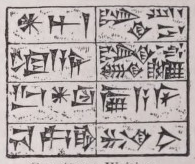
CUNEIFORM WRITING. The cuneiform or « wedge-shaped” system of writing takes its name from the wedgelike form of its characters, which were once extensively used over Western Asia. It has sometimes been called “arrow-headed” from the supposed resemblance of the several strokes which compose a character to the head of an arrow. The characters were originally hieroglyphics, each denoting an object or idea, and, like the Chinese, were gradually corrupted into the forms we see on the Assyrian monuments. They were invented by the primitive Accadian population of Chaldea, who spoke an agglutinative language, and were borrowed from them by their Semitic conquerors, the Babylonians and Assyrians. The characters had come to be used phonetically as well as ideographically even in Accadian times; but they were not redacted into a systematic syllabary until the Semites changed the Accadian words they represented into as many phonetic values. The abundance of clay in Babylonia caused this material to be largely employed for writing purposes, and the impress of the metal style upon it gave the characters their wedge-like appearance. The Semites carried the new syllabary with them into Assyria, and, as in Babylonia, continued to employ it both as a syllabary and as a collection of ideographs; that is to say, a character might not only denote a mere unmeaning syllable, but an idea as well. As each character had answered to several different Accadian words, the Assyrian syllabary by changing these words into phonetic values became necessarily polyphonous. In the 9th century b.c. the Alarodian tribes of Armenia borrowed a selected number of characters and ideographs from the Assyrian syllabary, giving to each character one value only. At a subsequent date the “Turanian” ...population of Media and northern Susiania did the same, producing the syllabary of the Protomedic transcripts which accompany the Persian and Babylonian inscriptions of the Achaemenian kings. The Persian cuneiform alphabet of 40 characters was itself taken from the same source under the reign of Darius; the meaning of each character, when used as an ideograph, being expressed in Persian, and the initial letter of the Persian word being then assigned to it as a value. The cuneiform system of writing had been in use in southern Susiania in very early times, and accordingly the forms of the. characters employed there agree with those found in the oldest Chaldean inscriptions. Indeed it is probable that it was invented by the Accadians before they had descended into Babylonia from the mountains of Elam, about 3000 b.c. As employed in Babylonia and Assyria, the cuneiform writing tended to become more and more simplified, unnecessary wedges being discarded, and we may therefore divide it into Archaic, Hieratic, Assyrian, and Later Babylonian. See Inscriptions.
9th ed. Encyclopædia Britannica, vol. 6, p. 707 [456 words — estimated reading time: 3 minutes]
1. Wedge-shaped; as, a cuneiform bone; -- especially applied to the wedge-shaped or arrowheaded characters of ancient Persian and Assyrian inscriptions. See Arrowheaded.
2. Pertaining to, or versed in, the ancient wedge-shaped characters, or the inscriptions in them.
1. The wedge-shaped characters used in ancient Persian and Assyrian inscriptions.
2. One of the three tarsal bones supporting the first, second third metatarsals. They are usually designated as external, middle, and internal, or ectocuniform, mesocuniform, and entocuniform, respectively.
CUNITZ, Maria, a celebrated astronomer, born about the beginning of the 17th century, was the eldest daughter of a doctor of medicine in Silesia, and the wife of a Dutch physician, Elias de Loewen, whom she married in 1630. She is said to have understood Polish, German, French. Italian, Latin, Greek, and Hebrew, and to have had an extraordinary general culture, but her principal study was mathematics and astronomy. Her tables, published under the title Urania Propitia, sive Tabulae Astronomica?, which gained for her a great reputation, were composed in a Polish convent, where, with her husband, she had taken refuge at the outbreak of the Thirty Years’ War. They were printed in Latin and German (Gels, 1650, and Frankfort, 1651), and dedicated to the Emperor Ferdinand III.
9th ed. Encyclopædia Britannica, vol. 6, p. 707 [128 words — estimated reading time: 1 minute]
1. Knowing; skillful; experienced; well-instructed. It is applied to all kinds of knowledge, but generally and appropriately, to the skill and dexterity of artificers, or the knowledge acquired by experience.
9. They are resolved to be cunning; let others run the hazard of being sincere.
10. In this sense, the purpose or final end of the person may not be illaudalbe; but cunning implies the use of artifice to accomplish the purpose, rather than open, candid, or direct means. Hence,
Moreover thou shalt make the tabernacle with ten curtains of fine twined linen, and blue, and purple, and scarlet: with cherubims of cunning work shalt thou make them.
“You are to construct the tabernacle itself with ten curtains of finely spun linen, each with blue, purple, and scarlet yarn, and cherubimskillfully worked into them.
And thou shalt make the breastplate of judgment with cunning work; after the work of the ephod thou shalt make it; of gold, of blue, and of purple, and of scarlet, and of fine twined linen, shalt thou make it.
You are also to make a breastpiece of judgment with the same workmanship as the ephod. Construct it with gold, with blue, purple, and scarlet yarn, and with finely spun linen.
Them hath he filled with wisdom of heart, to work all manner of work, of the engraver, and of the cunningworkman, and of the embroiderer, in blue, and in purple, in scarlet, and in fine linen, and of the weaver, even of them that do any work, and of those that devisecunning work.
He has filled them with skill to do all kinds of work as engravers, designers, embroiderers in blue, purple, and scarlet yarn and fine linen, and as weavers—as artistic designers of every kind of craft.
And every wise hearted man among them that wrought the work of the tabernacle made ten curtains of fine twined linen, and blue, and purple, and scarlet: with cherubims of cunning work made he them.
All the skilled craftsmen among the workmen made the ten curtains for the tabernacle. They were made of finely spun linen, as well as blue, purple, and scarlet yarn, with cherubimskillfully worked into them.
And with him was Aholiab, son of Ahisamach, of the tribe of Dan, an engraver, and a cunningworkman, and an embroiderer in blue, and in purple, and in scarlet, and fine linen.
With him was Oholiab son of Ahisamach, of the tribe of Dan, an engraver, designer, and embroiderer in blue, purple, and scarlet yarn and fine linen.
And they did beat the gold into thin plates, and cut it into wires, to work it in the blue, and in the purple, and in the scarlet, and in the fine linen, with cunning work.
They hammered out thin sheets of gold and cut threads from them to interweave with the blue, purple, and scarlet yarn, and fine linen—the work of a skilled craftsman.
Let our lord now command thy servants, which are before thee, to seek out a man, who is a cunning player on an harp: and it shall come to pass, when the evil spirit from God is upon thee, that he shall play with his hand, and thou shalt be well.
Let our lord command your servants here to seek out someone who can skillfully play the harp. Whenever the spirit of distress from God is upon you, he is to play it, and you will be well.”
Then answered one of the servants, and said, Behold, I have seen a son of Jesse the Bethlehemite, that is cunning in playing, and a mighty valiant man, and a man of war, and prudent in matters, and a comely person, and the LORD is with him.
One of the servants answered, “I have seen a son of Jesse of Bethlehem who knows how to play the harp. He is a mighty man of valor, a warrior, eloquent and handsome, and the LORD is with him.”
Go, I pray you, prepare yet, and know and see his place where his haunt is, and who hath seen him there: for it is told me that he dealeth very subtilly.
Please go and prepare further. Investigate and watch carefully where he goes and who has seen him there, for I am told that he is extremely cunning.
He was a widow’s son of the tribe of Naphtali, and his father was a man of Tyre, a worker in brass: and he was filled with wisdom, and understanding, and cunning to work all works in brass. And he came to king Solomon, and wrought all his work.
He was the son of a widow from the tribe of Naphtali, and his father was a man of Tyre, a craftsman in bronze. Huram had great skill, understanding, and knowledge for every kind of bronze work. So he came to King Solomon and carried out all his work.
Likewise from Tibhath, and from Chun, cities of Hadarezer, brought David very much brass, wherewith Solomon made the brasen sea, and the pillars, and the vessels of brass.
And from Tibhath and Cun, cities of Hadadezer, David took a large amount of bronze, with which Solomon made the bronze Sea, the pillars, and various bronze articles.
So the number of them, with their brethren that were instructed in the songs of the LORD, even all that were cunning, was two hundred fourscore and eight.
Together with their relatives, who were all trained and skillful in the songs of the LORD, they numbered 288.
This site uses cookies to remember your display preferences (search sources and editions, Bible version, auto-link, images, light/dark theme). No personal data whatsoever is collected. Privacy Policy