
Any one of many species of large gallinaceous birds of Central and South America, belonging to Penelope, Pipile, Ortalis, and allied genera. Several of the species are often domesticated.
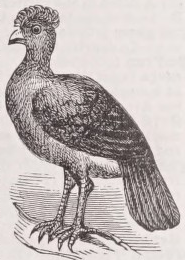
GUAN, a word apparently first introduced into the ornithologist’s vocabulary about 1743 by Edwards, who said that a bird he figured {Nat. Hist. Uncommon Birds, pl. xiii.) was “so called in the West Indies,” and the name has hence been generally applied to all the members of the Subfamily Penelopinoe, which are distinguished from the kindred Subfamily Cracinoe or Curassows by the broad postacetabular area of the pelvie, as pointed out by Prof. Huxley {Proc. Zool. Society, 1868, p. 297), as well as by their mιxillι being wider than it is high, with its culmen depressed, the crown feathered, and the nostrils bare—the last two characters separating the Penelop>ince from the Oreophasinoe, which form the third Subfamily of the Cracidoe f a Family belonging to that taxonomer’s division Peristeroρodes i of the Order Callinοe....
The Penelopinoe have been separated into seven genera, of which Pendope and Ortalida (properly Ortalis), containing respectively about sixteen and nineteen species, are the largest, the others numbering from one to three only. Into their minute differences it would be useless to enter: nearly all have the throat bare of feathers, and from that of many of them hangs a wattle; but one form, Chamoe- petes, has neither of these features, and Sfegnoloema, though wattled, has the throat clothed. With few exceptions the Guans are confined to the South-American continent; one species of Penelope is however found in Mexico and at Mazatlan, Pipile cumanensis inhabits Trinidad as well as the mainland, while three species of Ortalis occur in Mexico or Texas, and one, which is also common to Venezuela, in Tobago. Like Curassows, Guans are in great measure of arboreal habit. They also readily become tame, but all attempts to domesticate them in the full sense of the word have wholly failed, and the cases in which they have even been induced to breed and the young have been reared in confinement are very few. Yet it would seem that Guans and Curassows will interbreed with poultry {Ibis, 1866, p. 24; Bull. Soc. Imp. d ’ Acclimatation, 1868, p. 559; 1869, p. 357), and what is more extraordinary is that in Texas the hybrids between the Chiacalacca {Ortalis vetula) and the domestic Fowl are asserted to be far superior to ordinary Game-cocks for fighting purposes. More information on this subject is very desirable. (a. n.)
GUANACO{Auchenia guanaσus), one of the four species of ruminant animals which represent in South America the camels of the East, and which resemble them in the possession of canine teeth in both lower and upper jaws. The Guanaco is the largest species, standing nearly 4 feet high at the shoulders. It is an elegant creature, with gracefully curved neck and long slender legs; its body is covered with long soft hair of a fawn colour above and almost pure whito beneath. It 13 found throughout the southern half of South America, from Peru in the north to Cape Horn in the south, but occurs in greatest abundance in Patagonia. It lives in herds usually of from six to thirty, although these occasionally contain several hundreds, while solitary individuals are sometimes met with. They are exceedingly timid, and therefore wary and difficult of approach; like many other ruminants, however, their curiosity sometimes overcomes their timidity, so as to bring them within range of the hunter’s rifle. Their cry is peculiar, being described by Cunningham {Natural History of the Strait of Magellan, 1871) as something between the belling of a deer and the neigh of a horse. The chief enemies of the guanaco, according to the same authority, are the Patagonian Indiane and the puma, as it forms the principal food of both. Its flesh is palatable although wanting in fat, while its skin forms the chief clothing material of the gigantic Patagonians. According to Darwin, who studied it in its native wilds, the guanaco is readily domesticated, and in this state becomes very bold and will attack man, striking him from behind with both knees. In the wild state, however, they never seek to defend themselves, and if approached from different points, according to the Indian fashion of hunting them, ...they get completely bewildered and fall an easy prey. They take readily to the water, and have been observed swimming from one island to another, while Byron in his Narrative states that he has seen them drinking salt-water. They have a singular habit of dropping their dung during successive days on the same spot—a habit which is greatly appreciated by the Peruvian Indians, who use those deposits for fuel. They seem also to have favourite localities in which to die, as appears from the great heaps of bones bearing no sign of having been gnawed by the puma, which have been found in particular spots.
GUANAJUATO, or Santa Fe de Guanajuato, a city of Mexico, capital of the state of Guanajuato, is situated in 21° 0' 50" N. lat. and 100° 54' 27" W. long., at a height of 7200 feet above the sea. Built as it is at the meetingplace of three mountain gorges, and obliged by lack of space to climb the underfalls of the surrounding heights, Guanajuato has a highly picturesque appearance. The houses of the lower town are four or five stories in height, most of the streets are narrow and tortuous, and the principal is small though beautiful. The cathedral, the Jesuit church, the mint dating from 1812, the new theatre built in 1874, the university, and the gymnasium are worthy of mention. The Alhondiga de Granaditas, originally a corn magazine, was occupied as a fort in the War of Independence, and acquired peculiar interest as the spot where the patriot Hidalgo met his death. Guanajuato, founded in 1554, owed its existence and prosperity to the fact that it is the centre of the greatest silver-mining district in the world. Of the individual mines perhaps the most famous is the Valenciana, with a shaft 2000 feet deep, which is in process of being cleared of the water by which it has long been flooded. The population, which includes a considerable number of foreigners, formerly amounted to 100,000, but in 1869 was only 63,500.
GUANCAVELICA. See Huancavelica.
GUANO. The deposits of guano, or huano, known locally as huaneras, are found in characteristic condition and abundance upon a large number of the islands lying off Peru and upon certain parts of the mainland. They occur in Bolivia and to the north of Peru also, but are there generally poorer in quality, if not always less in quantity. For the production and preservation of good guano two conditions are requisite—a rainless or nearly rainless climate and abundance of fish in the waters of the ocean. Both conditions are fulfilled on parts of the Bolivian and Peruvian coasts. The penguins, gannets, divers, cranes, cormorants, flamingoes, and other fish-eating birds thus find ample supplies of food; while their excreta retain their soluble and more valuable constituents. But even Peruvian guano is not exclusively excrementitious, nor wholly the produce of birds. These mιrine and maritime huaneras are the breeding-places, the resorts, and the cemeteries not only of sea-birds, but of many other sea-animals,—seals, sea-lions, &c., frequenting many guano lands and islands, and adding considerably during life and when dead to the deposits. In Peruvian guano, it is true, the evidences of its origin are often obscure, but the somewhat complex sources of this material are well shown in the West-African guano islands. On these Mr T. R. E Jen found (1845) three varieties of guano, the lowest being a crust or rock guano, the next above this being a seal guano, containing much seal-fur, and the uppermost layer being a bird guano, in which there were many mummified bird skins and large quantities of feathers....
The dung of bats, which has been found in large quantities in many caverns, both in Europe and in certain parts of France, the Pyrenees and Italy, in New Zealand, and on the North American continent, has been designated “bat-guano.” Further, the term guano, even when employed to describe the marine and maritime deposits previously mentioned, includes a considerable variety of substances very different in chemical composition and in manure value. For the deposits of guano occurring on the rainless or nearly rainless islands and coasts of Peru vary much in the proportion of their constituents—such variation being due less to differences in the origin of the deposits than to subsequent changes. Exposure to the action of the sea and of sea-mist, and the pressure of superincumbent layers, are not without influence on the nature of the guano, very different qualities being found at different depths.
Although allusions to guano occur in the writings of travellers in the 17th and I8th centuries, the credit of directing the attention of Europe to this curious and useful product is due to Humboldt. In 1804 he brought from the Chincha Islands a specimen which Klaproth and then Fourcroy and Vauquelin analysed. But it was not until the publication in 1840 of Liebig’s work on chemistry in its relations to agriculture and physiology had demonstrated the importance of artificial manures that a lively interest in this Peruvian fertilizer was awakened. In that year a firm of merchants of Lima sent a large cargo of guano to England; but it was not until 1842 that the regular trade in guano began. Messrs Gibbs & Co. imported 182 tons in that year, while in 1862 the amount was no less than 435,000 tons. The price was lowest (£9 per ton) in 1848-9. It rose successively, in the years 1854 to 1856, from £10 to £13, and has since remained at about the last sum for the best qualities. Happily the Peruvian Guano Company are now permitted to sell this manure according to the results of analysis, and not, as before, at a fixed price irrespective of the variable qualities of different cargoes. Each unit per cent, of nitrogen is set down as worth 19s. 2d. per ton; while the phosphates, calculated as tricalcic phosphate, are reckoned as worth 2 c . 3^d. per unit per ton. The only drawback to this plan lies in the rather exaggerated price which it assigns to the low qualities of Peruvian guano, namely, those which are poor in nitrogen but rich in phosphates—containing perhaps 40 to 60 per cent, of these compounds, which may be much more cheaply purchased in other forms. Still it must be urged that the phosphates of Peruvian guano are more useful than those from most other sources, on account of their physical condition, and their solubility. After all, however, the high phosphatic guanos are not much appreciated by farmers, who prefer to use bones and superphosphates as manure for grass lands and root crops.
For a long time the group of Peruvian islands known as the Chinchas furnished nearly all the guano that found its way to Europe. When these deposits, amounting to 7 million tons or more, were practically exhausted,—only 150,000 tons of deep deposits remaining in 1872,—their further working was stopped except for use in Peru iL·elf. Then the guanos on the Macabi and Huanape islands weιe exported to Europe, in four years (1870 to 1874) about 1 million tons having been shipped and about half a million tons remaining in 1875. Since then the Lobos islands, situated about 70 miles north of Macabi, have been worked, as have also the islands of the Ballestas group. Even in 1871 three-fourths of the cargoes of nitrogenous guano were from Huanape, but the amount of nitrogen generally present in them was rather low, often not exceeding 10 per cent, of “potential” ammonia, while the percentage of water was remarkably high—sometimes not less than 25 per cent. The Ballestas guanos of the same year were drier and contained one-third more nitrogen.
In spite of many testings and surveys, the amount of Peruvian guano still remaining to be exported has not been even approximately determined. Not only do contiguous deposits differ much in composition, but it is frequently impossible to ascertain what is guano and what is sand or rock. Sometimes the layers of guano are too thin to be worth removing, in other places they fill up ravines to a much greater depth than would be imagined. An estimate of the total quantity of Peruvian guano remaining in 1877 gave over 2 million tons available for commerce, but this figure presumably includes all varieties, both nitrogenous and pbosphatic. Most of the guano lately and now exported comes from the following groups of islands, or places on the coast—Macabi, Huanape, Ballestas, Punta de L0b03, Pabellon de Pica, and Huanillos, and, since 1877, particularly from the last two localities.
In the article Agriculture (vol. i. p. 347) some statistics of guano imports were given. According to the British Consular Reports (1878, No. iv. pp. 525-539) the quantities of Peruvian guano sold of late years were, in tons— [table]
The amounts of Peruvian guano taken by different countries during 1876 and 1877 were as follows :— [table]
In 1872, when the number of countries contributing guano was very large, the imports into the United Kingdom were as follows:— [table]
The following are amongst the more obvious characteristics of good Peruvian guano. Although at the present time it is by no means of uniform appearance or of constant composition, yet it may be stated that the best qualities, which most closely resemble the former supplies from the Chinchas, are light in colour, do not weigh much more than 60 ft per bushel, are friable, and do not cohere strongly when pressed between the fingers. Small soft lumps are often observed in good samples; when these are broken a white or pale-coloured substance is seen in the centre. This lighter-coloured matter contains carbonate and other ammoniacal salts; in some adulterated samples its appearance is imitated by means of gypsum. The hard lumps found in guano are of very varying composition, some being highly phosphatic and others highly siliceous. The ash left on burning a good Peruvian guano is white or grey; a red ash generally indicates adulteration with ochre or ferruginous earth. An unusual proportion of water commonly points to damage by sea-water or rain, a kind of injury which is the more serious, since it is usually accompanied by a considerable loss of ammonia. If more than a mere trace of chlorine be found in a sample of guano, damage by seawater may be suspected. Although a good guano commonly contains more than half its weight of organic matter and of other substances driven off by a red heat, yet when a still larger quantity of such volatile matters is found their presence may be, and often is, a sign of admixture with peat.
Guanos have been often submitted to analysis,—much more frequently, however, for the sake of determining their agricultural value than their precise chemical components. Their worth as manure practically depends, so far as analysis can show, upon their richness in nitrogen and phosphates. The nitrogen, we know, exists in several forms, of which uric acid or rather urates, with salts of ammonia (the urate, oxalate, carbonate, and phosphate), are the most important. But besides these compounds a peculiar bp.se or animal alkaloid known as guanine (C s H 6 N 5 O) is present in most samples of Peruvian guano; it is not unlikely that the nitrogen of this body is capable of direct assimilation by plants. A considerable though variable quantity of nitrates and nitrites has been recognized in some guanos, ranging, when expressed as potassium nitrate, from no more than τ ⅛ per cent, up to 5 and even 6 per cent. Other nitrogenous compounds present are those indeterminate substances which originate from the decay of the osseids of bone, skin, cartilage, and feathers, and of the proteids of flesh. These intermediate products of decay are ultimately resolved into ammonia salts and nitrates. Some guanos, notably those of the West-African coast (Ichaboe, for example), contain many undecomposed feathers, which cannot possibly yield their nitrogen to vegetation for some time. On this account less than half of the 8 to 12 per cent, of so-called “potential” ammonia in these guanos is as effective as that in the genuine Peruvian samples. The phosphates of guano are numerous, including tricalcic, dicalcic, ammonio-magnesic, and amnionic phosphates. The solubility of great part of the phosphates in guano helps to make its action more intense and immediate; as much as 10 to 13 per cent, of phosphorus pentoxide has been found to be soluble in some instances. Such is said to be often the case with the guano of Tarapaca; Baker Island and Jarvis Island guanos are similar. This solubility arises partly from the composition of the phosphates present, some of which are naturally moderately soluble in ordinary water; but it arises partly also from the presence of ammonium oxalate, by which the solubility of the calcic phosphates is increased. The carbon dioxide which the decaying organic matter of guano continually evolves also aids in effecting the solution of those phosphates which are not soluble in pure water.
As at least part of the nitrogen of guano exists in the form of the volatile carbonate, it will be found that this manure deteriorates sometimes very much on being kept. One sample of Chincha guano imported in 1865 contained nitrogen equal to 20⅜ per cent, of ammonia; of this 10⅜ per cent, was lost when the guano was exposed to the heat of boiling water, and 9⅜ per cent, when the sample was merely kept for a year in a powdered condition in an ordinary bottle. With so strongly ammoniacal a guano as this, the fixation of the volatile nitrogenous compounds by means of an acid is highly desirable. Oil of vitriol is employed iħ different proportions and in different ways for this purpose. About 5 or 6 It> of oil of vitriol diluted with water and mixed with sand or peat may be added to each cwt. of guano. Such a process was patented in 1859 by Dr Richardson of Newcastle. In this way the ammonia of the volatile carbonate is fixed in the form of sulphate, the oxalates and phosphates of the guano remaining unaffected. But sometimes, as in the manufacture of “dissolved guano,” a larger quantity of oil of vitriol is used—say 25 to 30 lb to each cwt. of raw guano. In this case a kind of rich superphosphate is obtained in which 20 per cent, or thereabouts of “bone-phosphate made soluble” is present in association with nitrogen equal to 9 or 10 per cent, of ammonia. Such a preparation is Ohlendorff’s dissolved Peruvian guano, while “sulphated” and “ammonia-fixed” guanos contain less oil of vitriol, and generally some inert substance like sawdust, which reduces their concentration as manures considerably. “Phospho guano” is in reality a superphosphate made from Mejillones or other phosphatic guano, and enriched by the addition of ammonium sulphate. This Mejillones (Bolivian) guano contains about ⅛ per cent, of nitrogen and 55 per cent, phosphates. “Native guano” is a term applied to the dried and prepared sludge or deposit obtained in the treatment of town sewage by the “A.B.C.” process—one of the many precipitation processes now in use. It has little in common with true guano. “Fish guano” is prepared chiefly from the refuse of the cod of the Newfoundland and Norwegian fisheries. It is rich both in nitrogen and in phosphates, often containing 8 per cent, of the former and 30 per cent, of the latter; but its oily nature causes its action as manure to be uncertain and slow.
Although it is usual and convenient to classify guanos into two groups according to their richness in nitrogen or phosphates respectively, there is no sharp line of demarcation between these classes. Indeed the guano from a single spot may show every gradation from nitrogenous to phosphatic. For instance, three samples taken from a deposit at Punta de Lobos gave amounts of nitrogen corresponding to the following percentage of ammonia in the several layers—surface, - 81 per cent.; middle, 3Ί5 per cent.; deepest, 15'67 per cent. Three samples from another working in the same huanera gave these figures—3 per cent, ammonia at 8 feet, 8 per cent, at 20 feet, and 12 at 40 feet. A cargo averaging 12 per cent, of potential ammonia, that is, containing an amount of nitrogen which, if expressed as ammonia, equals 12 parts in the hundred of guano, may be regarded as satisfactory; but immense quantities of guano are now exported from Peru, containing not more than 8 or 10 per cent, of ammonia. And there are lower qualities still, with 6 to 8 per cent, of ammonia; and these pass into more phosphatic varieties, with but little organic matter and nitrogen, but yet from their softness and fine state of division capable of being applied, without previous mechanical or chemical treatment, to the land. But when we are dealing with what are called “rock” or “crust” guanos, we not only have an almost complete absence of nitrogen and of organic matter, but the hardness of the material is such as to involve its being first ground and then treated with oil of vitriol to turn it into a superphosphate before it can become available as manure. With the highly phosphatic yet powdery and soft guanos of Peru and Bolivia such treatment is rarely necessary, but it is essential with Navassa (Caribbean Sea) and with the Sombrero Island (Gulf of Mexico) guanos. The latter variety contains no nitrogen, and is very hard, but contains on an average no less than 75 per cent, of tricalcic phosphate. It has been said that the imports into Great Britain of this Sombrero phosphate have been so large that the whole island has been transported thither.
Some notion of the main constituents of Peruvian and Bolivian guanos may be gathered from the following figures, which roughly represent the nature and percentage proportions of the chief constituents of fair samples from several localities :— [table]
One specimen of Angamos guano actually contained 25 per cent, potential ammonia and but 6 per cent, phosphates reckoned as tricalcic phosphate. It will indeed be seen how generally with the diminution of the nitrogenous organic matter the phosphates increase, and vice versa. Analyses of guanos from many different countries exhibit the same feature. But even the phosphatic guanos are less rich in phosphates than one might expect, owing to the intrusion of siliceous matter. In some guanos analysed by Nesbit more than 30 per cent, of sand occurred. Californian guanos gave this analyst from 1⅜ to 8⅜ per cent, ammonia, and about 30 per cent, phosphates. In Falkland Island guano he found about I to 2∣ per cent, ammonia and 20 to 25 per cent, phosphates. In the case of so variable a material as guano neither analyses of individual specimens nor averages can be considered as really representative. But it is instructive to note how low a proportion of nitrogen is present in many of the guanos from different countries :— Algoa Bay, ‘5 per cent, of potential ammonia; Ascension Island, 6Ό; Queensland, 1Ό; Chili, 1 ’ 4; Ecuador, ·8; Mexico, - 4; Patagonia, 2'7; Tasmania, 2 , 5.
In the guanos imported during 1847-48 Mr J. T. Way found the following average percentages of ammonia (calculated from total nitrogen) and of phosphates (calculated as tricalcic phosphate) :— [table]
Dr Voelcker’s analyses of samples taken in 1874 from the undermentioned places gave about 25 per cent, phosphates, and of ammonia 8 to 12 per cent, in guanos from Pabellon de Pica, 3 to 12 per cent, from Lobos, and 8 to 12⅜ per cent, from Huanillos.
The Lobos guanos, having since then become of generally inferior quality, have been but sparingly imported during the last few years. The percentage of ammonia in recent cargoes of guano from Punta de Lobos has been 5 to 6, from Huanillos 9, and from Pabellon de Pica 11 to 12.
The analysis of guano for commercial purposes is generally limited to the quantitative determination of three constituents,— the nitrogen, the soluble phosphorus pentoxide, and the insoluble phosphates; the latter are usually reckoned as tricalcic phosphate. The processes of analysis require a few special precautions. One of these consists in mixing the guano in the combustion tube itself when making a nitrogen determination by Will and Varrentrapp’s method; otherwise a loss of ammonia may occur.
As a manure the nitrogenous guano of Peru is rich, active, and stimulating. It has a decided tendency to cause an excessive development of foliage, and is therefore peculiarly fitted for application to grass and to other plants the development of the stem and leaf of which is desired. Its effects on clover are less marked. Mixed with superphosphate it may be applied to potatoes or root-crops, and to most of the plants of the kitchen garden; for many plants cultivated for their flowers it may be used also, but with great care and moderation, mixed with water or dry soil. On light and calcareous lands sown with swedes, turnips, or mangolds, guano has frequently been found to burn and destroy the young plants or even to prevent the germination of the seed; “dissolved” guano is less liable to cause this injury.
Guano, with another very useful natural product, namely, nitrate of soda, constitutes the chief source of revenue for Peru.
The following papers and reports in the Journal of the Royal Agricultural Society contain interesting information on guano, ser. i. vols. ii. p. 301; x. p. 196; xxv. p. 186; ser. ii. vols. i. p. 213; V. 92; vi. 142, 403; vii. 367; viii. 220; ix. 261; x. 541. Native guano is discussed, ser. ii. vol. vi. p. 415. The Jahresbericht der Agricultur-Chemie contains a digest of most of the important papers on guano published on the Continent; see, e. g., 1858-9, pp. 231-238; 1860-1, pp. 186-191; 1862-3, pp. 150-157; 1867, p. 189; 1870-2, pp. 190-195; 1873-4, iii. pp. 10-26. A pamphlet published in 1874 by Dunlop & Co., London, gives some important statistics and reports on the Peruvian guano then remaining; as also does the Commercial Blue Book, No. 23, 1878, pp. 525 to 539.