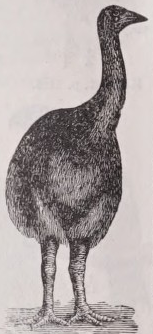
Any one of several very large extinct species of wingless birds belonging to Dinornis, and other related genera, of the suborder Dinornithes, found in New Zealand. They are allied to the apteryx and the ostrich. They were probably exterminated by the natives before New Zealand was discovered by Europeans. Some species were much larger than the ostrich.
MOAB. Moab and Ammon (children of Lot) constitute along with Edom and Israel (children of Isaac) that group of four Hebrew peoples which in early antiquity had issued from the Syro-Arabian wilderness, and settled on the border of the cultivated country eastward of the great depression which extends from the Gulf of Elath to the Dead Sea, and up the valley of the Jordan. According to the book of Genesis, they had come out of Mesopotamia, and so were precursors of the larger wave which followed from the same quarter, forming the most southern outpost of the Aramaeanimmigration into the lands of Canaan and Heth. Whether the Hebrews were originally Aramaeans is questionable, but it is certain that, like the Aramaeans, they were distinct from the Canaanites, whose conquerors they were. Such was the relation of the old and new inhabitants, not only in Western Palestine after the Israelite occupation, but also, and from a much earlier period, in Eastern Palestine, where the aborigines were Amori tes—that is, Canaanites—and where the Bne Ammon and Moab and the Bne Isaac successively settled in their lands. The old population did not disappear before the conquerors, but continued to subsist among them. Ju a considerable district—namely, in Gilead—the Amorites even remained unsubdued, and thus formed a gap, only imperfectly filled up by the Bne Ammon, between the Hebrew line of immigration on the south and the Aramaean line more to the north,—a gap which did not begin to close until the historical period. From this district they even endeavoured, and with some success, as will be afterwards seen, to recover the territory which had been taken from them in the south. But where they were the subjects of the Hebrews they constituted the basis of the population, the ...mainstock of the working and trading classes. The extent of their influence over the conquerors may be judged from the fact that it was their speech which gained the upper hand. The Moabites, and doubtless also the Ammonites and Edomites, spoke the language of Canaan as well as the Israelites. They must have learned it from the Canaanites in the land eastward of Jordan, prior to the period at which Jacob immigrated to and returned from Egypt. Our knowledge is extremely imperfect as regards other departments of the Canaanite influence; but in religion it has left a noticeable trace in the cultus of Baal-Peor, which was carried on in Moabite territory, but was certainly of Canaanite origin.
The assumption that the change of language was first brought about by the Israelites in the land which is called by preference that of Canaan, is rendered untenable by the fact that the Moabites also spoke Canaanitish. It is vain to urge against the identity of Hebrew and Canaanitish the distinction between Phoenician and Hebrew; for doubtless similar distinctions existed between the dialect of the Phoenician coast towns and that of the Hi vites, Amorites, and Canaanites generally, whose language the Hebrews borrowed. That the Aramaeans of Damascus, who also were compelled to mingle with the Hethites in the country of which they had taken possession, nevertheless retained their original tongue is to be explained by the circumstance that they continued to maintain direct relations with the mother-country of Mesopotamia, and moreover had greater internal cohesion. The designation Amorites, usually given in the Old Testament to the original inhabitants of Eastern Palestine, is substantially synonymous with that of Canaanites, although not quite so comprehensive. The Palestine of the Pre-Israelitic period, which in the Pentateuch is called the Land of Canaan, figures in Amos as the Land of the Amorites. While, however, the former name is bestowed chiefly upon that portion of the earlier population which had remained unconquered, the latter is given to the portion against which the Israelites first directed their attack and in whose territory they settled. This took place in the mountain district, first to the east and afterwards to the west of Jordan. For this reason the Amorites, as contrasted with the Canaanites of the cities of the level country, are.a highland race, like the Hebrews themselves, but belong exclusively to the past. In the time of the Biblical narrators, the Canaanites are still living here and there in the land, but the Amorites have once lived where the Israelites now are. This explains the fact that, while in ordinary peaceful circumstances the Canaanites are named as the old inhabitants, the Amorites are immediately substituted for them wherever war and conquest are spoken of. Sihon and Og, with whom Moses does battle, are kings of the Amorites; in like manner it is with the twelve kings of the Amorites that Joshua has to deal westward of the Jordan. The Amorites as an extinct race of course assume a half-mythical character, and are represented as giants, tall as cedars and strong as oaks.
Just as Israel was the people of Jehovah, and Ammon the people of Milcom, Moab was the people of Chemosh
Num. xxi. 29). The kingship of Chemosh was regarded as thoroughly national and political in its character, but did not on that account exclude the institution of a human king, which existed in Moab much earlier than in Israel; in the time of Moses the Moabites had a king, and the institution was even then an old one. The capitals of the kingdom were Ar-Moab and Kir-Moab, south from the Arnon; these were not, however, the constant residences of the kings, who continued to live in their native places, as, for example, Mesha in Dibon. Doubtless there were changes of dynasty, and traces exist of a powerful aristocracy (Ariele Moab; 2 Sam. xxiii. 20).
The land of the Moabites, the Balkâ, is bounded northward and southward by Mount Gilead and Wadi ’l-Ahsâ, westward and eastward by the Dead Sea and the Wilderness; it is divided into two portions by the deep bed of the Arnon, that to the north being the more level (Mishôr), and that to the south being more broken up, and constituting the proper stronghold of the nation. The soil is peculiarly adapted for sheep-farming (2 Kings iii.) and the culture of the vine (Isa. xvi.). 1
The historical importance of the Moabites lies wholly in their contact with Israel, and we have no knowledge of them apart from this. After the Israelites had quitted Egypt and passed a nomadic life for about a generation in the neighbourhood of Kadesh, they migrated thence, still under the leadership of Moses, into northern Moab, dispossessing the Amorites, who had made themselves masters of that district. The interval from Kadesh to the Arnon could be passed only by a good understanding with Edom, Moab, and Ammon,—a proof that the ethnical relationships, which at a later period were expressed only in legend, were at that time still living and practical. In all probability the Moabites called the Israelites to their aid; they were not as yet aware that this little pastoral people was destined one day to become to them a greater danger than the Canaanites by whom they were threatened at the moment. 2
As the story of Balaam indicates, the Moabites would willingly have been rid of their cousins after their service had been rendered, but were unable to prevent them from settling in the land of Sihon. The migration of the tribes of Israel into Western Palestine, however, and the dissolution of their warlike confederation soon afterwards made a restoration of the old frontiers possible. If King Eglon took tribute of Benjamin at Jericho, the territory between Arnon and Jordan must also have been subject to him, and
Reuben must even then have lost his land, or at least his liberty. It would appear that the Moabites next extended their attacks to Mount Gilead, giving their support to the Ammonites, who, during the period of the judges, were its leading assailants. So close was the connexion between Moab and Ammon that the boundary between them vanishes for the narrators (Judges xi.).
Gilead was delivered from the Ammonites by Saul, who at the same time waged a successful war against Moab; the fact is lightly touched upon in 1 Sam. xiv. 47, as if this were a matter of course. The establishment of the monarchy necessarily involved Israel in feuds with its neighbours and kin. The Moabites being the enemies of the Israelite kingdom, David naturally sent his people for shelter thither when he had broken with Saul; the incident is precisely analogous to what happened when he himself at a later period took refuge from Saul’s persecution in Philistine territory, and needs no explanation from the book of Ruth. As soon as he ceased to be the king’s enemy by himself becoming king, his relations with Moab became precisely those of his predecessor. The war in which apparently casual circumstances involved him with Hanun ben Nahash of Ammon really arose out of larger causes, and thus spread to Moab and Edom as well. The end of it was that all the three Hebrew nationalities were incorporated with the kingdom of Israel; the youngest brother eclipsed and subdued his seniors, as Balaam had foreseen. Through the work of Saul and David the political system of Palestine was altogether changed: the smaller peoples were no longer a match for Israel, which established a decisive preponderance, and transformed what had hitherto been jealousy on the part of Moab and Ammon as well as of Edom into bitter hatred; this hatred did not cease even after nothing but a religious shadow remained of what had once been the political supremacy of the people of Jehovah.
The struggle with Ammon which David began ultimately assumed larger dimensions, and brought the Aramaeans also into the field against him. He was successful, indeed, against them also, and destroyed their most powerful kingdom; but after his death they recovered themselves, and pressed steadily on from the borders of the wilderness towards the se⅝j at their head were those kings of Damascus who had established themselves on the ruins of Zoba. In presence of these enemies the already fading distinction between the ruling and the subject nationality within the kingdom of Israel now completely disappeared; and even towards the Canaanites outside the relations of the kings became friendly. It is in one instance expressly stated that the common danger threatening from the East had to do with this (2 Sam. viii. 9 sqq.}. But, conversely, it was natural that Ammon and Moab should make common cause with the Aramaeans; such an attitude was suggested by geographical position and old connexions, but above all by their helpless fury against Israel. Both nationalities must have succeeded in emancipating themselves very soon after David’s death, and only now and then was some strong king of Israel able again to impose the yoke for a time, not upon the Ammonites indeed, but upon Moab. The first to do so was 0mri, who garrisoned a number of their towns and compelled the king to acknowledge Israel’s suzerainty by a yearly tribute of sheep,—a state of matters which continued until the death of Ahab ben 0mri. But when that brave king fell in battle with the Aramaeans at RamothGilead (about 850 b.c. ), Mesha of Dibon, then the ruler of Moab, seized the favourable opportunity to make himself and his people independent. In his famous inscription he tells how, through the wrath of Chemosh, the land had fallen into the enemy’s power and endured forty years of slavery, and how by the grace of Chemosh the yoke is now broken and the Israelites ignominiously driven off. In 1 There does not seem to have been any difference in this respect between the northern and southern portions; instead of Heshbon, Sibmah, and Jaezer (Isa. xvi.), the poet Hatim of Tayyi, a little before Mohammed, names Maâb and Zoar as the chief wine centres (Yâkùt, iv. 377, 19).
2 The facts as a whole are indubitable; it cannot be an invention that the Israelites settled first in Kadesh, then in northern Moab, and thence passed into Palestine proper. The only doubtful point is whether the song in Num. xxi. 27 sqq. is contemporary evidence of these events. It is certainly not a forgery, but it is a question whether it really refers to the destruction of the kingdom of the Amorites at Heshbon. This reference rests entirely upon the words [ΙΠΌ '"MOK which might very well be omitted as a mere gloss, in which case the song would naturally be understood as directed against the Moabites themselves; it is in this last sense that it is taken by the author of Jer. xlviii. (Comp. E. Meyer in Stade’s Zeitschr. f. A Tliche Wissensch., 1881, p. 129 sqq. ) As Israel got the better of the Amorites on the plain of Moab, so did Hadad king of the Edomites vanquish the Midianites on the “field” of Moab (Gen. xxxvi. 35); this took place in Gideon’s time, as is borne out by the fact that between Hadad and the downfall of the ancient Edomite monarchy, i.e. to the period of David, there were four reigning princes. Confused recollections of a former settlement of the Midianites in northern Moab are seen in Num. xxii. 4, 7; xxv. 18.
the Bible we find only the curt statement that Moab rebelled against Israel after the death of Ahab (2 Kings i.); on the other hand, there is a full narrative of a later attempt on the part of Joram ben Ahab to bring Mesha again into subjection—an attempt which promised very well at first, but ultimately failed completely. Joram’s invasion took place not from the north but (probably very unexpectedly to the enemy) from the frontier of Edom over the Wadi Ί-Ahsâ.; he marched through Judah and Edom, and the kings of those countries served as auxiliaries. He defeated a Moabite army on the frontier, penetrated into the country and laid it λvaste; he laid siege to the fortress of Kir-Moab so closely as to reduce it to great straits. But these straits seem to have filled the besieged with a desperate courage, for the fortunes of war suddenly changed. The Israelites were compelled to retire homeward, a great wrath (of Jehovah) having come upon them, that is, a severe disaster having befallen them, which is not described, but, from the nature of the case, must have been a sudden surprise and defeat by the enemy.
As the Moabites owed their liberation from Israelite supremacy to the battle of Ramah—that is, to the Aramaeans—we accordingly find them (as well as the Ammonites) afterwards always seconding the Aramaeans in continual border warfare against Gilead, in which they took cruel revenge on the Israelites. With what bitterness the latter in consequence were wont to speak of their hostile kinsfolk can be gathered from Gen. xix. 30 sqq. — the one trace of open malice in the story of the patriarchs, and all the more striking as it occurs in a narrative of which Lot is the hero and saint, which therefore in its present form is of Moabite origin, although perhaps it has a still older Canaanite nucleus. Of these border wars we learn but little, although from casual notices it can be seen (2 Kings xiii. 20; Amos i. 13; comp. 2 Kings v. 2) that they were long kept up, although not quite uninterruptedly. But when at length the danger from the Aramaeans was removed for Israel by the intervention of the Assyrians, the hour of Moab’s subjection also came; Jeroboam II. extended his frontier over the eastern territory, as far as to the brook of the willows (Wadi Ί-Ahsâ). (Perhaps the song of Num. xxi. 27 sqq. has reference to these events.) A vivid picture of the confusion and anguish then prevalent in Moab has been preserved to us in the ancient prophecy of Isa. xv., xvi., which indeed would have greater historical value if we were able to tell precisely what in it -depicts the present, and what is prediction of the future.
This utterance of an older prophet was repeated some decennia later by the prophet Isaiah, with the addition of a clause adapting it to his time, to the effect that the Assyrians would carry out in all its fulness the hitherto imperfectly-executed threat. The Assyrians actually subjugated the Moabites, as well as the other small peoples of that region; but the blow was apparently not so grave as Isaiah had predicted. They lay more out of the way than their western neighbours, and perhaps their resistance to the scourge of God was not so obstinate as to demand the sharpest measures. What made it all the easier for them to reconcile themselves to the new situation was the fact that the Israelites suffered much more severely than they. From these their deadly enemies they were henceforth for ever free. They did not on that account, however, give up their old hatred, but merely transferred it from Israel to Judah. The political annihilation of the nation only intensified in Jerusalem the belief in its religious prerogative, and against this belief the hostility of neighbours was aroused more keenly than ever. The deepest offence at the religious exclusiveness of the people of Judaea, which then first began to manifest itself, was, as is easily understood, taken by their nearest relatives, Edom and Moab. They gave terrible expression to their feelings when the Chaldaeans urged them on like uncaged beasts of prey against the rebellious Jews; and they joined loudly in the general chorus of malignant joy which was raised over the burning of the temple and the ruin of the holy city.
“Because Moab saith: Behold the house of Judah is like all the other nations, therefore do I open his land to the Bne Kedem,” says the prophet Ezekiel (xxv. 8 sqq.). His threat against the Moabites as well as against the Edomites and Ammonites is that they shall fall before the approach of the desert tribes. Probably in his day the tide of Arabian invasion was already slowly rising, and of course it had first to overtake the lands situated on the desert border. At all events the Arab immigration into this quarter began at an earlier date than is usually supposed; it continued for centuries, and was so gradual that the previously - introduced Aramaeizing process could quietly go on alongside of it. The Edomites gave way before the pressure of the land-hungry nomads, and settled in the desolate country of Judah; the children of Lot, on the other hand, appear to have amalgamated with them,—the Ammonites maintaining their individuality longer than the Moabites, who soon entirely disappeared.
Israel and Moab had a common origin, and their early history was similar. The people of Jehovah on the one hand, the people of Chemosh on the other, had the same idea of the Godhead as head of the nation, and a like patriotism derived from religious belief,—a patriotism capable of extraordinary efforts, and which has had no parallel in the West either in ancient or in modern times. The mechanism of the theocracy also had much that was common to both nations; in both the king figures as the deity’s representative, priests and prophets as the organs through whom he makes his communications. But, with all this similarity, how different were the ultimate fates of the two! The history of the one loses itself obscurely and fruitlessly in the sand; that of the other issues in eternity. One reason for the difference (which, strangely enough, seems to have been felt not by the Israelites alone but by the Moabites also) is obvious. Israel received no gentle treatment at the hands of the world; it had to carry on a continual conflict with foreign influences and hostile powers; and this perpetual struggle with gods and men was not profitless, although the external catastrophe was inevitable. Moab meantime remained settled on his lees, and was not emptied from vessel to vessel (Jer. xlviii. 11), and corruption and decay were the result. This explanation, however, does not carry us far, for other peoples with fortunes as rude as those of Israel have yet failed to attain historical importance, but have simply disappeared. The service the prophets rendered at a critical time, by raising the faith of Israel from the temporal to the eternal sphere, has already been spoken of in the article Israel. Sources.— The Old Testament (Ruth and Chronicles, however, being of no historical worth in this connexion), and the inscription of Mesha, on the stone of Dibon, discovered in 1868, and now in the Louvre. The Berlin Moabitica are valueless,—Schlottmann himself, the unshakenchampion of their genuineness, conceding that they are mere scribbling, and do not even form words, much less sentences. The literature of the subject is to be found in the commentaries on the Old Testament books, and in those on the inscription of Mesha....
was the son of Lot, and of his eldest daughter, Gen. xix, 31, &c. He was born about the same time as Isaac, A. M. 2108, and was father of the Moabites, whose habitation lay beyond Jordan and the Dead Sea, on both sides of the river Arnon. Their capital city was situated on that river, and was called Ar or Areopolis, or Ariol of Moab, or Rabbah Moab, that is, the capital of Moab, or Kir-haresh, that is, a city with brick walls. This country was originally possessed by a race of giants called Emim, Deut. ii, 11, 12. The Moabites conquered them, and afterward the Amorites took a part from the Moabites, Judges xi, 13. Moses conquered that part which belonged to the Amorites, and gave it to the tribe of Reuben. The Moabites were spared by Moses, for God had restricted him, Deut. ii, 9. But there always was a great antipathy between the Moabites and the Israelites, which occasioned many wars between them. Balaamseduced the Hebrews to idolatry and uncleanness, by means of the daughters of Moab, Num. xxv, 1, 2; and Balak, king of this people, endeavoured to prevail on Balaam to curse Israel. God ordained that the Moabites should not enter into the congregation of his people, because they had the inhumanity to refuse the Israelites a passage through their country, nor would they supply them with bread and water in their necessity. Eglon, king of the Moabites, was one of the first that oppressed Israel after the death of Joshua. Ehud killed Eglon, and Israel expelled the Moabites, Judges iii, 12, &c. Hanun king of the Ammonites having insulted David’s ambassadors, David made war against him, and subdued Moab and Ammon; under which subjection they continued till the separation of the ten tribes. The Ammonites and the Moabites continued in subjection to the kings of Israel to ...the death of Ahab. Presently after the death of Ahab the Moabites began to revolt, 2 Kings iii, 4, 5. Mesha, king of Moab, refused the tribute of a hundred thousand lambs, and as many rams, which till then had been customarily paid, either yearly, or at the beginning of every reign; which of these two is not clearly expressed in Scripture. The reign of Ahaziah was too short to make war with them; but Jehoram, son of Ahab, and brother to Ahaziah, having ascended the throne, thought of reducing them to obedience. He invited Jehoshaphat, king of Judah, who, with the king of Edom, then his vassal, entered Moab, where they were near perishing with thirst, but were miraculously relieved, 2 Kings iii, 16, &c.
It is not easy to ascertain what were the circumstances of the Moabites from this time; but Isaiah, at the beginning of the reign of King Hezekiah, threatens them with a calamity, which was to happen three years after his prediction, and which probably referred to the war that Shalmaneser, king of Assyria, made with the ten tribes and the other people beyond Jordan. Amos, i, 13, &c, also foretold great miseries to them, which, probably, they suffered under Uzziah and Jothan, kings of Judah, or under Shalmaneser, 2 Chron. xxvi, 7, 8; xxvii, 5; or, lastly, in the war of Nebuchadnezzar, five years after the destruction of Jerusalem. This prince carried them captive beyond the Euphrates, as the prophets had threatened, Jer. ix, 26; xii, 14, 15; xxv, 11, 12; xlviii, 47, &c; xlix, 3, 6, 39; l, 16; and Cyrus sent them home again, as he did the rest of the captives. After their return from captivity they multiplied, and fortified themselves, as the Jews did, and other neighbouring people, still in subjection to the kings of Persia. They were afterward conquered by Alexander the Great, and were in obedience to the kings of Syria and Egypt successively, and finally to the Romans. There is a probability, also, that in the later times of the Jewish republic they obeyed the Asmonean kings, and afterward Herod the Great. The principal deities of the Moabites were Chemosh and Baal-peor.
The prophecies concerning Moab are numerous and remarkable. There are, says Keith, abundant predictions which refer so clearly to its modern state, that there is scarcely a single feature peculiar to the land of Moab, as it now exists, which was not marked by the prophets in their delineation of the low condition to which, from the height of its wickedness and haughtiness, it was finally to be brought down.
The land of Moab lay to the east and south-east of Judea, and bordered on the east, north-east, and partly on the south of the Dead Sea. Its early history is nearly analogous to that of Ammon; and the soil, though perhaps more diversified, is, in many places where the desert and plains of salt have not encroached on its borders, of equal fertility. There are manifest and abundant vestiges of its ancient greatness: the whole of the plains are covered with the sites of towns, on every eminence or spot convenient for the construction of one; and as the land is capable of rich cultivation, there can be no doubt that the country now so deserted once presented a continued picture of plenty and fertility. The form of fields is still visible; and there are the remains of Roman highways, which in some places are completely paved, and on which there are mile stones of the times of Trajan, Marcus Aurelius, and Severus, with the number of the miles legible upon them. Wherever any spot is cultivated the corn is luxuriant; and the riches of the soil cannot perhaps be more clearly illustrated than by the fact, that one grain of Heshbon wheat exceeds in dimensions two of the ordinary sort, and more than double the number of grains grow on the stalk. The frequency, and almost, in many instances, the close vicinity of the sites of the ancient towns, prove that the population of the country was formerly proportioned to its natural fertility. Such evidence may surely suffice to prove that the country was well cultivated and peopled at a period so long posterior to the date of the predictions, that no cause less than supernatural could have existed at the time when they were delivered, which could have authorized the assertion with the least probability or apparent possibility of its truth, that Moab would ever have been reduced to that state of great and permanent desolation in which it has continued for so many ages, and which vindicates and ratifies to this hour the truth of the Scripturalprophecies. The cities of Moab were to be desolate without any to dwell therein;” no city was to escape: Moab was to flee away.” And the cities of Moab have all disappeared. Their place, together with the adjoining part of Idumea, is characterized, in the map of Volney’s Travels, by the ruins of towns. His information respecting these ruins was derived from some of the wandering Arabs; and its accuracy has been fully corroborated by the testimony of different European travellers of high respectability and undoubted veracity, who have since visited this devastated region. The whole country abounds with ruins; and Burckhardt, who encountered many difficulties in so desolate and dangerous a land, thus records the brief history of a few of them: The ruins of Eleale, Heshbon, Meon, Medaba, Dibon, Aroer, still subsist to illustrate the history of the Beni Israel.” And it might with equal truth have been added, that they still subsist to confirm the inspiration of the Jewish Scriptures, or to prove that the seers of Israel were the prophets of God; for the desolation of each of these very cities was a theme of a prediction. Every thing worthy of observation respecting them has been detailed, not only in Burckhardt’s Travels in Syria,” but also by Seetzen, and, more recently, by Captains Irby and Mangles, who, along with Mr. Bankes and Mr. Leigh, visited this deserted district. The predicted judgment has fallen with such truth upon these cities, and upon all the cities of the land of Moab far and near, and they are so utterly broken down,” that even the pryingcuriosity of such indefatigable travellers could discover among a multiplicity of ruins only a few remains so entire as to be worthy of particular notice. The subjoined description is drawn from their united testimony: Among the ruins of El Aal (Eleale) are a number of large cisterns, fragments of buildings, and foundations of houses. At Heshban, (Heshbon,) are the ruins of a large ancient town, together with the remains of a temple, and some edifices. A few broken shafts of columns are still standing; and there are a number of deep wells cut in the rock. The ruins of Medeba are about two miles in circumference. There are many remains of the walls of private houses constructed with blocks of silex, but not a single edifice is standing. The chief object of interest is an immense tank or cistern of hewn stones, which, as there is no stream at Medeba,” Burckhardt remarks, might still be of use to the Bedouins, were the surrounding ground cleared of the rubbish to allow the water to flow into it; but such an undertaking is far beyond the views of the wandering Arabs.” There is also the foundation of a temple built with large stones, and apparently of great antiquity, with two columns near it. The ruins of Diban, (Dibon,) situated in the midst of a fine plain, are of considerable extent, but present nothing of interest. The neighbouring hot wells, and the similarity of the name, identify the ruins of Myoun with Meon, or Beth Meon of Scripture. Of this ancient city, as well as of Araayr, (Areor,) nothing is now remarkable but what is common to them with all the cities of Moab, their entire desolation. The extent of the ruins of Rabba, (Rabbath Moab,) formerly the residence of the kings of Moab, sufficiently proves its ancient importance; though no other object can be particularized among the ruins, than the remains of a palace or temple, some of the walls of which are still standing, a gate belonging to another building, and an insulated altar. There are many remains of private buildings, but none of them is entire. There being no springs on the spot, the town had two birkets, the largest of which is cut entirely out of the rocky ground, together with many cisterns. Mount Nebo was completely barren when Burckhardt passed over it, and the site of the ancient city had not been ascertained. Nebo is spoiled.”
While the ruins of all these cities still retain their ancient names, and are the most conspicuous amidst the wide scene of general desolation, and while each of them was in like manner particularized in the visions of the prophet, they yet formed but a small number of the cities of Moab; and the rest are also, in similar verification of the prophecies, desolate, without any to dwell therein.” None of the ancient cities of Moab now remain as tenanted by men. Kerek, which neither bears any resemblance in name to any of the cities of Moab which are mentioned as existing in the time of the Israelites, nor possesses any monuments which denote a very remote antiquity, is the only nominal town in the whole country, and, in the words of Seetzen, who visited it, in its present ruined state it can only be called a hamlet; and the houses have only one floor.” But the most populous and fertile province in Europe, especially any situated in the interior of a country like Moab, is not covered so thickly with towns as Moab is plentiful in ruins, deserted and desolate though now it be. Burckhardt enumerates about fifty ruined sites within its boundaries, many of them extensive. In general they are a broken down and undistinguishable mass of ruins; and many of them have not been closely inspected. But, in some instances, there are the remains of temples, sepulchral monuments; the ruins of edifices constructed of very large stones, in one of which buildings some of the stones are twenty feet in length, and so broad that one constitutes the thickness of the wall; traces of hanging gardens; entire columns lying on the ground, three feet in diameter, and fragments of smaller columns; and many cisterns out of the rock. When the towns of Moab existed in their prime, and were at ease; when arrogance, and haughtiness, and pride prevailed among them; the desolation, and total desertion and abandonment of them all, must have utterly surpassed all human conception. And that such numerous cities which subsisted for many ages, some of them being built on eminences, and naturally strong; others on plains, and surrounded by the richest soil; some situated in valleys by the side of a plentiful stream; and others where art supplied the deficiencies of nature, and where immense cisterns were excavated out of the rock, and which exhibit in their ruins many monuments of ancient prosperity, and many remains easily convertible into present utility; should have all fled away, all met the same indiscriminate fate, and be all desolate, without any to dwell therein,” notwithstanding all these ancient indications of permanent durability, and their existing facilities and inducements for becoming the habitations of men, is a matter of just wonder in the present day. They shall cry of Moab, How is it broken down!”
The strong contrast between the ancient and the actual state of Moab is exemplified in the condition of the inhabitants as well as of the land; and the coincidence between the prediction and the fact is as striking in the one case as in the other. The days come, saith the Lord, that I will send unto him (Moab) wanderers that shall cause him to wander, and shall empty his vessels.” The Bedouin (wandering) Arabs are now the chief and almost the only inhabitants of a country once studded with cities. Traversing the country, and fixing their tents for a short time in one place, and then decamping to another, depasturing every part successively, and despoiling the whole land of its natural produce, they are wanderers who have come up against it, and who keep it in a state of perpetual desolation. They lead a wandering life; and the only regularity they know or practise, is to act upon a systematic scheme of spoliation. They prevent any from forming a fixed settlement who are inclined to attempt it; for although the fruitfulness of the soil would abundantly repay the labour of settlers, and render migration wholly unnecessary, even if the population were increased more than tenfold; yet the Bedouinsforcibly deprive them of the means of subsistence, compel them to search for it elsewhere, and, in the words of the prediction, literally cause them to wander.” It may be remarked generally of the Bedouins,” says Burckhardt, in describing their extortions in this very country, that wherever they are the masters of the cultivators, the latter are soon reduced to beggary by their unceasing demands.” “O ye that dwell in Moab, leave the cities and dwell in the rock, and be like the dove that maketh her nest in the sides of the hole’s mouth.” In a general description of the condition of the inhabitants of that extensive desert which now occupies the place of these ancient flourishing states, Volney in plain but unmeant illustration of this prediction, remarks, that the wretched peasants live in perpetual dread of losing the fruit of their labours; and no sooner have they gathered in their harvest, than they hasten to secrete it in private places, and retire among the rocks which border on the Dead Sea.” Toward the opposite extremity of the land of Moab, and at a little distance from its borders, Seetzen relates, that there are many families living in caverns;” and he actually designates them the inhabitants of the rocks.” And at the distance of a few miles from the ruined site of Heshbon, according to Captains Irby and Mangles, there are many artificial caves in a large range of perpendicular cliffs, in some of which are chambers and small sleeping apartments.” While the cities are desolate, without any to dwell therein, the rocks are tenanted. But whether flocks lie down in the city without any to make them afraid, or whether men are to be found dwelling in the rocks, and are “like the dove that maketh her nest in the sides of the hole’s mouth,” the wonderful transition, in either case, and the close accordance, in both, of the fact to the prediction, assuredly mark it in characters that may be visible to the purblind mind, as the word of that God before whom the darkness of futurity is as light, and without whom a sparrow cannot fall unto the ground.
From thence they removed, and pitched on the other side of Arnon, which is in the wilderness that cometh out of the coasts of the Amorites: for Arnon is the border of Moab, between Moab and the Amorites.
From there they moved on and camped on the other side of the Arnon, in the wilderness that extends into the Amorite territory. Now the Arnon is the border between the Moabites and the Amorites.
For Heshbon was the city of Sihon the king of the Amorites, who had fought against the former king of Moab, and taken all his land out of his hand, even unto Arnon.
Heshbon was the city of Sihon king of the Amorites, who had fought against the former king of Moab and taken all his land as far as the Arnon.
Woe to thee, Moab! thou art undone, O people of Chemosh: he hath given his sons that escaped, and his daughters, into captivity unto Sihon king of the Amorites.
Woe to you, O Moab! You are destroyed, O people of Chemosh! He gave up his sons as refugees, and his daughters into captivity to Sihon king of the Amorites.
And Moab said unto the elders of Midian, Now shall this company lick up all that are round about us, as the ox licketh up the grass of the field. And Balak the son of Zippor was king of the Moabites at that time.
So the Moabites said to the elders of Midian, “This horde will devour everything around us, as an ox licks up the grass of the field.” Since Balak son of Zippor was king of Moab at that time,
And the elders of Moab and the elders of Midian departed with the rewards of divination in their hand; and they came unto Balaam, and spake unto him the words of Balak.
The elders of Moab and Midian departed with the fees for divination in hand. They came to Balaam and relayed to him the words of Balak.
And he said unto them, Lodge here this night, and I will bring you word again, as the LORD shall speak unto me: and the princes of Moab abode with Balaam.
“Spend the night here,” Balaam replied, “and I will give you the answer that the LORD speaks to me.” So the princes of Moab stayed with Balaam.
And he returned unto him, and, lo, he stood by his burnt sacrifice, he, and all the princes of Moab.
So he returned to Balak, who was standing there beside his burnt offering, with all the princes of Moab.
This site uses cookies to remember your display preferences (search sources and editions, Bible version, auto-link, images, light/dark theme). No personal data whatsoever is collected. Privacy Policy