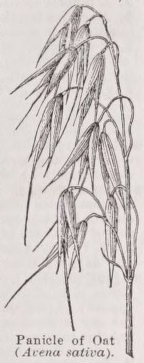
OAT, Avena sativa, L., one of about forty species mostly dispersed through the temperate regions of the Old World. It belongs to the tribe Aveneae of the order Graminex or Grasses. The spikelets form a loose panicle, familiar in the cultivated oat, the flowering glume having its dorsal rib prolonged into an awn, which is in some species twisted and bent near the base.
The origin of the cultivated oat is generally believed to be A. fatua, L., or “wild oat.” Prof. J. Buckman succeeded in raising “the potato-oat type” and “the white Tartarian oat” from grain of this species. Mr A. Stephen Wilson, however, thinks that as yet there is no real proof of this relationship, because his own cultivation of the wild oat made no difference upon it; but there appears to be a great tendency in the oat to degenerate on stiff clay soils into “weed oats,” a fact which may perhaps account for this divergence of opinion. Lindley had previously suggested that the cultivated oat was a domesticated variety of some wild species, and that it might not improbably be referred to A. strigosa, Schreb., “the bristle-pointed oat,” which is the origin of the Scotch oat, according to Buckman. The white and black varieties of this species, Mr Wilson observes, were cultivated in England and Scotland from remote times, and “are frequently mentioned in Rogers’ History of Agriculture and Prices . . . and they are still grown as a crop in Orkney and Shetland.” Both these species are found in Europe, North Africa, Siberia, and north-west India. The “naked oat,” A. nuda, L., is probably only a race of A. sativa ; it was found by Bunge in waste ground about Pekin. “According to Lindley,”...
writes Mr Wilson, “the naked oat is the pilcorn of the old agriculture, and we see from Rogers that it was in cultivation in England in the 13th century.” Both this and the “common otes,” A. vesca, are described by Gerard. Parkinson tells us that in his time [early in the 17th century] the naked oat was sown in sundry places, but “nothing so frequent” as the common sort. The chief differences between A. fatua and A. f., var. sativa, according to Buckman, are, that in the former the chaff-scales which adhere to the grain are thick and hairy, and in the latter they are not so coarse and are hairless. The wild oat, moreover, has a long stiff awn, usually twisted near the base. In the cultivated oat it may be wanting, and if present it is hot so stiff and is seldom bent. The grain is very small and worthless in the one, but larger and full in the other. Mr Wilson adds that in the point of attachment “in the wild oat the hanger terminates in a little oval spatula, . . . forming a kind of ball-and-socket connexion. . . . In the cultivated oat the continuity of the vascular tissue in the hanger is not broken off by any point of the kind.” There are now many varieties of the cultivated oat. With regard to the antiquity of the oat, De Candolle observes that it was not cultivated by the Hebrews, the Egyptians, the ancient Greeks, and the Romans. Central Europe appears to be the locality where it was cultivated earliest, at least in Europe, for grains have been found among the remains of the Swiss lake-dwellings perhaps not earlier than the bronze age, while Pliny alludes to bread made of it by the ancient Germans. Pickering also records Galen’s observations (De Alim. Fac., i. 14), that it was abundant in Asia Minor, especially Mysia, where it was made into bread as well as given to horses; he also states that ten varieties were introduced by Mohammed Ali into Egypt for fodder, and that it was seen by Bruce wild in Abyssinia, sometimes tall enough to conceal horse and rider (Grev.). And he adds that eastward from Syria it is called “sulu” by the Tatars, and was observed by Kaempfer and others in Japan; that it was brought over by colonists, and is now cultivated in north-east America; and that it has now become naturalized in parts of South America.
Besides the use of the straw when cut up and mixed with other food for fodder, the oat grain constitutes an important food for both man and beast. Being cultivated best in comparatively low temperatures, it has long formed the staple food for Scotland, north England, and Derbyshire, as well as for Germany, wherever wheat does not flourish. It is extensively grown in all the northern States of the American Union, and in New England its production largely exceeds that of wheat. The oat grain (excepting the naked oat), like that of barley, is closely invested by the husk. “This latter is used both in Scotland and Wales for the preparation of a kind of porridge . . . called sowans and sucan.” Oatmeal is made from the kiln-dried grain from which the husks have been removed; and the form of the food is the well-known “porridge.” In Ireland it is mixed with Indian-corn meal and is called “stirabout.” Groats or grits are the whole kernel from which the husk is removed. Their use is for gruel, which used to be consumed as an ordinary drink in the 17th century at the coffee-houses in London. The meal can be baked into “cake” or biscuit, as the Passover-cake of the Jews; but it cannot be made into loaves in consequence of the great difficulty in rupturing the starch grains, unless the temperature be raised to a considerable height. With regard to the nutritive value of oatmeal, as compared with that of wheat flour, it contains a higher percentage of albuminoids than any other grain, viz. , 12 · 6—that of wheat being 10 · 8—and less of starch, 58 ’ 4, as against 66 ’ 3 in wheat. It has rather more sugar, viz., 5'4—wheat having 4·2—and a good deal more fat, viz., 5 ’ 6, as against 2 0 in flour. Lastly, salts amount to 3’0 per cent, in oat, but are only 1 · 7 in wheat. Its nutritive value, therefore, is higher than that of ordinary seconds flour. fG H 1
[1,049 words — estimated reading time: 6 minutes]
OATES, Titus (c. 1650 to 1705), was, according to one account, the son of an Anabaptist preacher, chaplain to Pride, and, according to another, of Samuel, the rector of All Saints’ Church, Hastings. He was admitted on 11th June 1665 to Merchant Taylors’, having, according to one authority, been previously at Oakham. There he remained a year, more or less, “and seems afterwards to have gone to Sedlescombe school in Sussex, from whence he passed to Caius College, Cambridge, on 29th June 1667, and was admitted a sizar of St John’s, 2d February 1668/9, aged 18.” Upon very doubtful authority he is stated to have been also at Westminster School before going to the university. On leaving the university he apparently took Anglican orders, and officiated in several parishes, Hastings among them. Having brought malicious charges in which his evidence was rejected, he narrowly escaped prosecution for peιjury. He next obtained a chaplaincy in the navy, from which he appears to have been speedily dismissed for bad conduct and with the reputation of worse. He now, it is said, applied for help to Dr Tonge, rector of St Michael’s in Wood Street, an honest half-crazy man, who even then was exciting people’s minds by giving out quarterly “treatises in print to alarm and awake his majesty’s subjects.” Oates offered his help, and it was arranged that he should pretend to be a Roman Catholic so as the better to unearth the Jesuit plots which possessed Tonge’s brain (Lingard). Accordingly he was received into the church by one Berry, himself an apostate, and entered the Jesuit College of Valladolid as Brother Ambrose. Hence he was soon expelled. In October 1677 he made a second application, and was admitted to St Omer on 10th December. So scandalous, however, was his ...conduct that he was finally dismissed in 1678. Returning in June 1678 to Tonge, he set himself to forge a plot by piecing together things true and false, or true facts falsely interpreted, and by inventing treasonable letters and accounts of preparations for military action. The whole story was written by Oates in Greek characters, copied into English by Tonge, and finally told to one of Charles II.’s confidential servants named Kirkby (Lingard). Kirkby having given the king his information, Oates was sent for (13th August), and in a private interview gave details, in forty-three articles, of the plot and the persons who had engaged to assassinate Charles. The general improbability of the story was so manifest, and the discrepancies were so glaring, that neither then nor at any subsequent time did Charles express anything but amused incredulity. To bolster up the case a fresh packet of five forged letters was concocted (31st August); but the forgery was transparent, and even Sir William Jones, the attorney-general, though a violent upholder of the plot, dared not produce them as evidence.
Oates now (6th September) made an affidavit before Sir Edmondbury Godfrey to an improved edition of his story, in eighty-one articles. Among the persons named was Coleman, secretary to the duchess of York, whom Godfrey knew, and to whom he sent word of the charges. Coleman in turn informed the duke, and he, since the immediate exposure of the plot was of the utmost consequence to him, induced Charles to compel Oates to appear (28th September) before the privy council. Here Oates delivered himself of a story the falsehood of which was so obvious that the king was able to expose him by a few simple questions. At this moment an accident most fortunate for Oates took place. Amongst the papers seized at his request were Coleman’s, and in them were found copies of letters written by the latter to Père la Chaise, suggesting that Louis should furnish him with money, which he would use in the French and Catholic interest among members of parliament. Among them, too, were these passages: “Success will give the greatest blow to the Protestant religion that it has received since its birth”; “we have here a mighty work upon our hands, no less than the conversion of three kingdoms, and by that perhaps the utter subduing of a pestilent heresy, which has so long domineered over great part of the northern world.” The credit of Oates was thus, in the eyes of the people, re-established, and Coleman and others named were imprisoned. Charles was anxious for his brother’s sake to bring the matter to a conclusion, but he dared not appear to stifle the plot; so, when starting for Newmarket, he left orders with Danby that he should finish the investigation at once. But Danby purposely delayed; an impeachment was hanging over his head, and anything which took men’s minds off that was welcome. Possibly, too, he was sincerely desirous of frustrating Charles’s Catholic sympathies and secret dealings with France. Shaftesbury, with very different views, was eager in his patronage of the plot and its founder.
On 12th October occurred the murder of Godfrey, and the excitement was at its highest pitch. That Oates could ever have induced any one to believe in his tales is incredible to one who does not recollect the victories of Catholic France, the relaxing of the penal laws, the activity of the Jesuits, the fear of a standing army and of James, the agitation of the opposition led by Shaftesbury, and the ignorance and apprehension of the designs of the court. On 21st October parliament met, and, though Charles in his speech had barely alluded to the plot, all other business was put aside and Oates was called before the House. Here he gave details of a pretended apportioning by Oliva, the general of the Jesuit order, of all the chief posts to leading Roman Catholics in the country. The proceedings which followed are best read in the parliamentary history. A new witness was wanted to support Oates’s story, and in November Bedloe came forward. At first he remembered little; by degrees he remembered everything that was wanted. Not even so, however, did their witness agree together, so, as a bold stroke, Oates, with great circumstantiality, accused the queen before Charles of high treason. Charles both disbelieved and exposed him, whereupon Oates carried his tale before the House of Commons. The Commons voted for the queen’s removal from court, but, the Lords refusing to concur, the matter dropped. It was not, however, until 18th July 1679 that the slaughter of Jesuits and other Roman Catholics upon Oates’s testimony and that of his accomplices was to some extent checked. Sir George Wakeman, the queen’s physician, was accused of purposing to poison the king, and the queen was named as being concerned in the plot. The refusals of Charles to credit or to countenance the attacks on his wife are the most creditable episodes in his life. Scroggs had intimation that he was to be lenient. Sir Philip Lloyd proved Oates to have perjured himself in open court, and Wakeman was acquitted. On 26th June 1680, upon Oates’s testimony, the duke of York was presented as a recusant at Westminster, and in November the informer gave evidence in the trial of Strafford. But the panic had now worn itself out, and the importance .of Oates rapidly declined; so much so that after the dissolution in 1682 he was no more heard of during Charles’s reign, but enjoyed his pension of <£600 or <£900, it is uncertain which, in quiet. Shortly before the death of Charles, James brought, and won, a civil action against Oates, with damages of £100,000; in default of payment Oates was taken to prison; while there he was indicted for perjury, and was tried in May 1685, soon after the accession of James II. He was convicted, and received an awful sentence, the execution of which was expected to kill him, and which was rigorously carried out; but to the astonishment of all he survived.
Oates was in prison for three and a half years. Upon the flight of James, and during the excitement against the Catholics, he partially gained his liberty, and brought an appeal against his sentence before the Lords, who, while admitting the sentence to bè unjust, confirmed it by a majority of thirty-five to twenty-three. The Commons, however, passed a bill annulling the sentence; and a conference was held in which the Lords, while again acknowledging that legally they were wrong, adhered to their former determination. The matter was finally settled by Oates receiving a royal pardon, with a salary of £300 a year. In November 1689 he was again seen in Westminster Hall, when Peterborough, Salisbury, and others were impeached. In 1690, finding that there was no hope of preferment in the English Church, he became a Baptist, but in less than a year was ejected from their body. In 1691 he became acquainted with William Fuller, whom he induced to forge another plot, though not with the success he had himself attained. He appears to have lived after this chiefly in retirement, though we read in Evelyn that in 1696 he dedicated to William a book against James. He died 13th July 1705.
Authorities. — Oates’s, Dangerfield’s, and Bedloe’s Narratives; State Trials·, Journals of Houses of Parliament·, North’s Examen ; the various memoirs and diaries of the period; Fuller’s Narrative; Dryden’s Absalom and Achitophel; Burnet’s History ; Narcissus Luttrell’s Relation. Lingard gives an exhaustive and trustworthy account of the Popish terror and its victims; and the chief incidents in Oates’s career are graphically described by Macaulay. On the question of the place of his education see Notes and Queries, 22d December 1883. (0. A.)
[1,633 words — estimated reading time: 10 minutes]
OATH, Anglo-Saxon âdh, a word found throughout the Teutonic languages (Gothic aiths, modern German eid), but without ascertainable etymology. The verb to swear is also Old Teutonic (Gothic svaran, modern German schioören)·, this word, too, is not clear in original meaning, but is in some way connected with the notion of answering, —indeed it still forms part of the word answer, Anglo-Saxon and-swarian ∙, it has been suggested that the swearer answered by word or gesture to a solemn formula or act. Among other terms in this connexion, the Latin jurare, whence English law has such derivatives as jury, seems grounded on the metaphorical idea of binding (root ju, as in jungo) ; the similar idea of a bond or restraint may perhaps be traced in the Greek opκo<s. It may be worth notice that the Latin sacramentum (whence modern French serment) does not really imply the sacredness of an oath, but had its origin in the money paid into court in a Roman lawsuit, the loser forfeiting his pledge, which went to pay for the public rites (sacra) ; thence the word passed to signify other solemn pledges, such as military and judicial oaths....
The subject of oaths and swearing, difficult in itself, has been made more obscure by the unsatisfactory methods employed by most writers on it. This is not due to want of ability in the writers themselves, among whom are included such men as Calvin and Paley, but to their not having followed their subject on the lines of historical development; on the contrary, the usual plan has been to accommodate to modern views, and discuss with modern arguments, an institution which originated in an early stage of knowledge, and has been confused by the changes it has undergone while being carried on into the midst of new ideas. The student who finds, by consulting modern theological and legal authorities, how indefinite are their views of the binding operation of an oath and the consequences of breaking it (apart from prosecution for perjury) will understand that its meaning must be sought, not among those who now administer and take it, but in the history of older states of culture in which it arose. The very formula, “so help you God,” by which legal oaths are administered in England, has not for ages had any precise signification.
An oath may be defined as an asseveration or promise made under non-human penalty or sanction. Writers, viewing the subject among civilized nations only, have sometimes defined the oath as an appeal to a deity. It will be seen, however, by some following examples, that the harm or penalty consequent on perjury may be considered to result directly, without any spirit or deity being mentioned; indeed it is not unlikely that these mere direct curses invoked on himself by the swearer may be more primitive than the invocation of divinities to punish. Oaths scarcely belong to the lowest or savage level of life, unless when rude tribes may have learned them from more civilized neighbours. Their original appearance may rather have been in a somewhat higher barbaric stage of society, where legal forms had already come into use, and oaths were needed as a means of strengthening testimony or promise. Examples of the simplest kind of curse-oath may be seen among the Nagas of Assam, where two men will lay hold of a dog or a fowl by head and feet, which is then chopped in two with a single blow of the dao, this being emblematic of the fate expected to befall the perjurer. Or a man will stand within a circle of rope, with the implication that if he breaks his vow he may rot as a rope does, or he will take hold of the barrel of a gun, a spearhead, or a tiger’s tooth, and solemnly declare, “If I do not faithfully perform this my promise, may I fall by this!” (Butler in Journ. Asiatic Soc. Bengal, 1875, p. 316). Another stage in the history of oaths is that in which the swearer calls on some fierce beast to punish him if he lies, believing that it has the intelligence to know what he says and the power to interfere in his affairs. In Siberia, in lawsuits between Russians and the wild Ostyaks, it is described as customary to bring into court the head of a bear, the Ostyak making the gesture of eating, and calling on the bear to devour him in like manner if he does not tell the truth (Erman, Travels in Siberia, vol. i. p. 492, London, 1848). Similar oaths are still sworn on the head or skin of a tiger by the Santals and other indigenous tribes of India. To modern views, a bear or a tiger seems at any rate a more rational being to appeal to than a river or the sun, but in the earlier stage of nature-religion these and other great objects of nature are regarded as animate and personal. The prevalence of river-worship is seen in the extent to which in the old and modern world oaths by rivers are most sacred. In earlier ages men swore inviolably by Styx or Tiber, and to this day an oath on water of the Ganges is to the Hindu the most binding of pledges, for the goddess will take awful vengeance on the children of the perjurer In New Guinea certain tribes are reported to swear by the sun, or a mountain, or a weapon, that the sun may burn them, or the mountain crush them, or the weapon wound them if they forswear themselves. The Tunguz brandishes a knife before the sun, saying, “If I lie may the sun plunge sickness into my entrails like this knife.” The natural transition from swearing by these great objects of nature to invoking gods conceived in human form is well shown in the treaty-oath between the Macedonians and the Carthaginians recorded by Polybius (vii. 9); here the sun and moon and earth, the rivers and meadows and waters, are invoked side by side with Zeus and Hera and Apollo, and the gods of the Carthaginians. The heaven-god, able to smite the perjurer with his lightning, was invoked by the Romans, when a hog was slain with the sacred flint representing the thunderbolt, with the invocation to Jove so to smite the Roman people if they broke the oath (Liv., i. 24; Polyb., iii. 25). Another form of this Aryan rite was preserved by the old Slavonic nation of Prussia, where a man would lay his right hand on his own neck and his left on the holy oak, saying, “May Perkun (the thundergod) destroy me !” The oaths of the lower culture show a remarkable difference from those of later stages. In the apparently primitive forms the curse on the perjurer is to take effect in this world, as when an African negro swears by his head or limbs, which will wither if he lies; this kind of oath by the swearer’s body is still found in both the Eastern and the Western worlds, and generally with the same implication of evil to fall on the part sworn by. But as nations became more observant, experience must have shown that bears and tigers were as apt to kill truth-tellers as perjurers, and that even the lightningflash falls without moral discrimination. In the Clouds of Aristophanes, indeed, men have come openly to ridicule such beliefs, the Socrates of the play pointing out that notorious perjurers go unharmed, while Zeus hurls his bolts at his own temple, and the tall oaks, as if an oak-tree could perjure itself. The doctrine of miraculous earthly retribution on the perjurer lasted on in legend, as where Eusebius relates how three villains conspired to bring a false accusation against Narcissus, bishop of Jerusalem, which accusation they confirmed by solemn oath before the church, one wishing that if he swore falsely he might perish by fire, one that he might die of the pestilence, one that he might lose his eyes; a spark no man knew from whence burned to ashes the first perjurer’s house and all within, the second was consumed by the plague from head to foot, whereupon the third confessed the crime with tears so copious that he lost his sight (Euseb., Hist. Eccl., vi. 9). Asa general rule, however, the supernatural retribution on perjury has been transferred from the present world to the regions beyond the grave, as is evident from any collection of customary oaths. A single instance will show at once the combination of retributions in and after the present life, and the tendency to heap up remote penalties in the vain hope of securing present honesty. The Siamese Buddhist in his oath, not content to call down on himself various kinds of death if he breaks it, desires that he may afterwards be cast into hell to go through innumerable tortures, among them to carry water over the flames in a wicker basket to assuage the thirst of the infernal judge, then that he may migrate into the body of a slave for as many years as there are grains of sand in four seas, and after this that he may be born a beast through five hundred generations and an hermaphrodite five hundred more.
The forms of oath belonging to all nations and ages, various as they are in detail, come under a few general heads. It may be first observed that gestures such as grasping hands, or putting one hand between the hands of another in token of homage, are sometimes treated as of the nature of oaths, but wrongly so, they being rather of the nature of ceremonies of øompact. The Hebrew practice of putting the hand under another’s thigh is usually reckoned among oath-rites, but it may have been merely a ceremony of covenant (Gen. xxiv. 2, xlvii. 29; see Joseph., Ant., i. 16). Even the covenant among many ancient and modern nations by the parties mixing their blood or drinking one another’s is in itself only a solemn rite of union, not an oath proper, unless some such ceremony is introduced as dipping weapons into the blood, as in the form among the ancient Scythians (Herod., iv. 70); this, by bringing in the idea of death befalling the covenant-breaker, converts the proceeding into an oath of the strongest kind. The custom of swearing by weapons, though frequent in the world, is far from consistent in meaning. It may signify, in cases such as those just mentioned, that the swearer if forsworn is to die by such a weapon; or the warrior may appeal to his weapon as a powerful or divine object, as Parthenopaeus swears by his spear that he will level to the ground the walls of Thebes (Aeschyl., Sept, contra Theb., 530; see the custom of the Quadi in Ammian. Marcellin., xvii.); or the weapon may be a divine emblem, as when the Scythians swore by the wind and the sword as denoting life and death (Lucian, Toxaris, 38). Oaths by weapons lasted into the Christian period; for instance, the Lombards swore lesser oaths by consecrated weapons and greater on the Gospels (see Ducange, s.v. “Juramenta super arma”; Grimm, Deutsche Rechtsalterth., p. 896). Stretching forth the hand towards the object or deity sworn by is a natural gesture, well shown in the oath of Agamemnon, who with uplifted hands (∆ιι - χeζpας άναο-χών) takes Heaven to witness with Sun and Earth and the Erinnyes who below the earth wreak vengeance on the perjurer (Homer, Il., xix. 254; see also Pindar, Olymp., vii. 120). The gesture of lifting the hand towards heaven was also an Israelite form of oath: Abraham says, “I have lifted up my hand to Jehovah,” while Jehovah Himself is represented as so swearing, “For I lift up My hand to heaven, and say, I live for ever” (Gen. xiv. 22; Deut, xxxii. 40; see Dan. xii. 7; Rev. x. 5). This gesture established itself in Christendom, and has continued to modern times. In England, for example, in the parliament at Shrewsbury in 1398, when the Lords took an oath on the cross of Canterbury never to suffer the transactions of that parliament to be changed, the members of the Commons held up their hands to signify their taking upon themselves the same oath (J. E. Tyler, Oaths, p. 99). In France a juror takes oath by raising his hand, saying, “Je jure !” The Scottish judicial oath is taken by the witness holding up his right hand uncovered, and repeating after the usher, “I swear by Almighty God, and as I shall answer to God at the great day of judgment, that I will,” &c. In the ancient world sacrifice often formed part of the ceremony of the oath; typical examples may be found in the Homeric poems, as in Agamemnon’s oath already mentioned, or the compact between the Greeks and Trojans (Il., iii. 276), where wine is poured out in libation, with prayer to Zeus and the immortal gods that the perjurer’s brains shall, like the wine, be poured on the ground; the rite thus passes into a symbolic curse-oath of the ordinary barbaric type. Connected with such sacrificial oaths is the practice of laying the hand on the victim or the altar, or touching the image of the god. A classic instance is in a comedy of Plautus (Rudens, v. 2, 45), where Gripus says, “Tange aram hanc Veneris,” and Labrax answers “Tango” (Greek instance, Thucyd., v. 47; see Justin, xxiv. 2). Thus Livy (xxi. 1) introduces the phrase “touching the sacred objects” (tactis sacris) into the picturesque story of Hannibal’s oath. Details of the old Scandinavian oath have been preserved in Iceland in the Landnâmabôk (Islendinga Sögur, Copenhagen, 1843): a bracelet (baugr) of two rings or more was to be kept on the altar in every head court, which the godi or priest should wear at all law-things held by him, and should redden in the blood of the bullock sacrificed, the witness pronouncing the remarkable formula: “Name I to witness that I take oath by the ring, law-oath, so help me Frey, and Niörd, and almighty Thor/’ (hialpi mer svâ Freyr, ok Niördr, ok hinn almâttki Ass), &c. This was doubtless the great oath on the holy ring or bracelet which the Danes swore to King Alfred to quit his kingdom (“on tham halgan beage,” Anglo-Sax. Chron. ; “in eorum armilla sacra,” Ethelwerd, Chron., iv.). An oath, though not necessarily expressed in words, is usually so. In the Homeric instances the prayer which constitutes the oath has a somewhat conventional form, and in the classical ages we find well-marked formulas. These are often references to deities, as “by Zeus !” “I call Zeus to witness” (ναι μλ Δία ; foτω Zeus); “by the immortal gods !” “I call to witness the ashes of my ancestors” (per deos immortales; testor majorum cineres). Sometimes a curse is invoked on himself by the swearer, that he may perish if he fail to keep his oath, as “the gods destroy me,” “let me perish if,” &c. (dii me perdant; dispeream si). An important class of Roman oaths invokes the deity to favour or preserve the swearer in so far as he shall fulfil his promise—“as the gods may preserve me,” “as I wish the gods to be propitious to me” (me ita di servent; ita deos mihi velim propitios). The best Roman collection is to be found in the old work of Brissonius, De Formulis et Solemnibus Populi Romani Verbis, Paris, 1583. Biblical examples of these classes of oaths are “as the Lord liveth” (1 Sam. xiv. 39, and elsewhere), “so do God to me, and more also” (2 Sam. iii. 35, and elsewhere).
The history of oaths in the early Christian ages opens a controversy which to this day has not been closed. Under Christ’s injunction, “Swear not at all” (Matt. v. 34; also James v. 12), many Christians seem at first to have shrunk from taking oaths, and, though after a time the usual customs of judicial and even colloquial oaths came to prevail among them, the writings of the Fathers show efforts to resist the practice. Chrysostom perhaps goes furthest in inveighing against this “snare of Satan”: “Do as you choose; I lay it down as a law that there be no swearing at all. If any bid you swear, tell him, Christ has spoken, and I do not swear” (Homil. ix. in Act. Apostol.; see a collection of patristic passages in Sixt. Senens., Bibliothec. Sanct., vi. adnot. 26). The line mostly taken by influential teachers, however, was that swearing should indeed be avoided as much as possible from its leading to perjury, but that the passages forbidding it only applied to superfluous or trifling oaths, or those sworn by created objects, such as heaven or earth or one’s own head. On the other hand, they argued that judicial and other serious swearing could not have been forbidden, seeing that Paul in his epistles repeatedly introduces oaths (2 Cor. i. 23; Phil. i. 8; Gal. i. 20). Thus Athanasius writes: “I stretch out my hand, and as I have learned of the apostle, I call God to witness on my soul” (Apol. ad Imp. Const.·, see Augustine, De Mend., 28; Epist., cl., iii. 9; cl., iv. 250; Enarr. in Psalm. Ixxxviii. (4); Serm., 307, 319). This argument is the more forcible from Paul’s expressions being actually oaths in accepted forms, and it has also been fairly adduced that Christ, by answering to the adjuration of the high priest, took the judicial oath in solemn form (Matt, xxvi. 63). The passages here referred to will give an idea of the theological grounds on which in more modern times Anabaptists, Mennonites, and Quakers have refused to take even judicial oaths, while, on the other hand, the laws of Christendom from early ages have been only directed against such swearing as was considered profane or otherwise improper, and against perjury. Thus from the 3d or 4th century we find oaths taking much the same place in Christian as in non-Christian society. In the 4th century the Christian military oath by God, Christ, the Holy Spirit, and the majesty of the emperor is recorded by Vegetius (Rei Milit. Inst., ii. 5). Constantine’s laws required every witness in a cause to take oath; this is confirmed in Justinian’s code, which even in some cases requires also the parties and advocates to be sworn (Cod. Theod., xi. 39; Justin. Cod., iv. 20, 59). Bishops and clergy were called upon to take oath in ordination, monastic vows, and other ecclesiastical matters (see details in Bingham, Antiq. of Chr. Church, xvi. 7). By the Middle Ages oaths had increased and multiplied in Christendom far beyond the practice of any other age or religion. The Reformation made no change in principle, as is seen, for instance, in Art. xxxix. of the church of England: “As we confess that vain and rash swearing is forbidden Christian men by our Lord Jesus Christ, and
James His apostle, so we judge, that Christian Religion doth not prohibit, but that a man may swear when the Magistrate require th, in a cause of faith and charity, so it be done according to the Prophet’s teaching, in justice, judgement, and truth.” But about this time began a legal reformation, which has for reasons of public policy continually reduced the number of oaths required to be taken, and apparently tends toward their total abolition.
The history of swearing in early Christendom would lead us to expect that the forms used would be adopted with more or less modification from Hebrew or Roman sources, as indeed proves to be the case. The oath introduced in the body of one of Constantine’s laws—“As the Most High Divinity may ever be propitious to me” (Ita mihi summa Divinitas semper propitia sit)—follows an old Roman form. The Roman oath by the genius of the emperor being objected to by Christians as recognizing a demon, they swore by his safety (TertulL, Apol., 32). The gesture of holding up the hand in swearing has been already spoken of. The Christian oath on a copy of the Gospels seems derived from the late Jewish oath taken holding in the hand the scroll of the law (or the phylacteries), a ceremony itself possibly adapted from Roman custom (see treatise “Shebuoth” in Gemard). Among the various mentions of the oath on the Gospels in early Christian writers is that characteristic passage of Chrysostom in a sermon to the people of Antioch: “But do thou, if nothing else, at least reverence the very book thou boldest forth to be sworn by, open the Gospel thou takest in thy hands to administer the oath, and, hearing what Christ therein saith of oaths, tremble and desist” (8erm. ad Pop. Antioch., Homil. XV. ). The usual mode was to lay the hand on the Gospel,...

[6,640 words — estimated reading time: 40 minutes]
a solemn invocation of a superior power, admitted to be acquainted with all the secrets of our hearts, with our inward thoughts as well as our outward actions, to witness the truth of what we assert, and to inflict his vengeance upon us if we assert what is not true, or promise what we do not mean to perform. Almost all nations, whether savage or civilized, whether enjoying the light of revelation or led only by the light of reason, knowing the importance of truth, and willing to obtain a barrier against falsehood, have had recourse to oaths, by which they have endeavoured to make men fearful of uttering lies, under the dread of an avenging Deity. Among Christians, an oath is a solemn appeal for the truth of our assertions, the sincerity of our promises, and the fidelity of our engagements, to the one only God, the Judge of the whole earth, who is every where present, and sees, and hears, and knows, whatever is said, or done, or thought in any part of the world. Such is that Being whom Christians, when they take an oath, invoke to bear testimony to the truth of their words, and the integrity of their hearts. Surely, then, if oaths be a matter of so much moment, it well behoves us not to treat them with levity, nor ever to take them without due consideration. Hence we ought, with the utmost vigilance, to abstain from mingling oaths in our ordinary discourse, and from associating the name of God with low or disgusting images, or using it on trivial occasions, as not only a profane levity in itself, but tending to destroy that reverence for the supreme Majesty which ought to prevail in society, and to dwell in our own hearts. The forms of oaths,” says Dr. Paley, like other religious ceremonies, have in all ages been various; consisting, however, for the most part of some ...bodily action, and of a prescribed form of words.” Among the Jews, the juror held up his right hand toward heaven, Psalm cxliv, 8; Rev. x, 5. The same form is retained in Scotland still. Among the Jews, also, an oath of fidelity was taken by the servant’s putting his hand under the thigh of his lord, Genesis xxiv, 2. Among the Greeks and Romans, the form varied with the subject and occasion of the oath: in private contracts, the parties took hold of each other’s hands, while they swore to the performance; or they touched the altar of the god by whose divinity they swore: upon more solemn occasions, it was the custom to slay a victim; and the beast being struck down with certain ceremonies and invocations, gave birth to the expression, _ferire pactum_; and to our English phrase, translated from this, of striking a bargain.” The form of oaths in Christian countries is also very different; but in no country in the world worse contrived, either to convey the meaning or impress the obligation of an oath, than in our own. The juror with us, after repeating the promise or affirmation which the oath is intended to confirm, adds, So help me God;” or, more frequently, the substance of the oath is repeated to the juror by the magistrate, who adds in the conclusion, So help you God.” The energy of this sentence resides in the particle _so_: So, that is, _hâc lege_, upon condition of my speaking the truth, or performing this promise, and not otherwise, may God help me! The juror, while he hears or repeats the words of the oath, holds his right hand upon a Bible, or other book containing the Gospels, and at the conclusion kisses the book. This obscure and elliptical form, together with the levity and frequency of them, has brought about a general inadvertency to the obligation of oaths, which, both in a religious and political view, is much to be lamented; and it merits public consideration, whether the requiring of oaths upon so many frivolous occasions, especially in the customs, and in the qualification for petty offices, has any other effect than to make such sanctions cheap in the minds of the people. A pound of tea cannot travel regularly from the ship to the consumer, without costing half a dozen oaths at least; and the same security for the due discharge of their office, namely, that of an oath, is required from a churchwarden and an archbishop; from a petty constable and the chief justice of England. Oaths, however, are lawful; and, whatever be the form, the signification is the same. Historians have justly remarked, that when the reverence for an oath began to diminish among the Romans, and the loose epicurean system, which discarded the belief of providence, was introduced, the Roman honour and prosperity from that period began to decline. The Quakers refuse to swear upon any occasion, founding their scruples concerning the lawfulness of oaths upon our Saviour’s prohibition, Swear not at all,” Matt. v, 34. But it seems our Lord there referred to the vicious, wanton, and unauthorized swearing in common discourse, and not to judicial oaths; for he himself answered, when interrogated, upon oath, Matt. xxvi, 63, 64; Mark xiv, 61. The Apostle Paul also makes use of expressions which contain the nature of oaths, Romans i, 9; 1 Cor. xv, 31; 2 Cor. i, 18; Gal. i, 20; Heb. vi, 13–17. The administration of oaths supposes that God will punish false swearing with more severity than a simple lie, or breach of promise; for which belief there are the following reasons: 1. Perjury is a sin of greater deliberation. 2. It violates a superior confidence. 3. God directed the Israelites to swear by his name, Deut. vi, 13; x, 20; and was pleased to confirm his covenant with that people by an oath; neither of which, it is probable, he would have done, had he not intended to represent oaths as having some meaning and effect beyond the obligation of a bare promise.
[1,005 words — estimated reading time: 6 minutes]