1. Fine particles of stone, esp. of siliceous stone, but not reduced to dust; comminuted stone in the form of loose grains, which are not coherent when wet.
2. A single particle of such stone.
3. The sand in the hourglass; hence, a moment or interval of time; the term or extent of one's life.
4. Tracts of land consisting of sand, like the deserts of Arabia and Africa; also, extensive tracts of sand exposed by the ebb of the tide.
SAND-BLAST. The erosive influence of driven sand is turned to useful account for several industrial purposes by means of an apparatus devised, about 1870, by Mr B. C. Tilghman of Philadelphia. Tilgliman’s sand-blast consists of a contrivance for impelling, with graduated degrees of velocity, a jet or column of sand, by means of compressed air or steam, against the object or surface to be acted on. The apparatus is principally adapted for obscuring, engraving, and ornamenting glass, but according to the velocity with which the sand is impelled it may be used to carve deep patterns in granite, marble, and other hard stones, to bite into steel, &c., and even to cut and perforate holes through these and other most refractory materials. Sheets of glass 4 feet wide are obscured at the rate of 3 feet per minute, with a blast of air having a pressure of 1 lb) per inch. With the aid of tough elastic stencils, patterns and letters are engraved on flashed glass, globes for lamps and gaslights are ornamented, druggists’ bottles are lettered, &c. Driven with moderate velocity against a metal surface, the sand produces by its impact a fine uniform pitted appearance without removing the metal; and in this way it is used for “frosting” plated goods. A strong blast is largely used for sharpening files, which, as they leave the cutter, have always a slight backward curve or “burr” on their cutting edges which blunts their biting effect. By directing a blast of very fine sand, mixed with water into a thin mud, with steam pressure of 70 ft), at an angle against the back of the teeth, this burr is ground off, the shape of the teeth is improved, and the file is rendered very keen. While the use of steam for impelling the sand-blast is most simple and economical, many practical ...difficulties have hitherto been found in the way of its employment, and consequently for obtaining high pressure of air costly apparatus was required, thus limiting the applications of the agency. In 1884 Mr Mathewson patented an apparatus in which, by an ingenious exhaust arrangement, the impelling steam is swept away, leaving only cool, dry sand to strike against the object acted on; and the success of this device has already opened up a wider field for the employment of the sand-blast.
9th ed. Encyclopædia Britannica, vol. 21, p. 257 [395 words — estimated reading time: 3 minutes]
SAND-EEL or Sand-Launce. The fishes known under these names form a small isolated group (Ammodytina), distantly related to the cod-fishes. Their body is of an elongate-cylindrical shape, with the head terminating in a long conical snout, the projecting lower jaw forming the pointed end. A low long dorsal fin, in which no distinction between spines and rays can be observed, occupies nearly the whole length of the back, and a long anal, composed of similar short and delicate rays, commences immediately behind the vent, which is placed about midway between the head and caudal fin. The caudal is forked and the pectorals are short. The total absence of ventral fins indicates the burrowing habits of these fishes. The scales, when present, are very small; but generally the development of scales has only proceeded to the formation of oblique folds of the integuments. The eyes are lateral and of moderate size; the dentition is quite rudimentary....
Sand-eels are small littoral marine fishes, only one species attaining a length of 18 inches (Ammodytes lanceolate). They live in shoals at various depths on a sandy bottom, and bury themselves in the sand on the slightest alarm. They are able to do this with the greatest ease and rapidity whilst the bottom is covered with water. Many of those which live close inshore are left by the receding tide buried in the sand, and are then frequently dug out from a depth of one or two feet. Other shoals live in deeper water; when they are surprised by fish of prey or porpoises, they are frequently driven to the surface in such dense masses that numbers of them can be scooped out of the water with a bucket or hand-net. In fact, this used to be, in the Channel Islands, the common practice of the fishermen to provide themselves with bait. Some species descend to a depth of 100 fathoms and more; and the greater sand-eel is not rarely taken on the mackerel line far out at sea near the surface. Sand-eels are very rapacious, destroying a great quantity of fry and other small creatures, such as the lancelet (Branchiostoma), which lives in similar localities. They are excellent eating, and are much sought after for bait.
Sand-eels are common in all suitable localities of the North Atlantic; a species scarcely distinct from the European common sand-launce occurs on the Pacific side of North America, another on the east coast of South Africa. On the British coasts three species are found :—the Greater Sand-Eel (Ammodytes lanceolate), distinguished by a tooth-like bicuspid prominence on the vomer; the Common Sand-Launce (A. tobiamis), from five to seven inches long, with unarmed vomer, even dorsal fin, and with the integuments folded; and the Southern Sand-Launce (A. siculus), with unarmed vomer, smooth skin, and with the margins of the dorsal and anal fins undulated. The last species is common in the Mediterranean, but local farther northwards. It has been found near the Shetlands at depths from 80 to 100 fathoms, and is generally distinguished from the common species by the fishermen of the Channel Islands, who have a tradition that it appeared suddenly on their coasts some fifty years ago.
9th ed. Encyclopædia Britannica, vol. 21, p. 257 [544 words — estimated reading time: 4 minutes]
SAND-GROUSE, the name by which are commonly known the members of a small but remarkable group of birds frequenting sandy tracts, and having their feet more or less clothed with feathers after the fashion of Grouse (vol. xi. p. 221), to which they were originally thought to be closely allied, and the species first described were by the earlier systematists invariably referred to the genus Tetrao. Their separation therefrom is due to Temminck, who made for them a distinct genus which he called Pterocles, and his view, as Lesson tells us (Traité, p. 515), was subsequently corroborated by De Blainville; while in 1831 Bonaparte (Saggio, p. 54) recognized the group as a good Family, Pediophili or Pterocliae. Further investigation of the osteology and pterylosis of the Sand-Grouse revealed still greater divergence from the normal Gallinae (to which the true Grouse belong), as well as several curious resemblances to the Pigeons; and in the Zoological Society’s Proceedings for 1868 (p. 303) Prof. Huxley proposed to regard them, under the name of Pteroclomorphae, as forming a group equivalent to the Alectoromorphae. and Peristeromorphae, for reasons already briefly stated (Ornithology, vol. xviii. p. 46). The Pteroclidae consist of two genera— Pterocles, with about fifteen species, and Syrrhaptes, with two. Of the former, two species inhabit Europe, P. arenarius, the Sand-Grouse proper, and that which is usually called P. alchata, the Pin-tailed SandGrouse. The European range of the first is practically limited to Portugal, Spain, and the southern parts of Russia, while the second inhabits also the south of France, where it is generally known by its Catalan name of “Ganga,” or locally as “Grandaulo,” or, strange to say, “Perdrix d'Angleterre’’ Both species are ...also abundant in Barbary, and have been believed to extend eastwards through Asia to India, in most parts of which country they seem to be only winter-visitants; but in 1880 Herr Bogdanow pointed out to the Academy of St Petersburg (Bulletin, xxvii. p. 164) a slight difference of coloration between eastern and western examples of what had hitherto passed as P. alchata ; and the difference, if found to be constant, may require the specific recognition of each, while analogy would suggest that a similar difference might be found in examples of P. arenarius. India, moreover, possesses five other species of Pterocles, of which however only one, P. fasciatus, is peculiar to Asia, while the others inhabit Africa as well, and all the remaining species belong to the Ethiopian region—one, P. personatus, being peculiar to Madagascar, and four occurring in or on the borders of the Cape Colony.
The genus Syrrhaptes, though in general appearance resembling Pterocles, has a conformation of foot quite unique among birds, the three anterior toes being encased in a common “podotheca,” which is clothed to the claws with hairy feathers, so as to look much like a fingerless glove. The hind toe is wanting. The two species of Syrrhaptes are S. tibetanus— the largest Sand-Grouse known— inhabiting the country whence its trivial name is derived, and S. paradoxus, ranging from Northern China across Central Asia to the confines of Europe, which it occa sionally, and in a marvellous manner, invades, as has been already briefly described (Birds, vol. iii. p. 770). Though its attempts at colonization in the extreme west have failed, it would seem to have established itself of late years in the neighbourhood of Astrakhan (Ibis, 1882, p. 220). It appears to be the “Barguerlac ” of Marco Polo (ed. Yule, i. p. 239); and the “Loung-Kio” or “Dragon’s Foot,” so unscientifically described by the Abbé Huc (Souvenirs d’un Voyage dans la Tartarie, i. p. 244), can scarcely be anything else than this bird.
Externally all Sand-Grouse present an appearance so distinctive that nobody who has seen one of them can be in doubt as to any of the rest. Their plumage assimilates in general colour to that of the ground they frequent, being above of a dull ochreoushue, more or less barred or mottled by darker shades, while beneath it is frequently varied by belts of deep brown intensifying into black. Lighter tints are, however, exhibited by some species,—the drabmerging into a pale grey, the buffbrightening into a lively orange, and streaks or edgings of an almost pure white relieve the prevailing sandy or fawn-coloured hues that especially characterize the group. The sexes seem always to differ in plumage, that of the male being the brightest and most diversified. The expression is decidedly Dove-like, and so is the form of the body, the long wings contributing also to that effect, so that among Anglo-Indians these birds are commonly known as “Rock-Pigeons.” The long wings, the outermost primary of which in Syrrhaptes has its shaft produced into an attenuatedfilament, are in all the species worked by exceedingly powerful muscles, and in several forms the middle rectrices are likewise protracted and pointed, so as to give to their wearers the name of Pin-tailed Sand-Grouse. The nest is a shallow hole in the sand. Three seems to be the regular complement of eggs laid in each nest, but there are writers who declare (most likely in error) that the full number in some species is four. These eggs are of peculiar shape, being almost cylindrical in the middle and nearly alike at each end, and are of a pale earthy colour, spotted, blotched, or marbled with darker shades, the markings being of two kinds, one superficial and the other more deeply seated in the shell. The young are hatched fully clothed in down (P. Z. S. 1866, pl. ix. fig. 2), and though not very active would appear to be capable of locomotion soon after birth. Morphologically generalized as the Sand-Grouse undoubtedly are, no one can contest the extreme specialization of many of their features, and thus they form one of the most instructive groups of birds with which ornithologists are acquainted. The remains of an extinct species of Pterocles, P. sepultus, intermediate apparently between P. alchata and P. gutturalis, have been recognized in the Miocene caves of the Allier by Prof. A. Milne-Edwards (Ois . foss. de la France, p. 294, pl. clxi. figs. 1-9); and, in addition to the other authorities on this very interesting group of birds already cited, reference may be made to Mr Elliot’s “Study” of the Family (P. Z. S., 1878, pp. 233-264) and Dr Gadow, “On certain points in the Anatomy of Pterocles” (op. dt., 1882, pp. 312-332). (A. N. )
9th ed. Encyclopædia Britannica, vol. 21, p. 258 [1,099 words — estimated reading time: 7 minutes]
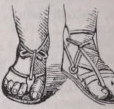
1. A kind of shoe, consisting of a sole fastened to the foot. The Greek and Roman ladies woresandals made of a rich stuff, ornamented with gold or silver.
2. A shoe or slipper worn by the pope and other Romish prelates when they officiate. A like sandal is worn by several congregations of monks.
4. A resin in white tears, more transparent than those of mastic; obtained from the juniper tree, in which it occupies the place between the bark and the wood. It is used in powder to prevent ink from sinking or spreading. This is the substance denoted by the Arabic word, and it is also called varnish. For distinction, this is called gum sandarac or sandaric.
2. A bath made by warm sand, with which something is enveloped.
3. A box with a perforated top or cover, for sprinkling paper with sand.
4. A tree or plant of the genus Hura. It is said that the pericarp of the fruit will burst in the heat of the day with a loud report, and throw the seeds to a distance.
at first, were only soles tied to the feet with strings or thongs; afterward they were covered; and at last they called even shoes sandals. When Judith went to the camp of Holofernes, she put sandals on her feet; and her sandals ravished his eyes, Judith x, 4; xvi, 9. They were a magnificent kind of buskins proper only to ladies of condition, and such as dressed themselves for admiration. But there were sandals also belonging to men, and of mean value. We read, “If the man like not to take his brother’s wife, then let his brother’s wife go up to the gate unto the elders, and say, My husband’s brother will not perform the duty of a husband’s brother; then shall his brother’s wife come unto him, in the presence of the elders, and loose his shoe from off his foot, and spit in his face; and shall say, So shall it be done unto that man that will not build up his brother’s house. And his name shall be called in Israel, The house of him who hath had his shoe loosed,” Deuteronomy xxv, 7. A late writer observes that the word rendered “shoe,” usually means “sandal,” that is, a mere sole fastened on the foot in a very simple manner; and that the primary and radical meaning of the word rendered _face_, is surface, the superficies of any thing. Hence he would submit, that the passage may be to the following purpose: The brother’s wife shall loose the sandal from off the foot of her husband’s brother; and shall spit upon its face or surface, (that is, of the shoe,) and shall say, &c. This ceremony is coincident with certain customs among the Turks. We are told that in a complaint against her own husband, for withholding himself from her intimacy, the wife when before the judge takes off her own shoe, and spits upon it; but in case of complaint against her ...husband’s brother, she takes off his shoe and spits upon it.
The business of untying and carrying the sandals being that of a servant, the expressions of the Baptist, “whose shoes I am not worthy to bear,” “whose shoelatchet I am not worthy to unloose,” was an acknowledgment of his great inferiority to Christ, and that Christ was his Lord. To pull off the sandals on entering a sacred place, or the house of a person of distinction, was the usual mark of respect. They were taken care of by the attendant servant. At the doors of an Indian pagoda, there are as many sandals and slippers hung up, as there are hats in our places of worship.
1. The highly perfumed yellowish heartwood of an East Indian and Polynesian tree (Santalumalbum), and of several other trees of the same genus, as the HawaiianSantalum Freycinetianum and S. pyrularium, the Australian S. latifolium, etc. The name is extended to several other kinds of fragrant wood.
2. Any tree of the genus Santalum, or a tree which yields sandalwood.
3. The red wood of a kind of buckthorn, used in Russia for dyeing leather (Rhamnus Dahuricus).
SANDALWOOD, a fragrant wood obtained from various trees of the natural order Santalaceae and from the genera Santalum and Fusanus. The principal commercial source of sandalwood is Santalumalbum, L., a native of India, but it is also yielded by S. Freycinetianum, Gaud., and S. pyrularium, A. Gray, in the Hawaiian Islands, S. Homei, Seem., and S. austro-caledonicum, Viell., in New Caledonia, and S. insulare, Bert., in Tahiti. The wood of S latifolium, Benth., and also that of Fusanus spicatus, R. Br., have been exported from south-west Australia, and that of Eremophila Mitchelli, of the natural order Myoporineae, from Queensland, but these have little odour and are chiefly used for cabinet work. Sandalwood is also said to be produced in Nossi-Bé, and has been imported into London from Zanzibar, and into Germany from Venezuela, but of the botanical source of these varieties little is at present known. The use of sandalwood dates as far back at least as the 5th century B.c., for the wood is mentioned under its Sanskrit name “chandana” in the Nirukta, the earliest extant Vedic commentary. It is still extensively used in India and China, wherever Buddhism prevails, being em ployed in funeral rites and religious ceremonies; comparatively poor people often spend as much as 50 rupees on sandalwood for a single cremation. Until the middle of the 18th century India was the only source of sandalwood. The discovery of a sandalwood in the islands of the Pacific led to a considerable trade of a somewhat piratical nature, resulting in difficulties with the natives, often ending in bloodshed, the celebrated missionary John Williams, amongst others, having fallen a victim to an indiscriminateretaliation by the natives on white men visiting the islands. The loss of life in this ...trade was at one time even greater than in that of whaling, with which it ranked as one of the most adventurous of callings. About the year 1810 as much as 400,000 dollars is said to have been received annually for sandalwood by Kamehameha, king of Hawaii. The trees consequently have become almost extinct in all the well-known islands, except New Caledonia, where the wood is now cultivated. Sandalwood of inferior quality derived from Fusanus acuminatus was exported from south-west Australia in 1884 to the extent of 2620 tons, valued at an average of about £8 per ton, genuine sandalwood being worth in China from £12 to £40 per ton.
In India sandalwood is largely used in the manufacture of boxes, fans, and other ornamental articles of inlaid work, and to a limited extent in medicine as a domestic remedy for all kinds of pains and aches. The oil is largely used as a perfume, few native Indian attars or essential oils being free from admixture with it. In the form of powder or paste the wood is employed in the pigments used by the Brahmans for their distinguishing caste-marks.
During the last few years oil of sandalwood has largely replaced copaiba, both in the United Kingdom and on the Continent, in the treatment of various diseases of the mucous membrane. Three varieties are distinguished in trade—East-Indian, Macassar, and West-Indian. The first-named is derived from S. album, the second probably from another species of Santalum, and the third from a wood imported from Puerto Cabello in Venezuela. Bucida capitata, a Combretaceous plant, is known in the West Indies as sandalwood; but the odour of the wood as well as of the oil, which is quite distinct from that of the true sandalwood, has more resemblance to that of a Myroxylon. Inferior qualities of the oil are said to be adulterated in Germany with the oil of red cedar wood (Juniperus virginiana).
In India sandalwood is produced in the dry tracts of country in Mysore and Coimbatore, north and north-west of the Nilgiri Hills, also farther eastward in the districts of Salem and North Arcot, where the tree grows from the sea-level up to an elevation of 3000 feet. In the first-named district the wood is a Government monopoly and can only be felled by the proper officers, this privilege having been retained since 1770, when it was conferred by treaty with Hyder Ali on the East India Company. The Mysore sandalwood is shipped from Mangalore to the extent of about 700 tons annually, valued at £27,000. In the Madras Presidency—although there is now no monopoly—sandalwood, by the careful management of the forest department, has been made to yield an increasing revenue to the Government, as much as 547½ tons having been furnished by the reserved forests in 1872-3. The tree is propagated by seeds, which, however, must be placed where they are intended to grow, since the seedlings will not bear transplantation, probably on account of deriving their nourishmentparasitically by means of tuberous swellings attached to the roots of other plants. The trees are cut down when between eighteen and twenty-five years old, at which period they have attained their maturity, the trunks being then about one foot in diameter. The felling takes place at the end of the year, and the trunk is allowed to remain on the ground for several months, during which time the white ants eat away the valueless sapwood but leave the fragrantheartwood untouched. The heartwood is then sawn into billets about 2 or 2½ feet long. These are afterwards more carefully trimmed at the forest depôts, and left to dry slowly in a close warehouse for some weeks, by which the odour is improved and the tendency of the wood to split obviated. An annual auction of the wood takes place, at which merchants from all parts of India congregate. The largest pieces are chiefly exported to China, the small pieces to Arabia; and those of medium size are retained for use in India. China imported into the treaty ports 66,237 piculs (of 133 1 / 3 lb) of sandalwood in 1872. As much as 700 tons are annually imported into Bombay from the Malabar coast, of which about 450 tons are again exported. The oil, which is distilled chiefly at Mangalore from the roots and chips, is also imported into Bombay to the extent of 12,000 lb annually.
Red Sandalwood, known also as Red Sanders Wood, is the product of a small Leguminous tree, Pterocarpus santalinus, native of Southern India, Ceylon, and the Philippine Islands. The wood is obtained principally from Madras, in certain parts of which province it is regularly cultivated, coming into the market in the form of irregular billets of heartwood, 3 or 4 feet in length. A fresh surface of the wood has a rich deep red colour, which on exposure, however, assumes a dark brownishtint. Under the influence of alkaline solutions, alcohol, or strong acetic acid, red sandalwood yields up to 16 per cent. of a resinoid body, santalin or santalic acid C 15 H 14 O 5 (?), which substance is the tinctorial principle of the wood. Santalin is quite insoluble in cold water; it neutralizes alkalies, and with them forms uncrystallizable salts. In its pure condition santalin forms minute prismatic crystals of a beautiful ruby colour. The wood also contains small proportions of colourless crystalline principles—santal, C 8 H 6 O 3 , and pterocarpin, C 17 H 6 O 5 —and of an amorphous body having the formula C 17 A 18 O 6 . In mediaeval times red sandalwood possessed a high reputation in medicine, and it was valued as a colouring ingredient in many dishes. Now it is a little used as a colouring agent in pharmacy, its principal application being in wool-dyeing and calico-printing. Several other species of Pterocarpus, notably P. indicus, contain the same dyeing principle and can be used as substitutes for red sandalwood. The barwood and camwood of the Guinea Coast of Africa, presumably the produce of one tree, Baphia nitida Pterocarpus angolensis of Do Candolle), called santalrouge d’Afrique by the French, are also in all respects closely allied to the red sandalwood of Oriental countries.
See Seemann, Flora Vitiensis. pp. 210-215; Pharm. Journ. and Trans., 1885-86; Pharmacographia, 2d ed , p. 599; Dymock, Materia Medica of Western India, p. 617; Jour. Soc. Arts, 1875, p. 641; Seemann, Voyage of the “Herald," 1853, p. 83; Seemann, Jour. Botany, 1864, p. 218; Erskine, Islands of the W . Pacific, 1853, p. 143, 326, 390, and Appendix, p. 478, 486: Martin, Natives of the Tonga Islands, 1817, pp. 319-333; Birdwood, Bombay Products, p. 306; Madras Jury Reports, 1857; Hawkes, Report on Oils of India, p. 38.
9th ed. Encyclopædia Britannica, vol. 21, p. 255 [1,445 words — estimated reading time: 9 minutes]
2. A white or yellow resin obtained from a Barbary tree (Callitris quadrivalvis or Thuyaarticulata), and pulverized for pounce; -- probably so called from a resemblance to the mineral.
SANDARACH is a resinous body obtained from the small Coniferous tree Callitris quadrivalvis, native of the north-west regions of Africa, and especially characteristic of the Atlas Mountains. The resin, which is procured as a natural exudation on the stems, and also obtained by making incisions in the bark of the trees, comes into commerce in the form of small round balls or elongated tears, transparent, and having a delicate yellow tinge. It is a little harder than mastic, for which it is sometimes substituted, and does not soften in the mouth like that resin; but, being very brittle, it breaks with a clean glassy fracture. Sandarach has a faintly bitter resinous taste, and a pleasant balsamic odour. It consists of a mixture of three distinct resins, the first readily soluble in alcohol, constituting 67 per cent. of the mass, while the second dissolves with more difficulty, and the third is soluble only in hot alcohol. Sandarach is imported chiefly from Mogador, and is an important ingredient in spirit varnishes. It is also used as incense, and by the Arabs medicinally as a remedy for diarrhoea. An analogous resin is procured in China from Callitris sinensis, and in South Australia, under the name of pine gum, from C. Reissii.
9th ed. Encyclopædia Britannica, vol. 21, p. 256 [209 words — estimated reading time: 2 minutes]
SANDBACH, a town and urban sanitary district of Cheshire, is situated on the Trent and Mersey Canal, and on the London and North-Western Railway, at the junction for Northwich, 25 miles east-south-east of Chester and 5 north-east of Crewe. In the market-place are two ancient obelisks, dating, according to some, from the 7th century. The principal public buildings are the parish church of St Mary, in the Perpendicular style, with a tower rebuilt 1847-9, the grammar school, the public reading rooms, and the town-hall. Anciently the town was celebrated for its ale. The principal industry was formerly silk throwsting, but this is now discontinued, and the inhabitants are chiefly employed in the salt-works and alkali-works. The population of the urban sanitary district (area 2694 acres) in 1871 was 5259, and in 1881 it was 5493.
9th ed. Encyclopædia Britannica, vol. 21, p. 256 [144 words — estimated reading time: 1 minute]
SANDBY, Paul (1725-1809), founder of the English school of water-colour painting, was descended from a branch of the Sandbys of Babworth, and was born at Nottingham in 1725. After commencing his artistic studies in London, in 1746 he was appointed by the duke of Cumberlanddraughtsman to the survey of the Highlands. In 1752 he quitted this post, and retired to Windsor, where he occupied himself with the production of watercolour drawings of scenery and picturesque architecture, which brought him under the notice of Sir Joseph Banks, who gave him his patronage, and subsequently commissioned him to bring out in aquatinta (a method of engraving then peculiar to Sandby) forty-eight plates drawn during a tour in Wales. Sandby displayed considerable power as a caricaturist in his attempt to ridicule the opposition of Hogarth to the plan for creating a public academy for the arts. He was chosen a foundation-member of the Royal Academy in 1768, and the same year was appointed chief drawing-master to the Royal Military Academy at Woolwich. He held this situation till 1799, and during that time he trained many artists who afterwards gained a name in their profession. Sandby will be best remembered, however, by his water-colour paintings. They are topographical in character, and, while they want the richness and brilliancy of modern watercolour, he nevertheless impressed upon them the originality of his mind. In his later pieces, in particular, decided progress is observable in richness and in harmony of tinting, and they also show a measure of poetic feeling, due, in great part, to the influence of Cozens. His etchings, such as the Cries of London and the illustrations to Ramsay’s Gentle Shepherd, and his plates, such as those to Tasso’s Jerusalem Delivered, are both numerous ...and carefully executed. He died in London on the 9th November 1809.
9th ed. Encyclopædia Britannica, vol. 21, p. 257 [311 words — estimated reading time: 2 minutes]
SANDEAU, Léonard Sylvain Jules (1811-1882), a French novelist of much grace and not a little power, was born at Aubusson (Creuse) on February 9, 1811. He made acquaintance as an art student with Madame Dudevant (George Sand), who had just taken to an unrestrained literary life at Paris. The intimacy did not last long, but it produced Rose et Blanche (1831), a novel written in common, and from it George Sand took the idea of the famous nom de guerre by which she is and always will be known. Sandeau’s subsequent work showed that he could run alone, and for nearly fifty years he continued to produce novels and to collaborate in plays. His best works are Marianna (1839), Le Docteur Herbeau (1841), Catherine (1845), Mademoiselle de la Seiglière and Madeleine (1848), La Chasse au Roman (1849), Sacs et Parchemins (1851), La Maison de Penarvan (1858), La Roche aux Mouettes (1871). The famous play of Le Gendre de M. Poirier is only one of several which he wrote with Emile Angier,—the novelist usually contributing the story and the dramatist the theatrical working up. Meanwhile Sandeau, who had accepted the empire, but who never took any active part in politics, had been made conservateur of the Mazarin library in 1853, elected to the Academy in 1858, and next year appointed librarian of St Cloud. At the suppression of this latter office, after the fall of the empire, he was pensioned. He died on the 24th of April 1882. He was never a very popular novelist, judging by the sale of his works; and the peculiar quiet grace of his style, as well as his abstinence from sensational incident, and his refusal to pander to the French taste in fictitious morals, may be thought to have disqualified him for popularity. But his literary ability has always been recognized by competent ...judges. His skill in construction was very great; his character-drawing, though pure, is eminently free from feebleness and commonplace; and of one particular situation—the tragicalclashing of aristocratic feeling with modern tendencies—he had an extraordinary mastery, which he showed without any mere repetition, but in many different studies.
9th ed. Encyclopædia Britannica, vol. 21, p. 257 [364 words — estimated reading time: 3 minutes]
The ammodyte, a fish that resembles an eel. It seldom exceeds a foot in length; its head is compressed, the upper jaw larger than the under one, the body cylindrical, with scales hardly perceptible. There is one species only, a native of Europe. It coils with its head in the center, and penetrates into the sand; whence its name in Greek and English. It is a delicate food.
N. determination, will, iron will, unconquerable will, will of one's own, decision, resolution, backbone, clear grit, true grit, grit, sand, strength of mind, strength of will, resolve, firmness, energy, manliness, vigor, game, pluck, resoluteness, zeal, aplomb, desperation, devotion, devotedness, mastery over self, self control, self command, self possession, self reliance, self government, self restraint, self conquest, self denial, moral courage, moral strength, perseverance, tenacity, obstinacy, bulldog, british lion
V. have determination, know one's own mind, be resolved, make up one's mind, will, resolve, determine, decide, form a determination, come to a determination, come to a resolution, come to a resolve, conclude, fix, seal, determine once for all, bring to a crisis, drive matters to an extremity, take a decisive step, take upon oneself, devote oneself to, give oneself up to, throw away the scabbard, kick down the ladder, nail one's colors to the mast, set one's back against the wall, set one's teeth, put one's foot down, take one's stand, stand firm, steel oneself, stand no nonsense, not listen to the voice of the charmer, buckle to, buckle oneself put one's shoulder to the wheel, lay one's shoulder to the wheel, set one's shoulder to the wheel, put one's heart into, run the gauntlet, make a dash at, take the bull by the horns, rush in medias res, plunge in medias res, go in for, insist upon, make a point of, set one's heart upon, set one's mind upon, stick at nothing, stop at nothing, make short work of, not stick at trifles, go all lengths, go the limit *, go the whole hog, persist, go through fire and water, ride the tiger, ride in the whirlwind and direct the storm
Adv.resolutely, in earnest, in good earnest, seriously, joking apart, earnestly, heart and soul, on one's mettle, manfully, like a man, with a high hand, with a strong hand, at any rate, at any risk, at any hazard at any price, at any cost, at any sacrifice, at all hazards, at all risks, at all events, a bis ou a blanc, cost what it may, coute, a tort et a travers, once for all, neck or nothing, rain or shine
Phr. spes sibi quisque, celui qui veut celui-la peut, chi non s'arrischia non guadagna, frangas non flectes, manu forti, tentanda via est
That I will not take from a thread even to a shoelatchet, and that I will not take any thing that is thine, lest thou shouldest say, I have made Abram rich:
that I will not accept even a thread, or a strap of a sandal, or anything that belongs to you, lest you should say, ‘I have made Abram rich.’
That in blessing I willbless thee, and in multiplying I will multiply thy seed as the stars of the heaven, and as the sand which is upon the sea shore; and thy seed shall possess the gate of his enemies;
I will surely bless you, and I will multiply your descendants like the stars in the sky and the sand on the seashore. Your descendants will possess the gates of their enemies.
And thus shall ye eat it; with your loins girded, your shoes on your feet, and your staff in your hand; and ye shall eat it in haste: it is the LORD’S passover.
This is how you are to eat it: You must be fully dressed for travel, with your sandals on your feet and your staff in your hand. You are to eat in haste; it is the LORD’s Passover.
Then shall his brother’s wife come unto him in the presence of the elders, and loose his shoe from off his foot, and spit in his face, and shall answer and say, So shall it be done unto that man that will not build up his brother’s house.
his brother’s widow shall go up to him in the presence of the elders, remove his sandal, spit in his face, and declare, “This is what is done to the man who will not maintain his brother’s line.”
They shall call the people unto the mountain; there they shall offer sacrifices of righteousness: for they shall suck of the abundance of the seas, and of treasures hid in the sand.
They will call the peoples to a mountain; there they will offer sacrifices of righteousness. For they will feast on the abundance of the seas and the hidden treasures of the sand.”
And these bottles of wine, which we filled, were new; and, behold, they be rent: and these our garments and our shoes are become old by reason of the very long journey.
These wineskins were new when we filled them, but look, they are cracked. And these clothes and sandals are worn out from our very long journey.”
And they went out, they and all their hosts with them, much people, even as the sand that is upon the sea shore in multitude, with horses and chariots very many.
So these kings came out with all their armies, a multitude as numerous as the sand on the seashore, along with a great number of horses and chariots.
And the Midianites and the Amalekites and all the children of the east lay along in the valley like grasshoppers for multitude; and their camels were without number, as the sand by the sea side for multitude.
Now the Midianites, Amalekites, and all the other people of the east had settled in the valley like a swarm of locusts, and their camels were as countless as the sand on the seashore.
Now this was the manner in former time in Israel concerning redeeming and concerning changing, for to confirm all things; a man plucked off his shoe, and gave it to his neighbour: and this was a testimony in Israel.
Now in former times in Israel, concerning the redemption or exchange of property, to make any matter legally binding a man would remove his sandal and give it to the other party, and this was a confirmation in Israel.
And the Philistines gathered themselves together to fight with Israel, thirty thousand chariots, and six thousand horsemen, and people as the sand which is on the sea shore in multitude: and they came up, and pitched in Michmash, eastward from Beth-aven.
Now the Philistines assembled to fight against Israel with three thousand chariots, six thousand horsemen, and troops as numerous as the sand on the seashore. They went up and camped at Michmash, east of Beth-aven.
Therefore I counsel that all Israel be generally gathered unto thee, from Dan even to Beer-sheba, as the sand that is by the sea for multitude; and that thou go to battle in thine own person.
Instead, I advise that all Israel from Dan to Beersheba—a multitude like the sand on the seashore—be gathered to you, and that you yourself lead them into battle.
Moreover thou knowest also what Joab the son of Zeruiah did to me, and what he did to the two captains of the hosts of Israel, unto Abner the son of Ner, and unto Amasa the son of Jether, whom he slew, and shed the blood of war in peace, and put the blood of war upon his girdle that was about his loins, and in his shoes that were on his feet.
Moreover, you know what Joab son of Zeruiah did to me—what he did to Abner son of Ner and Amasa son of Jether, the two commanders of the armies of Israel. He killed them in peacetime to avenge the blood of war. He stained with the blood of war the belt around his waist and the sandals on his feet.
This site uses cookies to remember your display preferences (search sources and editions, Bible version, auto-link, images, light/dark theme). No personal data whatsoever is collected. Privacy Policy