1. SCOT ,
2. SCOT 'AL,
SCOT, Michael, whose fame as a magician has surrounded his history with legend, is sometimes claimed by the Italians as a native of Salerno and by the Spaniards as a native of Toledo; but there is no reason to doubt the Scottish origin to which his name testifies. Scottish tradition is unanimous in identifying him with Sir Michael Scot of Balwearie in Fifeshire, but the ascertainable dates place some difficulties in the way of this. The traditional date of Scot’s birth is 1190, but this does not harmonize well with the embassy to Norway attributed to Sir Michael Scot in 1290. Some accordingly have fixed the date of his birth approximately as 1214, but apparently without any further reason than is afforded by the supposed date of his death in 1291. But Jourdain refers to certain manuscript translations of Scot’s which are expressly dated “1217 at Toledo.” This would accord fairly well with the date 1190, the translations being executed by Scot soon after the conclusion of his student period. Scot is said to have studied at Oxford, whence he proceeded, as was usual, to Paris, then the centre of mediaeval learning, devoting himself especially to philosophy and mathematics. Du Boulay, the historian of the university of Paris, adds that he received the degree of doctor of theology and acquired a brilliant reputation in that faculty. There is no evidence of this, however, in his writings. At Toledo, where he also studied, Scot acquired a knowledge of Arabic. It is not likely that his knowledge extended to Greek and the other Eastern tongues mentioned by the earlier bibliographers. His knowledge of Arabic was sufficient to open up to him the Arabic versions of Aristotle and the multitudinous commentaries of the Arabians upon them, with which Western Christendom had ...only lately become acquainted in Latin translations (see Scholasticism). It also brought him into contact with the original works of Avicenna and Averroes. His own first work was done as a translator. He was one of the savants whom Frederick II. attracted to his brilliant court, and at the instigation of the emperor he superintended (along with Hermannus Alemannus) a fresh translation of Aristotle and the Arabian commentaries from Arabic into Latin. There exist translations by Scot himself of the Historia Animalium, the De Anima, and De Coelo, along with the commentaries of Averroes upon them. This connexion with Frederick and Averroes—both of evil reputation in the Middle Ages—doubtless contributed to the formation of the legend which soon enveloped Michael Scot’s name. His own books, however, dealing as they do almost exclusively with astrology, alchemy, and the occult sciences generally, are mainly responsible for his popular reputation. The chief of these according to the more critical views of recent investigators are Super Auctorem Spherεe, printed at Bologna in 1495 and at Venice in 1631: De Sole et Luna, printed at Strasburg, 1622, in the Theatrum Chimicum, and containing more alchemy than astronomy, the sun and moon being taken as the images of gold and silver; De Chiromantia, an opuscule often published in the 15th century; and, perhaps best known of all, De Physiognomia et de Hominis Procreatione, which saw no fewer than eighteen editions between 1477 and 1660. This treatise is divided into three books, of which the first deals with generation according to the doctrine of Aristotle and Galen, the second with the signs by which the character and faculties of individuals may be determined from observation of different parts of the body. The Physiognomia (which also exists in an Italian translation) and the Super Auctorem Spherae expressly bear that they were undertaken at the request of the emperor Frederick. To the above list should be added certain treatises in manuscript,— De Signis Planetarum; Contra Averrhoem in Meteora; Notitia Convinctionis Mundi Terrestris cum Coelesti, et de Definitione utriusque Mundi; De Praesagiis Stellarum et Elementaribus. Michael is said to have foretold (after the double-tongued manner of the ancient oracles) the place of Frederick’s death, which took place in 1250. The Italian tradition makes Scot die in Sicily not long afterwards, stating that he foretold the manner of his own death. Jourdain is inclined to agree with this approximate date, observing that Scot is spoken of by Albert the Great as if he were already dead, and that Vincent of Beauvais (d. c . 1268) quotes him with the epithet “vetus.” But the generally received tradition makes him return by way of England (where he was received with much honour by Edward I.) to his native country. The ordinary account gives 1291 as the date of Scot’s death. According to one tradition he was buried at Holme Cultram in Cumberland; according to another, which Sir Walter Scott has followed in the Lay of the Last Minstrel, in Melrose Abbey. In the notes to that poem, of which the opening of the wizard’s tomb forms the most striking episode, Scott gives an interesting account of the various exploits attributed by popular belief to the great magician. “In the south of Scotland any work of great labour and antiquity is ascribed either to the agency of Auld Michael, of Sir William Wallace, or the devil.” He used to feast his friends with dishes brought by spirits from the royal kitchens of France and Spain and other lands. His embassy to France alone on the back of a coal-black demon steed is also celebrated, in which he brought the French monarch to his feet by the effects which followed the repeated stamping of his horse’s hoof. Other powers and exploits are narrated in Folengo’s Macaronic poem of Merlin Coccaius (1595). But Michael’s reputation as a magician was already fixed in the age immediately following his own. He appears in the Inferno of Dante (canto xx. 115-117) among the magicians and soothsayers— “Quell’ altro, che ne’ fianchi è cosi poco, Michele Scotto fù; che veramente Delle magiche frode seppe il giuoco.”
He is represented in the same character by Boccaccio, and is severely arraigned by John Pico de Mirandola in his work against astrology, while Naudé finds it necessary to defend his good name in his Apologie pour les grands personnages faussement accusés de magie.
SCOT, Reginald (c. 1538-1599), was the son of Richard, third son of Sir John Scot of Scotshall, Smeeth (Kent), studied at Hart Hall in Oxford, and afterwards lived in studious retirement at Smeeth, dying in 1599. He was the author of a very remarkable book, The Discoverie of Witchcraft, the object of which was to put an end to the cruel persecution of witches, by showing that “there will be found among our Witches only two sorts ; the one sort being such by imputation, as so thought of by others (and these are abused and not abusers), the other by acceptation, as being willing so to be accounted, and these be meer Coseners." This thesis is worked out in sixteen books, with great learning and acuteness, in a spirit of righteous indignation against the witchmongers. Scot was far in advance of his time, and his book, of which the first edition appeared in 1584, was burned by order of King James I. The book is still interesting, not only as having anticipated Bekker by a century, but for the great mass of curious details as to every branch of so-called witchcraft which it contains. It also takes up natural magic and conjuring at considerable length (bk. xiii.), and contains an argument against “alchymistry” (bk. xiv.).
Scot also published in 1574 A perfite Platforme of a Hoppe Garden (3d ed. 1578), which is noteworthy as having originated the cultivation of the hop in England. A second edition of the Discoverie appeared in 1651 and a third in 1665; the latter contained nine new chapters, prefixed by an anonymous hand to bk. XV. of the Discoverie, and the addition of a second book to the “Discourse concerning Angels and Spirits.”
See B. Nicholson’s Scot's Discovery of Witchcraft, London, 1886.
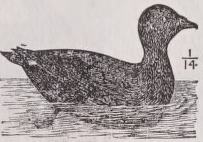
SCOTER, a word of doubtful origin, perhaps a variant of “Scout,” one of the many local names shared in common by the Guillemot (vol. xi. p. 262) and the Razorbill (vol. XX. p. 302), or perhaps primarily connected with Coot (vol. vi. p. 341), the English name of the Anas nigra of Linnaeus, which with some allied species has been justifiably placed in a distinct genus, Oedemia (often misspelt Oidemia) —a name coined in reference to the swollen appearance of the base of the bill. The Scoter is also very generally known around the British coasts as the “Black Duck” from the male being, with the exception of a stripe of orange that runs down the ridge of the bill, wholly of that colour. In the representative American form, Oe. americana, the protuberance at the base of the bill, black in the European bird, is orange as well. Of all Ducks the Scoter has the most marine habits, keeping the sea in all weathers, and rarely resorting to land except for the purpose of breeding. Even in summer small flocks of Scoters may generally be seen in the tideway at the mouth of any of the larger British rivers or in mid-channel, while in autumn and winter these flocks are so increased as to number thousands of individuals, and the water often looks black with them. A second species, the Velvet-Duck, Oe. fusca, of much larger size, distinguished by a white spot under each eye and a white bar on each wing, is far less abundant than the former, but examples of it are occasionally to be seen in company with the commoner one, and it too has its American counterpart, Oe. vel·vetina ; while a third, only known as a straggler to Europe, the Surf-Duck, Oe. perspicillata, with a white patch on the crown and another on the nape, and a curiously particoloured bill, is a not uncommon bird in ...North-American waters. All the species of Oedemia, like most other Sea-Ducks, have their true home in arctic or subarctic countries, but the Scoter itself is said to breed occasionally in Scotland (Zoologist, s.s. p. 1867). The females display little of the deep sable hue that characterizes their partners, but are attired in soot-colour, varied, especially beneath, with brownish white. The flesh of all these birds has an exceedingly strong taste, and, after much controversy, was allowed by the authorities to rank as fish in the ecclesiastical dietary (cf. Graindorge, Traité de Vorigine des Macreuses, Caen, 1680; and Correspondence of John Ray, Ray Soc. ed., p. 148).
SCOTLAND PART I.—HISTORY....
1. Roman Period.— The first certain lines of the history of Scotland were written by the Romans. Their account of its partial conquest and occupation for more than three hundred years gives the earliest facts to which fixed dates can be assigned. The invasion commenced by Julius Caesar reached in Agricola’s last campaign limits never afterwards exceeded. It was in the last year of Vespasian’s life that Julius Agricola, the ablest general bred in his camp, came to command the army in Britain. Landing in midsummer 78, he at once commenced a campaign against Wales. In his second campaign he passed the Solway and, defeating the tribes of Galloway, introduced rudiments of Roman civilization in the district where Ninian taught the rudiments of Christianity three centuries later. This was the first conquest within modern Scotland. Two main roads, of which traces can still be seen, mark his advance: the western, from Carlisle through Dumfries and Lanark, extends across the Clyde to Camelon on the Carron; and the eastern, from Bremenium (High Rie-chester) in Northumberland, passes through Roxburgh and Lothian to the Forth at Cramond. Next year Agricola subdued unknown tribes, reached the estuary of the Tay, and occupied camps at various points of central Scotland, in the future shires of Stirling and Perth. Traces of them are still visible at Bochastle near Callander, Dalginross near Comrie, Fendoch on the Almond, Inver-almond at the junction of the Almond with the Tay near Perth, Ardargie on the north of the Ochils, and the great camp at Ardoch south of Crieff. The fourth year of his command was devoted to the construction of a line of forts between the Forth and the Clyde. This barrier, strengthened by a wall in the reign of Antoninus Pius, guarded the conquests already made against the Caledonians—the general Latin name of the northern tribes of the forests and mountains, the Highlanders of later times—and, in connexion with camps already occupied in the lowlands of Perthshire, formed the base for further operations. In the fifth year Agricola crossed the Clyde, and, without making any permanent conquest on the western mainland, viewed from Cantyre the coast of Ireland. Statements by one of its chiefs as to the character and factions of that country, whose ports were already known to Roman merchants, led to the opinion communicated to Tacitus by Agricola, that with a single legion and a few auxiliaries he could reduce it to subjection. The number of legions in the Roman army of Britain was fixed at five, besides auxiliaries and cavalry,—a total of perhaps 50,000 men. The resistance of northern Britain explains why the easier conquest was not undertaken. A year was required to explore the estuaries of the Forth and the Tay with the fleet. The absence of camps indicates that no attempt was made to conquer the peninsula of Fife, perhaps a separate kingdom; and Agricola prepared to advance against the Caledonians. Two years’ fighting, although Tacitus chronicles only an assault on the advanced camp of the IXth legion (at Lintrose (?) near Coupar Angus), passed before the final engagement known in history as the battle of the Grampians (84). It was probably fought in the hilly country of the Stormont near Blairgowrie, the Celts descending from strongholds in the lowest spurs of the Grampians and attacking the Romans, whose camp lay near the junction of the Isla and the Tay. It decided that the Roman conquest was to stop at the Tay. Galgacus, the Caledonian leader, was, according to the Roman historian, defeated; but in the following winter Agricola retreated to the camps between the Forth and the Clyde, while the fleet was sent round Britain. Starting probably from the Forth and rounding the northern capes, it returned after establishing the fact, already suspected, and of so much consequence in future history, that Britain was an island,— planting during its progress the Roman standard on the Orkneys, which had for several centuries been known by report, and sighting Shetland, the Thule of earlier navigators. Agricola, with one legion—probably the IXth, which had suffered most—was now recalled by Domitian.
The absence of any notice of Britain for twenty years implies the cessation of further advances,—a change of policy due to the reverses in the Dacian War and the financial condition of the empire.
The indefatigable Hadrian came to Britain (120) with the VIth legion, named Victrix, which replaced the IXth. He began, and his favourite general Aulus Plautorius Nepos completed, between the mouth of the Tyne near Newcastle and the Solway near Carlisle, the great wall of stone (see Hadrian, Wall of), about 80 miles in length, 16 feet high, and 8 feet thick, protected on the north by a trench 34 feet wide and 9 deep, with two parallel earthen ramparts and a trench on the south,— proving the line required defence on both sides. Massive fragments of the wall, its stations, castles, and protecting camps, with the foundation of a bridge over the North Tyne, may be still seen. It was garrisoned by the VIth legion, and by the XIth and XXth, which remained throughout the whole Roman occupation. The conquests of Agricola in what is modern Scotland were for a time abandoned. Hadrian’s wall was the symbol of the strength of Rome, and also of the valour of the northern Britons. There must have been a stubborn resistance to induce the conquerors of the world to set a limit to their province, though the roads through the wall showed they did not intend this limit to be permanent. The first step had been taken. The country between the Tyne and Solway and the Forth and Clyde, including the southern Lowlands of Scotland, was now within the scope of Roman history, if not yet of Roman civilization. The country north of the last two rivers remained barbarous and unknown under its Celtic chiefs. Hadrian had thus resumed the task of Agricola, in one of the rapid campaigns by which he consolidated the empire through visits to its most distant parts; but it is doubtful whether he passed beyond the wall, which continued to separate the Romans from the barbarians. In the reign of his successor, Antoninus Pius, Lollius Urbicus recovered the country from the wall of Hadrian to the forts of Agricola, and built an earthen rampart about half the length of the southern wall, 20 feet high and 24 thick, protected on the north by a trench 40 feet wide and 20 deep. It was known later as Grim’s or Graham’s dyke. Remains may yet be seen between Carriden near Borrowstounness on the Forth and West Kilpatrick on the Clyde, with forts either then or subsequently erected at intermediate stations, connected by a military road on the south of the wall.
About this period Ptolemy composed the first geography of the world, illustrated by maps—probably constructed somewhat later —of Ireland and Britain, still called Albion. South of modern Scotland the plan and description of the distances are generally accurate, but north of the Solway (Itunae Aestuarium) and the Wear (? Vedra) the island is figured as lying west and east instead of north and south. Learned ingenuity corrects this error and, by other modifications and the use of a few points deemed certain, applies the names of Ptolemy to places on the map of modern Scotland. But the certain points are almost confined to the Clyde (Glotta Aestuarium), the Forth (BoderiaAestuarium), the Tay (Tava Aestuarium), and perhaps the Wear (Vedra) and the Nith (Novius), the Caledonian Wood (Caledonia Silva), and the Orkneys (Orcades). Even if the other identifications were clear, it would not add much to our knowledge of ancient Scotland. The names of Ptolemy are names on his map and in books only. No tribe (except the Caledonii), no town, no river (except the Forth and Clyde and Tay), no island (except the Orkneys), was, so far as we know, called before or since by the names which there appear. No inscription or coin confirms them. No mountains in this land of mountains are to be found on the plan of the geographer. Etymological conjecture, after allowance for mispronunciation and errors of transcribers, fails to reconcile the names of Ptolemy with the oldest names of Celtic origin still retained by the rivers and hills. Yet the attempt represents the highest knowledge embodied in writing to which the Romans attained of this distant and disputed part of the empire, for the Itineraries, except the forged one attributed to Richard of Cirencester, stop at Hadrian’s wall. His treatise remained until the revival of learning the only written geographical description of the country from which the learned could picture northern Britain. With all its imperfections and mistakes, it conveyed in rough outline the figure of a country to the west of the European continent, to the north of the Roman province of Britain, to the east of Ireland, surrounded by the German Ocean, the Northern Ocean, and the Irish Channel, with bold promontories and many rivers (several tidal), peopled by various tribes, its towns chiefly on the rivers or the coast, and in its centre the vast forest to which the Caledonians gave or from which they received their name, itself the northern part of the largest British island, with groups of smaller isles lying off its northern and western shores. This region was unknown to Caesar and imperfectly known to Tacitus,—the only writer of the first century to whom we can resort. Yet the description of the Britons by the greatest historical genius of Rome, based on the account of one of its greatest generals, attempts a discrimination between the Celtic tribes first and those afterwards conquered, which may perhaps be applied to the inhabitants of the north as contrasted with those of the south of Britain.
“Whether the inhabitants of Britain were indigenous or foreigners, being barbarian, they did not take the trouble to inquire. The different character of their bodily appearance in different parts of the island gave rise to arguments. The red hair and big limbs of the natives of Caledonia point to a German origin. The coloured faces of the Silures, their hair generally plaited, and Spain being opposite give credit to the opinion that the ancient Iberi had migrated and occupied these settlements. Those nearest the Gauls were like them, whether on account of the enduring force of descent or the position of the sky determining in lands adjoining the character of the races. On a general view it is credible that the Gauls occupied the neighbouring island. You may detect the same sacred rites and superstitions. There is not much difference in their language. There is the same daring in demanding, the same fear in declining danger. The Britons exhibit greater fierceness, as a long peace has not yet softened them. For we have heard that the Gauls also were distinguished in war, until sloth came with ease and valour was lost with freedom. This too has been the case with the Britons formerly conquered. The rest remain what the Gauls were. Their strength is in their foot; some tribes, however, fight also from chariots. The noble drives; his followers are in front. Formerly they obeyed kings. Now they are distracted by parties and factions amongst their chiefs, and the want of common counsel is most useful to us. An agreement between two or three states to resist a common danger is rare; so while they fight singly the whole are defeated.”
In the account of the battle of the Grampian Mount and the speech of Galgacus there is little that is local or individual. What the Celtic chief said in an unknown tongue can scarcely have been literally interpreted to the Romans. The historian trained in oratory embodies in Latin eloquence the universal sentiments of freedom. It may be thought, however, that the soil and air of Scotland favour independence of action and thought, and that the words, whether of Tacitus or of Galgacus, contain an unconscious prophecy of passages in its future annals and traits in the character of its people not yet obliterated. In the first century of the Christian era Scotland was the scene of events which belong to universal history.
The necessity of the walls of Hadrian and Antonine to protect the Roman province soon appeared. It is doubtful how long or during what intervals the country between them remained subject. Few coins of emperors later than Antonine have been found to the north of Hadrian’s wall.
In the reign of Aurelius, the philosophic emperor, war was not encouraged; but Calphurnius Agricola had to be sent (161) as legate and propraetor to Britain to prevent incursions of the northern tribes. In that of Commodus a more formidable invasion passed the wall, but Ulpius Marcellus drove back the Britons and repaired it, gaining for Commodus the title of Britannicus. While Septimius Severus was removing rivals from his path, his legate, Virius Lupus, purchased peace (201) from the Meatae, a tribe of central Scotland now first named, who along with the Caledonii supersede the older designations of Tacitus and Ptolemy for the population in the vicinity and to the north of Antonine’s wall, until in the latter half of the 4th century the Picts and Scots appear. Seven years later (208) Severus, with his sons Caracalla and Geta, came, like Edward I. in his last campaign, worn out in body but not in spirit, to Britain. After repairing the breaches in Hadrian’s wall he not only reconquered the country between it and the wall of Antonine, which he restored, but, passing beyond the steps of Agricola, carried the Roman eagles to the most northern points they reached. The traces of Roman roads from Falkirk to Stirling, through Strathearn to Perth, thence through Forfar, Mearns, and Aberdeen to the Moray Firth, and of Roman camps at Wardykes (Keithock), Raedykes (Stonehaven), Norman Dykes (on the Dee), and Raedykes on the Ythan belong to this period and represent an attempt to subdue or overawe the whole island. The historian Dion does not conceal the failure of the enterprise, which he ascribes to the illness that terminated in the death of Severus at York (211). He adds a little to our knowledge of the Caledonians by describing the painting of their bodies with forms of animals, their scanty clothing and iron ornaments, their arms—a sword, small shield, and spear, without helmets or breastplates—their chariots, and their mode of warfare by rapid attack and as rapid retreat to the forest and the marsh. Being without towns, they lived on the produce of herds and the chase, not on fish, though they had plenty. Their mode of government he calls democratic, doubtless from the absence of any conspicuous king rather than of chiefs.
From the death of Severus to the accession of Constantius Chlorus, a period of nearly a century, the history of northern Britain is unknown. In the first (305) of the two years of his reign Constantius defeated the tribes between the walls called by Eumenius the Panegyrist “the Caledonians and other Picts,”—a name now first heard, and by this association identified with the Caledonians. Next year Constantius died at York; and for more than fifty years a veil is again drawn over northern Britain. It was during this period that Constantine was converted to Christianity, which his father Constantius had favoured during the persecutions of Diocletian. So rapid was the progress of the church in the British province that only ten years after the martyrdom of St Alban Celtic bishops of York, London, and Caerleon— probably the place of that name on the Usk—were present at the council of Arles. In 360 the Scots are for the first time named, by Ammianus Marcellinus, who records their descent along with the Picts upon the Roman province in terms which imply that they had before passed the southern wall. Four years later the Picts, Saxons, Scots, and Attacotts are said by the same writer to have caused the Britons perpetual anxiety; but Theodosius, father of the emperor of the same name, repulsed them and recovered the country between the walls, which became (368) a fifth province of Britain, called in honour of the reigning emperor Valentia. It remained so for a very brief space: the revolt of Maximus (391), which reduced the Roman troops to two legions, led to fresh raids of the Picts and Scots. A legion sent by Stilicho drove them back to the northern wall. But it was soon recalled, and the garrisons were permanently removed prior to 409.
The Roman empire in Britain left widely different results in the southern and in the northern portions of the island. The former became an organized, and in the centres of population a civilized province, in which Latin was spoken by the educated, the arts cultivated, Roman law administered, and Christianity introduced. The latter, with the partial exception of the district south of Antonine’s wall, remained in the possession of barbarous heathen races, whose customs had altered little since Roman writers described them as similar to, though ruder than, those of the Celts in Gaul before its conquest. The condition of the population between the walls was probably intermediate between that of the. southern provincial Britons and that of the northern savages of the same original Celtic stock, more nearly resembling the latter, perhaps not unlike the condition of the people of Wales, which the Romans in like manner overran, but could not hold, or of Afghanistan as compared with British India. No Roman towns existed, and only one or two villas have been found north of York, and quite near to that place. The camp, the altar, the sepulchral monument, possibly a single temple (the mysterious Arthur’s Oven or Julius’s Hof on the Carron, now destroyed, but described by Boece and Buchanan and figured by Camden), the stations along the wall, the roads with their milestones, a number of coins (chiefly prior to the 2d century), and a few traces of baths are the only vestiges of Roman occupation in this part of Britain. So completely had Britain passed beyond the serious attention of the emperor of the East that in the beginning of the 6th century Belisarius, Justinian’s general, sarcastically offered it to the Goths in exchange for Sicily; while Procopius, the Byzantine historian, has nothing to tell of it except that a wall was built across it by the ancients, the direction of which he supposes to have been from north to south, separating the fruitful and populous east from the barren serpent-haunted western district, and the strange fable that its natives were excused from tribute to the kings of the Franks in return for the service of ferrying the souls of the dead from the mainland to the shores of Britain.
2. Early Celtic Period to Union of Picts and Scots by Kenneth Macalpine.— It is to the Celts, the first known inhabitants of Britain, that our inquiry next turns. This people were not indigenous, but came by sea to Britain. A conjecture, not yet proved, identifies as inhabitants of Britain before the Celts a branch of the race now represented in Europe only by the Basques. Amongst many names of British tribes in Latin writers three occur, two with increasing frequency, as the empire drew near its close — Britons, Picts, and Scots — denoting distinct branches of the Celts. Britain was the Latin name for the larger island and Britons for its inhabitants; Albion, a more ancient title, has left traces in English poetry, and in the old name Alba or Albany for northern Scotland. The Britons in Roman times occupied, if not the whole island, at least as far north as the Forth and Clyde. Their language, British, called later Cymric, survives in modern Welsh and the Breton of Brittany. Cornish, which became extinct in the 17th century, was a dialect of the same speech. Its extent northwards is marked by the Cumbraes—the Islands of Cymry in the Clyde—and Cumberland, a district originally stretching from the Clyde to the Mersey.
The Picts, a Latin name for the northern tribes who preserved longest the custom of painting their bodies, called themselves Cruithne. Their original settlements appear to have been in the Orkneys, the north of Scotland, and the north-east of Ireland—the modern counties of Antrim and Down. They spread in Scotland, before or shortly after the Romans left, as far south as the Pentland Hills, which, like the Pentland Firth, are thought to preserve their name, occupied Fife, and perhaps left a detachment in Galloway. Often crossing, probably some times using, the deserted wall of Hadrian, they caused it to acquire their name,—a name of awe to the provincial Britons and their English conquerors. Their language, though Celtic, is still a problem difficult to solve, as so few words have been preserved. Its almost complete absorption in that of the Gaels or Scots suggests that it did not differ...