
[Gr. white; Latin albus
Word of the Day: Catachrestical
1. A very high mountain. Specifically, in the plural, the highest chain of mountains in Europe, containing the lofty mountains of Switzerland, etc.
2. Fig.: Something lofty, or massive, or very hard to be surmounted.
3. A bullfinch.
Alp arslan
Encyclopedia Britannica
ALP ARSLAN or AXAN, Mohammed Ben Daoud, the second sultan of the dynasty of Seljuk, in Persia, and great-grandson of Seljuk, the founder of the dynasty. He was born in the year 1029 a.d., 421 of the Hegira. He assumed the name of Mohammed when he embraced the Mussulman faith; and on account of his military prowess he obtained the surname Alp Arslan, which signifies “a valiant lion.” He succeeded his father Daoud as ruler of Khorassan in 1059, and his uncle Togrul Bey as sultan of Oran in 1063, and thus became sole monarch of Persia, from the river Oxus to the Tigris. In consolidating his empire and subduing contending factions he was ably assisted by Nizam-al-Mulk, his vizier, one of the most eminent statesmen in early Mahometan history. Peace and security being established in his dominions, he convoked an assembly of the states, and declared his son Malik Shah his heir and successor. With the hope of acquiring immense booty in the rich temple of St Basil in Coesarea, the capital of Cappadocia, he placed himself at the head of the Turkish cavalry, crossed the Euphrates, and entered and plundered that city. He then marched into Armenia and Georgia, which, in the year 1064, he finally subdued. To punish the Georgians for the brave defence which they had made, and as a badge of their humiliating condition, the conqueror obliged them to wear at their ears horse-shoes of iron. In the year 1068 Alp Arslan invaded the Roman empire, the seat of which was then at Constantinople. The Emperor Romanus Diogenes, assuming the command in person, met the invaders in Cilicia. In three several campaigns his arms were victorious, and the Turks were forced to retreat beyond the Euphrates. In the fourth he advanced with an army of 100,000 men into the Armenian territory, for the relief ...of that country. Here he was met by Alp Arslan; and the sultan having proposed terms of peace, which were insultingly rejected by the emperor, a bloody and decisive engagement took place near Malazkurd, in which the Greeks, after a terrible slaughter, were totally routed. Romanus was taken prisoner and conducted into the présence of Alp Arslan, who treated him with a noble generosity. A ransom of a million and an annual tribute of 3000 pieces of gold, an intermarriage between the families, and the deliverance of all the captive Mussulmans in the power of the Greeks, having been agreed to as the terms of peace and the liberty of the emperor, Romanus was dismissed, loaded with presents and respectfully attended by a military guard. He was unable, however, to fulfil the terms of the treaty, and the war was accordingly renewed. At this time the dominion of Alp Arslan extended over the fairest part of Asia: 1200 princes or sons of princes surrounded his throne, and 200,000 soldiers were ready to execute his commands. He now declared his purpose of attempting the conquest of Turkestan, the original seat of his ancestors. After great preparations for the expedition, he marched with a powerful army, and arrived at the banks of the Oxus. Before he could pass the river with safety, it was necessary to gain possession of some fortresses in its vicinity, one of which was for several days vigorously defended by the governor, Yussuf Kothual, a Kharizmian. He was, however, obliged to surrender, and was carried a prisoner before the sultan. Being condemned to suffer a cruel death, Yussuf became incensed, rushed upon the sultan, and stabbed him in the breast. The wound proved mortal, and Alp Arslan expired a few hours after he received it, on the 15th Dec. 1072.
9th ed. Encyclopædia Britannica, vol. 1, p. 598
[619 words — estimated reading time: 4 minutes]
[619 words — estimated reading time: 4 minutes]
1. An animal of Peru (Lama paco), having long, fine, wooly hair, supposed by some to be a domesticated variety of the llama.
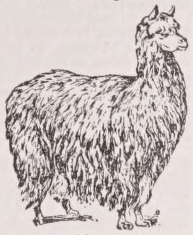
2. Wool of the alpaca.
3. A thin kind of cloth made of the wooly hair of the alpaca, often mixed with silk or with cotton.
Alpaca
Encyclopedia Britannica
ALPACA is a name applied generally to several allied South American wool-bearing animals, but more properly restricted to one of the species. It is further used to distinguish the wool obtained from these animals, and the woven textures manufactured from the wool are also known as alpacas. The alpacas or llamas are natives of the lofty table-lands and mountain-range of the Andes in Peru and Chili, and in that region of the globe they long occupied the position held in the Old World by their congeners of larger size, the camels. To the ancient Peruvians the llamas were the only available beasts of burden and wool-bearing creatures, just as to the present day the camel is to the tribes of the Asiatic deserts. The camel (Camelus) and the llama (Auchenia) form the two existing genera of the family Camelidae; and thus in a zoological sense also the one represents the other in different regions of the earth. A great deal of doubt and confusion has existed as to the number of species into which the llamas can be divided—a very common occurrence in dealing with domesticated or semi-domesticated creatures. Most authorities now, however, agree in regarding them as separable into four species, following the classification of Von Tschudi, who has given much careful consideration to the subject. The species, according to that naturalist, are the llama (Auchenia lama), the huanaco or guanaco (A. huanaco), the alpaca or paco (A. paco), and the vicugna (A. υicunna.) The two first-named species are, or rather were, more valued as beasts of burden, and for their flesh, than as sources of wool, being able to bear from 120 to 150 lb burden over long distances daily. The guanaco attains a size not much less than our red deer; and is the largest and most widely spread of all the species, ...being found from the equator southward to Patagonia. The llama is next in size, but its habitat is limited to the loftier mountains of North Peru. Although both species yield a serviceable quality of wool, which is used by the Peruvians and found in commerce, it is chiefly to the alpaca we owe the supply of wool imported into this country under that name. The alpaca is considerably smaller than either the llama or the guanaco, but in general outline all the species resemble each other. In its native condition the alpaca ranges between 10° and 20° S. lat., from the centre of Peru into Bolivia, not coming lower down in vertical distribution than between 8000 and 9000 feet above the sea-level. At and above these heights it lives in herds in a semidomesticated condition, being only driven into the villages to be shorn. The wool, which varies in length from 2 to 6 inches, is of a very lustrous and fine quality, and is mostly white, black, or gray, shades of brown or fawn being rarer. The vicugna is a much rarer animal than the alpaca, being found sparsely scattered from Ecuador, throughout Peru, into Bolivia, but seldom descending under 13,000 feet above the sea-level. It is about the same size as the alpaca, and yields an exceedingly delicate wool, varying in colour from a reddish yellow to a dull white. It is usually worth about twice as much as alpaca, and is greatly valued for fine felts.
There is evidence of these animals having been held domesticated and used for their wool in their native regions from remote antiquity. Remains of clothing made from alpaca wools have been found in the graves of the Incas; and when, in the early part of the 16th century, Europeans first visited Peru, these animals formed the chief wealth of the natives, being the carriers of their commerce as well as the main source of their food and clothing. Small quantities of the wool were occasionally met with in English commerce; but it was not till 1836 that it became established as a regular trading commodity with Europe. In that year Mr (now Sir) Titus Salt, a wool-broker and manufacturer in Bradford, purchased a quantity he met with in a Liverpool warehouse at 8d. per lb, and set himself to discover its capabilities. The amount and manner of his success will be described in the articles Wool and Worsted Manufactures; it need only be remarked here that his experiments have resulted in making alpaca a staple second in importance to wool, and so creating an industry of great and rapidly increasing dimensions. The success of his experiments led to the erection of his great manufacturing establishment of Saltaire, in which upwards of 3000 hands are employed in the alpaca manufacture. The quantity of alpaca imported into England from 1836—the year of Sir Titus Salt’s first experimental purchase—to 1840, averaged 560,800 lb yearly, which sold at about 10d. per lb. In 1852 the imports had risen to 2,186,480 lb. and the price advanced to 2s. 6d. per lb. In 1864 the imports amounted to 2,664,027 lb, and in 1872 they were 3,878,739 lb; the value of average qualities being from 2s. 6d. to 2s. 10d. per lb. The introduction of the various species of llama into Europe has been frequently urged, Geoffrey St Hilaire and other French naturalists having specially pointed out the desirability of their introduction into France, and at one time a herd existed in the Pyrenees; but in Europe the creatures must be still regarded as curiosities of zoological collections. In 1859 systematic and costly attempts were made to acclimatise the alpaca in our Australian colonies by Mr Ledger, a gentleman who had devoted many years to observation of the conditions of life of the animal. At first the experiment presented most encouraging prospects; the herds continued healthy and increased in numbers; but gradually the subtle influences of the loss of their native mountain climate became apparent,—the creatures drooped, their numbers dwindled, and for the present the undertaking must be regarded as a complete failure.
9th ed. Encyclopædia Britannica, vol. 1, p. 597
[1,013 words — estimated reading time: 6 minutes]
[1,013 words — estimated reading time: 6 minutes]
Of or pertaining to the Alps.
A long staff, pointed with iron, used in climbing the Alps.
Alpes
Encyclopedia Britannica
ALPES, the name of three departments in the southeast of France,— Basses Alpes, Hautes Alpes, and Alpes Maritimes. Basses Alpes is bounded on the N. by the department of Hautes Alpes; on the E. by the kingdom of Italy and the department of Alpes Maritimes; on the S. by the departments of Var and Bouches du Rhone; and on the ,W. by those of Vaucluse and Drôme. It extends at the widest points 90 miles from N.E. to S.W., and 70 from E. to W., and contains an area of 2680 square miles. Its surface is mountainous, especially on the north-east, where offshoots of the Maritime Alps penetrate into the country, rising near the river Ubaye to an elevation of over 9000 feet above the level of the sea. With the exception of the south-eastern corner, which is drained by the Var, the whole department is in the basin of the Durance, which for a considerable distance separates Basses from Hautes Alpes, but eventually strikes southward through the former. Its chief tributaries are the Buech and the Jabron on the right, and the Ubaye, the Bléone, the Asse, and the Verdon on the left. The climate in the mountainous districts of the north is cold and variable. The soil there is poor, but it is cultivated with great industry — producing rye, oats, barley, potatoes, and timber. In the south and south-west, however, where the country is comparatively flat, the temperature is milder and the soil more fertile; here plums, almonds, apricots, peaches, and other fruits are produced in large quantities, as well as wine of an excellent description, chiefly for home consumption. Considerable numbers of cattle, sheep, goats, and pigs are reared in the Basses Alpes, besides which many flocks of sheep, from Var and Bouches du Rhone, are pastured during summer in the upper valleys of the ...department. Game is abundant. There are mines of lead and other metals of some value. The manufactures are few and of little importance, the chief being leather, coarse woollen cloths, cutlery, earthenware, and paper. Basses Alpes, one of the departments formed out of ancient Provence, is divided into five arrondissements—Digne, in the centre; Barcelonnette and Castellane, on the east; Sisteron and Forcalquier on the west; which together contain 30 cantons and 251 communes. Digne is the capital and the seat of a bishop, whose diocese is co-extensive with the department; and among the other towns are Barcelonnette, Castellane, Sisteron, Forcalquier, and Manosque. Population (1871), 139,332.
Hautes Alpes is bounded on the N. by the departments of Isère and Savoir; on the E. by the kingdom of Italy; on the S. by the department of Alpes Basses; and on the W. by that of Drôme. It extends nearly 80 miles from N.E. to S.W., and contains an area of 2158 square miles. Its surface is very mountainous, being traversed in all directions by the Cottian and Dauphiné Alps, which, in Mont Pelvoux and other peaks, rise to an elevation of about 13,000 feet above the sea, the highest summits in France. The Drac, flowing northwards into the Isère, and the Durance, with its tributaries the Guil and the Buech, are the chief rivers of Hautes Alpes. The climate is cold in winter, and in summer variable; the soil is barren, yielding only oats, barley, potatoes, rye, and timber, except in a few favoured valleys, where wine of a fair quality and fruits of various kinds are produced. Large numbers of sheep and other domestic animals are reared or pastured in the department. Game, both large and small, is found in great abundance. The mines produce lead, copper, iron, and other metals. There are no manufactures of any commercial importance, although some leather, coarse woollen cloth, hats, woodwork, and iron wares are made. Hautes Alpes, a part of the old province of Dauphiné, is divided into three arrondissements: Gap on the west, Embrun on the south-east, and Briançon on the north-east, with 24 cantons and 89 communes. The capital is Gap, the seat of the bishop; Embrun and Briançon being the only other towns of any size. Population, 118,898.
Alpes Maritimes, bounded on the N. by Basses Alpes and the kingdom of Italy, which also forms its boundary on the E.; on the S. by the Mediterranean Sea; and on the W. by Var and Basses Alpes. It extends at the widest points 55 miles from N. to S., and 50 from E. to W.; and contains an area of 1517 square miles. The surface of this department, like that of the two former, is more or less mountainous, branches of the Maritimes Alpes covering the greater part of the territory. It is watered by the Roya, the Paillon, the Var (with its tributaries the Tinéa and the Esteron), the Loup, and the Siagne. The climate is on the whole warm and gentle, except among the higher mountains; while the mildness of the temperature along the shores of the Mediterranean has made that portion of the department a favourite resort for invalids. The upper valleys and mountain slopes are chiefly devoted to pasture for sheep, being ill-suited for cultivation, although a little barley and maize is grown; the richer districts of the south produce fruits of various kinds, tobacco, honey, and flowers, used in the making of perfumes. The other manufactures are of dried fruits, olive-oil, preserved anchovies and sardines, silk, soap, and paper. Alpes Maritimes is divided into three arrondissements—Grasse and Nice on the south, and Puget Théniers on the north, containing 25 cantons and 146 communes. The arrondissements of Nice and Puget Théniers constitute the bishopric of Nice; Grasse belongs to that of Fréjus. Nice is the capital; and among the other towns are Mentone, Villafranche, Grasse, Antibes, Cannes, and Puget Théniers. The Marseilles, Nice, and Ventimille railway, skirting the coast, connects Cannes, Antibes, Nice, and Mentone, and joins an Italian line which affords direct railway communication with Genoa. The department of Alpes Maritimes was formed in 1860 from the territory of Nice, which had been ceded to France, together with Mentone and Roccabruna, purchased from the Prince of Monaco, and the arrondissement of Grasse, transferred from Var. It had a population of 119,037 in 1871.
9th ed. Encyclopædia Britannica, vol. 1, p. 599
[1,064 words — estimated reading time: 7 minutes]
[1,064 words — estimated reading time: 7 minutes]
Pertaining to the Alps, or other high mountains; as, Alpestrine diseases, etc.
1. The first letter in the Greek alphabet, answering to A, and used to denote first or beginning.
2. I am alpha and Omega. Revelation 1:8 .
3. As a numeral, it stands for one. It was formerly used also to denote chief; as, Plato was the alpha of the wits.
The first letter in the Greek alphabet, answering to A, and hence used to denote the beginning.
Alpha
Encyclopedia Britannica
ALPHA and OMEGA (A and Ω), the first and last letters of the Greek alphabet, frequently employed to symbolise the idea of completeness or infinity. They are used as a designation of himself by the speaker in Rev. i. 8; xxi. 6; xxii. 13. In the last passage the speaker is undoubtedly Jesus Christ. In the symbolism of the early church A and Ω, combined with a cross or with the monogram of Χ ριστός , represented Christianity, or, more specifically, faith in the divinity of Christ.
9th ed. Encyclopædia Britannica, vol. 1, p. 599
[82 words — estimated reading time: 1 minute]
[82 words — estimated reading time: 1 minute]
Alpha
Watson's Biblical & Theological Dictionary
the first letter of the Greek alphabet; Omega being the last letter. Hence Alpha and Omega is a title which Christ appropriates to himself, Rev. i, 8; xxi, 6; xxii, 13; as signifying the beginning and the end, the first and the last, and thus properly denoting his perfection and eternity.
Watson's Biblical & Theological Dictionary
[51 words — estimated reading time: 1 minute]
[51 words — estimated reading time: 1 minute]
The letters of a language arranged in the customary order; the series of letters which form the elements of speech.
To arrange in the order of an alphabet; to form an alphabet in a book, or designate the leaves by the letters of the alphabet
1. The letters of a language arranged in the customary order; the series of letters or signs which form the elements of written language.
2. The simplest rudiments; elements.
To designate by the letters of the alphabet; to arrange alphabetically.
Alphabet
Encyclopedia Britannica
ALPHABET [table] [table]...
BY an alphabet we mean a list of symbols which represent conventionally to the eye the sounds which are heard in the speech of a nation. An alphabet will therefore be perfect if the number of its symbols exactly corresponds to the number of simple sounds which are commonly distinguishable in the spoken language. But this perfection has probably never yet been reached: all known alphabets have failed, either by defect, i.e., from not representing all the simple sounds; or by redundancy, in having more than one symbol for the same sound. They must also necessarily become imperfect by lapse of time. No nation keeps the sound of its language unaltered through many centuries: sounds change as well as grammatical forms, though they may endure longer, so that the symbols no longer retain their proper values; often, too, several different sounds come to be denoted by the same symbol; and in strictness the alphabet should be changed to correspond to all these changes. But little inconvenience is practically caused by the tacit acceptance of the old symbol to express the new sound; indeed the change in language is so gradual that the variation in the values of the symbols is imperceptible. It is only when we attempt to produce the exact sounds of the English language less than three centuries ago that we realise the fact that if Shakespeare could now stand on our stage he would seem to us to speak in an unknown tongue; though one of his plays, when written, is as perfectly intelligible now as then. Such changes of sound are most developed in countries where many different dialects, through conquest, immigration, or otherwise, exist side by side: they are checked by the increase of education and by facility of locomotion—both of which causes tend to assimilate all dialects to that one which by some lucky chance has become the literary speech of the nation.
The term alphabet has come to us from the Latin alphabetum, which, however, occurs in no prose writer before Tertullian. It could not have been used, for metrical reasons, by Juvenal, when he wrote, “Hoc discunt omnes ante alpha et beta puellae ”—their a b c. But there is no reason why it should not have existed earlier: the word was borrowed from the Greek, as seems clear from the compound αναλφάβητος, which is as old as the comedian Philyllius (Meineke, Com. Frag. ii. 857), and he was alive in 392 b.c. It does not seem likely that this compound adjective would have been coined if the noun itself had not already existed in the same sense which it now bears.
The symbols of our alphabet are nearly those of the Latin; these in their turn were borrowed from a Greek alphabet; and there seems no reasonable ground for doubting the common tradition that the Greeks derived their characters from a Phoenician source. All these borrowings will be fully described hereafter. At this point absolute certainty ends. We cannot prove to demonstration the origin of our alphabet; but positive facts and analogical arguments may be adduced which enable us to attain a very high degree of probability. It is now commonly believed that the characters were originally hieroglyphics, and in that ultimate form were devised in Egypt. There, for convenience of writing, they took a simpler form (called hieratic). In this shape they were borrowed by the Phoenicians; and thus, in their long course down to us, they passed gradually from being the written expression of an idea into the written expression each of a single sound. It is true that the proof is not clear throughout: sometimes the links are feeble, and here we have to employ the analogy of other languages, in which the particular step which we want to prove has undoubtedly been made under similar circumstances. Still, it may with some truth be said that we can only prove the possibility of such a process, while any given alphabet may have had a perfectly independent origin; the Phoenician alphabet may have been developed in Phoenicia itself, and never been hieroglyphic at all. But this is very difficult to conceive. The a priori argument for the derivation of phonetic from hieroglyphic characters is strong. Hieroglyphics have unquestionably been the first attempt of many nations in a rude state to record their thoughts in a permanent and universally intelligible form. It is also certain that these hieroglyphics have undergone progressive degradation of shape, so that their visible connection with the thing signified was often lost; they became in many cases the expression of those combinations of sounds by which the things were denoted in the spoken language, though they still generally retained their original value as well. Here, at all events, a certain connection between hieroglyphics and sounds establishes itself; and a priori it is more probable that all alphabets should have derived the single sounds of which they consist from hieroglyphics, through the medium of their derived phonetic values, than that any alphabet should have been produced independently of hieroglyphics (which are admitted to have existed), by some arbitrary process of formation for which absolutely no testimony can be adduced. As we have said above, such a process is not impossible, and may be true for any particular alphabet; but the opposite theory has the most internal probability and all the evidence of which the case admits. Against this it seems insufficient to urge (as has been done) that there exist upon earth savages who have never developed any alphabetic writing out of their rude attempts—a fact which may be readily granted; or that civilised men often return to the simple' methods employed by uncivilised nations, such as cutting notches on sticks or tying knots in strings—such return being apparently adduced to prove that two totally different methods of expression can co-exist without there being any tendency to pass from one to the other; nay, it is added that in Egypt the hieroglyphic and the common (or demotic) character did certainly exist side by side; and if the latter were borrowed from the former, it would have superseded it, which it did not do. Now, in answer to this, reasons will appear shortly why the hieroglyphic characters lingered so persistently, even when the later phonetic character was in common use—nay, in the very same inscription or document with the hieroglyphic. Still, the argument would have some weight if it were not grounded on the false assumption that the demotic alphabet was a purely phonetic one, totally unconnected with its more aged rival. But modern research has proved incontestably that the demotic characters can be traced back to their original hieroglyphic shape through the medium of the hieratic; in fact, that the cumbrous hieroglyphics were successively put into more and more abbreviated shapes, for convenience of writing, as its use increased.
Excluding, then, attempts of savages such as have been mentioned above, which were neither durable nor intelligible enough to make them of service, except for the smallest number of men during the most limited time— excluding these as not deserving the name, we derive all real writing from hieroglyphics, such hieroglyphics being either purely pictorial, the expression of visible objects in the external world; or symbolic, when some external object is conventionally chosen to represent some action or some abstract idea. These two methods were probably nearly contemporaneous in their origin, because the necessity of writing at all supposes a considerable advance in civilisation, and therefore a considerable development of ideas. To this system as a whole the convenient term ideography is now generally applied. From this men have passed to phonetic writing, first, apparently, in the form of syllabism, in which each syllable of a word is regarded as an independent whole and represented by a single sign; then from this to alphabetism, in which the syllable is no longer denoted by an indivisible symbol, but is resolved into vowel and consonant, each with its own accepted sign.
It seems probable that all known alphabets (with one or two possible exceptions) may be traced back to four or five parents. These have differed much in fruitfulness, but all were originally hieroglyphic. These five systems of writing are the Egyptian, the cuneiform, the Chinese, the Mexican or Aztec, and the curiously cumbrous characters of Yucatan and central America: these last may be seen interspersed with figurative paintings in a facsimile given by Μ. de Rosny at p. 20 of his very useful little summary, Les Ecritures Figuratives des Di ffe rents Peuples Anciens et Modernes. Of these, the first three alone can be said to have had any great extension; and the first, if the Phoenician, and by consequence the European alphabets, were derived from it, far exceeds in importance all the rest together. These systems were perfectly independent, and developed themselves, each in the same course, but in its own manner, and each in the main to a different degree. At certain points in their history all but one became crystallised, and remained to show us the steps by which the progress to phonetism can be made. We do not propose to describe here fully any of these systems of hieroglyphics. We are only concerned to point out their relative degrees of development, their deficiencies, and the consequent motives which must have impelled men by degrees to the production of a genuine alphabet.
There are obvious deficiencies even in the most highly developed hieroglyphics. In the first place, they must have been excessively burdensome to the memory. They speedily lost their original form, which was in most cases too cumbrous to be retained when writing became frequent; their pictorial value was therefore lost, and the new form could not generally have been intelligible to a learner, who was thus obliged to acquire by memory an enormous number of symbols, compared with which even the Sanskrit alphabet may be regarded as easy. Secondly, it is impossible by hieroglyphics to express grammatical relations: the order, indeed, in which the symbols are placed may denote the distinction between subject and object; plurality may be expressed by the repetition of a symbol; some even of the relations in space, denoted in more advanced languages by cases, may be pictorially rendered; but all these helps do not go far to remedy this obvious want. Experience, however, shows how much inconvenience a nation will undergo rather than make any radical change in its phonetic system. We have only to look at our own alphabet, with its numerous and universally confessed deficiencies and redundancies, and then remember the fruitless attempts which have been made to work a reform in it, to be convinced that no people will of its own accord strike out a thoroughly new system of writing. Such revolutions can only be produced by the meeting of two different civilisations, and the reception by the one of the arts and ideas of the other. But such a meeting may, and more commonly does, only stimulate the inferior race to some partial development. For the new ideas new names are required: these may be metaphorically represented out of the old vocabulary, as when the Romans called the unknown elephant the Lucanian ox, and of course wrote it so. But suppose the inferior people to be one which has not yet advanced beyond hieroglyphic writing; their simplest and most obvious plan will be to take the strange name, and express it by those symbols out of their old stock which denote the nearest sounds to that of the name required. Such symbols then cease to represent ideas only, as they used to do; they are consciously employed to represent mere sounds, and thus arise the first beginnings of phonetism. A good example of this process may be found in the Aztec (Lenormant, i. 29; De Rosny, p. 19, who also gives others). When Christianity was introduced into Mexico, the Lord’s Prayer was reduced to writing in the following manner :—The Mexican symbols nearest to the two syllables of pater were a flag (sounded a s pantli), and a rock (tetl) :pater was therefore represented pictorially by a flag and a rock; we cannot tell whether it was sounded as pan-tetl, or only as pa-te— the nearest possible equivalent in the Mexican language, which has no r. Similarly, noster was phonetically represented by noch-tetl, pictorially by the Indian fig (nochtli) and the rock as before. Here, then, we have the application of symbols to denote sound without regard to the original sense; just as we might draw the figures of an eye, a saw, and a horse, and convey by them the idea, “I saw a horse.” The Aztec would not long have the ideas of a flag, a rock, and a fig presented to his mind when he read these symbols; and so the first conception of phonetism was gained, the first move from hieroglyphic to alphabetic writing. Yet he had not attained the first real step in the progress— i.e., syllabic writing—because if he had decomposed his new words, pan would not have represented to his mind merely so much sound—a syllable by itself meaningless: it would have given him only the idea of a flag. And further than this the Aztec language did not pass: probably it only reached this stage incompletely with a small number of words. The great advance to syllabic writing is to be found elsewhere; first in the Chinese, perhaps through the accident of the monosyllabic nature of the language; but with a clearly-developed purpose in the Aramaic cuneiform inscriptions.
In the Chinese written character we find a considerable number of symbols which were unquestionably at first pictorial. Though but very slight vestiges of their original meaning can now be seen in them, yet they can be traced back to older forms which are unmistakeable; and their origin is further attested by the name “images,” which the Chinese give them, as distinguished from others which they call “letters.” These symbols were simple, and denoted very ingeniously natural objects—the sun (by a circle with a dot inside), the moon (by a crescent with a line inside), a mountain (by three peaks side by side), rain (by drops under an overarching line), a child (thus ), a mother ( , a figure expressing the arms and bosom effectively enough), &c. These symbols could be combined: thus the symbols for water and eye combined denoted tears, an ear and a door expressed hearing and understanding; but such combinations of pure hieroglyphics were rare, as they would have been liable to be confused with combinations of the same kind used in a different way, as will be seen immediately. There were also some hieroglyphs used symbolically; e.g., a hand to denote a workman, the two valves of a shell-fish to denote friends. These also are few in number, and not very ingenious. Last in this class come some symbols which are essentially pictorial, though they represent no visible object; e.g., “above” was expressed by a dot above a horizontal line; "below,” by a dot below it; the numerals one, two, three, by so many horizontal lines; “right,” by the symbol "left,” by , &c. So far, we have simple hieroglyphs, or ideograms (a more convenient term),—pictorial representations, expressing not merely visible objects, but also abstract ideas, and even actions; but each of these could also have the phonetic value of the name of the object which it depicted.
Distinct from these are the “letters ”—in use, though not in origin. These have two parts—one, a symbol which was originally an ideogram, and which could still be used as such, but which in this particular combination lost its ideographic value, and retained only the phonetic value of the name of its object; the other, an ideogram, which laid aside its phonetic value, and only restricted to a particular class the phonetic symbol which it accompanied. Thus, for example, the ideogram of a ship had also the phonetic value tcheu—i.e., the name denoting ship in the spoken language; the ideogram of fire had the phonetic value hv ó : these two symbols combined were still pronounced tcheu, and meant the flickering of flame. The second symbol dropped its phonetic value altogether, but kept the generic idea of fire: the ship was lost, but the idea of undulating motion modified that of fire, and the complex symbol combined the two ideas, with the one sound tcheu. Similarly, the ideogram ship and speech combined expressed loquacity, and this in the spoken language was also tcheu, the phonetic value of the symbol for speech being dropped, just like that of the symbol fire above. In this way there are ten different ideas given by Endlicher (p. 10), all called in the spoken language tcheu, and all expressed to the eye by different complex symbols formed on this principle. These symbols, he reckons, form at least 29 / 30 ths of the written language.
This is a very imperfect sketch of the Chinese system of writing, and into the history of the “keys,” which indeed belong rather to Chinese lexicography, we do not propose to enter. But it is enough to throw light on some questions connected with our subject. First of all, we see ideography and phonetism existing side by side; and even the same symbol, having in most cases (not in all) either an ideographic or a phonetic value at will. Therefore, in this case the passage from the one system to the other may be considered as certain; but how it was made there is not sufficient evidence to show. It must have been earlier than the combination of pure ideograms mentioned above. It was probably greatly facilitated by the Chinese being a monosyllabic language; each syllable is a complete word in itself, expressing a complete notion: hence the idea of completeness and individuality would attach to such a combination of sound more easily than would be possible in polysyllabic language; and it would seem more natural to give that sound a symbol for itself, quite apart from its ideographic meaning. Further, as the whole number of single syllables of which the language consists is only 450, the effort of remembering the symbols could not be great, and the memory must have been already trained in that direction, because the symbols (even in their ideographic acceptation) had lost their obviously pictorial character, and must have been kept by the memory, not recognised each time by the eye; just as children, in learning to read, commonly remember short and familiar words as a whole, without analysing them into the component letters.
The explanation of the cumbrous “letters” described above is simple; and it will show us, secondly, how so apparently monstrous a system of writing could be maintained, and has been in its essence maintained, down to the present day. With so few radical sounds in the language, it was inevitable that many different objects must have been expressed, as ideas grew and multiplied, by the same sound, as we saw above that there were eleven different ideas (including the ship itself) all called tcheu. These could be distinguished in the spoken language by tone or accent, and actually were so distinguished. But how were they to be distinguished in writing? Now, writing is but the visible exponent of language, and therefore is naturally formed under the same conditions—those conditions which, because the effect is obvious while the reason is often difficult to detect, we vaguely call the genius of the language: and it must accommodate itself to the defects as well as the strength of the language. There is an inherent evil in Chinese speech—inevitable in a monosyllabic language with a limited number of radicals—that the same combination of sound should serve to express many different ideas. A combination, therefore, of symbols is absolutely necessary, which shall represent to the mind through the eye the fact that the sound which is heard has changed its meaning to meet that of another sound which is not heard—that tcheu no longer means a ship, but means the flickering of flame, or something else quite different. It would have been easy enough to have had different symbols for the different meanings of tcheu; but it would not practically have been so convenient, because it would not have represented so well the facts of the language. If the Chinese had chosen in their speech to do universally what they did occasionally, to form compounds like “ear-dooring” for “hearing” a thing, the native genius for pictorial representation would have produced a symbolism which might have supplied all its wants down to the present day. But that was not the bent of the language; and the writing therefore remains to the present day a mixture of ideography and phonetism, and is perhaps better so. Still, a great deal of confusion is possible. In modern writing, according to Endlicher, each syllable has several symbols, partly because of the extraordinary...
9th ed. Encyclopædia Britannica, vol. 1, p. 600
[18,113 words — estimated reading time: 1.8 hours]
[18,113 words — estimated reading time: 1.8 hours]
A learner while in the adjective B.C.
A learner of the alphabet; an abecedarian.
ALPHABET'IC ,
In the order of an alphabet, or in the order of the letters as customarily arranged.
Alt. of Alphabetical
1. Pertaining to, furnished with, expressed by, or in the order of, the letters of the alphabet; as, alphabetic characters, writing, languages, arrangement.
2. Literal.
Alphabetical index
Encyclopedia Britannica
ALPHABETICAL INDEX.
The numerals refer to the sections. [table]
9th ed. Encyclopædia Britannica, vol. 1, p. 119
[9 words — estimated reading time: 1 minute]
[9 words — estimated reading time: 1 minute]
In an alphabetical manner; in the customary order of the letters.
In an alphabetic manner; in the customary order of the letters.
The science of representing spoken sounds by letters.
The expression of spoken sounds by an alphabet.
1. To arrange alphabetically; as, to alphabetize a list of words.
2. To furnish with an alphabet.
Height Roget’s Thesaurus §206
N. height, altitude, elevation, eminence, pitch, loftiness, sublimity, tallness, stature, procerity, prominence, colossus, giant, grenadier, giraffe, camelopard, mount, mountain, hill alto, butte, monticle, fell, knap, cape, headland, foreland, promontory, ridge, hog's back, dune, rising ground, vantage ground, down, moor, moorland, alp, uplands, highlands, heights &c. (summit), 210, knob, loma, pena, picacho, tump, knoll, hummock, hillock, barrow, mound, mole, steeps, bluff, cliff, craig, tor, peak, pike, clough, escarpment, edge, ledge, brae, dizzy height, tower, pillar, column, obelisk, monument, steeple, spire, minaret, campanile, turret, dome, cupola, skyscraper, pole, pikestaff, maypole, flagstaff, top mast, topgallant mast, ceiling, high water, high tide, flood tide, spring tide, altimetry, batophobia, satellite, spy-in-the-sky
V. be high, tower, soar, command, hover, hover over, fly over, orbit, be in orbit, cap, culminate, overhang, hang over, impend, beetle, bestride, ride, mount, perch, surmount, cover, overtop, stand on tiptoe, become high, grow higher, grow taller, upgrow, rise, send into orbit, render high, heighten
Adj. high, elevated, eminent, exalted, lofty, tall, gigantic, patagonian, towering, beetling, soaring, hanging, elevated, upper, highest, high reaching, insessorial, perching, upland, moorland, hilly, knobby, mountainous, alpine, subalpine, heaven kissing, cloudtopt, cloudcapt, cloudtouching, aerial, overhanging, incumbent, overlying, superincumbent, supernatant, superimposed, prominent &c. c, 250, tall as a maypole, tall as a poplar, tall as a steeple, lanky
Adv. on high, high up, aloft, up, above, aloof, overhead, airwind, upstairs, abovestairs, in the clouds, on tiptoe, on stilts, on the shoulders of, over head and ears, breast high, over, upwards, from top to bottom
Phr. e meglio cader dalle finistre che dal tetto
King James Bible KJV Bible
Berean Standard Bible BSB Bible
9 KJV and 8 BSB verses contain “ALP”
Philip, and Bartholomew; Thomas, and Matthew the publican; James the son of Alphaeus, and Lebbaeus, whose surname was Thaddaeus;
Philip and Bartholomew; Thomas and Matthew the tax collector; James son of Alphaeus, and Thaddaeus;
And Andrew, and Philip, and Bartholomew, and Matthew, and Thomas, and James the son of Alphaeus, and Thaddaeus, and Simon the Canaanite,
Andrew, Philip, Bartholomew, Matthew, Thomas, James son of Alphaeus, Thaddaeus, Simon the Zealot,
Matthew and Thomas, James the son of Alphaeus, and Simon called Zelotes,
Matthew and Thomas; James son of Alphaeus and Simon called the Zealot;
And when they were come in, they went up into an upper room, where abode both Peter, and James, and John, and Andrew, Philip, and Thomas, Bartholomew, and Matthew, James the son of Alphaeus, and Simon Zelotes, and Judas the brother of James.
When they arrived, they went to the upper room where they were staying: Peter and John, James and Andrew, Philip and Thomas, Bartholomew and Matthew, James son of Alphaeus, Simon the Zealot, and Judas son of James.