
COM , in composition as a prefix denotes with, to or against.
Word of the Day: Catachrestical
Com postella
Encyclopedia Britannica
COMTE, Auguste, the most eminent and important of that interesting group of thinkers whom the overthrow of old institutions in France turned towards social speculation. Vastly superior as he was to men like De Maistre on the one hand, and to men like Saint Simon or Fourier on the other, as well in scientific acquisitions as in mental capacity, still the aim and interest of all his thinking was also theirs, namely, the renovation of the conditions of the social union. If, however, we classify him, not thus according to aim, but according to method, then he takes rank among men of a very different type from these. What distinguishes him in method from his contemporaries is his discernment that the social order cannot be transformed until all the theoretic conceptions that belong to it have been rehandled in a scientific spirit, and maturely gathered up into a systematic whole along with the rest of our knowledge. This presiding doctrine connects Comte with the social thinkers of the 18th century,—indirectly with Montesquieu, directly with Turgot, and more closely than either with Condorcet, of whom he was accustomed to speak as his philosophic father....
Isidore-Auguste-Marie-Frauçois-Xavier Comte was born in January 1798, at Montpellier, where his father was a receiver-general of taxes for the district. He was sent for his earliest instruction to the school of the town, and in 1814 was admitted to the École Polytechnique. His youth was marked by a constant willingness to rebel against merely official authority; to genuine excellence, whether moral or intellectual, he was always ready to pay unbounded deference. That strenuous application which was one of his most remarkable gifts in manhood showed itself in his youth, and his application was backed or inspired by superior intelligence and aptness. After he had been two years at the Ecole Polytechnique he took a foremost part in a mutinous demonstration against one of the masters; the school was broken up, and Comte like the other scholars was sent home. To the great dissatisfaction of his parents, he resolved to return to Paris (1816), and to earn his living there by giving lessons in mathematics. Benjamin Franklin was the youth’s idol at this moment. “I seek to imitate the modern Socrates,” he wrote to a school friend, “not in talents, but in way of living. You kno,w that at five and twenty he formed the design of becoming perfectly wise, and that he fulfilled his design. I have dared to undertake the same thing, though I am not yet twenty.” Though Comte’s character and aims were as far removed as possible from Franklin’s type, neither Franklin nor any man that ever lived could «surpass him in the heroic tenacity with which, in the face of a thousand obstacles, he pursued his own ideal of a vocation.
For a moment circumstances led him to think of seeking a career in America, but a friend who preceded him thither warned him of the purely practical spirit that prevailed in the new country. “If Lagrange were to come to the United States, he could only earn his livelihood by turning land surveyor.” So Comte remained in Paris, living as he best could on something less than £80 a year, and hoping, when he took the trouble to break his meditations upon greater things by hopes about himself, that he might by-and-by obtain an appointment as mathematical master in a school. A friend procured him a situation as tutor in the house of Casimir Périer. The salary was good, but the duties were too miscellaneous, and what was still worse, there was an end of the delicious liberty of the garret. After a short experience of three weeks Comte returned to neediness and contentment. He was not altogether without the young man’s appetite for pleasure; yet when he was only nineteen we find him wondering, amid the gaieties of the carnival of 1817, how a gavotte or a minuet could make people forget that thirty thousand human beings around them had barely a morsel to eat. Hardship in youth has many dιawbacks, but it has the immense advantage over academic ease of making the student’s interest in men real, and not merely literary,
Towards 1818 Comte became associated as friend and disciple with a man who was destined to exercise a very decisive influence upon the turn of his speculation. Henry, count of Saint Simon, was second cousin of the famous duke of Saint Simon, the friend of the Regent, and author of the most important set of memoirs in a language that is so incomparably rich in memoirs. He was now nearly sixty, and if he had not gained a serious reputation, he had at least excited the curiosity and interest of his contemporaries by the social eccentricities of his life, by the multitude of his schemes and devices, and by the fantastic ingenuity of his political ideas. Saint Simon’s most characteristic faculty was an exuberant imagination, working in the sphere of real things. Scientific disciplinedidnυthing for him; he had never undergone it, and he never felt its value. He was an artist in social construction; and if right ideas, or the suggestion of right ideas, sometimes came into his head, about history, about human progress, about a stable polity, such ideas were not the products of trains of ordered reasoning; they were the intuitional glimpses of the poet, and consequently as they professed to be íl real matter, even the right ideas were as often as not accompanied by wrong ones.
The young Comte, now twenty, was enchanted by the philosophic veteran. In after years he so far forgot himself as to write of Saint Simon as a depraved quack, and to deplore his connection with him as purely mischievous. While the connection lasted he thought very differently. Saint Simon is described as the most estimable and lovable of men, and the most delightful in his relations; he is the worthiest of philosophers. Even after the association had come to an end, and at the very moment when Comte was congratulating himself on having thrown off the yoke, he honestly admits that Saint Simon’s influence has been of powerful service in his philosophic education. “I certainly,” he writes to his most intimate friend, “am under great personal obligations to Saint Simon; that is to say, he helped in a powerful degree to launch me in the philosophical direction that I have now definitely marked out for myself, and that I shall follow without looking back for the rest of my life.” Even if there were no such unmistakable expressions as these, the most cursory glance into Saint Simon’s writings is enough to reveal the thread of connection between the ingenious visionary and the systematic thinker. We see the debt, and we also see that when it is stated at the highest possible, nothing has really been taken either from Comte’s claims as a powerful original thinker, or from his immeasurable pre-eminence over Saint Simon in intellectual grasp and vigour and coherence. As high a degree of originality may be shown in transformation as in invention, as Molière and Shakespeare have proved in the region of dramatic art. In philosophy the conditions are not different. Il faut prendre son bien où on le trouve.
It is no detriment to Comte’s fame that some of the ideas which he recombined and incorporated in a great philosophic structure had their origin in ideas that were produced almost at random in the incessant fermentation of Saint Simon’s brain. Comte is in no true sense a follower of Saint Simon, but it was undoubtedly Saint Simon who launched him, to take Comte’s own word, by suggesting to his strong and penetrating mind the two starting points of what grew into the Comtist system—first, that political phenomena are as capable of being grouped under laws as other phenomena; and second, that the true destination of philosophy must be social, and the true object of the thinker must be the reorganization of the moral, religious, and political systems. We can readily see what an impulse these far-reaching conceptions would give to Comte’s meditations. There were conceptions of less importance than these, in which it is impossible not to feel that it was Saint Simon’s wrong or imperfect idea that put his young admirer on the track to a right and perfected idea. The subject is not worthy of further discussion. That Comte would have performed some great intellectual achievement, if Saint Simon had never been born, is certain. It is hardly less certain that the great achievement which he did actually perform was originally set in motion by Saint Simon’s conversation, though it was afterwards directly filiated with the fertile speculations of Turgot and Condorcet. Comte thought almost as meanly of Plato as he did of Saint Simon, and he considered Aristotle the prince of all true thinkers; yet their vital difference about Ideas did not prevent Aristotle from calling Plato master.
After six years the differences between the old and the young philosopher grew too marked for friendship. Comte began to fret under Saint Simon’s pretensions to be his director. Saint Simon, on the other hand, perhaps began to feel uncomfortably conscious of the superiority of his disciple. The occasion of the breach between them (1824) was an attempt on Saint Simon’s part to print a production of Comte’s as if it were in some sort connected with Saint Simon’s schemes of social reorganization. Comte was never a man to quarrel by halves, and not only was the breach not repaired, but long afterwards Comte, as we have said, with painful ungraciousness took to calling the encourager of his youth by very hard names.
In 1825 Comte married. His marriage was one of tħose pf which “magnanimity owes no account to prudence,” and it did not turn out prosperously. His family were strongly Catholic and royalist, and they were outraged by his refusal to have the marriage performed other than civilly. They consented, however, to receive his wife, and the pair went on a visit to Montpellier. Madame Comte conceived a dislike to the circle she found there, and this was the too early beginning of disputes which lasted for the remainder of their union. In the year of his marriage we find Comte writing to the most intimate of his correspondents:—“I have nothing left but to concentrate my whole moral existence in my intellectual work, a precious but inadequate compensation; and so I must give up, if not the most dazzling, still the sweetest part of my happiness.” We cannot help admiring the heroism which cherishes great ideas in the midst of petty miseries, and intrepidly throws all squalid interruptions into the background which is their true place. Still, we may well suppose that the sordid cares that come with want of money made a harmonious life none the more easy. Comte tried to find pupils to board with him, but only one pupil came, and he was soon sent away for lack of companions. “I would rather spend an evening,” wrote the needy enthusiast, “in solving a difficult question, than in running after some empty-headed and consequential millionaire in search of a pupil.” A little money was earned by an occasional article in Le Producteur, in which he began to expound the philosophic ideas that were now maturing in his mind. He announced a course of lectures (1826), which it was hoped would bring money as well as fame, and which were to be the first dogmatic exposition of the Positive Philosophy. A friend had said to him, “You talk too freely, your ideas are getting abroad, and other people use them without giving you the credit; put your ownership on record.” The lectures were intended to do this among other things, and they attracted hearers so eminent as Humboldt the cosmologist, as Poinsot the geometer, as Blainville the physiologist.
Unhappily, after the third lecture of the course, Comte had a severe attack of cerebral derangement, brought on by intense and prolonged meditation, acting on a system that was already irritated by the chagrin of domestic failure. He did not recover his health for more than a year, and as soon as convalescence set in he was seized by so profound a melancholy at the disaster which had thus overtaken him, that he threw himself into the Seine. Fortunately he was rescued, and the shock did not stay his return to mental soundness. One incident of this painful episode is worth mentioning. Lamennais, then in the height of his Catholic exaltation, persuaded Comte’s mother to insiston her son being married with the religious ceremony, and as the younger Madame Comte apparently did not resist, the rite was duly performed, in spite of the fact that the unfortunate man was at the time neither more nor less than raving mad. To such shocking conspiracies against common sense and decency does ecclesiastical zealotry bring even good men like Lamennais. On the other hand, philosophic assailants of Comtism have not always resisted the temptation to recall the circumstance that its founder was once out of his mind,—an unworthy and irrelevant device, that cannot be excused even by the provocation of Comte’s own occasional acerbity. As has been justly said, if Newton once suffered a cerebral attack without on that account forfeiting our veneration for th a Principia, Comte may have suffered in the same way, and still not have forfeited our respect for what is good in the systems of Positive Philosophy and Positive Polity.
In 1828 the lectures were renewed, and in 1830 was published the first volume of the Course of Positive Philosophy. The sketch and ground plan of this great undertaking had appeared in 1826. The sixth and last volume was published in 1842. The twelve years covering the publication of the first of Comte’s two elaborate works were years of indefatigable toil, and they were the only portion of his life in which he enjoyed a certain measure, and that a very modest measure, of material prosperity. In 1833 he was appointed examiner of the boys in the various provincial schools who aspired to enter the Ecole Polytechnique at Paris. This and two other engagements as a teacher of mathematics secured him an income of some £400 a year. He made Μ. Guizot, then Louis Philippe’s minister, the important proposal to establish a chair of general history of the sciences. If there are four chairs, he argued, devoted to the history of philosophy, that is to say, the minute study of all sorts of dreams and aberrations through the ages, surely there ought to be at least one to explain the formation and progress of our real knowledge? This wise suggestion, which still remains to be acted upon, was at first welcomed, according to Comte’s own account, by Guizot’s philosophic instinct, and then repulsed by his “metaphysical rancour.”
Meanwhile Comte did his official work conscientiously, sorely as he grudged the time which it took from the execution of the great object of his thoughts. We cannot forbear to transcribe one delightful and touching trait in connection with this part of Comte’s life. “I hardly know if even to you,” he λvrites in the expansion of domestic confidence to his wife, “I dare disclose the sweet and softened feeling that comes over me when I find a young man whose examination is thoroughly satisfactory. Yes, though you may smile, the emotion would easily stir me to tears if I were not carefully on my guard.” Such sympathy with youthful hope, in union with the industry and intelligence that are the only means of bringing the hope to fulfilment, shows that Comte’s dry and austere manner veiled the fires of a generous social emotion. It was this which made the over worked student take upon himself the burden of delivering every year from 1831 to 1848 a course of gratuitous lectures on astronomy for a popular audience. The social feeling that inspired this disinterested act showed itself in other ways. He suffered the penalty of imprisonment rather than serve in the national guard; his position was that though he would not take arms against the new monarchy of July, yet being a republican he would take no oath to defend it. The only amusement that Comte permitted himself was a visit to the opera. In his youth he had been a play-goer, but he shortly came to the conclusion that tragedy is a stilted and bombastic art, and after a time comedy interested him no more than tragedy. For the opera he had a genuine passion, which he gratified as often as he could, until his means became too narrow to afford even that single relaxation.
Of his manner and personal appearance we have the following account from one who was his pupil :—“Daily as the clock struck eight on the horologe of the Luxembourg, while the ringing hammer on the bell was yet audible, the door of my room opened, and there entered a man, short, rather stout, almost what one might call sleek, freshly shaven, without vestige of whisker or moustache. He was iι variably dressed in a suit of the most spotless black, as if going to a dinner party; his white neck-cloth was fresh from the laundress’s hands, and his hat shining like a racer’s coat. He advanced to the arm-chair prepared for him in the centre of the writing-table, laid his hat on the left·hand corner; his snuff-box was deposited on the same side beside the quire of paper placed in readiness for his use, and dipping the pen twice into the ink-bottle, then bringing it to within an inch of his nose, to make sure it was properly filled, he broke silence: ‘ We have said that the chord AB,’ &c. For three quarters of an hour he continued his demonstration, making short notes as he went on, to guide the listener in repeating the problem alone; then, taking up another cahier-which lay beside him, he went over the written repetition of the former lesson. He explained, corrected, or commented till the clock struck nine; then, with the little finger of the right hand brushing from his coat and waistcoat the shower of superfluous snuff which had fallen on them, he pocketed his snuff-box, and resuming his hat, he as silently as when he came in made his exit by the door which I rushed to open for him.
In 1842, as we have said, the last volume of the Positive Philosophy was given to the public. Instead of that contentment which we like to picture as the reward of -twelve years of meritorious toil devoted to the erection of a high philosophic edifice, the author of this great contribution found himself in l ,the midst of a very sea of small troubles. And they were troubles of that uncompensated kind that harass without elevating, and waste a man’s spirit without softening or enlarging it. First, the jar of temperament between Comte and his wife had become so unbearable that they separated (1842). It is not expedient for strangers to attempt to allot blame in such cases, for it is impossible for strangers to know all the deciding circumstances. We need only say that in spite of one or two disadvantageous facts in her career which do not concern the public, Madame Comte seems to have uniformly comported herself towards her husband with an honourable solicitude for his well-being. Comte made her an annual allowance, and for some years after the separation they corresponded on friendly terms. Next in the list of the vexations that greeted Comte on emerging from the long tunnel of philosophizing, was a lawsuit with his publisher. The publisher had impertinently inserted in the sixth volume a protest against a certain foot-note, in which Comte had used some hard words about Μ. Arago. Comte threw himself into the suit with an energy worthy of Voltaire, and he won it. Third, and worst of all, he had prefixed a preface to the sixth volume, in which he deliberately went out of his way to rouse the active enmity of the very men on whom depended his annual re-election to the post of examiner for the Polytechnic School. The result of this perversity was that by-and-by he lost the appointment, and with it one-half of his very modest income. This was the occasion of an episode, which is of more than merely personal interest.
Before 1842 Comte had been in correspondence with our distinguished countryman, J S. Mill. Mr Mill had been greatly impressed by Comte’s philosophic ideas; he admits that his own System of Logic owes many valuable thoughts to Comte, and that, in the portion of that work which treats of the logic of the moral sciences, a radical improvement in the conceptions of logical method was derived from the Positive Philosophy. Their correspondence, which was extremely full and copious, and which we may hope...
9th ed. Encyclopædia Britannica, vol. 6, p. 229
[12,367 words — estimated reading time: 1.2 hours]
[12,367 words — estimated reading time: 1.2 hours]
Com-
Webster's Dictionary 1913
A prefix from the Latin preposition cum, signifying with, together, in conjunction, very, etc. It is used in the form com- before b, m, p, and sometimes f, and by assimilation becomes col- before l, cor- before r, and con- before any consonant except b, h, l, m, p, r, and w. Before a vowel com- becomes co-; also before h, w, and sometimes before other consonants.
2. In botany, a species of bracte, terminating the stem of a plant, in a tuft or bush; as in crown-imperial.
1. A state of profound insensibility from which it is difficult or impossible to rouse a person. See Carus.
3. A tuft or bunch, -- as the assemblage of branches forming the head of a tree; or a cluster of bracts when empty and terminating the inflorescence of a plant; or a tuft of long hairs on certain seeds.
Comacchio
Encyclopedia Britannica
COMACCHIO, a town of Italy, in the province of Ferrara, at the head of a circondario, is situated on a long island near the seaward side of an extensive lagoon in the Adriatic, known as the Valli diComacchio, in 44° 41' 36" N. lat. and 29° 51' 23" E. long. It is the seat of a bishop, and possesses a Capuchin convent and several fine churches. It was at one time strongly fortified, and still has remains of the citadel, which, in accordance with the treaty of Vienna, was held by the Austrians till 1859. The inhabitants are mainly engaged in the manufacture of salt and the prosecution of the fisheries in the lagoon, which, with its shallow area of 41,600 acres, affords a rich feeding ground for eels and grey mullets. The seaward entrance is carefully guarded by a system of nets, so that the fish, once within the lagoon, cannot find their way out again. The eels are exported to all parts of Italy, sometimes alive, Dut more usually in a pickle; and they are greatly esteemed for their delicate flavour. The average annual production is 1,800,000 ìb, and the value about £40,000. Population, 8900
9th ed. Encyclopædia Britannica, vol. 6, p. 177
[201 words — estimated reading time: 2 minutes]
[201 words — estimated reading time: 2 minutes]
Comana
Encyclopedia Britannica
COMANA (frequently called Chryse, or Aurea, i.e., the golden, to distinguish it from Comana in Pontus), a city of Cappadocia, in a deep valley of the Anti-Taurus range, through which the River Sarus (Sihun) flows. This city was celebrated in ancient times as the place where the rites of the goddess Mã, the Greek Enyo, were celebrated with much solemnity. The service was carried on in a sumptuous temple and with great magnificence. To defray expenses, large estates had been set apart, which yielded a more than royal revenue. The city of Comana, which was a mere apanage of the temple, was governed immediately by the chief priest, who was always a member of the reigning family, and took rank next to the king. The number of persons engaged in the service of the temple, even in Strabo’s time, was upwards of 6000. Under Caracalla, Comana became a Roman colony. Its site has not been identified....
COMANA, an ancient city of Pontus in Asia Minor, said to have been colonized from Comana in Cappadocia. It stood on the River Iris (or Tocat-su), not far from its source, and from its central position was a favourite emporium of the Armenian and other merchants. The moon-goddess was worshipped in the city with a pomp and ceremony in all respects analogous to those employed iu the Cappadocian city. ∙ Large multitudes were attracted to the place by the great annual processions, and the permanent population was increased by the influx of devotees. The slaves attached to the temple alone numbered not less than. 6000. Remains of Comana are still to be seen near a village called Gumenek on the Tocat-su, seven miles from the city of Tocat. “They consist,” says Van Lennep, “of a low hill upon which are scattered fragments of brick and hewn-stone, with here and there the remains of a wall or a partly fallen vault.” The bridge that crosses the river at the spot is largely composed of fragments of ancient structures, and several sepulchral inscriptions can be deciphered on the blocks beneath the arches. Still nearer the modern village of Gumenek than these ruins lies a large boulder of marble iu which tombs or cells have been excavated. One of these is reputed to have been the abode of Chrysostom during his first exile from Constantinople.
9th ed. Encyclopædia Britannica, vol. 6, p. 177
[159 words — estimated reading time: 1 minute]
[159 words — estimated reading time: 1 minute]
A warlike, savage, and nomadic tribe of the Shoshone family of Indians, inhabiting Mexico and the adjacent parts of the United States; -- called also Paducahs. They are noted for plundering and cruelty.
Comanches
Encyclopedia Britannica
COMANCHES, a tribe of North American Indians, so called by the Spaniards, but known to the French as Padouques, and among themselves as Naiini. They belong to the Shohone family, and when first met by Europeans occupied the regions between the upper waters of the Brazos and Colorado on the one hand and the Arkansas and Missouri on the other. They were brought to nominal submission in 1783 by the Spanish general Anza, who killed thirty of their chiefs; but they again became troublesome, and continued to harass the district of Texas till they were settled in a reservation iu the Indian Territory. In 1872 a portion of the tribe, called the Quanhada or Staked Plain Comanches, had to be reduced by military measures. Their total numbers, estimated by President Burnet in 1847 as 10,000 or 12,000, are now reduced to little more than 3000 or 4000.
9th ed. Encyclopædia Britannica, vol. 6, p. 177
[149 words — estimated reading time: 1 minute]
[149 words — estimated reading time: 1 minute]
A treaty; article; agreement.
A covenant.
1. COMATOSE ,
A crinoid of the genus Antedon and related genera. When young they are fixed by a stem. When adult they become detached and cling to seaweeds, etc., by their dorsal cirri; -- called also feather stars.
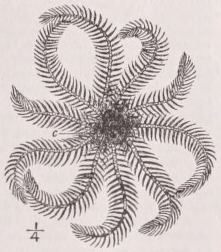
Comayagua
Encyclopedia Britannica
COMAYAGUA, a city of Central America, capital of tho republic of Honduras, and of the department of Comayagua, is situated in 14° 28' N. lat. and 87° 39' W. long., about half way between the Pacific and the Atlantic, on the right bank of the Humuya or Ulua River, and near the southern edge of a wide and fertile valley to which it gives its name. It lies 2060 feet above the level of the sea; and the valley is shut in by mountains varying in height from 5000 to 6000 feet, so that it enjoys a comparatively temperate and equable climate. It is the residence of the president and the seat of the only bishop in Honduras; but‘the political disturbances of the country have reduced it to a very poor condition. The houses are mainly of one story aud built of sun-dried bricks; and the fine fountains, monuments, and public buildings, of which it once could boast, have for the most part fallen into ruins or decay. Of those still left the principal is the cathedral, a rather imposing building, with cupolas and towers dating from the beginning of the 18th century. The university, founded in 1678, and more than once nominally restored in the present century, does not practically exist. The trade of the city is very small, in spite of the fertility of the neighbouring district; but a railway is in course of construction, which will put it in direct communication with both sides of the continent. In the neighbourhood, Mr Squier informs us, “hardly a step can be taken without encountering evidences of aboriginal occupation; but the only relic mentioned in the city itself is a dogshaped figure built into the walls of the church of Out* Lady of Dolores.” The present city, originally designated Valladolid la Nueva, was founded in 1540 by Alonzo Caceres, who had been instructed to find ...out an eligible site for a town midway between the oceans. In 1557 it received the rights of a city, and in 1561 was made a bishop’s see. Its prosperity is shown by the fact that at the great revolution of 1827 it had about 18,000 inhabitants. Burned in that year by the monarchical party of Guatemala, it has since suffered during successive contests, more especially in 1872, when it witnessed the defeat of General Medina’s army by the allied forces of San Salvador and Guatemala, and in 1873, when it was besieged for about two months. In 1854 Scherzer estimated the population at only 2000; but it is believed now to number between 7000 and 8000.
9th ed. Encyclopædia Britannica, vol. 6, p. 177
[437 words — estimated reading time: 3 minutes]
[437 words — estimated reading time: 3 minutes]
1. A valley between hills or mountains.
2. b silent.
3. An instrument, with teeth, for separating, cleansing and adjusting hair, wool, or flax. Also, an instrument of horn or shell, for keeping the hair in its place when dressed.
4. The crest, caruncle or red fleshy tuft, growing on a cocks head; so called from its indentures which resemble the teeth of a comb
6. A dry measure of four bushels.
In the language of seamen, to roll over, as the top of a wave; or to break with a white foam.
To separate, disentangle, cleanse, and adjust with a comb as to comb hair; or to separate, cleanse and lay smooth and straight, as to comb wool.
1. An instrument with teeth, for straightening, cleansing, and adjusting the hair, or for keeping it in place.
3. A toothed instrument used for separating and cleansing wool, flax, hair, etc.
5. A former, commonly cone-shaped, used in hat manufacturing for hardening the soft fiber into a bat.
7. The notched scale of a wire micrometer.
8. The collector of an electrical machine, usually resembling a comb.
9. The naked fleshy crest or caruncle on the upper part of the bill or hood of a cock or other bird. It is usually red.
10. One of a pair of peculiar organs on the base of the abdomen of scorpions.
11. The curling crest of a wave.
12. The waxen framework forming the walls of the cells in which bees store their honey, eggs, etc.; honeycomb.
14. To roll over, as the top or crest of a wave; to break with a white foam, as waves.
15. Alt. of Combe
16. A dry measure. See Coomb.
To disentangle, cleanse, or adjust, with a comb; to lay smooth and straight with, or as with, a comb; as, to comb hair or wool. See under Combing.
Comb
Encyclopedia Britannica
COMB, a toothed implement for arranging and dressing hair and other fibrous substances. Worsted wools, waste silk, and other long fibres are dressed and prepared for spinning by a process called combing, performed formerly by hand-combs, but now by an elaborate combing machine. This process of combing will be described in connection with the manufactures to which it belongs. Here we have only to do with the implement so well known in domestic economy. Comb-making is necessarily a prominent and extensive industry, in which a considerable vaιiety of materials are employed, the most common being the horns and hoofs of cattle, tortoise-shell, ivory, boxwood, vulcanite or hardened Indian-rubber, and to a small extent German silver aud other metals. Of these materials horn is by far the most extensively employed, and the working of that sub·...
stance illustrates all the peculiarities of the craft. The industry is one still extensively prosecuted on a small scale, with all the disadvantages of manual labour and wasteful and tedious processes; but in several large factories very ingenious labour and material-saving machinery is brought into operation, as in the extensive and complete works of Messrs Stewart & Co. of Aberdeen. In Messrs Stewart’s factory the raw material annually consumed averages 3,500,000 horns, about 1,000,000 hoofs, nearly 600 lb of tortoise-shell and 20 tons of vulcanite, out of which more than 10,000,000 combs are manufactured. The British supply of horn is very limited, and altogether inadequate to the demand. The sources whence this raw material is drawn are chiefly South America and Australia, whence ox and cow horns are procured, and India, China, and Siam, which supply buffalo horns. When the horn is brought into the factory it is first assorted into sizes, preparatory to being cut up into pieces. From an ordinary horn two cross sections are taken for comb-making, called, first, the head or root cut, and, second, the screw or tip cut. The solid tips remaining are disposed of either for buttonmaking or for being formed into knife and other handles. Other scraps and cuttings are of great value to makers of prussiate of potash and for artificial manure. The sections to be used for combs are taken to the opening department, where they are wetted in water and heated over an open fire till the horny substance becomes quite soft. The head cut is slit longitudinally once, or if it is a large horn it may be slit into two. The screw cut is so termed on account of the peculiar spiral direction in which it is slit, the cut being so directed that the piece when opened out may form an oblong rectangular plate with as little waste of horn as practicable. After slitting, the cuts are opened out between tongs, and inserted between screw plates where they are pressed quite flat. Plates which are intended for staining in imitation of tortoise-shell are at this stage inserted in strong iron frames between heated and oiled iron plates, in which they are submitted for some time to enormous pressure. After this pressure the plates are found to have a translucent appearance and a uniform greenish hue. The pressure, however, operates injuriously on the fibre or grain of the horn, rendering it liable to split. When, therefore, the horn is of good natural colour, it is preferred to finish it in that condition. The prepared plates of horn are laid aside to dry in a room where a high temperature is maintained by steam-pipes. Subsequently they are squared and trimmed on circular saw benches, and assorted into sizes suitable for the various kinds of combs manufactured.
In the manufacture of ordinary dressing-combs two distinct processes of tooth-cutting are followed. The first method, which is applied to all fine combs, consists in cutting out the teeth by means of circular saws; and this is the only process applicable to the preparation cf small toothed combs and all combs made of ivory and boxwood. Saw-cutting is, moreover, the only process formerly adopted, but instead of a circular saw, the comb-maker used a gauged hand-saw called a stadda or steady. The saws now employed are of small diameter; and, according to the work they have to perform, they are fine-toothed and thin, some of them being constructed to cut from 70 to 80 teeth per lineal inch. The saws are mounted on a spindle which revolves with great rapidity, and the plate or plates of horn to be toothed are clamped up in a holder, which by a cam motion is alternately raised and depressed, bringing the horn each time against the saw, which cuts out one tooth to its full depth. After each cut an automatic arrangement moves the horn forward the breadth of a tooth, the gearing being so mounted that the teeth may be cut fine or coarse at pleasure. The second method of cutting the teeth is known as twinning, from the fact that a pair of combs are cut out of a single plate. The process of twinning consists in so cutting a plate of horn that the whole material is utilized, what is removed to form the teeth of one comb being exactly sufficient for the teeth of a corresponding opposite comb. When the cutting of twinned combs is complete the plate presents the appearance of a pair of combs with their teeth exactly inosculating or dovetailing into each other. The twinning machine, by which this is accomplished, is a complex and beautiful piece of mechanism. The plates of horn to be twinned are softened by heat, and secured in a bed-plate which travels under a pair of cutting chisels, fast or slow, as the teeth are to be cut coarse or fine. The chisels, having cutting edges equal to s he length of the teeth to be formed, descend alternately and cut through the plate, but as their cutting edges are at a small angle in relation to each other, the cuts are wedge-formed or tapering, and thus the pointed ends of one comb are taken out of the roots or head of another. With the aid of this apparatus a man and boy can cut more than 2000 combs per day, while an old-fashioned comb-maker working with his hand-saw can only cut from two to three dozen combs daily, and that with almost double the material required in the twinning process.
After the combs are formed either by circle saw or by twinning, they are next thinned or tapered to their outer edges on grindstones. They then pass to the “grading” department, where by means of special forms of files or rasps, known as grails and topers, the individual teeth are rounded or bevelled, tapered, and smoothed. If the combs are to be finished in their natural colours, they are then smoothed with sand-paper, buffed on leather wheels, and polished on wheels built up of discs of soft calico. If, as is frequently the case, the combs are to be finished as imitation tortoise-shell, they are, in the translucent state before alluded to, treated with dilute nitric acid, which communicates a light yellow’tinge like the ground colour of tortoise-shell. The deep semi-opaque orange spotting is next produced by dropping over the surface spots of a composition containing caustic soda, litharge, and dragon’s blood. After some time this composition is washed off, and the parts to which it was applied are found to be a little swollen up and stained a deep orange tinge. The combs are then polished as above stated.
The elaborate pierced patterns of ornamental back combs are cut out by small ribbon saws; and the work is generally finished by hand-carving with proper tools. Plainer and less artistic work is done by embossing in heated dies and ordinary pierced work is also produced by cutting dies. Formerly the wide set teeth of back combs were frequently stamped out.
In order to economize tortoise-shell, and to obtain large and thick combs out of the comparatively small and thin plates in which that substance usually occurs, a process of cementing or soldering is resorted to. The joining of two plates of tortoise-shell is very perfectly accomplished by first carefully scraping and cleaning the surfaces to be united. They are then applied to each other, heated, and strongly pressed between pincers,—this being sufficient to cause a perfect amalgamation of the two surfaces. After cementation tortoise-shell is treated in every respect as a piece of fine white or buffalo horn. (j. pa.)
9th ed. Encyclopædia Britannica, vol. 6, p. 177
[1,451 words — estimated reading time: 9 minutes]
[1,451 words — estimated reading time: 9 minutes]
A gallinaceous fowl of Africa, of the size of a turkey-cock.
A brush to clean combs.
One whose occupation is to make combs.
Combaconum
Encyclopedia Britannica
COMBACONUM, a town of Southern India, in the district of Tanjore, 20 miles from the city of that name and 30 miles from the sea, in 10° 58' N. lat. and 79° 26' E. long. It is a large town with wide and airy streets, and is adorned with pagodas, gateways, and other buildings of considerable pretension. The great gopura, or gatepyramid, is one of the most imposing buildings of the kind,—rising in twelve stories to a height of upwards of 100 feet, and ornamented with a bewildering profusion of figures of men and animals formed in stucco. One of the water-tanks in the town is popularly reputed to be filled with water admitted from the Ganges every twelve years by a subterranean passage 1200 miles long; and it consequently forms a centre of attraction for large numbers of devotees. A considerable trade is carried ou in the town and weaving is one of its chief industries. The bazaar occupies a long and wide street, and is well supplied with provisions. The city is historically interesting as the capital of the Chola race, one of the oldest Hindu dynasties of which any traces remain, and from which the whole coast of Coromandel, or more properly Cholamundel, derives its name. Population about 40,000.
9th ed. Encyclopædia Britannica, vol. 6, p. 178
[215 words — estimated reading time: 2 minutes]
[215 words — estimated reading time: 2 minutes]
No thesaurus entries found for "Com".
King James Bible KJV Bible
Berean Standard Bible BSB Bible
4,378 KJV and 3,179 BSB verses contain “Com” — showing the first 20. Show all 5,405 verses (searchable)
Thus the heavens and the earth were finished, and all the host of them.
Thus the heavens and the earth were completed in all their vast array.
And the LORD God commanded the man, saying, Of every tree of the garden thou mayest freely eat:
And the LORD God commanded him, “You may eat freely from every tree of the garden,
And God said unto Noah, The end of all flesh is come before me; for the earth is filled with violence through them; and, behold, I will destroy them with the earth.
Then God said to Noah, “The end of all living creatures has come before Me, because through them the earth is full of violence. Now behold, I will destroy both them and the earth.
But with thee will I establish my covenant; and thou shalt come into the ark, thou, and thy sons, and thy wife, and thy sons’ wives with thee.
But I will establish My covenant with you, and you will enter the ark—you and your sons and your wife and your sons’ wives with you.
And they that went in, went in male and female of all flesh, as God had commanded him: and the LORD shut him in.
And they entered, the male and female of every living thing, as God had commanded Noah. Then the LORD shut him in.
And the flood was forty days upon the earth; and the waters increased, and bare up the ark, and it was lift up above the earth.
For forty days the flood kept coming on the earth, and the waters rose and lifted the ark high above the earth.
And the waters prevailed exceedingly upon the earth; and all the high hills, that were under the whole heaven, were covered.
Finally, the waters completely inundated the earth, so that all the high mountains under all the heavens were covered.
Go forth of the ark, thou, and thy wife, and thy sons, and thy sons’ wives with thee.
“Come out of the ark, you and your wife, along with your sons and their wives.
And God said, This is the token of the covenant which I make between me and you and every living creature that is with you, for perpetual generations:
And God said, “This is the sign of the covenant I am making between Me and you and every living creature with you, a covenant for all generations to come: