BELLA, Stefano de la, engraver, was born at Florence in 1610. He was apprenticed to a goldsmith; but some prints of Callot having fallen into his hands, he began to turn his attention entirely towards engraving, and studied the art under Canta Gallina, who had also been the instructor of Callot. By the liberality of Lorenzo de’ Medici he was enabled to spend three years in study at Rome. In 1642 he went to Paris, where Cardinal Richelieu engaged him to go to Arras and make drawings of the siege and taking of that town by the royal army. After residing a considerable time at Paris he returned to Florence, where he obtained a pension from the grand duke, whose son, Cosmo, he instructed in drawing. He died in 1664. His productions were very numerous, amounting to over 1400 separate pieces.
9th ed. Encyclopædia Britannica, vol. 3, p. 543 [141 words — estimated reading time: 1 minute]
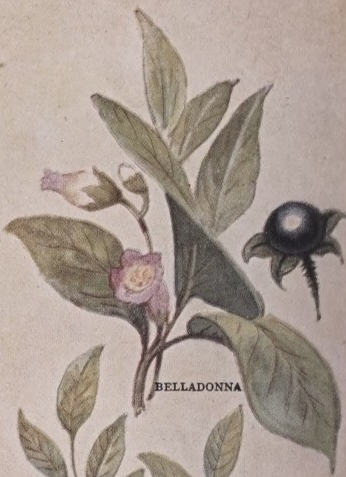
1. An herbaceous European plant (Atropa belladonna) with reddish bell-shaped flowers and shining black berries. The whole plant and its fruit are very poisonous, and the root and leaves are used as powerful medicinal agents. Its properties are largely due to the alkaloidatropine which it contains. Called also deadly nightshade.
2. A species of Amaryllis (A. belladonna); the belladonna lily.
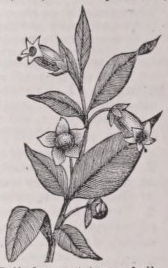
BELLADONNA, Dwale, or Deadly Nightshade(Atropa BdlaΛonnay, a tall bushyherb of the natural order Solanace<n, growing to a height of 4 or 5 feet, having leaves of a dull green colour, with a black shiningberry fruit about the size of a cherry, and a large tapering root. The plant is a native of Central and South Europe, extending into Asia, and it is also found in waste places and hedgerows of Britain, though it is a doubtful native. The entire plant is highly poisonous, and accidents not unfrequently occur through children and unwary persons eating the attractive-looking fruit. Its leaves and roots are largely used in medicine, on which account the plant is cultivated, chiefly in South Germany, Switzerland, and France. Both roots and leaves contain the poisonous alkaloidatropia, but in practice the roots only are employed for its extraction. The proportions in which atropia is present in the roots range between 0 ’ 6 and 0 ’ 25, the roots of young plants being always richest in the alkaloid. The percentage found in leaves is much more uniform, being about 0’47, and extracts and tinctures of the leaves are therefore of much more constant strength than if prepared from roots. Preparations of belladonna and atropia are used in medicine as anodynes in local nervous pains,—atropia being frequently hypodermically injected but rarely taken internally. They are also of great value in ophthalmic practice on account of their peculiar property of producing dilatation of the pupil, either when painted around or dropped into the eye. Belladonna is also used as an antispasmodic in hooping-cough and spasmodic coughs generally, and for various other medicinal purposes. A remarkable antagonism between the physiological action of atropia and the alkaloid of the calabarbean...has been experimentally worked out by Dr Thomas R. Fraser (Trans. Roy. Soc. Ed., 1870-1). To a more limited extent also an anta gonism between atropia and morphia and other alkaloids has been established; and the researches on these substances, and on the mutual action of alkaloids generally, have been continued in experiments conducted by Dr J. G. M'Kendrick, reported to the British Medical Association in 1874.
9th ed. Encyclopædia Britannica, vol. 3, p. 543 [365 words — estimated reading time: 3 minutes]
BELLAMY, Jacobus, a Dutch poet, was born at Flushing in 1757. He was apprenticed when young to a baker, but his abilities were discovered by a clergyman named De Water, who exerted himself in the boy’s behalf, and obtained sufficient assistance to send him, in 1782, to the University of Utrecht. In 1785 appeared his Vaderlandsche Gézangen , which at once gained him the highest reputation as'a poet. Three years previously a small volume of his, Gezangen mijner Jeugd, published under the pseudonym Zelandus, had attracted considerable attention. His longest and, in the opinion of many, his best work is the poetic romance Roosje, 1784. Bellamy was one of the first to create a new and original literature in Holland; his songs have had wide circulation and great popularity.
9th ed. Encyclopædia Britannica, vol. 3, p. 543 [131 words — estimated reading time: 1 minute]
BELLARMINE (Ital. Bellarmino), Robert Francis Romulus, Cardinal, Catholic theologian and polemic, was born, October 4, 1542, at Montepulciano, in Tuscany. He was destined by his father for state service, but his inclinations were too strong to be restrained, and at the age of eighteen he entered the Society of Jesus. After studying in various colleges for some years, he was appointed by the order to lecture on theology at the famous university of Louvain. His seven years’ residence in the Low Countries brought him into close relations with modes of thought differing essentially from his own, and so compelled him to define his theological principles more clearly and sharply than before. On his return to Italy he received from Gregory XIII. an appointment in the newly-founded Collegium Romanum, and began to deliver lectures on the principal points of difference between the Roman Catholic and other forms of faith. Out of these lectures grew his famous work, Disputationes de Controversiis Christianes Fidei adversus hujus temporis Hoereticos (3 vols., 1581, 1582, 1593), for long the finest polemical writing on the Catholic side, and still worthy of consideration. It was replied to at the time by Chemnitz, Gerhard, and Charnier, and continued for many years to furnish occasions of attack to Protestant theologians. So highly were Bellarmine’s abilities rated, that he was selected to accompany, in the capacity of divine or theologian, the legation sent into France in 1590 by Sixtus V. In 1599 he was, much against his will, raised to the dignity of cardinal, and two years later was made archbishop of Capua. He resigned the archbishopric in 1605, being detained in Rome by the desire of the newly-elected Pope Paul V. About the same time he had a con- ∙oversy with James I. of ...England, who, after the discovery of the Gunpowder Plot, had passed severe laws against Roman Catholics. In 1610 he published his work De Potestate summi Pontificis in rebus Temporcdibus, directed against William Barclay, in which he asserted boldly and undisguisedly the doctrine of the Pope’s temporal sovereignty. For some years before his death, which occurred at Rome, 17th September 1621, he held the bishopric of his native town. Bellarmine, whose life was a model of Christian asceticism, is one of the greatest theologians, particularly in the department of polemics, that the Romish Church has ever produced. His works, which are very numerous, are written in an easy perspicuous style. The most important are the Disputatio de Controversiis, the De Potestate summi Pontificis, Institutiones Hebroeicoe Linguoe, De Scriptoribus Ecclesiasticis, De Ascensione Mentis in Deum. A life of Bellarmine, founded on an autobiography, was written by Fulligato, 1624.
9th ed. Encyclopædia Britannica, vol. 3, p. 544 [444 words — estimated reading time: 3 minutes]
BELLAY, Joachim du, an eminent French poet and member of the Pleiad, was born late in 1524, at Lyré, on the left bank of the Loire, not far from Angers. In the absence of documents we are thrown upon the autobiographical passages in his poems for information about the events of his life, and these, fortunately, are copious. From these, and especially from the beautiful Latin elegy addressed to his friend Jean Morel, we learn that, deprived early of both his parents, he was left to the mercy of an elder brother, who allowed him to be brought up without other education than what his own ardent spirit supplied. Before he reached manhood this brother also died, and Joachim found himself at the head of the family, a vigorous, manly, but half-cultured youth. Suddenly he was struck down by illness; and, confined for many months to his bed, he softened the long hours of suffering by fervent study; he now read the Latin and Greek poets for the first time, and felt a passionate desire to imitate them in French. In 1548, having to a great measure recovered his health, he happened to meet Ronsard in an inn in Poitiers, and a friendship instantly sprang up between them that ceased only with Du Bellay’s death. He joined the six poets, who, under Dorat, were forming a society, the Pleiad, for the creation of a French school of Renaissance poetry; and his first contribution to it was a prose volume, the famous Deffence et Illustration de la Langue française, which remains one of the earliest and most perfect pieces of literary criticism in existence, and overweighs in positive value much of his actual poetry. This appeared in 1549, and was followed within a twelvemonth by two volumes in verse, the Recueil de Poésie, and the collection of lovesonnets called L ’ Olive. The latter ...celebrate, in the manner of Petrarch, the loveliness of a semi-mythicalmistress, understood to be a Parisienne, and by name Viole, of which Olive is an anagram. The Recueil caused a quarrel with Ronsard, about which much speculation has been wasted, and which still remains obscure. It seems that Ronsard had invented a new form of the ode, which he allowed Du Bellay to see in manuscript. Ronsard’s book was delayed in publication, and Du Bellay’s odes, written after his metrical pattern, appeared first. Ronsard’s natural and passing vexation has been exaggerated into a law-suit; but the friends were soon on the old affectionate footing. In L ’ Olive Du Bellay was the first French writer to use the sonnet with fluency. After he had translated two books of the Aeneid, which appeared in 1552, the yearning he had always felt to visit Italy was appeased by his being sent to Rome in 1550 as secretary to his influential relative, Cardinal du Bellay, and he remained in that city four years and a half. At first, however, he was miserable enough. Everything around him was displeasing to him and jarred on his refined and sometimes sickly nerves. At last he fell violently in love with a lady, whose real name was Faustine, but whom he celebrates under the poetical title of Columba and Columbelle. In his Latin poems this sincere and absorbing passion burns like a clear flame, more veiled though no less burning in his French Regrets. Before he won her she was shut up from his sight by her old and jealous husband. Frenzied with grief and desire, burning with fever, exhausted with watching and physical suffering,—for his health was still very delicate,·—Du Bellay walked day and night to and fro before the house. At last, mysteriously enough, she is given to him; and the Latin poems end in rapturous delight. At this point, however, and possibly for this reason, he was hurried back to Paris, where he became canon of NôtreDame in June 1555. He returned by Venice, the Grisons, and Geneva, and was received by his friends in France with transport. He set himself to literary labour of various kinds, publishing his Latin poems and his French sonnets called Les Antiquitez de Rome, in 1558, and his greatest lyrical work, the Regrets, in 1559. In the latter year, however, a calumny deprived him of the protection of the -cardinal, and threw him into the deepest distress and embarrassment. The nature of this charge is not known, but it must have quickly passed away, for later on in that year we find him preparing a new volume of poems, Les Jeux Rustiques, for the press, and nominated archbishop of Bordeaux. He did not live to enjoy this distinction, for on the 1st of January 1560, he died of apoplexy, and was bαried in Nôtre-Dame de Paris. Like Ronsard he was very deaf.
His collected works did not appear until 1568. The early death of the French Ovid, as he has been called, was a serious loss to European literature, for Joachim du Bellay wa3 at the height of his power, and still rapidly advancing. His poems have a force, an occasional sublimity, and a direct pathos for which we look in vain among his contemporaries; and none but Ronsardexcelled him in facility and grace. His most famous poem, Un Vanneur de Blé aux Vents, one of the loveliest lyrics of the age, was written shortly before his death, and appeared in the Jeux Rustiques in 1560; it is nominally a paraphrase from the Latin of Naugerius. The standard edition of the French works of Joachim du Bellay is that published in 2 vols, by Lemerre in 1866, and edited by Ch. Marty-Laveaux. Spenser translated sixty of Du Bellay’s Roman sonnets into English, and published them in 1591. A very delicate essay on the poet will be found in Mr W. H. Pater’s Studies in the History of the Renaissance, 1873.
9th ed. Encyclopædia Britannica, vol. 3, p. 544 [994 words — estimated reading time: 6 minutes]
No thesaurus entries found for "Bella".
No Bible verses found for "Bella".
This site uses cookies to remember your display preferences (search sources and editions, Bible version, auto-link, images, light/dark theme). No personal data whatsoever is collected. Privacy Policy