CAMP, Roman. While the Greeks, depending more upon the advantages of situation, adapted the form of their encampment to the nature of the ground selected, the Romans laid out theirs according to a fixed and definite plan, modified only by the numbers for whom accommodation had to be provided. Its form and arrangement in the best days of the republic are minutely and clearly described by Polybius, the companion in many wars of the younger Scipio....
A Roman camp of the Polybian type was intended primarily to accommodate a consular army, consisting of two legions, each of 4200 infantry and 300 cavalry, with the ordinary contingent of “socii,” amounting in all to 16,800 foot and 1800 horse and for this purpose it was pitched in the form of a square, each side of which extended 2017 Roman feet in length. This square was divided into two unequal portions by a perfectly straight road called the “principia,” 100 feet in breadth, running parallel with the front and rear of the camp, and forming at its extremities in the sides AC and BD of the camp two gates, the “porta principalis dextra” and the “porta principalis sinistra.” In what may be called the upper and smaller portion, determining the arrangement of the rest of the camp, stood the “praetorium” (P), or general’s tent, so situated as to have a commanding view in all directions. 1QD feei.of clear ground on every side left the “praetorium” in the centre of a square, whose sides, each 200 feet in length, were carefully traced parallel to the sides of the camp. To the right and left of the “praetorium,” at F and Q, were the “forum,” or market-place, and the “quaestorium,” or paymaster’s tent. Further to the right and left, at (p, q), (p', q'), (r, s), (r,' s'), were stationed the cavalry and infantry that formed the bodyguard of the consul and quaestor. Fifty feet in front of the “praetorium,” along the line forming the upper boundary of the “principia,” were the tents of the twelve tribunes of the legions, six to the right and six to the left of the “praetorium,” opposite their respective legions. In the prolongation of the same line were probably stationed the “praefecti sociorum.” Passing from the upper to the lower division, or to what was called the front of the camp, we cross the “principia,” the great thoroughfare of the army, where the standards of the legion were placed round the altars of the gods. This part of the camp, i.e., between the “principia” and the side CD, was allotted to the main body of the army. It was intersected transversely in the middle by a street 50 feet broad, the “via quintana,” as well as longitudinally by what were called the “viae” or streets of the camp. Each of the latter was also 50 feet in breadth, and the central “via” formed the boundary between the two legions, which were placed symmetrically to the right and left on each side. The “equites,” “triarii,” “principes,” and “hastati” of the legion were stationed in the spaces numbered (1, 1'), (2, 2'), (3, 3'), (4, 4'),—each of the spaces devoted to the cavalry containing, within an area of 10,000 square feet, one squadron of thirty men and horses, while in the same area there were quartered of the “principes” and “hastati” two “maniples” or divisions of sixty men each. Each of the spaces where the “triarii” were stationed was only half this area, and devoted to one “maniple” of sixty men. Spaces (5, 5'), (6, 6') were assigned to the cavalry and infantry of the allies, of whom, however, a part was quartered in the upper camp. The “velites” (light-armed troops) were probably distributed proportionally among the three divisions of the infantry. Between the tents and outer wall of the camp there was an “intervallum” all round, 200 feet broad, by which ample room was given for the passage of the legions in and out, and which also served as a receptacle for booty, as well as to increase the distance of the troops from the enemy. The camp was provided with four gates—(1) “porta principalis dextra,” and (2) “porta principalis sinistra,” at the extremities of the “principia;” (3), “porta praetoria,” on the side nearest the “praetorium,” and in the very centre of that side; (4), “porta decumana,” in the centre of the side opposite. The fortifications consisted of a fosse or ditch (fossa), 9 feet deep and 12 feet wide, the earth from which, as it was dug out, being thrown to the inside, formed, with the addition of turf and stone, a mound (agger), on the summit of which were fixed stout wooden stakes (sudes).
Such was the general outline of the Polybian camp; but when, under the emperors, changes were made in the constitution of the army, and organization by cohorts was introduced, the form and disposition of a Roman camp underwent modifications that resulted in what has been called the Hyginian camp, from Hyginus, a land surveyor who flourished under Trajan and Hadrian, and who has given an account of its arrangement in his day. The principal points of contrast with the Polybian camp were, that the form was now oblong and did not occupy half so much space, that the troops were stationed in cohorts round the rampart so as to enclose the whole body of foreigners and baggage, and that the fortification was much less substantial.
The ordinary entrenchments thrown up from day to day by a Roman army while on the march were but slight; but, where it was necessary or expedient to remain together for some time, or where it was likely they might reoccupy the same ground, a more permanent camp, with a proportionably stronger· rampart, was formed. Such an encampment was called “castra stativa,” or a stationary camp. This, again, was distinguished as “castra aestiva,” a permanent summer camp, and “castra hiberna,” a permanent winter camp. Such were the camps that, in process of time, becoming surrounded by a numerous population, formed the nucleus of large towns, many of which may be recognized in England by the name-termination “ehester” or “cester.”

[1,041 words — estimated reading time: 6 minutes]
or ENCAMPMENT, of the Israelites. The whole body of the people, consisting of six hundred thousand fighting men, beside women and children, was disposed under four battalions, so placed as to enclose the tabernacle, in the form of a square, and each under one general standard. (See _Armies_.) There were forty-one encampments, from their first in the month of March, at Rameses, in the land of Goshen, in Egypt, and in the wilderness, until they reached the land of Canaan. They are thus enumerated in Numbers xxxiii:--
Rameses 2. Succoth 3. Etham, on the edge of the wilderness 4. Pihahiroth 5. Marah 6. Elim 7. By the Red Sea 8. Wilderness of Sin 9. Dophkah 10. Alush 11. Rephidim 12. Wilderness of Sinai 13. Kibroth-hattaavah 14. Hazeroth 15. Rithmah 16. Rimmon-parez 17. Libnah 18. Rissah 19. Kehelatha 20. Shapher 21. Haradah...
Makheloth 23. Tahath 24. Tarah 25. Mithcah 26. Hashmonah 27. Moseroth 28. Bene-jaakan 29. Hor-hagidgad 30. Jotbathah 31. Ebronah 32. Ebion-gaber 33. Kadesh 34. Mount Hor 35. Zalmonah 36. Punon 37. Oboth 38. Ije-abarim 39. Dibon-gad 40. Almon-diblathaim 41. Mountains of Abarim In the second year after their exodus from Egypt they were numbered; and upon an exact poll, the number of their males amounted to six hundred and three thousand, five hundred and fifty, from twenty years old and upward, Num. i, ii. This vast mass of people, encamped in beautiful order, must have presented a most impressive spectacle. That it failed not to produce effect upon the richly endowed and poetic mind of Balaam, appears from Num. xxiv, 2; “And Balaam lifted up his eyes and he saw Israel abiding in his tents according to their tribes; and the Spirit of God came upon him, and he took up his parable and said, How goodly are thy tents, O Jacob, and thy tabernacles, O Israel! As the valleys are they spread forth, as gardens by the river side, as the trees of lign aloes which the Lord hath planted, and as cedar trees beside waters.” Grandeur, order, beauty, and freshness, were the ideas at once suggested to the mind of this unfaithful prophet, and called forth his unwilling admiration. Perhaps we may consider this spectacle as a type of the order, beauty, and glory of the true “church in the wilderness,” in those happy days when God “shall not behold iniquity in Jacob, nor perverseness in Israel;” when it shall be said, “The Lord his God is with him, and the shout of a king is among them.”
[87 words — estimated reading time: 1 minute]
CAMPAGNA, a town of Italy, in the province of Principato Citeriore, 19 miles east of Salerno. It stands in the centre of a mountainous district, of which it is the capital. It is the see of a bishop, and contains a cathedral and college, besides several churches and convents. Population, 9813.
[51 words — estimated reading time: 1 minute]
CAMPAGNA DI ROMA, is, in the wider application of the word, an extensive plain of central Italy, almost coinciding with the ancient Latium, and, in a more restricted signification, that portion of the larger area which lies immediately round the city of Rome between the Tiber and the Anio. The circumference of the latter “might be marked,” says Gregorovius, “by a series of well-known points,—Civita Vecchia, Tolfa, Ronciglione, Soracte, Tivoli, Palestrina, Albano, and Ostia;” while the former may be regarded as bounded on the N. by the Mountains of Viterbo (Sylva Ciminia), on the E. by the lower ranges of the Apennines, and on the S. and W. by the Tyrrhenian Sea. It extends about 84 miles in length from Civita Vecchia to Terracina, and has a breadth of 24 miles,—its area being nearly 1400 square miles. Of distinctly volcanic formation, the surface presents a very undulating appearance, broken by deep gullies and studded with extinct craters, that now form the basins of lakes, such as those of Bolsena, Vico, and Baccano. In ancient times it seems to have been a well-peopled region, and was the seat of numerous cities; but in the 3d and 4th centuries b.c. the Roman aristocracy turned the most of the district into huge estates, and thus led to the disappearance of the agricultural population. In the earlier period of the empire its condition grew worse and worse, and many parts of the plain became covered with pestilential marshes. The emperors Claudius, Nerva, and Trajan turned their attention to the amelioration of the district, and under their example and exhortation the Roman aristocracy erected numerous villas within its boundaries, and used them at least for summer residence. With the ruin of the empire and the inroad of the barbarian hordes the desolation ...of the Campagna was complete; but, again, in the Middle. Ages, it became dotted over with the baronial castles of the rival families of Rome—the Orsini, the Colonnas, the Savelli, the Conti, and the Caetani-—who ruthlessly destroyed the remains of earlier edifices to obtain materials for their own. Several of the popes, as Boniface IX., Sixtus IV., and Julius III., made unsuccessful attempts to improve the sanitary condition of the Campagna; and equally fruitless in more recent times—as far, at least, as the general purpose is concerned—have been the efforts of Popes Pius VI. and VII., and of General Miollis, the French governor of Rome. The most healthy portions of the territory are in the north and east, embracing the slopes of the Apennines which are watered by the Teverone and Saccho; and the most pestilential is the stretch between the Lepini Hills and the sea. The Pontine marshes, included in the latter division, were drained, according to the plan of Bolognini, by Pius VI.; but though they have been restored to cultivation, their insalubrity is still notorious. The soil in many parts is very fertile; and the atmosphere, which is so deadly to man, has no hurtful effect on the lower animals. In summer, indeed, the vast expanse is little better than an arid steppe; but in the winter it furnishes abundant pasture to flocks of sheep and herds of silver-grey oxen and shaggy black horses. The land is for the most part let by the proprietors to Mercaηti di Campagna, who employ a subordinate class of factors (fattori) to manage their affairs on the spot. It is evident that the malaria which renders the Campagna almost uninhabitable during the summer is owing to natural causes affecting a wide area with which it is very difficult to deal, and that no merely local improvements can have any effect. The regulation of the rivers is so defective that they annually overflow a great extent of surface; the character of the soil allows the waters to gather in fetid masses, and the heat of summer turns them into noxious vapours. The attention∙of the Italian Government and of General Garibaldi has recently been turned towards the systematic sanitary improvement of the district, —with what results remains to be seen. The planting of the Eucalyptus globulus and the Helianthus annuus has been partially resorted to, especially in the district of Tre Fontani, and, it is reported, with some success.
Full details on the Campagna will be found in Westphal, Die Römische Cαmpαgηα, 1829; Didier, La Campagne de Rome, 1842; Adolph Stahr, Ein Winter in Rom, 1847-50; Paolo Mantovani, Descrizione gβologica delta Campagna Romana, Turin, 1875; Dr Pietro Balestra, L’lgiene nella ' Campagna e città di Roma, 1875; Augustus Hare, Days near Rome, 1875. See also an article by Fr. Siebmann in Ausland for August 1875, and another by Fr. von Hellwald in the following number.
[796 words — estimated reading time: 5 minutes]
CAMPAN, Jeanne Louise Henriette (1752-1822), née Genest, was born at Paris in 1752. Carefully educated, and surrounded by the most cultivated society, at the age of fifteen she had gained so high a reputation for her accomplishments as to be appointed reader to the young princesses. At court she was a general favourite, and when she bestowed her hand upon Μ. Campan, son of the secretary of the royal cabinet, the king gave her an annuity of 5000 livres as dowry. She was soon after appointed first lady of the bedchamber by Marie Antoinette; and she continued to be the faithful attendant of that princess till she was forcibly separated from her at the sacking of the Tuileries, on 20th June 1792. After this event Mme. Campan, almost penniless, and thrown on her own resources by the illness of her husband, bravely determined to support herself by establishing a school at Saint-Germain. The institution prospered, and was patronized by Mme. Beauharnais, whose influence led to the appointment of Mme. Campan as superintendent of the academy founded by Napoleon at Ecouen, for the education of the daughters and sisters of members of the Legion of Honour. This post she held till it was abolished at the restoration of the Bourbons, when she retired to Mantes, where she spent the rest of her life amid the kind attentions of affectionate friends, but saddened by the loss of her only son, and by the calumnies circulated on account of her connection with the Bonapartes. She died in 1822, leaving interesting Mémoires szιr la vie privée de Marie Antoinette, suivis de souvenirs et anecdotes historiques sur les règnes de Louis XI V.-XV. (Paris, 1823); a treatise De VEducation des Femmes; and one or two small didactic works, written in a clear and natural style.
[307 words — estimated reading time: 2 minutes]
CAMPANELLA, Tomaso (1568-1639), one of the most brilliant and unfortunate of the Italian Renaissance philosophers, was born at Stilo in Calabria in 1568. At a very early age he showed remarkable mental power; his memory was uncommonly tenacious, and before he was thirteen years of age he had mastered nearly all the Latin authors presented to him. In his fifteenth year he entered the order of the Dominicans, attracted partly by reading the lives of /Ubertus Magnus and Aquinas, partly by his intense love of learning. He was placed at first in the convent at Morgentia in Abruzzo, and after completing his course of philosophy was transferred to Cosenza, there to study theology. He soon became discontented with his teachers, for he earnestly desired to read, not only the works of Aristotle, but the book of nature, which was the language of God. An accident drew his attention to the work De Rerum Natura of Telesius, which he read with great eagerness. He was delighted with its freedom of speech and its appeal to nature rather than to authority. His first work in philosophy, for he was already the author of numerous poems, was a defence of Telesius against the attacks of Marta, an Aristotelian. It was styled Piιilo-soplιιa seìisiljus demonstrata, and appeared in 1591. The freedom and boldness of his attacks upon established authority soon brought him into disfavour with the clergy. He left Naples, where he had been residing, and proceeded to Rome For seven years he led an unsettled life, wandering through Padua, Bologna, Venice and other towns, everywhere attracting attention by the brilliancy of his talents and the boldness of his teaching. Yet Campanella was strictly orthodox, held the established faith, and was an uncompromising advocate of the Pope’s temporal power...
He returned to Stilo in 1598. In the following year he was arrested and committed to prison. What was the immediate cause of this is not clearly known. According to the most common report the motives for his imprisonment were entirely political. He had joined himself to those who desired to free Naples from Spanish tyranny, and had excited them by his fiery eloquence and independence of spirit. His friend Naudée, however, declares that this was a complete mistake, and that the expressions used by Campanella, which were interpreted as revolutionary, had quite a different reference and signification. Whether from error or not, the unfortunate philosopher was committed to prison, and remained there for twenty-seven years, suffering much torture and misery. Yet his spirit was unbroken; he composed sonnets, and prepared a series of works, forming a complete system of philosophy, which were published at a later date. During the latter years of his long confinement he was kept in the castle of St Elmo, and was allowed considerable liberty. There seem, indeed, to have been great doubts even in the minds of those who imprisoned him whether he had done anything deserving such a punishment. Still he was looked upon as dangerous, and it was thought better to restrain his boldness. At last, in 1626, he was set at liberty For some three years he was confined in the chambers of the Inquisition, but in 1629 he was fairly free. He was well treated at Rome by the Pope, but he made enemies; and, profiting by the lessons of experience, he thought it well to avoid future danger by taking flight from Rome. He came to Paris in 1634 under the protection of the French ambassador to Italy, and was received with marked favour by Cardinal Richelieu The last few years of his life he spent in preparing a complete edition of his works; but only the first volume appears to have been published. He died on the 26th of May 1639.
The philosophy of Campanella is in many respects interesting and important, but it has much that is fantastic, and is wanting in unity and completeness. With Telesius he agreed in rejecting the Aristotelian method of inference. According to him truth or certainty is only to be found in immediate intuition. The sciences are not to be constructed from definitions by deduction, but proceed by induction to definition, which in the natural order comes last. The syllogism is only useful for expounding; the universal rule which it involves is always a result of induction, and the particular subsumed under it is itself part of the induction. Our knowledge begins in doubt. We know neither the past nor the future; even in the present we only know things as they appear to be, not as they are. The first proposition in a theory of cognition is that I myself think; the certainty of self-consciousness is the primary truth.
With all this freedom of philosophizing Campanella preserved a completely orthodox respect for revealed religion; he aimed indeed at a system which should embrace in one comprehensive scheme religious and philosophical principles. His view of God is not far removed from that of Bruno; he lays stress upon the divine unity and omnipresence, and as he is convinced that community of action is only possible where there is identity of being, he is driven to an apparently pantheistic conclusion. God is the ultimate unit; His three manifestations may be called power, wisdom, and love. He alone has pure being; all other things created by or emanating from Him are limited, i.e., have non-being. All things are of the same nature, otherwise there could be no mutual action; there is a universally diffused life and sensibility.
In his natural philosophy Campanella mainly follows Telesius, and lays dυwn as fundamental forces heat and cold, in their concrete form, sun and earth. By these all things are formed. The soul of man is in nature corporeal, but is immortal, being endowed with a striving after happiness never attained in this life.
In practical philosophy Campanella was an extreme reformer. In his Civitas Solis he sketches an ideal state, in which principles of communism are fully carried out. He contends for a community of goods and wives, for state control of population, and for a universal military training. The kingin his ideal state is called Hoh, f.e., Metaphysics; his ministers have names meaning respectively Power, Wisdom, and Might. The whole work is cold and abstract, utterly wanting in the rich practical detail of its prototype, the Utopia.
A long list of Campanella’s works is given by Echard, App. to Cypriano, Vita. Campanélloe, who enumerates eighty-two, and l>y Campanella himself in the first vol. of his collected works. The most important were De Sensu Rerum, 1620 ∖ Riealis PJiilosophioe Epilogisticoe Partes IV. (containing Civitas Solis'), 1623; Atheismus Triumphatus, 1631; Philosophia Rationalis, 1637; Philosophia Universalis seu Metaphysica, 1638; De Monarchia Hispanica, 1640, translated into English.
See on his life Cypriano, Vita Campanelloe, 1705, 1722; Baldacchini, Vita et Filosofia di Tomaso Campanella, 1840. On his philosophy, see Ritter, Ges. cl. Phil. vol. ix., who gives a very full account; Carriere, Phil. Weltanschauung der Reformationszeit, 522-608; Dareste, Th. Morus et Campanella, 1843. Some of the works have been translated into French, Oeuvres choisies de Campanella, par Mme. L. Collet, 1844; Cité du soleil, par Villegar-delle, 1840.
[1,210 words — estimated reading time: 7 minutes]
CAMPANI-ALIMENIS, Matteo, an Italian mechanician and natural philosopher of the 17 th century, was born at Spoleto. He held a curacy at Rome in 1661, but devoted himself principally to scientific pursuits. As au optician, he is chiefly celebrated for the manufacture of the large object-glasses with which Cassini discovered two of Saturn’s satellites, and for an attempt to rectify chromatic aberration by using a triple eye-glass; and in clock-making, for his invention of the illuminated dial-plate, and that of noiseless clocks, as well as for an attempt to correct the irregularities of the pendulum which arise from variations of temperature. Campani published in 1678 a work on horology, and on the manufacture of lenses for telescopes. His younger brother Giuseppe was also an ingenious optician (indeed the attempt to correct chromatic aberration has been ascribed to him instead of to Matteo), and is, besides, noteworthy as an astronomer, especially for his discovery, by the aid of a telescope of his own construction, of the spots in Jupiter, the credit of which was, however, also claimed by Divini.
[184 words — estimated reading time: 2 minutes]
CAMPANIA, an ancient province of Italy, separated from Latium on the N. by the Massican Hills, and from Samnium on the E. by the Apennines, and bounded on the W. by the Tyrrhenian Sea, and on the S. by Lucania. It was distinguished by its fertility, beauty, and genial climate, and by the excellence of its harbours. It consists of a plain, broken only by a low volcanic range of hills, of which the chief is Mons Gaurus, and by Mount Vesuvius. The original inhabitants of Campania were Oscans or Ausonians. The first settlers were the Greeks who founded Cumae, and afterwards Dicaearchia, Palaepolis, and Neapolis. It seems pretty certain that the next invaders were the Etruscans, and that they founded Capua and Nola. The Etruscans in turn had to give place to the Samnites. But both these invaders were few in number; and the Campanian people continued to be of essentially Oscan race. The remains of their language are, indeed, our best specimen of Oscan. In the 4th century b.c. war broke out with the Romans, and in 340 b.c., by the battle of Vesuvius, Campania fell into their hands. For subsequent history see Roman History. The Bay of Naples was one of the favourite situations for the villas of the ancient Romans; and, notwithstanding the eruption of Vesuvius in 79 A.D., which buried the cities of Herculaneum and Pompeii, Campania continued to flourish. The chief towns were Capua, Cumae, Neapolis, Nola, Pompeii, Herculaneum, Vulturnum, Puteoli, Liternum, Teanum, Salernum, Suessa, Misenum, Surrentum, Picentia. The province was traversed by several roads—the Via Appia, the Via Latina, part of the high road from Rome to Rhegium, and a road constructed by Domitian along the coast from Sinuessa to Neapolis. Under Augustus, Campania was joined to Latium to form the First Region of ...Italy Its name then gradually superseded that of Latium; so that at present the district round Rome is known as the Campagna di Roma.
[329 words — estimated reading time: 2 minutes]
CAMPANILE, the bell tower attached to the churches and town-halls in Italy. Bells are supposed to have teen first used for announcing the sacred offices by Pope Sabinian (604), the immediate successor to St Gregory; and their use by the municipalities came with the rights granted by kings and emperors to the citizens to enclose their towns with fortifications, and assemble at the sound of a great bell. It is to the Lombard architects of the north of Italy that we are indebted for the introduction and development of the campanile, which, when used in connection with a sacred building, is a feature peculiar to Christian architecture,—Christians alone making use of the bell to gather the multitude to public worship. The campanile of Italy serves the same purpose as the tower or steeple of the churches in the north and west of Europe, but differs from it in design and position with regard to the body of the church. In the north and west the tower forms an integral part of the building; it is frequently placed at the west end or at the south or north side of the nave, in which case the ground story forms a porch to the church; sometimes it is at the intersection of the nave and transepts, in which case it rises as a grand central feature round which everything else groups, as seen at Salisbury, Lincoln, Norwich, Ac. In Italy the campanile is almost always detached from the church, or at most connected with it by an arcaded passage. In Italy there are (with one or two exceptions, such as San Ambrosio, Milan, and at Novara) never more than one campanile to a church, whereas in the north and west the number varies from one to seven....
The design of the campanile differs entirely from its northern type. It never has buttresses, is very tall and thin in proportion to its height, and is square on plan, occasionally round, as at Ravenna and Pisa, and in one or two cases, as at San Gottardo, Milan, octagonal. The campanile generally rises from base to summit without break; the faces are divided vertically by flat pilasters, and horizontally by string-courses, arcades, or windows. As a rule the openings increase in number with the height of the stage. Many, perhaps the finest examples, have openings at the top only.
The chief architectural defect of the square campanile is the covering. This is generally a short conical roof, either square, circular, or octagonal on plan; but its junction with the tower was never successfully managed. The campanili in the north of Italy and in Rome are nearly all built of brick. In Tuscany, as at Pisa and Siena, and further south, as at Viterbo, they are veneered with marble of various colours. ’
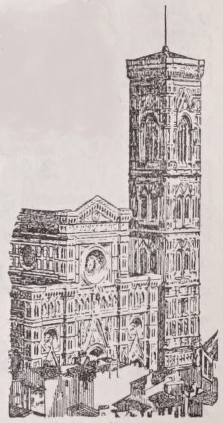
The tallest campanile is the one at Cremona; it rises to a height of 393 feet. Probably the grandest and richest is that designed by Giotto in 1334 for the cathedral at Florence. It measures 275 feet high and 45 feet square; it is entirely veneered with black, red, and white marble, and is divided into five stages, the upper three only having windows. Giotto intended to have finished it with a spire 90 feet high, but Taddio Gaddi, who succeeded Giotto as architect, thinking that the tower would not be improved by it, left it as it now exists. Some of the best examples of church campanili are to be found in Venice, Verona, Modena, Cremona, Parma, and Pisa.
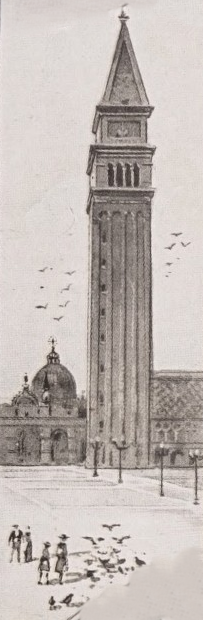
The campanili belonging to the municipalities have generally a distinct character from those attached to sacred edifices; they have a smaller section on plan in proportion to the height. They want the conical roof, and are generally battlemented; some have an upper and smaller stage, wherein the bells are hung, as at Florence, Siena, Volterra, and Montepulciano. Their faces are rarely divided by pilasters; there are few windows, generally small openings only to light the staircase; and they are more frequently incorporated with the body of the building than the church campanüi, often rising from the wall heads and not from the ground to great heights. The most remarkable campanili are those at Venice, Florence, Pisa, and Siena. The campanile of St Mark’s at Venice stands in the great square in front of the cathedral. Its erection was commenced about the beginning of the 10th, and completed up to the belfry about the middle of the 12th century. The belfry was erected and finished by Bartolomeo Buono in 1517. From the level of the piazza to the belfry stage, it is constructed of brick; the belfry and surmounting pyramid are of marble. The total height is 323 feet, and it is 42 feet square at the base. The gallery at top is reached by an inclined plane, and there are no windows other than small openings lighting the ascent.
The leaning tower or campanile of Pisa, built by the citizens to rival that of Venice, was erected by Bonanno, and begun in the year 1174. It is circular on plan, and about 51 feet in diameter and 172 feet high. Not including the belfry it is divided vertically into seven stages, all of which, with the exception of the lowest, are decorated with an open arcade. The conical covering of the belfry was never constructed. This tower overhangs its base upwards of 13 feet, and for Jong it was supposed to have been built so. It is founded on wooden piles driven into boggy ground. When the tower had been carried up about 35 feet it began to settle to one side. That no such settlement was ever anticipated may be asserted from the fact that a gurgoyle or water-spout to throw off the water from the first arcade, may be observed on what is now the highest side. As the work was carried on, the levels were altered so as to keep the centre of gravity within the base. This tower was finished by an architect called William of Innspruck. The outside is entirely constructed of white marble, and the inside of stone from Verruca. There are many campanili, notably the Garisendi and Asihelli towers at Bologna, that incline to one side,—all from the same cause as at Pisa.
The campanili of Florence and Siena are somewhat similar in design. The one at Florence is built of stone, and is about 20 feet square and about 300 feet high. That at Siena is built entirely of brick, and measures about 21 feet square and 282 feet high. Both are battlemented and have a smaller upper stage for the belfry. Several other important examples exist at Volterra, Montepulciano, Figline, Oppi, &c., &c. (r. an.)
[1,127 words — estimated reading time: 7 minutes]