GERA, the chief town of the principality of Reuss-Schleiz, stands in a valley on the banks of the White Elster, 35 miles S.S.W. cf Leipsic. It has been all rebuilt since a great fire in 1780, and the streets are in general wide and straight, and contain many handsome houses. The principal buildings are the churches of St Salvator’s and St Trinity, the town-hall, the buildings of the imperial bank and of the Gera bank, the music hall, and the central hall. Its educational establishments include a gymnasium, a general town school (which contains a real school of the first order, a higher female school, and three citizen schools), a commercial school, anormal school, and a weaving school. The castle of Osterstein, the residence of the prince of Reuss, dates from the 9th century, but has been nearly all rebuilt within the last thirty years. Gera has long been noted for its industrial activity. Its manufactures comprise woollen, cotton, and silk goods, tapestry, artificial flowers, oil-cloth, leather, hats, tobacco, soap, beer, vinegar, chocolate, glue, porcelain and other earthenware, bricks, musical instruments, and carriages.
Gera was raised to the rank of a town in the 11th century, at which time it belonged to the counts of Groitch. In the 12th century it came into the possession of the lords of Reus∙>. It was stormed and sacked by the Bohemians in 1450, was two-thirds burned down by the Swedes in 1639 during the Thirty Years’ War, and suffered afterwards from great conflagrations in 1686 and 1780, being in the latter year almost completely destroyed. The population in 1875 was 20,810, nearly all of whom are Protestants.
9th ed. Encyclopædia Britannica, vol. 10, p. 438 [282 words — estimated reading time: 2 minutes]
GERACE or Gieraci, a town of Italy in the province of Reggio di Calabria, about 59 miles from Reggio on the railway between that city and Monasterace, is situated on a limestone hill not far from the coast, 30 miles N.N.E. of Cape Spartivento, between the rivers Merico and Novito. It is the seat of a bishop and of a subprefect, and has a civil and criminal court dependent on that of Catanzaro. The citadel, formerly of great strength, was reduced to ruins by the earthquake of 1793; and the cathedral was at the same time so severely injured that only a portion of the crypt remained available for public worship. There is a good trade in a white wine known as Vino Greco; silk is manufactured; and the warm sulphur springs of the neigbourhood attract patients to the town. About 5 miles off, at Torre di Gerace, are the ruins of the Greek city of LocriEpi zephyrii, from which Gerace derived materials for its buildings, and more especially fine marble columns for the cathedral. The population in 1871 was 7257. This Gerace is not to be confounded with Gerace Siculo, a town of between 3000 and 4000 inhabitants, 4 miles from Cefalu, which was the first place in Sicily erected into a marquisate.
9th ed. Encyclopædia Britannica, vol. 10, p. 439 [217 words — estimated reading time: 2 minutes]
1. A genus of plants having a beaklike tours or receptacle, around which the seed capsules are arranged, and membranous projections, or stipules, at the joints. Most of the species have showy flowers and a pungentodor. Called sometimes crane's-bill.
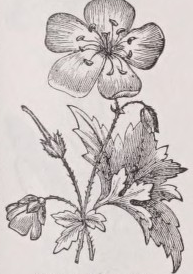
GERANIUM is the name of a genus of polypetalousexogenous plants, which is taken by botanists as the type of the natural order Geraniaceae. The name, as a scientific appellation, has a much more restricted application than when taken in its popular sense. Formerly the genus Geranium was almost conterminous with the order Geraniaceae, which latter had then a more limited meaning than is given to it by those of our leading botanists of the present day who include in it the Tropaeolaceae, the 0xali- daceae, and the Balsaminaceae. Then as now the geranium was very popular as a garden plant, and the species included in the original genus became widely known under that name, which has more or less clung to them ever since, in spite of scientific changes which have removed the larger number of them to the genus Pelargonium. This result has been probably brought about in some degree by an error of the nurserymen, who seem in many cases to have acted on the conclusion that the group commonly known as Scarlet Geraniums were really geraniums and not pelargoniums, and have in consequence inserted them under the former name in their trade catalogues. In fact it may be said that, from a popular point of view, the pelargoniums of the botanist are better known as geraniums than are the geraniums themselves....
The species of Geranium bear the English name of Cranesbill, and consist mostly of herbs, of annual or perennial duration, dispersed throughout the temperate regions of the world. They number nearly a hundred, and bear a considerable family resemblance. The leaves are for the most part palmately-lobed, and the flowers are regular, consisting of five sepals, five imbricating petals, alternating with five glandules at their base, ten stamens, and a beakedovary. Some dozen or more species are natives of the British Isles; and many of those of exotic origin form handsome border plants in our gardens of hardy perennials. Amongst these G. ibericum, G. platypetalum, G. sanguineum, G. Backhousianum, and the double-flowered varieties of G. pratense are conspicuous. The genus is not without its virtues, G. maculatum being the alum-root of North America, used there as an astringent in diarrhoea, dysentery, and such like complaints, while the native Herb Robert of English hedgesides, G. Robertianum, which is both astringent and aromatic, is used as a remedy in nephritic disorders.
From these regular-flowered herbs, with which they had been mixed up by the earlier botanists, L’Heritier in 1787 separated those plants which have since borne the name of Pelargonium, and which, though agreeing with them in certain points of structure, differ in others which are admitted to be of generic value. One obvious distinction of Pelargonium is that the flowers are irregular, the two petals which stand uppermost being different—larger, smaller, or differently marked—from the other three, which latter are occasionally wanting. This difference of irregularity the modern florist has done very much to annul, for the increased size given to the flowers by high breeding has usually been accompanied by the enlargement of the smaller petals, so that a very near approach to regularity has been in some cases attained. Another well-marked difference however remains in Pelargonium: the back or dorsal sepal is furnished with a hollow spur, which spur is adnate, i.e., joined for its whole length with the flower-stalk; while in Geranium there is no spur. This peculiarity is best seen by cutting clean through the flower-stalk just behind the flower, when in Pelargonium there will be seen the hollow tube of the spur, which in the case of Geranium will not be found as it does not exist, but the stalk will appear as a solid mass. There are other characters which support those already pointed out, such as the absence of the glandules, and the declination of the stamens; but the features already described offer the most ready and obvious distinctions.
To recapitulate, the geraniums properly so-called are regular-flowered herbs with the flower stalks solid, while many geraniums falsely so-called in popular language are really pelargoniums, and may be distinguished by their irregular flowers and hollow flower stalks. In a great majority of cases too, the pelargoniums so commonly met with in greenhouses and summer parterres are of shrubby or sub-shrubby habit.
9th ed. Encyclopædia Britannica, vol. 10, p. 439 [728 words — estimated reading time: 5 minutes]
GERARD of Cremona (1114-1187), the mediaeval translator of Ptolemy and Avicenna, was born at Cremona, Lombardy, in 1114. Dissatisfied with the meagrephilosophies of his Italian teachers, he went to Toledo to study among the Moors, who were at that time the chief depositaries and interpreters of the wisdom of the ancients; and, having thus acquired a knowledge of the Arabic language, he appears to have devoted the remainder of his life to the business of'making Latin translations from its literature. The date of his return to his native town is uncertain, but he is known to have died there in 1187. His original version of Avicenna’s Canon of Medicine was the basis of all the very numerous subsequent Latin editions of that well-known work; and the Latin translation by which alone Ptolemy’s Almagest until the discovery of the original μeyaλη σvvτaLLς was known to Europe is also ascribed to him. In addition to these, he translated various other treatises in medicine, mathematics, and astronomy, to the number, it is said, of sixty-six; but some of the works with which he has been credited (including the translation of the Almansorius of Er-Razi or Rhazes) are more probably due to a later Gerard also called “Cremonensis,” but more precisely “de Sabloneta,” See Boncompagni, Della Vita e delle Opere di Gherardo Cremonense e di G her ar do da Sabbionetta....
GERARD, variously surnamed Tum, Tunc, Tenque, or Thom (c. Γ040-1120), founder of the order of the knights hospitallers of St John or of Malta, was born at Amalfi about the year 1040. According to other accounts Martigues in Provence was his birthplace, while one authority even names the Château d’Avesnes in Hainault. Whether as a soldier or a merchant, he in the course of the latter part of the 11th century found his way to Jerusalem, where a hospice had for some time existed for the convenience of those who wished to visit the holy places. Of this institution Gerard became guardian or provost at a date not later than 1100; and here he organized that religious order of St John which received papal recognition from Pascal II. in 1113, by a bull which was renewed and confirmed by Calixtus II. shortly before the death of Gerard in 1120.
GERARD, John (1545-1608), herbalist and surgeon, was born towards the end of 1545 at Nantwich in Cheshire. He was educated at Wisterson, or Willa t 3t0n, 2 miles from Nantwich, and eventually, after spending some time in travelling, took up his abode in London, where he exercised his profession. For more than twenty years he also acted as superintendent of the gardens of Lord Burghley, secretary of state to Queen Elizabeth. In 1596 he published a catalogue of plants cultivated in his own garden, 1039 in number, inclusive of varieties of the same species. Their English as well as their Latin names are given in a revised edition of the catalogue issued in 1599. In 1597 appeared Gerard’s well-known IIerball, described by him in its pre face as ’ ' the first fruits of these mine own labours,” but more truly an adaptation of the Stirpium historice pemptades of Rembert Dodoens, published in 1583, or rather of a translation of the whole or part of the same by Dr Priest, with L’Obel’s arrangement. Of the numerous illustrations of the IIerball sixteen appear to be original, the remainder are mostly impressions from the wood blocks employed by Jacob Theodorus (Tabernaemontanus) in his leones Stirpium, published at Frankfort in 1590. A second edition of the Rerball, with considerable improvements and additions, was brought out by Thomas Johnson in 1633, and reprinted in 1636. Gerard was elected a member of the court of assistants of the barber-surgeons in 1595, by which company he was appointed an examiner in 1598, juniorwarden in 1605, and master in 1608. He died in February 1612, and was buried at St Andrews, Holborn.
See Johnson’s preface to his edition of the Herball ; and A Catalogue of Plants cultivated in the Garden of John Gerard in the years 1596-1599, edited with Notes, References to Gerards Herball, the Addition of modern Names, and a Life of the Author, by Benjamin Daydon Jackson, F.L.S., privately printed, Lond. , 1876, 4to.
9th ed. Encyclopædia Britannica, vol. 10, p. 439 [236 words — estimated reading time: 2 minutes]
GERASA, the modern Gerash or Jerash, a city of Palestine, in the Decapolis of Peraea, situated amid the mountains of Gilead, about 1757 feet above the level of the sea, at a distance of 20 miles from the Jordan and 21 miles to the north of Philadelphia. Of its origin nothing is known. Its name is never mentioned in the Old Testament, and in the New Testament the only reference to its existence is the alternative reading of Gerasenes for Gadarenes in Matthew viii. 28. From Josephus we learn that it was captured by Alexander Jannaeus, burned by the Jews in revenge for the massacre at Caesarea, and again plundered and depopulated by Annius the general of Vespasian; but in spite of these disasters it was still in the 2d and 3d centuries of the Christian era one of the wealthiest and most flourishing cities of Palestine. As late as 1121 it gave employment to the soldiers of Baldwin II., who found it defended by a castle built by a king of Damascus; but at the beginning of the following century the Arabian geographer Yakut speaks of it as deserted and overthrown. The ruins of Jerash, discovered by Seitzen about 1806 and since then frequently visited and described, still attest the splendour of the Roman city. They are distributed along both banks of theKerwan, a brook which flows south through the Wady-ed-Dêr to join the Zerka or Jabbok; but all the principal buildings are situated on the level ground to the right of the stream. The town walls, which can still be traced and indeed are partly standing, had a circuit of not more than 2 miles, and the main street was less than half a mile in length; but remains of buildings skirt the road for fully a mile beyond the south gate, and show that the town had far outgrown the limit of its fortifications. The most striking feature of ...the ruins is the profusion of columns, no fewer than 230 being even now in position: the main street is a continuous colonnade, a large part of which is still entire, and it terminates to the south in a forum of similar formation. Among the public buildings still recognizable are a theatre capable of accommodating 6000 spectators, a naumachia or circus for naval combats, and several temples, of which the largest was probably the grandest structure in the city, possessing a portico of Corinthian pillars 38 feet high. The desolation of the city is probably due to earthquake; and the absence of Moslem erections or restorations would seem to show that the disaster took place before the Mahometan period.
9th ed. Encyclopædia Britannica, vol. 10, p. 441 [444 words — estimated reading time: 3 minutes]
GÉRARD, Étienne Maurice, Count (1773-1852), a distinguished French general, was born at Damvilliers in the department of Meuse, 4th April 1773. He joined the second battalion of the Meuse in 1791, and served in the campaigns of 1792-1793 under Generals Dumouriez and Jourdan. In 1798 he accompanied Bernadotte as aide-decamp in his embassy to Vienna. In 1799 he was named chief of a squadron, and in 1800 colonel. He distinguished himself by a brilliant charge against the Russian imperial guard at the battle of Austerlitz, and being raised to the rank of general in November 1806, played a prominent part in the battles of Halle, Jena, and Erfurt; and for his conduct in the battle of Wagram, where he greatly contributed to the victory, he was created a baron. In the Spanish campaign of 1810 and 1811 he gained special distinction at the battle of Fuentes-de-Onoro; and in the subsequent expedition to Russia he was present at the capture of Smolensk, had a principal share in the victory of Walontina-Gora, displayed such bravery and ability in the battle of the Moskova that he was made general of division, ≈and by his coolness and energy in the disastrous retreat from Moscow saved the rearguard of the French army at the passage of the Wilna. In the campaign of 1813, in command of a division under Macdonald, he took part in the battles of Lützen, Bautzen, Goldberg, and Leipsic, where he was dangerously wounded. After the battle of Bautzen he was created by Napoleon a count of the empire. In the campaign of France of 1814, in command of the army of reserves composed chiefly of recruits, he by his skilful manoeuvres powerfully assisted in securing the victories of Nogent, Nangis, and Montereau-sur-Yonne. After the first restoration he was named by Louis XVIII. grand cross of ...the legion of honour and chevalier of St Louis. On the return of Napoleon from Elba he was entrusted with the command of the army of the Moselle, and took part in the battle of Ligny. On the morning of the battle of Waterloo, being under the orders of Grouchy, who was marching towards Wavre, he strongly urged him to proceed in the direction whence they heard cannon firing, but his advice was not followed. Gérard retired to Brussels after the fall of Napoleon, and did not return to France till 1817. He was chosen a member of the chamber of deputies in 1822, and was re-elected in 1823 and 1827. He took part in the revolution of 1830, after which he was appointed minister of war and named a marshal of France. On account of his health he resigned the office of w ar minister in the October following, but in 1831 he took the command of the northern army, and was successful in thirteen days in driving the army of Holland out of Belgium. In 1832 he compelled the surrender of Antwerp, and in the same year he was raised to the peerage of France. He was again chosen war minister in July 1834, and again resigned that office in the October following. In 1835 he was named grand chancellor of the legion of honour, and in 1838 commander-general of the national guards of the Seine, an office which he held till 1842. He became a senator under the empire in 1852, and died in April of the same year.
GÉRARD, François, Baron (1770-1837), was born on May 4, 1770, at Rome, where his father occupied a post in the house of the French ambassador. At the age of twelve Gérard left Rome with his family for Paris, and there obtained admission into the Pension du Roi. From the Pension he passed to the studio of Pajou (sculptor), which he left at the end of two years for that of the painter Brenet, whom he quitted almost immediately to place himself under David. In 1789 Gérard competed for the Prix de Rome, which was carried off by his comrade Girodet. In the following year (1790) he again presented himself, but the death of his father prevented the completion of his work, and obliged him to accompany his mother to Rome.
In 1791 he returned to Paris; but his poverty was so great that he was forced to forego his studies in favour of employment which should bring in immediate profit. David at once availed himself of his help, and one of that master’s most celebrated portraits—Le Pelletier de St Fargeau—is due to the hand of “le petit Gérard.” This portrait was executed early in 1793, the year in which Gérard, at the request of David, was named a member of the revolutionary tribunal, from the fatal decisions of which he, however, invariably absented himself. In 1794 he obtained the first prize in a competition, the subject of which was “The Tenth of August,” and, further stimulated by the successes of his rival and friend Girodet in the Salons of 1793 and 1794, Gérard (nobly aided by Isabey the miniaturist) produced in 1795 his famous “Bélisaire.” In 1796 a portrait of his generous friend (Louvre) obtained undisputed success, and the money received from Isabey for these two works enabled Gérard to execute in 1797 his “Psyche et 1’Amour.” At last, in 1799, his portrait of Madame Bonaparte established his position as one of the first portrait painters of the day. In 1808 as many as eight, in 1810 no less than fourteen portraits by him, were exhibited at the Salon, and these figures afford only an indication of the enormous numbers which he executed yearly; all the leading figures of the empire and of the restoration, all the most celebrated men and women of Europe, sat to Gérard. This extraordinary vogue was due partly to the charm of his manner and conversation, for his salon was as much frequented as his studio; Madame de Stael, Canning, Talleyrand, the duke of Wellington, have all borne witness to the attraction of his society. Rich and famous, Gérard was stung by remorse for earlier ambitions abandoned; at intervals he had indeed striven to prove his strength with Girodet and other rivals, and his “Bataille d’Austerlitz” (1810) showed a breadth of invention and style which are even more conspicuous in “L’Entrée d’Henri IV.” (Versailles),—the work with which in 1817 he did homage to the Bourbons. After this date Gérard declined, watching with impotent grief the progress of the Romantic school. Loaded with honours—baron of the empire, member of the Institute, officer of the legion of honour, first painter to the king—he worked on sad and discouraged; the revolution of 1830 added to his disquiet; and in 1837 on 11th January, after three days of fever, he died. By his portraits Gérard is best remembered; the colour of his paintings has suffered, but his drawings show in uninjured delicacy the purity of his line; and those of women are specially remarkable for a virginal simplicity and frankness of expression.
Μ. Ch. Lenomιant published in 1846 Essai de Biographic ct de Critique sur François Gérard, a second edition of which appeared in 1847; and Μ. Delécluze devoted several pages to the same subject, in his λvork Louis David, son école et son temps.
GÉRARD, Jean IgnaceIsidore (1803-1847), a French caricaturist generally known by the pseudonym of Grandville—the professional name of his grandparents, whowaere actors—was born at Nancy, 13th September 1803 He received his first instruction in drawing from his father, a miniature painter, and at the age of twenty-one came to Paris, where he soon afterwards published a collection of lithographs entitled Les tribulations de la petite jyropñété. He followed this by Les plaisirs de tout âge, and La sibylle des salons ; but the work which first established his fame was Metamorphoses du jour, published in 1828, a series of 70 scenes in which individuals with the bodies of men and faces of animals are made to play a human comedy. These drawings are remarkable for the extraordinary skill with which human characteristics are represented in animal features, but they are liable to the olyection of attempting to express by the pencil what can be properly done only by the pen; while at the same time, in conquering difficulties incident to his purpose, much ingenuity and labour has been wasted which might have been employed otherwise with better results. The success of this work led to his being engaged as artistic contributor to various periodicals such as La Silhouette, L'Artiste, La Caricature, Le Charivari ', and his political caricatures, which were characterized by marvellous fertility of satirical humour, soon came to enjoy a general popularity which never diminished. Besides supplying illustrations for various standard works, such as the songs of Béranger, the fables of La Fontaine, Don Quixote, Gulliver's Travels, Robinson Crusoe, he also continued the issue of various lithographic collections, among which may be mentioned La vie privée et publique des animaux, Les cent proverbes, L'autre monde, and Les fieurs animées. Though the designs of Gérard are occasionally unnatural and absurd, they usually display keen analysis of character and marvellous inventive ingenuity, and his humour is always tempered and refined by delicacy of sentiment and a vein of soberthoughtfulness. He died of mental disease 17th March 1847.
A short notice of Gérard, under the name of Grandville, is contained in Theophile Gautier’s Portraits Contemporains. See also Charles Blanc, Grandville, Paris, 1855.
9th ed. Encyclopædia Britannica, vol. 10, p. 440 [579 words — estimated reading time: 4 minutes]
GÉRARD DE NERVAL (1808-1855) is the adopted name of Gérard Labrunie, a French litterateur, and that by which he is generally known. The son of an officer in the army, and born at Paris, May 21, 1808, he received his early education chiefly from his father, who taught him German, and he afterwards studied at the college of Charlemagne. He made his literary début by the publication of a volume of political odes, and in 1828 he published a translation of Goethe’s Faust, of which Goethe himself expressed high approval, and the choruses of which were afterwards made use of by Berlioz for his legendsymphony, The Damnation of Faust. Several other translations from the German, contributed chiefly to the Mercure de France, a number of poetical pieces, and three comedies combined to acquire for him, at the age of twenty-one, a considerable literary reputation, and led to his being associated with Theophile Gautier in the preparation of the dramatic feuilleton for the Presse. On the death of Jennie Colon, an actress with whom he had contracted a liaison, he resigned his connexion with the Presse, and travelled in various parts of Europe, leading a somewhat dissipated life. He contributed an account of his travels to the Revue des Deτιx Mondes and other periodicals. After his return to Paris in 1844 he resumed for a short time the feuilleton. From 1841 he was subject to periodical attacks of insanity, aud he committed suicide by hanging, 25th January 1855. The literary style of Gérard is simple and unaffected, and he has a peculiar faculty of giving to his imaginative creations an air of naturalness and reality. In a series of novelletes, afterwards published under the name of Les Illuminés ou les Précurseurs du Socialisme (1852), he gave a sort of analysis of the ...feelings which followed his third attack of insanity; and among his numerous other works the principal are Elégies nationales et Satires politiques, 1827; Scènes de la Vie Orientale, 2 vols., 1848-1850; Contes et Facéties, 1852; La Bohême galante, 1856; and L' Alchimiste, a drama in five acts, the joint composition of Gérard and Alexander Dumas. His Oeuvres complètes were published in 1868 in 5 volumes.
9th ed. Encyclopædia Britannica, vol. 10, p. 441 [383 words — estimated reading time: 3 minutes]
And there was a famine in the land, beside the first famine that was in the days of Abraham. And Isaac went unto Abimelech king of the Philistines unto Gerar.
Now there was another famine in the land, subsequent to the one that had occurred in Abraham’s time. And Isaac went to Abimelech king of the Philistines at Gerar.
And the herdmen of Gerar did strive with Isaac’s herdmen, saying, The water is ours: and he called the name of the well Esek; because they strove with him.
But the herdsmen of Gerar quarreled with Isaac’s herdsmen and said, “The water is ours!” So he named the well Esek, because they contended with him.
This they shall give, every one that passeth among them that are numbered, half a shekel after the shekel of the sanctuary: (a shekel is twenty gerahs:) an half shekel shall be the offering of the LORD.
Everyone who crosses over to those counted must pay a half shekel, according to the sanctuary shekel, which weighs twenty gerahs. This half shekel is an offering to the LORD.
And those that are to be redeemed from a month old shalt thou redeem, according to thine estimation, for the money of five shekels, after the shekel of the sanctuary, which is twenty gerahs.
You are to pay the redemption price for a month-old male according to your valuation: five shekels of silver, according to the sanctuary shekel, which is twenty gerahs.
But when the children of Israel cried unto the LORD, the LORD raised them up a deliverer, Ehud the son of Gera, a Benjamite, a man lefthanded: and by him the children of Israel sent a present unto Eglon the king of Moab.
And again they cried out to the LORD, and He raised up Ehud son of Gera, a left-handed Benjamite, as their deliverer. So they sent him with tribute to Eglon king of Moab.
And when king David came to Bahurim, behold, thence came out a man of the family of the house of Saul, whose name was Shimei, the son of Gera: he came forth, and cursed still as he came.
As King David approached Bahurim, a man from the family of the house of Saul was just coming out. His name was Shimei son of Gera, and as he approached, he kept yelling out curses.
And there went over a ferry boat to carry over the king’s household, and to do what he thought good. And Shimei the son of Gera fell down before the king, as he was come over Jordan;
and crossed at the ford to carry over the king’s household and to do what was good in his sight. When Shimei son of Gera crossed the Jordan, he fell down before the king
And, behold, thou hast with thee Shimei the son of Gera, a Benjamite of Bahurim, which cursed me with a grievouscurse in the day when I went to Mahanaim: but he came down to meet me at Jordan, and I sware to him by the LORD, saying, I will not put thee to death with the sword.
Keep an eye on Shimei the son of Gera, the Benjamite from Bahurim who is with you. He called down bitter curses against me on the day I went to Mahanaim, but when he came down to meet me at the Jordan, I swore to him by the LORD: ‘I will never put you to the sword.’
This site uses cookies to remember your display preferences (search sources and editions, Bible version, auto-link, images, light/dark theme). No personal data whatsoever is collected. Privacy Policy