HEDGE-SPARROW. See Sparrow....
ΠEEM, Jan Davidsz van (or Johannes de), was born according to Houbraken and Sandrart in 1604, according to Descamps in 1600, at Utrecht, and died at Antwerp in 1683 or 1684. Thoré has said of Heda, but it is only true of De Heem, that “he glorified insects, butterflies, and all the minute beings that swarm in vegetation, and made the moth drink in cups of chased gold.” He was, if not the first, certainly the greatest painter of still life in Holland; no artist of his class combined more successfully perfect reality of form and colour with brilliancy and harmony of tints. No object of stone or silver, no flower humble or gorgeous, no fruit of Europe or the tropics, no twig or leaf, with which he was not familiar. Sometimes he merely represented a festoon or a nosegay. More frequently he worked with a purpose to point a moral or illustrate a motto. Here the snake lies coiled under the grass, there a skull rests on blooming plants. Gold and silver tankards or cups suggest the vanity of earthly possessions; salvation is allegorized in a chalice amidst blossoms, death as a crucifix inside a wreath. Sometimes De Heem painted alone, sometimes in company with men of his school, Madonnas or portraits surrounded by festoons of fruit or flowers. At one time he signed with initials, at others with Johannes, at others again with the name of his father joined to his own. At rare intervals he condescended to a date, and when he did the work was certainly of the best. De Heem entered the guild of Antwerp in 1635-6, and became a burgher of that city in 1637. He steadily maintained his residence till 1667, when he moved to Utrecht, where traces of his presence are preserved in records of 1668, 1669, and 1670. It is not known when he finally returned to Antwerp, but his death is recorded in the guild books of that place. A very early picture, dated 1628, in the gallery of Gotha, bearing the signature of Johannes in full, shows that De Heem at that time was familiar with the technical habits of execution peculiar to the youth of Albert Cuyp. In later years he completely shook off dependence, and appears in all the vigour of his own originality.
Out of 100 pictures or more to be met with in European galleries scarcely eighteen are dated. The earliest after that of Gotha is a chased tankard, with a bottle, a silver cup, and a lemon on a marble table, dated 1640, in the museum of Amsterdam. A similar work of 1645, with the addition of fruit and flowers and a distant landscape, is in Lord Radnor’s collection at Longford. A chalice in a wreath, with the radiant host amidst wheatsheaves, grapes, and flowers, is a masterpiece of 1648 in the Belvedere of Vienna. A wreath round a Madonna of life size, dated 1650, in the museum of Berlin, shows that De Heem could paint brightly and harmoniously on a large scale. In the Pinakothek at Munich is the celebrated composition of 1653, in which creepers, beautifully commingled with gourds and blackberries, twigs of orange, myrtle, and peach, are enlivened by butterflies, moths, and beetles. A landscape with a blooming rose tree, a jug of strawberries, a selection of fruit, and a marble bust of Pan, dated 1655, is in the Hermitage at St Petersburg; an allegory of abundance in a medallion wreathed with fruit and flowers, in the gallery of Brussels, is inscribed with De Heem’s monogram, the date of 1668, and. the name of an obscure artist called Lambrechts. All these pieces exhibit the master in full possession of his artistic faculties.
Cornelius de Heem, the son of Johannes, was in practice as a flower painter at Utrecht in 1658, and was still active in his profession in 1671 at the Hague. His pictures are not equal to those of his sire, but they are all well authenticated, and most of them in the galleries of the Hague, Dresden, Cassel, Vienna, and Berlin. In the Staedel at l· rankfort is a fruit piece, with pot-herbs and a poιcelaιn jug, dated 1658; another, dated 1671, is in the museum of Brussels. David de Heem, another member of the family, entered the guild of Utrecht in 1668 and that of Antwerp in 1693. lhe best piece assigned to him is a table with a lobster fruit, and glasses, in the gallery of Amsterdam; others bear his signature in the museums of Florence, St Petersburg, and Brunswick. It is well to guard against the fallacy that David de Heem above mentioned is the hither of Jan de Heem. We should also be careful not to make two persons of the artist who sometimes signs Johannes, sometimes Jan Davidsz or J. D. Heem.

[818 words — estimated reading time: 5 minutes]
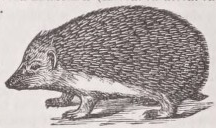
HEDGEHOG{Erinaceus europoeus, Linn.), the Common Urchin of Pennant, Hérisson of the French, Riccio of the Italians, Igel of the Germans, is the best known, and from an anatomical point of view perhaps the most characteristic, of the Insectivora. The genus is remarkable for its dentition, its armature of spines, and its short tail, while the ordinary species is characterized by not having the spines longer than the head or the ears more than half that length. The upper jaw is longer than the lower one, and the whole snout, which is long and flexible, has somewhat the appearance of that of the hog; the nostrils are narrow; and the claws are long but weak. The animal is about 10 inches long, its eyes are small, and the integument of the ventral surface is covered with hairs of the ordinary character. The brain is remarkable for its low degree of development, the cerebral hemispheres being excessively small, and marked with but one groove, and that a shallow one, on each side, while the more special characters of this region call to mind the organization of the same parts in the very lowest of mammals....
The most remarkable point in its external appearance is the possession of spines, and the power possessed by it of rolling itself up into a ball, from which these spines stand out in every direction. The spines, which are modified hairs, are sharp, hard, and elastic, and form so efficient a defence that there are but few animals that are able, and even they rarely, to effect a successful attack on this curious creature. The moment it is touched, or even hears the sound of so slight a menace as the report of a gun, it rolls itself up by the action of the powerful muscles which lie just beneath the skin, while this same contraction effects the erection of the spines. The most important muscle is the orbicularis panniculi, which extends over the anterior region of the skull, as far down the body as the ventral or purely hairy region, and on to the tail; three other muscles are connected with this, and aid in the contraction of the integument, passing as they do from the breast-bone to the face and lower jaw, from the fore-arm to the sides of the ventral region, and from the fore-arm to the dorsal surface.
Though insectivorous, the hedgehog is reported to have a great liking for mice, while frogs and toads, as well as plants and fruits, all seem to be acceptable; its ingestion of snakes has been detailed by Buckland and Broderip, and its fondness for eggs has caused it to meet with the enmity of game preservers. Pennant reports that “it lies under the undeserved reproach of sucking cattle, and hurting their udders, but the smallness of its mouth renders that impossible,” nor does it seem that any well-authenticated report of such an occurrence has ever been made. It makes a not rare domestic pet. In a state of nature it does not emerge from its retreat during full daylight, unless urged out by hunger or by the necessities of its young. During the cold of winter it passes into a state of complete hibernation, and its temperature falls very considerably; having provided itself with a nest of dry leaves, it is well protected from the influences of the rain, and rolling itself up it remains undisturbed till distinctly warmer weather returns. In July or August the female brings forth four to eight young, or, according to others (Bell), two to four at a somewhat earlier period; at birth the spines, which in the adult are black in the middle, are white and soft, but soon harden, though they do not attain their full size until the succeeding spring. It is commonly found in woods and gardens, and extends over nearly the whole of Europe; it has been found at 6000 to 8000 feet above the level of the sea. The witch in Macbeth who heard the “hedge-pig” whine thrice and once gave not an incorrect account of the character of its voice, rarely as this is heard. The adult is provided with thirty-six, and the young with twenty-four teeth; in both cases canines appear to be absent; the median incisors are very long, and project; there are two more false grinders in the upper than in the lower jaw, while the true molars of the upper jaw are remarkable for the presence of four cusps, of which the anterior inner and the posterior outer are connected by an obliquely-set ridge. This is the same arrangement as is seen in man. In the lower jaw the corresponding teeth are, as in the lemurs (or half-apes), provided with two transverse ridges.
Sixteen species of the genus have been recognized by some zoologists. The tenrec {Centetes} of Madagascar has very many points in common with it.
[828 words — estimated reading time: 5 minutes]