TRUMPET, a musical instrument, consisting of a long, narrow brass tube, cylindrical for the greater part of its length: the fusiform development which terminates in the bell or opening of the lower end only begins at a point that varies from a third to a fourth of the total length from that extremity. The air inside is set in vibration by the lips (which act as true reeds) applied to the edges of a basin-like mouthpiece fitted to the upper part of the instrument. The material has nothing to do with the production of that brilliant quality of tone by which the trumpet is so easily distinguished from every other mouthpiece instrument: the difference is partly due to the distinct form given to the basin of the mouthpiece, but principally to the proportions of the column of air determined by the conical or cylindrical form of its envelope....
The possibility of producing sonorous disturbance of a mass of air through a mouthpiece, or more simply through the orifice of the tube, has been known from a very early period,—a shell bored at its extremity, or a horn with the point removed, being without doubt the most ancient instrument for producing sound. Nearly all the nations of antiquity had mouthpiece instruments; but the greater number of these, though grouped under the general designation of trumpets, have only a very distant relationship to the modern instrument. The Romans had four such instruments,—the tuba, buccina, cornu, and lituus. The tuba, represented in the bas-reliefs of the triumphal arch of Titus, was a kind of straight bronze clarion, with a conical column of air. It is ordinarily designated the Roman trumpet, and was about 39 inches long; its compass should not go beyond the first six proper notes of the harmonic scale. The Roman tuba and the Greek salpinx are supposed to be one and the same instrument. The buccina was also of bronze, with a tube measuring fully 11 feet in length. The tube is only slightly conical, and the quality of tone bears a striking resemblance to that of the bass trombone in G; the proper tones for harmonics were those subjoined. The cornu was often made of a bullock’s horn, but bronze was also employed, as in a specimen in the British Museum. This instrument measured 4 feet 6 inches in length, and the scale was that herewith shown. The Roman cornu was probably like the Greek keras. The three preceding instruments were used in giving signals to the infantry. The cavalry calls were given with the lituus, a specimen of which exists in the museum of the Vatican, found in 1827 in a tomb at Cerveteri (Caere). The tube is cylindrical for the greater part of its length, its conical development beginning only at the lower end, where the instrument begins to curve. The lituus easily produces the accompanying proper notes; its quality of tone is like that of a trumpet in G. In Ireland and Denmark numerous mouthpiece instruments in bronze have been found, sixteen different specimens being preserved in the museum of the Royal Irish Academy at Dublin, and six (of which facsimiles exist in South Kensington Museum) in the museum at Copenhagen. But none of these have the proportions of a trumpet; all, by the conical development of the tube as well as by the curved form, recall their first model, the horn, successive transformations of which have given rise to the clarion and the numerous family of bugles.
We have no precise information as to the form which the lituus, the ancestor of the modern trumpet, assumed during the Middle Ages. A miniature in the Bible presented in 850 to Charles the Bald places the lituus in the hands of one of the companions of King David, but we are not warranted in concluding from this that the Etruscan instrument was in use in the 9th century. The earliest representation of the trumpet with its present proportions of tube and form of bell seems to belong to the 15th century. Fra Angelico (d. 1455) has painted angels with trumpets having either straight or zigzag tubes, the shortest being about 5 feet long. The perfect representation of the details, the exactness of the proportions, the natural pose of the angel players, suggest that the artist painted the instruments from real models.
The credit of having bent the tube of the trumpet in three parallel branches, thus creating its modern form, has usually been claimed for a Frenchman named Maurin (1498-1515). But the transformation was really made in Italy about the middle of the 15th century, as is proved by the bas-reliefs of Luca della Robbia intended to ornament the organ chamber of the cathedral of Florence (see vol. XX. p. 588); there a trumpet having the tube bent back as just described is very distinctly figured. From the beginning of the 16th century we have numerous sources of information. Virdung cites three kinds of mouthpiece instruments—the felttrumet, the clareta, and the thurner horn ; unfortunately he does not mention their distinctive characters, and it is impossible to make them out by examination of his engravings. Probably the felttrumet and the clareta closely resembled each other; but the compass of the former, destined for military signals, hardly went beyond the 8th proper tone, while the latter, reserved for high parts, was like the clarino (see below). The thurner horn was probably a kind of clarino or clarion used by watchmen on the towers. The trummet and the jäger trommet are the only two mouthpiece instruments of the trumpet kind cited by Praetorius. The first was tuned in D at the chamber pitch or “kam-merton,” but with the help of a shank it could be put in C, the equivalent of the “chorton” D, the two differing about a tone. Sometimes the trummet was lowered to B and even B♭. The jäger trommet, or “trompette de chasse,” was composed of a tube bent several times in circles, like the posthorn, to make use of a comparison employed by Praetorius himself. His drawing does not make it clear whether the column of air was like that of the trumpet; there is therefore some doubt as to the true character of the instrument. The same author further cites a wooden trumpet (hölzern trommet), which is no other than the Swiss alpen-horn or Norwegian luur. Mersenne’s information is not very instructive; but he gives a description of the sourdine, a kind of mute or damper introduced into the bell, already employed in his time, and still made use of to weaken the sound. The shape of the trumpet, as seen in the bas-reliefs of Luca della Robbia, was retained for more than three hundred years: the first alterations destined to revolutionize the whole technique of the instrument were made about the middle of the 18th century. Notwithstanding the imperfections of the trumpet during this long period, the performers upon it acquired an astonishing dexterity.
The usual scale of the typical trumpet, that in D, is
Praetorius exceeds the limits of this compass in the higher range, for he says a good trumpeter could produce the subjoined notes.
This opinion is shared by Bach, who, in a trumpet solo which ends the cantata “Der Himmel lacht,” wrote up to the twentieth of these sounds. So considerable a compass could not be reached by one instrumentalist: the trumpet part had therefore to be divided, and each division was designated by a special name. The fundamental or first proper note was called flattergrob, the second grobstimme, the third faulstimme, the fourth mittelstimme. The part that was called principal went from the fifth to the tenth of these tones. The higher region, which had received the name of “clarino,” was again divided into two parts: the first began at the eighth proper tone and mounted up towards the extreme high limit of the compass, according to the skill of the executant; the second, beginning at the sixth proper tone, rarely went beyond the twelfth. Each of these parts was confided to a special trumpeter, who executed it by using a larger or a smaller mouthpiece.
Playing the clarino differed essentially from playing the military trumpet, which corresponded in compass to that called principal. Compelled to employ very small mouthpieces to facilitate the emission of very high sounds, clarino players could not fail to alter the tone of the instrument, and instead of getting the brilliant and energetic quality of tone of the mean register they were only able to produce more or less doubtful notes without power and splendour. Apart from this inconvenience, the clarino presented numerous deviations from just intonation. Hence the players of that time failed to obviate the bad effects inevitably resulting from the natural imperfection of the harmonic scale of the trumpet in that extreme part of its compass; in the execution, for instance, of the works of Bach, where the trumpet should give sometimes and the instrumentalist could only command some the eleventh proper tone, which times is neither the one nor the other of these.
Further, the thirteenth proper tone, for which is written, is really too flat, and it is absolutely impossible to remedy this defect, since it entirely depends upon the laws of resonance affecting columns of air.
Since the abandonment of the clarino (about the middle of the 18th century) our orchestras have been enriched with trumpets that permit the execution of the old clarino parts, not only with perfect justness of intonation, but with a quality of tone that is not deficient in character when compared with the mean register of the old principal instrument. The introduction of the clarinet or little clarino is one of the causes which led to the abandonment of the older instrument and may explain the preference given by the composers of that epoch to the mean register of the trumpet. The clarino having disappeared before Mozart’s day, he had to change the trumpet parts of Handel and Bach to allow of their execution by the performers of his own time. It was now that crooks began to be frequently used. Trumpets were made in F instead of in D, furnished with a series of shanks of increasing length for the tonalities of E, E♭, D, D♭, C, B, B♭, and sometimes even A.
The first attempts to extend the limited resources of the instrument in its new employment arose out of Hampel’s idea of lowering the harmonic sounds by introducing the hand into the bell. But, instead of fixing the shanks between the mouthpiece and the upper extremity, they were adapted to the body of the instrument itself by a double slide, upon the two branches of which tubes were inserted bent in the form of a circle and gradually lengthened as required. This modified instrument became known as the “invention horn.” This system was applied to the trumpet by Michel Woegel (born at Rastatt in 1748), whose “invention trumpet” had a great success, notwithstanding the unavoidable imperfection of a too great disparity in quality of tone between the open and the closed sounds. The idea of applying the trombone slide to the trumpet is obvious. The slide trumpet is mentioned by T. E. Altenburg, who compares it, and with reason, to the alto trombone; and there are grounds for identifying it with the “tromba da tirarsi” employed by J. S. Bach in some of his compositions. The slide trumpet is still used in England in a somewhat modified form. About 1760, Kolbel, a Russian musician, applied a key to the horn, and soon afterwards the trιmpet received a similar addition. By opening this key, which is placed near the bell, the instrument was raised a diatonic semitone, and by correcting errors of intonation by the pressure of the lips in the mouthpiece the following diatonic succession was obtained.
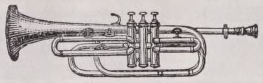
This invention was improved in 1801 by Weidinger, trumpeter to the imperial court at Vienna, who increased the number of keys and thus made the trumpet chromatic thoughout its scale. The instrument shown in the accompanying figure is in G; the keys are five in number, and as they open one after another or in combination it is possible to connect the second proper tone with the third by chromatic steps, and thus produce the following succession. The number of keys was applied to fill up the gaps between the extreme sounds of the interval of a fifth; and a like result was arrived at more easily for the intervals of the fourth, the major third, &c., furnished by the proper tones of 3, 4, 5, &c. But, though the keyed trumpet was a notable improvement on the invention trumpet, the sounds obtained by means of the lateral openings of the tube did not possess the qualities which distinguish sounds caused by the resonance of the air-column vibrating in its entirety. But in 1815 Stölzel made a genuine chromatic trumpet by the invention of the ventile or piston; for this ingenious mechanism, see Trombone. The simple trumpet is now no longer employed except in cavalry regiments.
It is usually in E♭. The bass trumpet in E♭, which is an octave lower, is sometimes, but rarely, used. Trumpets with pistons are generally constructed in F, with crooks in E and E♭. In Germany trumpets in the high B♭ with a crook in A are very often used in the orchestra. They are easier for cornet à piston players than the trumpet in F. The present writer has recently constructed for the concerts of the Conservatoire at Brussels trumpets in the high D, an octave above the old trumpet in the same key. They permit the execution of the high trumpet parts of Handel and J. S. Bach. The bass trumpet with pistons used for Wagner’s tetralogy is in E♭, in unison with the ordinary trumpet with crooks of D and C; but, when constructed so as to allow of the production of the second proper tone as written by this master, this instrument belongs rather to the trombones than to the trumpets. (V. Μ.)
TRUMPET, Speaking and Hearing. The speaking trumpet, though some instrument of the kind appears to have been in earlier use in more than one part of the world, is connected in its modern form with the name of Athanasius Kircher and that of Sir Samuel Morland, who in 1670 proposed to the Royal Society of London the question of the best form for a speaking trumpet. Lambert, in the Berlin Memoirs for 1763, seems to have been the first to give a theory of the action of this instrument, based on an altogether imaginary analogy with the behaviour of light. In this theory, which is still commonly put forward, it is assumed that sound, like light, can be propagated in rays. This, however, is possible only when the aperture through which the wave-disturbance passes into free air is large compared with the wave-length. If the fusiform mouth of the speaking trumpet were half a mile or so in radius, Lambert’s theory might give an approximation to the truth. But with trumpets whose aperture is only a foot in diameter at most the problem is one of diffraction; and it has not yet been seriously studied from this point of view.
In the case of the hearing trumpet, the disturbance is propagated along the converging tube much in the same way as the tide-wave is propagated up the estuary of a tidal river.
Until the theory has been rigorously worked out the only safe course to adopt in manufacturing either class of instruments is to be guided by the results of varied trials.
The theoretical foundations of the subject will be found in Lord Rayleigh’s Sound and in Sir G. Airy’s Tides and Waves , respectively. In speaking and hearing trumpets alike all reverberation of the instrument should be avoided by making it thick and of the least elastic materials, and by covering it externally with cloth.
[2,370 words — estimated reading time: 14 minutes]
The Lord commanded Moses to make two trumpets of beaten silver, to be employed in calling the people together when they were to decamp, Num. x, 2, 3, &c. They also chiefly made use of these trumpets, to proclaim the beginning of the civil year, the beginning of the Sabbatical year, and the beginning of the jubilee, Lev. xxv, 9, 10. Josephus says, that these trumpets were near a cubit long; and had a tube, or pipe, of the thickness of a common flute. Their mouths were only wide enough to be blown into, and their ends were like those of a modern trumpet. At first there were but two in the camp, but afterward a greater number were made. Even in the time of Joshua there were seven of them, Joshua vi, 4. At the dedication of the temple of Solomon six-score priests sounded as many trumpets, 2 Chron. v, 12. Beside the sacred trumpets of the temple, the use of which was restrained to the priests only, in war there were others, which the generals sometimes employed for gathering their troops together. For example, Ehud sounded the trumpet, to assemble the Israelites against the Moabites, who oppressed them, and whose king Eglon he had lately slain, Judg. vi, 27. Gideon took a trumpet in his hand, and gave every one of his people one, when he assaulted the Midianites, Judges vii, 2, 16. Joab sounded the trumpet, to give the signal of retreat to his soldiers, in the battle against those of Abner’s party, and in that against Absalom; and lastly, in the pursuit of Sheba the son of Bichri, 2 Sam. ii, 28; xviii, 16; xx, 22. The feast of trumpets was kept on the first day of the seventh month of the sacred year, the first of the civil year. See MUSIC.
[306 words — estimated reading time: 2 minutes]
TRUMPETER, or Trumpet-Bird, the literal rendering in 1747, by the anonymous English translator of De la Condamine’s travels in South America (p. 87), of that writer’s “Oiseau trompette” (Mem. de l'Acad. des Sciences, 1745, p. 473), which he says was called “Trompetero” by the Spaniards of Maynas on the upper Amazons, from the peculiar sound it utters. He added that it was the “Agami” of the inhabitants of Para and Cayenne, wherein he was not wholly accurate, since those birds are specifically distinct, though, as they are generically united, the statement may pass. But he was also wrong, as had been Barrere (France Equinoxiale, p. 132) in 1741, in identifying the “Agami” with the “Macucagua” of Marcgrave, for that is a Tinamou ( q.v.) ; and both still more wrongly accounted for the origin of the peculiar sound just mentioned, whereby Barrere was soon after led (Ornith. Spec. Novum, pp. 62, 63) to apply to the bird the generic and vulgar names of Psophia and “Petteuse,” the former of which, being unfortunately adopted by Linnaeus, has ever since been used, though in 1766 and 1767 Pallas (Miscellanea, p. 67, and Spicilegia, iv. p. 6), and in 1768 Vosmaer (Descr. du Trompette Américain, p. 5), showed that the notion it conveys is erroneous. Among English writers the name “Trumpeter” was carried on by Latham and others so as to be generally accepted, though an author may occasionally be found willing to resort to the native “Agami,” which is that almost always used by the French....
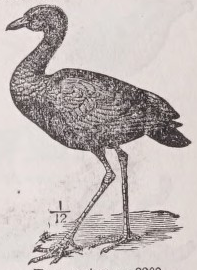
Messrs Sclater and Salvin in their Nomenclator (p. 141) admit 6 species of Trumpet-Birds—(1) the original Psophia crepitans of Guiana; (2) P. napensis of eastern Ecuador (which is very likely the original “Oiseau trompette” of De la Condamine); (3) P. ochroptera from the right bank of the Rio Negro; (4) P. leucοptera from the right bank of the upper Amazons; (5) P. viridis from the right bank of the Madeira; and (6) P. obscura from the right bank of the lower Amazons near Para. And they have remarked in the Zoological Proceedings (1867, p. 592) on the curious fact that the range of the several species appears to be separated by rivers, a statement confirmed by Mr Wallace (Geogr. Distr. Animals, ii. p. 358); and in connexion therewith it may be observed that these birds have short wings and seldom fly, but run, though with a peculiar gait, very quickly. A seventh species, P. cantatrix, from Bolivia, has since been indicated by Prof. W. Blasius (Jοurn. f. Ornith., 1884, ρp. 203-210), who has given a monographic summary of the whole group very worthy of attention. The chief distinctions between the species lie in colour and size, and it will be here enough to describe briefly the best known of them, P. crepitans. This is about the size of a large barndoor Fowl; but its neck and legs are longer, so that it is a taller bird. The head and neck are clothed with short velvety feathers; the whole plumage is black, except that on the lower front of the neck the feathers are tipped with golden green, changing according to the light into violet, and that a patch of dull rusty brown extends across the middle of the back and wing-coverts, passing into ash-colour lower down, where they bang over and conceal the tail. The legs are bright pea-green. The habits of this bird are very wonderful, and it is much to be wished that fuller accounts of them had appeared. The curious sound it utters, noticed by the earliest observers, has been already mentioned, and by them also was its singularly social disposition towards man described; but the information supplied to Buffon (Oiseaux, iv. pp. 496-501) by Manoncour and De la Borde, which has been repeated in many works, is still the best we have of the curious way in which it becomes semi-domesticated by the Indians and colonists and shows strong affection for its owners as well as for their living property—poultry or sheep — though in this reclaimed condition it seems never to breed. Indeed nothing can be positively asserted as to its mode of nidification; but its eggs, according to Mr E. Bartlett, are of a creamy white, rather round, and about the size of Bantams’. Waterton in his Wanderings (Second Journey, chap. iii. ) speaks of falling in with flocks of 200 or 300 “Waracabas,” as he called them, in Demerara, but added nothing to our knowledge of the species; while the contributions of Trail (Mem . Wem. Society, v. pp. 523-532) and Dr Hancock (Mag. Nat. History, ser. 2, ii. pp. 490-492) as regards its habits only touch upon them in captivity.
To the Trumpeters must undoubtedly be accorded the rank of a distinct Family, Psophiidae ; but like so many other South-American birds they seem to be the less specialized descendants of an ancient generalized group —perhaps the common ancestors of the Rallidae and Gruidae— and they are therefore rightly placed in Prof. Huxley’s Geranomorphae. The structure of the syrinx is stated by Trail (ut supra) to be quite unique; but his description of it is unsatisfactory, and he clearly had not an adult male to dissect or he would have hardly failed to notice the curious arrangement of the trachea in that sex made known by Hancock (ut supra). This, though different from that described in any Crane (q.v. ), suggests an early form of the structure which in some of the Gruidae is so marvellously developed, for in Psophia the windpipe runs down the breast and belly immediately under the skin to within about an inch of the anus, whence it returns in a similar way to the front of the sternum, and then enters the thorax. Analogous instances of this formation occur in several other groups of birds not at all allied to the Psophiidae. The skeleton and some of the detached bones are figured in Eyton’s Οsteol. Avium (pls. xxix. and 5 κ). (a. n.)
[1,015 words — estimated reading time: 6 minutes]