
To beat soundly; to thrash.
Word of the Day: Catachrestical
2. A small species of camel, the Camelus lama of South America.
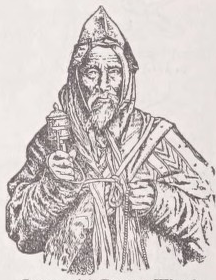
Lama-miau
Encyclopedia Britannica
LAMA-MIAU, or Dolanok, one of the chief cities of Inner Mongolia, is situated 150 miles north of Peking, in a barren sandy plain watered by the Urtingol, a tributary of the Shandugol. The town proper, almost exclusively occupied by Chinese, is about a mile in length by half a mile in breadth, has narrow and dirty streets, and contains a large population for its extent. Unlike the ordinary Chinese town of the same rank, it is not walled. A busy trade is carried on between the Chinese and the Mongolians, who bring in their cattle, sheep, camels, hides, and wool to barter for tea, tobacco, cotton, and silk. At some distance from the Chinese town lies the Mongolian quarter, with two groups of lama temples and villages occupied by 2300 priests. Dr Williamson (Journeys in North China) describes the chief temple as a huge oblong building with an interior not unlike a Gothic church. Lama-miau is the seat of a manufactory of bronze idols and other articles of ritual, which find their way to all parts of Mongolia and Tibet. The craftsmen work in their own houses. See Prejevalsky, Mongolia, 1876.
9th ed. Encyclopædia Britannica, vol. 14, p. 230
[193 words — estimated reading time: 2 minutes]
[193 words — estimated reading time: 2 minutes]
Lamaism
Watson's Biblical & Theological Dictionary
the religion of the people of Thibet. The _Delai Lama_, Grand Lama,” is at once the high priest, and the visible object of adoration, to this nation, to the hordes of wandering Tartars, and to the prodigious population of China. He resides at Patoli, a vast palace on a mountain near the banks of the Burampooter, about seven miles from Lahasse. The foot of the mountain is surrounded by twenty thousand lamas, or priests, in attendance on their sovereign pontiff, who is considered as the viceregent of the Deity on earth; and the remote Tartars are said to regard him absolutely as the Deity himself, and call him God, the everlasting Father of heaven. They believe him to be immortal, and endowed with all knowledge and virtue. Every year they come up from different parts to worship, and make rich offerings at his shrine. Even the emperor of China, who is a Mantchou Tartar, does not fail in acknowledgments to him in his religious capacity; and entertains in the palace of Pekin an inferior lama, deputed as his nuncio from Thibet. The grand lama is only to be seen in a secret place of his palace, amidst a great number of lamps, sitting cross-legged on a cushion, and decked all over with gold and precious stones; while, at a distance, the people prostrate themselves before him, it being not lawful for any so much as to kiss his feet. He returns not the least sign of respect, nor ever speaks, even to the greatest princes; but only lays his hand upon their heads, and they are fully persuaded that they thereby receive a full forgiveness of their sins. The _Sunniasses_, or Indian pilgrims, often visit Thibet as a holy place; and the lama entertains a body of two or three hundred in his pay. Beside his religious influence and authority, he is possessed of unlimited power throughout ...his dominions, which are very extensive. The inferior lamas, who form the most numerous as well as the most powerful body in the state, have the priesthood entirely in their hands, and, beside, fill up many monastic orders, which are held in great veneration among them. The whole country, like Italy, abounds with priests; and they entirely subsist on the rich presents sent them from the utmost extent of Tartary, from the empire of the great mogul, and from almost all parts of the Indies. The opinion of the orthodox among the Thibetians is, that when the grand lama seems to die, either of old age or infirmities, his soul, in fact, only quits a crazy habitation to enter another, younger and better; and is discovered again in the body of some child, by certain tokens, known only to the lamas, or priests, in which order he always appears. Almost all the nations of the east, except the Mohammedans, believe the _metempsychosis_, or transmigration of the soul, as the most important article of their faith; especially the inhabitants of Thibet and Ava, the Peguans, the Siamese, the greater part of the Chinese and Japanese, and the Monguls and Kalmucks. According to their doctrine, the soul no sooner leaves her old habitation than she enters a new one. The _delai lama_, therefore, or rather the god Foe or Fuh, residing in the _delai lama_, passes to his successor; and he being a god, to whom all things are known, the grand lama is therefore acquainted with every thing which happened during his residence in his former bodies. This religion, which was early adopted in a large part of the globe, is said to have been of three thousand years’ standing; and neither time, nor the influence of men, has had the power of shaking the authority of the grand lama. This theocracy, which extends as fully to temporal as to spiritual concerns, is professed all over Thibet and Mongalia; is almost universal in Greater and Less Bucharia, and several provinces of Tartary; has some followers in the kingdom of Cashmere, in India; and is the predominant religion of China. It has been observed that the religion of Thibet is the counterpart of the Roman Catholic, since the inhabitants of that country use holy water, and a singing service. They also offer alms, prayers, and sacrifices for the dead. They have a vast number of convents filled with monks and friars, amounting to thirty thousand, and confessors chosen by their superiors. They use beads, wear the mitre, like the bishops; and their _delai lama_ is nearly the same among them as the sovereign pontiff was formerly, in the zenith of his power, among the Roman Catholics. So complete is the resemblance, that, when one of the first Romish missionaries penetrated Thibet, he came to the conclusion that the devil had set up there an imitation of the rites of the Catholic church, in order the more effectually to destroy the souls of men. Captain Turner, speaking of the religion of Thibet, says, It seems to be the schismatical offspring of the religion of the Hindoos, deriving its origin from one of the followers of that faith, a disciple of Bouddhu, who first broached the doctrine which now prevails over the wide extent of Tartary. It is reported to have received its earliest admission in that part of Tibet, or Thibet, bordering upon India, which from hence became the seat of the sovereign lamas, to have traversed over Mantchieux Tartary, and to have been ultimately disseminated over China and Japan. Though it differs from the Hindoo in many of its outward forms, yet it still bears a very close affinity with the religion of Brumha in many important particulars. The principal idol in the temples of Tibet, or Thibet, is Muha-Moonee, the Booddhu of Bengal, who is worshipped under these and various other epithets, throughout the great extent of Tartary, and among all nations to the eastward of the Brumhapootru. In the wide-extended space over which this faith prevails, the same object of veneration is acknowledged under numerous titles: among others, he is styled Godumu, or Gotumu, in Assam and Ava, Shumunu in Siam, Amida Buth in Japan, Fohi in China,” &c.
Watson's Biblical & Theological Dictionary
[1,026 words — estimated reading time: 6 minutes]
[1,026 words — estimated reading time: 6 minutes]
1. LAM'ANTIN ,
2. LAMB, noun lam.
3. The young of the sheep kind.
5. Behold the lamb of God, who taketh away the sin of the world. John 1:1 .
To bring forth young, as sheep.
Lamarck
Encyclopedia Britannica
LAMARCK, Jean Baptiste Pierre Antoine de Monet, Chevalier de (1744-1829), a celebrated French naturalist, was born 1st August 1744, at Bazantin, a village of Picardy. He was an eleventh child; and his father, lord of the manor and of old family, but of limited means, having already placed three sons in the army, destined this one for the church, and sent him to the Jesuits at Amiens, where he continued till his father’s death. After this he would remain with the Jesuits no longer, and, not yet seventeen years of age, started for the seat of war at Bergen-op-Zoom, before which place one of his brothers had already been killed. Mounted on an old horse, with a boy from the village as attendant, and furnished by a lady with a letter of introduction to a colonel, he reached his destination on the evening before a battle. Next morning the colonel found that the new and very diminutive volunteer had posted himself in the front rank of a body of grenadiers, and could not be induced to quit the position. In the battle, the company which he had joined became exposed to the fire of the enemy’s artillery, and in the confusion of retreat was forgotten. All the officers and subalterns were killed, and not more than fourteen men were left, when the oldest grenadier seeing there were no more French in sight proposed to the young volunteer so soon become commandant to withdraw his men. This he refused to do without orders. These at last arrived; and for his bravery he was made an officer on the spot, and soon after was named to a lieutenancy....
After the peace, the regiment was sent to Monaco. There it happened that one of his comrades playfully lifted him by the head, and to this it was imputed that he was seized with disease of the glands of the neck, so severe as to necessitιfe grave surgical interference, and put a stop to his military career.
The courage of Lamarck, so early exhibited, was in future to be shown by the maintenance of his opinions in the absence of any friendly support, and by fortitude amid many adversities; while his activity was to be displayed, not only in manifold speculation, but in copious and varied scientific work. He went to Paris and began the study of medicine, supporting himself by working in a banker’s office. He early became interested in meteorology and in physical and chemical speculations of a chimerical kind, but happily threw his main strength into botany, and in 1778 published his Flore française, a work in which by a dichotomous system of contrasting characters he enabled the student with facility to determine species. This work, which went through several editions and long kept the field, gained for its author immediate popularity as well as the honour of admission to the Academy of Sciences.
In 1781 and 1782, under the title of botanist to the king, an appointment obtained for him by Buffon, whose son accompanied him, he travelled through various countries of Europe, extending his knowledge of natural history; and on his return he began those elaborate contributions to botany on which his reputation in that science principally rests, namely, the Dictionnaire de Botanique and the Illustrations de Genres, voluminous works contributed to the Encyclopédie Méthodique (1785). In 1793, when he was already forty-nine years of age, in consequence of changes in the organization of the natural history department at the Jardin du Roi, where he had held a botanical appointment since 1788, Lamarck was presented to a zoological chair, and called on to lecture on the Insecta and Vermes of Linnaeus, the animals for which he introduced the term Invertebrata, still employed. Thus driven, comparatively late in life, to devote his principal attention to zoology instead of botany, he had the misfortune soon after to suffer from impaired vision; and the malady progressing resulted subsequently in total blindness. Yet his greatest zoological work, the Histoire Naturelle des Animaux sans Vertèbres, was published from 1815 to 1822, with the assistance, in the last two volumes, of his eldest daughter and of M. Latreille. A volume of plates of the fossil shells of the neighbourhood of Paris was collected in 1823 from his memoirs in the Annales des Museum. The later years of his blind old age were spent in straitened circumstances and accumulating infirmities, solaced, however, by the devotion of bis family, and particularly of his eldest daughter, of whom Cuvier records that she never left the house from the time that he was confined to his room. He died 18th December 1829.
The character of Lamarck as a naturalist is remarkable alike for its excellences and its defects. His excellences were width of scope, fertility of ideas, and a pre-eminent faculty of precise description, arising not only from a singularly terse style, but from a clear insight into both the distinctive features and the resemblances of forms. That part of his zoological work which still finds a large and important place in the science of the present day, and constitutes his solid claim to the highest honour as a zoologist, is to be found in his extensive and detailed labours in the departments of living and fossil Invertebrata. His endeavours at classification of the great groups were necessarily defective on account of the imperfect knowledge possessed in his time in regard to many of them, e.g., echinoderms, ascidians, and intestinal worms; yet they are not without interest, particularly on account of the comprehensive attempt to unite in one great division as Articulata all those groups that appeared to present a segmented construction. Moreover, Lamarck was the first to distinguish vertebrate from invertebrate animals by the presence of a vertebral column, and among the Invertebrata to found the groups Crustacea, Arαchnida, and Annelida. In 1785 (Hist. de l ’ Acad.) he evinced his appreciation of the necessity of natural orders in botany by an attempt at the classification of plants, interesting, though crude and falling immeasurably short of the system which grew in the hands of his intimate friend Jussieu. The problem of taxonomy has never been put more philosophically than he subsequently put it in his Animaux sans Vertèbres :— “What arrangement must be given to the general distribution of animals to make it conformable to the order of nature in the production of these beings 1”
The most prominent defect in Lamarck must be admitted, quite apart from all consideration of the famous hypothesis which bears his name, to have been want of control in speculation. Doubtless the speculative tendency furnished a powerful incentive to work, but it outran the legitimate deductions from observation, and led him into the production of volumes of worthless chemistry without experimental basis, as well as into spending much time on fruitless meteorological predictions.’ His Annuaires Météorologiques were published yearly from 1800 to 1810, and were not discontinued until after an unnecessarily public and brutal tirade from Napoleon, administered on the occasion of being presented with one of his works on natural history.
To the general reader the name of Lamarck is chiefly interesting on account of his theory of the origin of life and of the diversities of animal forms. The idea, which appears to have been favoured by Buffon before him, that species were not through all time unalterable, and that the more complex might have been developed from pre-existent simpler forms, became with Lamarck a belief or, as he imagined a demonstration. Spontaneous generation, he considered, might be easily conceived as resulting from such agencies as heat and electricity causing in small gelatinous bodies an utricular structure, and inducing a “singular tension,” a kind of “éréthisme” or “orgasme”; and, having thus accounted for the first appearance of life, he explained the whole organization of animals and formation of different organs by four laws :—
“1. Life by its proper forces tends continually to increase the volume of every body possessing it, and to enlarge its parts, up to a limit which it brings about.
“2. The production of a new organ in an animal body results from the supervention of a new want (besoin) continuing to make itself felt, and a new movement which this want gives birth to and encourages.
“3. The development of organs and their force of action are constantly in ratio to the employment of these organs.
“4. All which has been acquired, laid down, or changed in the organization of individuals in the course of their life is conserved by generation and transmitted to the new individuals which proceed from those which have undergone those changes.”
It is the second law which has been principally associated with Lamarck’s name, and is often referred to as his hypothesis of the evolution of organs in animals by appetence or longing, although Lamarck does not teach that the animal’s desires affect its conformation directly, but that altered wants lead to altered habits, which result in the formation of new organs as well as in modification, growth, or dwindling of those previously existing. Thus, he suggests that, ruminants being pursued by carnivora, their legs have grown slender; and, their legs being only fit for support, while their jaws are weak, they have made attack with the crown of the head, and the determination of fluids thither has led to the growth of horns. So also the stretching of the giraffe’s neck to reach the foliage he supposes to have led to its elongation; and the kangaroo, sitting upright to support the young in its pouch, he imagines to have had its fore-limbs dwarfed by disuse, and its hind legs and tail exaggerated by using them in leaping. The length to which he carried such notions can be fairly estimated by the illustration which, long after the publication of his Philosophic Zoolpgiquc, he selected in the introduction to the Hist. Nat. des Anim. sans Vert. ‘ ‘ I conceive that a gasteropod mollusc, which, as it crawls along, finds the need of touching the bodies in front of it, makes efforts to touch those bodies with some of the foremost parts of its head, and sends to these every time quantities of nervous fluids, as well as other liquids. I conceive, I say, that it must result from this reiterated afflux towards the points in question that the nerves which abut at these points will, by slow degrees, be extended. Now, as in the same circumstances other fluids of the animal flow also to the same places, and especially nourishing fluids, it must follow that two or more tentacles will appear and develop insensibly in those circumstances on the points referred to.”
However absurd this may seem, it must be admitted that, unlimited time having been once granted for organs to be developed in series of generations, the objections to their being formed in the way here imagined are only such as equally apply to the theory of their origin by natural selection. Thus, for example, neither theory considers that it has to deal, not with crude heaps of mere functional organs, but with exquisitely orderly forms, nor accounts for the symmetrical first appearance of parts or for sex; nor, though Lamarck tried hard, has he or any later writer reduced to physical law the rise of consciousness in association with structures wlιich in their physical relations are mere mechanisms capable of reflex actions.
In judging the reasonableness of the second law of Lamarck as compared with more modern and now widely received theories, it must be observed that it is only an extension of his third law; and that third law is a fact. The strengthening of the blacksmith’s arm by use is proverbially notorious. It is, therefore, only the sufficiency of the Lamarckian hypothesis to explain the first commencement of new organs which is in question, if evolution by the mere operation of forces acting in the inorganic world be granted; and surely the Darwinian theory is equally helpless to account for the boginnings of a new organ, while it demands as imperatively that every stage in the assumed hereditary development of an organ must have been useful.
Furthermore, to no writer more recent than Lamarck can be attributed the credit of first pointing attention to the repetition of acquired variations in the progeny, or the idea of weaving that fact into a theory of the origin of species. His words are ^“Everything which nature has caused individuals to acquire or lose by the influence of the circumstances to which their race is long exposed, and consequently by the influence of the predominant employment of such organ, or its constant disuse, she preserves by generation to the new individuals proceeding from them, provided that the changes are common to the two sexes, or to those which have produced these new individuals” (Phil. Zook, i. 235). It is interesting to note in this passage that he hesitated to believe that peculiarities could become permanent unless possessed by both parents.
Notwithstanding his attempt to e÷olve all vital action from the forces at work in the inorganic world, Lamarck made a broad dis tinction between the “power of life,” to which he attributed the production of ‘ ‘ a real progression in the composition of the organization of animals,” and the modifying effects of external circumstances. The existence of such a progression cannot now be doubted, and constitutes evolution in the only sense in which it is universally admitted. Lamarck, equally with Darwin, teaches the more speculative doctrine that the complex forms are descended from simpler ancestors. In the modus operandi by which they hold this to have been accomplished both have admitted the action of a variety of modifying circumstances. Lamarck gave great importance to the influence of new wants acting indirectly by stimulating growth and use. Darwin has given like importance to the effects of accidental variations acting indirectly by giving advantage in the struggle for existence. The speculative writings of Darwin have, however, been interwoven λvith a vast number of beautiful experiments and observations bearing on his speculations, though by no means proving his theory of evolution; while the speculations of Lamarck lie apart from his wonderful descriptive labours, unrelieved by intermixture with other matters capable of attracting the numerous class who, provided they have new facts set before them, are not careful to limit themselves to the conclusions strictly deducible therefrom. But those who read the Philosophie Zoologique will find how many truths often supposed to be far more modern are stated with abundant clearness in its pages.
9th ed. Encyclopædia Britannica, vol. 14, p. 231 — signed J. CL.
[2,451 words — estimated reading time: 15 minutes]
[2,451 words — estimated reading time: 15 minutes]
Pertaining to, or involved in, the doctrines of Lamarckianism.
The theory that structural variations, characteristic of species and genera, are produced in animals and plants by the direct influence of physical environments, and esp., in the case of animals, by effort, or by use or disuse of certain organs.
Lamartine
Encyclopedia Britannica
LAMARTINE, Alphonse Marie Louis de Prat de (1790-1869), poet, historian, and statesman, was born at Mâcon on the 21st of October 1790, and died at Passy on the 1st of March 1869. The family of Lamartine was good, and the title of Prat was taken from an estate in Franche Comté. His father was imprisoned during the Terror, and only released owing to the events of the 9th Thermidor. Subsequently the family returned to the country. Lamartine’s early education was received from his mother. He was sent to school at Lyons in 1805, but not being happy there was transferred to the care of the Pères de la Foi at Belley, where he remained until 1809. For some time afterwards he lived at home, reading romantic and poetical literature, but in 1811, being then tv/enty years old, he set out on his travels for Italy, where he seems to have sojourned for nearly two years. His family having been steady royalists, he entered the Gardes du corps at the return of the Bourbons, and during the Hundred Days he sought refuge first in Switzerland and then at Aix en Savoie, where he fell in love, with abundant results of the poetical kind. After Waterloo he returned to Paris, and mixed a good deal in society. In 1818-19 he revisited Switzerland, Savoy, and Italy, the death of his beloved affording him new subjects for verse. He had now got together a considerable body of poetry, and after some difficulties he got his first book, the Meditations, published (1820). It was exceedingly popular, and helped him to make a position. He had left the army for some time, and he now entered the diplomatic service and was appointed secretary to the embassy at Naples. On his way to his post he married at Geneva a young English lady, Marianne Birch, who had both money and beauty (1823), and in the same ...year his Nouvelles Méditations appeared. In 1824 he was transferred from Naples to Florence, where he remained for fivef years. His Last Canto of Childe Harold appeared in 1825, and he had to fight a duel with an Italian officer, Colonel Pepe, in consequence of a phrase in it. The Harmonies Politiques et Religieuses appeared in 1829, when he had left Florence. Having refused an appointment at Paris under the Polignac ministry (destined to be fatal to legitimism), he went on a special mission to Prince Leopold of Saxe-Coburg, who was not yet king of the Belgians, but was talked of as king of Greece. The next year he was elected to the Academy. Lamartine was in Switzerland, not in Paris, at the time of the Revolution of July, and, though he put forth a pamphlet on Rational Policy, he did not take any active part in politics. In 1832 he set out with his wife and daughter for Palestine, having been unsuccessful in his candidature for a seat in the chamber. His daughter Julia died at Beyrout, and before long he received the news of his election by a constituency (Bergues) in the department of the Nord. He returned through Turkey and Germany, and made his first speech shortly after the beginning of 1834. Thereafter he spoke constantly, and acquired considerable reputation as an orator,—bringing out, moreover, many books in prose and verse. His Eastern travels (Souvenirs d'Orient) appeared in 1835, his Jocelyn in 1836, his Chute d'un Ange in 1838, and his Recueillements, the last remarkable volume of his poetry, in 1839. As the reign of Louis Philippe went on, Lamartine, who had previously been a liberal royalist, something after the fashion of Chateaubriand, became more and more democratic in his opinions. He set about his greatest prose work, the Histoire des Girondins, which at first appeared periodically, and was published as a whole in 1847. Like many other French histories, it was a pamphlet as well as a chronicle, and the subjects of Lamartine’s pen became his models in politics. At the revolution of February Lamartine at once became one of the most important personages in France. He was one of the first to declare for a provisional government, and became a member of it himself, with the post of minister for foreign affairs. He was elected for the new constituent assembly in ten different departments, and was chosen one of the five members of the Executive Committee. For a few months indeed Lamartine, who for nearly sixty years had been a distinguished man of letters, an official of inferior rank in diplomacy, and an eloquent but unpractical speaker in parliament, became one of the foremost men in Europe. His own inexperience in the routine work of government, the utterly unpractical nature of his colleagues and of the constitution which they endeavoured to carry out, and the turbulence of the Parisian mob proved fatal to his chances. During his brief tenure of office Lamartine gave some proofs of statesmanlike ability, notably in his reply to the deputation of United Irishmen who visited him in the hope that the new French democracy would take up the old hatred of the republic against England; and his eloquence was repeatedly called into requisition to pacify the Parisians. But no one can permanently carry on the government of a great country by speeches from the balcony of a house in the capital, and Lamartine found himself in a dilemma. So long as he held aloof from Ledru-Rollin and the more radical of his colleagues, the disunion resulting weakened the Government; as soon as he effected an approximation to them, the middle classes, who more in France than any where else were and are the arbiters of Governments, fell off from him. The quelling of the insurrection of the 15th May was his last successful act. A month later the renewal of active disturbances brought on the fighting of June, and Lamartine’s influence was extinguished in favour of Cavaignac. There is hardly another instance on record of so sudden an elevation and so rapid a fall. Before February in 1848 Lamartine was, as has been said, a private person of talent and reputation; after June in the same year he was once more the same, except that his chance of political pre eminence was gone. He had been tried and found wanting, having neither the virtues nor the vices of his situation. In January 1849, though he was nominated for the presidency, only a few thousand votes were given to him, and three months later he was not even elected to the legislative assembly.
The remaining story of Lamartine’s life is somewhat melancholy. He had never been a rich man, nor had he been a saving one, and during his period of popularity and office he had incurred great expenses. He now set to work to repair his fortune by unremitting literary labour. He brought out in the Presse a series of Confidences, and somewhat later a kind of autobiography, entitled Raphael, which treated his own experiences in romantic fashion. He began and finished several historical works of more or less importance, the History of the Revolution of 1848, The History of the Restoration, The History of Turkey, The History of Russia, besides a very large number of small biographical and miscellaneous works. In 1858 a subscription was opened for his benefit. Two years afterwards, following the example of Chateaubriand, he supervised an elaborate edition of his own works in forty-one volumes. This occupied five years, and while he was engaged on it his wife died (1863). He was now a man of more than seventy years old; his powers had deserted him, and even if they had not the public taste had entirely changed, and was no longer disposed to welcome or enjoy his sentimental fashion of handling prose and poetry. His efforts had not succeeded in placing him in a position of comfort and independence; and at last, in 1867, the Government of the empire (from which he had perforce stood aloof, though he never considered it necessary to adopt the active protesting attitude of Quinet and Victor Hugo) came forward to his assistance, a vote of twenty thousand pounds being proposed in April of that year for his benefit by M. Emile Ollivier. In no other country than France would this have been anything but creditable to both parties, for Lamartine, both as a distinguished man of letters and as a past servant of the state, had every claim to the bounty of his country. But the bitter party feeling which animated the later years of the reign of Napoleon III. made the grant something of a party matter, and Lamartine was reproached for accepting it by the extreme republicans and irreconcilables. He did not enjoy it long, dying, as has been said, on the 1st of March 1869, two years before the collapse of the empire.
As a statesman Lamartine was placed during his brief tenure of office in a position from which it would have been almost impossible for any man who was not prepared and able to play the dictator to emerge with credit. At no time in history, not even in the great revolution of sixty years earlier, were unpractical crotchets so rife in the heads of men as in 1848, and at no time was there such an absence of what may be called backbone in a nation as then in France. But Lamartine could hardly have guided the ship of state safely even in much calmer weather. Personally he was amiable and even estimable, the chief fault of his character being vanity and an incurable tendency towards theatrical elΓect, which makes his travels, memoirs, and other personal records as well as his historical works radically untrustworthy. Nor does it appear that he had any settled political ideas. He was first an ardent legitimist, then a liberal royalist, then a constitutionalist of an indefinite type, then a republican; and it does not appear that any of these 1)hases was the result of reasoned conviction, but rather of a vague ûnd of sentiment and of the contagion of popular and prevalent ideas. In regard to money he was entirely disinterested, never obtaining or seeking any lucrative office. That he was quite so disinterested in the matter of personal vanity and ambition cannot perhaps be safely affirmed. He did good by moderating the revolutionary and destructive ardour of the Parisian populace in 1848; but he had been perhaps more responsible than any other single person for bringing about the events of that year by the vague and frothy republican declamation of his Histoire des Girondins. Altogether little more can be said of his political career than that he was the most striking if not the most successful instance of the French system, which has prevailed since the downfall of the first empire, of making literary success a direct road to political eminence.
More must be said of his literary position. Lamartine had the advantage of coming at a time when the literary field, at least in the departments of belles lettres, was almost empty. The feeble school of descriptive writers, epic poets of the extreme decadence, fabulists, and miscellaneous verse-makers which the empire had nourished could satisfy no one, though its members still continued with unceasing fidelity to copy themselves and their models. Madame de Stael was dead; Chateaubriand, though alive, was something of a classic, and had not effected a full revolution. Lamartine did not himself go the complete length of the romantic revival, but he went far in that direction. He availed himself of the reviving interest in legitimism and Catholicism which was represented by Bonald and Joseph <le Maistre, of the nature worship of Rousseau and Bernardin de St Pierre, of the sentimentalism of Madame de Stael, of the mediaevalism and the romance of Chateaubriand and Scott, of the maladie du siècle of Chateaubriand and Byron. Perhaps if his matter be very closely analysed it will be found that he added hardly anything of his own. But if the parts of the mixture were like other things the mixture itself was not. It seemed indeed to the immediate generation so original that tradition has it that the Méditations were refused by a publisher because they were in none of the accepted styles. They appeared, as has been said, in 1820, that is to say, when Lamartine was nearly thirty years old. The best of them and the best thing that Lamartine ever did is the famous Lac, describing his return to the little mountain tarn of Le Bourget after the death of his mistress, with whom he had visited it in other days. The verse is exquisitely harmonious, the sentiments conventional but refined and delicate, the imagery well chosen and gracefully expressed. There is indeed an unquestionable want of vigour, but to readers of that day the want of vigour was entirely compensated by the presence of freshness and grace. Lamartine’s chief misfortune in poetry was that not only was his note a somewhat weak one, but that he could strike but one. The four volumes of the Méditations, the Harmonies, and the Recueillements, which contained the prime of his verse, are perhaps the most monotonous reading to be found anywhere in work of equal bulk by a poet of equal talent. They contain nothing but meditative lyrical pieces, almost any one of which is typical of the whole, though there is of course considerable variation of merit. The two narrative poems which succeeded the early lyrics, Jocelyn and the Chute d , un Ange, were, according to Lamartine’s original plan, parts of a vast ‘ ‘ Epic of the Ages,” some further fragments of which survive, especially one of not a little merit which was published four years after the author’s death in company with some youthful attempts at the classical tragedy and a few miscellanea. Jocelyn had at one time more popularity in England than most French verse. La Chute d'un Ange, in which the Byronic influence is more obvious than in any other of Lamartine’s works, is more ambitious in theme and less regulated by scrupulous conditions of delicacy in handling than most of its author’s poetry. It does, however, little more than prove that such audacities were not for him.
As a prose writer Lamartine was, as may be seen from what has been said (and many of his works have not been mentioned), very fertile. His characteristics in his prose fiction and descriptive work are not very different from those of his poetry. He is always and everywhere sentimental, though very frequently, as in his shorter prose tales (The Stone Mason of St Point, Graziella, &c. ), he is graceful as well as sentimental. In his histories, the style being one for which he was radically unfitted, the effect is worse. It has been hinted that Lamartine’s personal narratives are doubtfully trustworthy; indeed with regard to his Eastern travels some of the episodes were stigmatized as mere inventions by persons who had every reason to be well informed and none to bear false witness. In his histories proper the special motive for embellishment—falsification would be too rough a word—for the most part disappears, but the habit of inaccuracy remains. Lamartine as an historian belongs exclusively to the rhetorical school as distinguished from the philosophical on the one hand and the documentary on the other.
It is not surprising when these characteristics of Lamartine’s work are appreciated, to find that his fame has declined with singular rapidity in France. As a poet indeed he had lost his reputation many years before he died. He was entirely eclipsed by the brilliant and vigorous school who succeeded him with Victor Hugo at their head. It is possible that the Chute d’un Ange was an effort to compete with them on their own ground; if so, it was an entire failure. Lamartine’s power of initiative in poetry was very small, and the range of poetic ground which he could cover strictly limited. He did not attempt the great task of the day, the freeing of the Alexandrine from the restraints imposed upon it, and the devising or reviving of new lyric metres to refresh and invigorate French poetic style. He could only carry the picturesque sentimentalism of Rousseau, Bernardin de St Pierre, and Chateaubriand a little further, and clothe it in language and verse a little less antiquated than that of Chênedollé and Millevoye. He has been said to be a French Cowper, and the parallel holds good in respect of versification and of his relative position to the more daringly innovating school that followed, though not in respect of individual peculiarities. Lamartine in short occupied a kind of half-way house between the 18th century and the Romantic movement, and he never got any further. When a living English critic questioned·his importance in conversation with Sainte-Beuve, the answer was, “He is important to us,” and it was a true answer; but his importance is now chiefly historical, even to Frenchmen.
The already mentioned edition is the most complete one of Lamartine, but there are many issues of his separate works. Since his death, besides the poems already mentioned, some Mémoires Inédits of his youth have been published, and also two volumes of correspondence.
9th ed. Encyclopædia Britannica, vol. 14, p. 232 — signed G. SA.
[2,916 words — estimated reading time: 17 minutes]
[2,916 words — estimated reading time: 17 minutes]
A monastery or convent of lamas, in Thibet, Mongolia, etc.
1. The young of the sheep.
2. Any person who is as innocent or gentle as a lamb.
3. A simple, unsophisticated person; in the cant of the Stock Exchange, one who ignorantly speculates and is victimized.
To bring forth a lamb or lambs, as sheep.
Lamb
Encyclopedia Britannica
LAMB, Charles (1775-1834), an original and delightful English essayist and critic, was born in Crown Office Row, Inner Temple, London, February 10, 1775. His father, John Lamb, a Lincolnshire man, who filled the situation of clerk and servant companion to Mr Salt, one of the benchers of the Inner Temple, was successful in obtaining for Charles, the youngest of three children, a presentation to Christ’s Hospital, where the boy remained from his eighth to his fifteenth year (1782-1789). Here he was fortunate enough to have for a schoolfellow the afterwards famous Samuel Taylor Coleridge, his senior by rather more than two years, and a close and tender life-long friendship began which had a singularly great influence on the whole of his after career. When the time came for leaving school, where he had learned some Greek and acquired considerable facility in Latin composition, Lamb, after a brief stay at home (spent, as his school holidays had often been, over old English authors in the library of Mr Salt), was condemned to the labours of the desk,—an “unconquerable impediment” in his speech disqualifying him for a school exhibition, and thus depriving him of the only means by which he could have obtained a university education. For a short time he held a clerkship in the South Sea House under his elder brother John, and in 1792 he entered the accountant’s office in the East India House, where during the next three and thirty years the hundred folios of what he used to call his true “works” were produced. A dreadful calamity soon came upon him, which seemed to blight all his prospects in the very morning of life. There was insanity in the family, which in his twenty-first year had led to his own confinement for some weeks in a lunatic asylum; and, a few months ...afterwards, on the 22d of September 1796, his sister Mary, “worn down to a state of extreme nervous misery by attention to needlework by day and to her mother by night,” was suddenly seized with acute mania, in which she stabbed her mother to the heart. The calm self-mastery and loving self-renunciation which Charles Lamb, by constitution excitable, nervous, and timid, displayed at this crisis in his own history and in that of those nearest him, will ever give him an imperishable claim to the reverence and affection of all who are capable of appreciating the heroisms of common life. His sister was of course immediately placed in confinement, and with the speedy return of comparative health came the knowledge of her fatal deed; himself calm and collected, he knew how to speak the words of soothing and comfort. With the help of friends he succeeded in obtaining her release from the life-long restraint to which she would otherwise have been doomed, on the express condition that he himself should undertake the responsibility for her safe keeping. It proved no light charge; for, though no one was capable of affording a more intelligent or affectionate companionship than Mary Lamb during her long periods of health, there was ever present the apprehension of the recurrence of her malady; and, when from time to time the premonitory symptoms had become unmistakable, there was no alternative but her removal, which took place in quietness and tears. How deeply the whole course of Lamb’s domestic life must have been affected by his singular loyalty as a brother need not be pointed out; for one thing, it rendered impossible his union with Alice Winterton, whom he appears to have truly loved, and to whom such touching reference was made long afterwards in Dream Children, a Reverie.
Lamb’s first appearance as an author was made in the year of the great tragedy of his life (1796), when there were published in the volume of Poems on Various Subjects by Coleridge four sonnets by “Mr Charles Lamb of the India House.” In the following year he also contributed along with Charles Lloyd some pieces in blank verse to Coleridge’s new volume of Poems. In 1798 he published a short and pathetic prose tale entitled Rosamund Cray, and in 1799 he was associated with Coleridge and Southey in the publication of the Annual Anthology, to which he had contributed a short religious poem in blank verse entitled “Living without God in the World”; the company in which he was thus found brought upon him the irrelevant and pointless ridicule of Canning and Gillray. His next public appearance was not more fortunate. His John JVoodvil (1801), a slight dramatic piece written in the style of the earlier Elizabethan period, and containing some genuine poetry and happy delineation of the gentler emotions, but as a whole deficient in plot, vigour, and character, was held up to ridicule by the Edinburgh Review as a specimen of the rudest condition of the drama, a work by “a man of the age of Thespis.” The dramatic spirit, however, was not thus easily quenched in Lamb. His next effort (1806) was a farce, named Mr H., the point of which lay in the hero’s anxiety to conceal his name, “Hogsflesh”; it has recently been put upon the boards with success in America, but in London it did not survive the first night of its appearance. Its author bore the failure with rare equanimity and good humour, and soon struck into new and more successful fields of literary exertion. In 1807 appeared Tales founded on the Plays of Shakespeare, written by Charles and Mary Lamb; and in 1808 Specimens of English Dramatic Poets who lived about the time of Shakespeare, with short but felicitous critical notes. In the same year Mary Lamb, assisted by her brother, also published Poetry for Children and a collection of short school-girl tales under the title Mrs Leicester's School ; and to the same date belongs the Adventures of Ulysses, designed by Lamb as a companion to the Adventures of Telemachus. In 1810 began to appear Leigh Hunt’s quarterly periodical, The Reflector, in which Lamb published much (including the essays on the tragedies of Shakespeare and on Hogarth) that subsequently appeared in the first collective edition of his TFbrZrs (2 vols. 12mo), which appeared in 1818. The establishment of the London Magazine in 1820 stimulated him to the production of a series of new essays which rose into instant popularity, and may be said to form the chief corner-stone in the small but classic temple of his fame. The first of these, as it fell out, was a description of the old South Sea House, with which Lamb happened to have associated the name of a “gay light-hearted foreigner” called Elia, who had frequented it in the days of his service there. The pseudonym adopted on this occasion was retained for the subsequent contributions which appeared collectively in a post 8vo volume of Essays in 1823. After a brief career of five years the London Magazine came to an end; and about the same period Lamb’s long connexion with the India House terminated, a pension of about £450 having been assigned to him. The increased leisure, however, for which he had long sighed, did not prove favourable to literary production, which henceforth was limited to a few trifling contributions to the New Monthly and other serials. The malady of his sister, which continued to increase with eveι∙ shortening intervals of relief, broke in painfully on his lettered ease and comfort; and it is unfortunately impossible to ignore the deteriorating effects of an over-free indulgence in the use of tobacco and alcohol on a temperament such as his. His removal on account of his sister to the quiet of the country, by tending to withdraw him from the stimulating society of the large circle of literary friends who had helped to make his Wednesday evening “at homes” so remarkable, doubtless also tended to intensify his listlessness and helplessness. One of the brightest elements in the closing years of his life was the friendship and companionship of Emma Isola, whom he and his sister had adopted, and whose marriage in 1833 to Mr Moxon, though a source of unselfish joy to Lamb, left him more than ever alone. While living at Edmonton, he was overtaken by an attack of erysipelas brought on by an accidental fall as he was walking on the London road; after a few days’ illness he painlessly passed away on December 27, 1834. The sudden death of one so widely known, admired, and beloved as Charles Lamb fell on the public, as well as on his own attached circle, with all the poignancy of a personal calamity and a private grief. His memory wanted no tribute that affection could bestow, and Wordsworth has commemorated in simple and solemn verse the genius, virtues, and fraternal devotion of his early friend.
In depth of thought and splendour of genius Charles Lamb was surpassed by not a few of his contemporaries, but as an essayist he is entitled to a place beside Montaigne, Sir Thomas Browne, Steele, and Addison. He unites many of the characteristics of each of these writers,—refined wit, exquisite humour, a genuine and cordial vein of pleasantry, and heart-touching pathos. His fancy as an essayist is distinguished by great delicacy and tenderness; and even his conceits are imbued with human feeling and passion. He had an extreme and almost exclusive partiality for our earlier prose writers, particularly for Fuller, Browne, and Burton, as well as for the dramatists of Shakespeare’s time; and the care with which he studied them is apparent in all he ever wrote. It shines out conspicuously in his style, which has an antique air, and is redolent of the peculiarities of the 17th century. Its quaintness has subjected the author to the charge of affectation, but there is nothing really affected in his writings. His style is not so much an imitation as a reflexion of the older writers; for in spirit he made himself their contemporary. A confirmed habit of studying them in preference to modern literature had made something of their style natural to him; and long experience had rendered it not only easy and familiar but habitual. It was not a masquerade dress he wore, but the costume which showed the man to most advantage. With thought and meaning, often profound, though clothed in simple language, every sentence of his essays is pregnant, and in this respect he bears a strong resemblance to the writers already named. If he had their manner, he possessed their spirit likewise. To some of his essays and specimens we are considerably indebted for the revival of the dramatic writers of the Shakespearian age; for he preceded Gifford and others in wiping the dust of ages from the works of these authors. In his brief comments on each specimen he displays exquisite powers of discrimination; his discernment of the true meaning of his author is almost infallible. As a poet Lamb is not entitled to so high a place as that which can be claimed for the essayist and critic. His dependence on Elizabethan models is here also manifest, but in such a way as to bring into all the greater prominence his native deficiency in “the accomplishment of verse.” Yet it is impossible, once having read, ever to forget the tenderness and grace of such verses as those to Hester Savory and on “The Old Familiar Faces,” or the quaint humour of “A Farewell to Tobacco.” As a letter writer also Lamb is entitled to rank very high.
The Letters of Charles Lamb, with a sketch of his life by one of his executors, Sir Thomas Noon Talfourd, appeared in 2 vols, in 1837, and Final Memorials of Charles Lamb, by the same hand, were published in 1848. Supplementary to these is the Memoir by another personal friend B. W. Procter (Barry Cornwall) published in 1866. See also Fitzgerald’s Charles Lamb, his Friends, his Haunts, and his Books, 1866; Cradock ’ s Charles Lamb, 1867; and Carew Hazlitt’s Mary and Charles Lamb: Poems, Letters, and Remains, 1874. There have been several complete editions of the Works of Lamb; of these the fullest as well as most recent is that of Fitzgerald (Life, Letters, and Writings of Charles Lamb, 6 vols., 1870-76).
9th ed. Encyclopædia Britannica, vol. 14, p. 234
[2,066 words — estimated reading time: 12 minutes]
[2,066 words — estimated reading time: 12 minutes]
A feast at the time of shearing lambs.
Lamballe
Encyclopedia Britannica
LAMBALLE, Marie ThérèseLouise de Savoie-Carignan, Princesse de (1749-1792), daughter of Louis Victor of Carignan, was born at Turin, 8th September 1749. In 1767 she was married to Stanislaus, prince of Lamballe, and son of the duke of Penthièvre. After his death in the following year an unsuccessful attempt was made to arrange a marriage between her and Louis XV. She then retired from the court; but, having accidentally made the acquaintance of Marie-Antoinette, she was after the accession of Louis XVI. appointed by the queen superintendent of the royal household, and enjoyed her closest intimacy and friendship. In 1792 she shared for a week her imprisonment in the Temple, but on the 19th August she was transferred to La Force, and, having refused the oath against the monarchy, she was on September 3d delivered over to the fury of the populace, after which her head was placed on a pike and carried before the windows of the imprisoned queen.
See Lescure, La Princesse de Lamballe, 1869; and Fassy, Louise de Savoie-Carignan, Princesse de Lamballe, et la Prison de La Force, 1868.
9th ed. Encyclopædia Britannica, vol. 14, p. 235
[188 words — estimated reading time: 2 minutes]
[188 words — estimated reading time: 2 minutes]
To beat severely.
No thesaurus entries found for "LAM".
King James Bible KJV Bible
Berean Standard Bible BSB Bible
341 KJV and 372 BSB verses contain “LAM” — showing the first 20. Show all 447 verses (searchable)
When Methuselah was 187 years old, he became the father of Lamech.
And Methuselah lived after he begat Lamech seven hundred eighty and two years, and begat sons and daughters:
And after he had become the father of Lamech, Methuselah lived 782 years and had other sons and daughters.
And Isaac spake unto Abraham his father, and said, My father: and he said, Here am I, my son. And he said, Behold the fire and the wood: but where is the lamb for a burnt offering?
Then Isaac said to his father Abraham, “My father!” “Here I am, my son,” he replied. “The fire and the wood are here,” said Isaac, “but where is the lamb for the burnt offering?”
And Abraham said, My son, God will provide himself a lamb for a burnt offering: so they went both of them together.
Abraham answered, “God Himself will provide the lamb for the burnt offering, my son.” And the two walked on together.
And he removed that day the he goats that were ringstraked and spotted, and all the she goats that were speckled and spotted, and every one that had some white in it, and all the brown among the sheep, and gave them into the hand of his sons.
And Jacob did separate the lambs, and set the faces of the flocks toward the ringstraked, and all the brown in the flock of Laban; and he put his own flocks by themselves, and put them not unto Laban’s cattle.
And they came to the threshingfloor of Atad, which is beyond Jordan, and there they mourned with a great and very sore lamentation: and he made a mourning for his father seven days.