LIZARD. The name Lizard (Lat., lacerta) originally referred only to the small European species of four-legged reptiles, but is now applied to a whole order (Lacertil·ia) which is represented by extremely numerous species in all temperate and tropical parts of the globe. Lizards may be described as reptiles with a more or less elongate body terminating in a tail, and with the skin either folded into scales (as in snakes) or granular or tubercular; legs are generally present—usually four, rarely two in number— but sometimes they are reduced to rudiments or entirely hidden below the skin; the jaws are toothed, and the two mandibles firmly united in front by an osseous suture. Eyelids are generally present. The vent is a transverse slit, and not longitudinal as in Crocodilians. Other structural characteristics, especially of the skeleton, separate lizards from the other orders of reptiles; but will be better understood if described in relation to'the other members of that class. See Reptiles....
At a low estimate the number of described species of lizards may be given as about one thousand seven hundred. They are extremely scarce north of 60° N. lat.; and in the southern hemisphere the southern point of Patagonia forms the furthest limit of their range. As we approach the tropics, the variety of forms and the number of individuals increase steadily, the most specialized and the most developed forms (the monitors and leguans) being restricted to the tropical regions where lizards abound. They have adapted themselves to almost every physical condition, except the extreme cold of high latitudes or altitudes. Those inhabiting temperate latitudes hibernate. The majority live on broken ground, rocks with or without vegetation; others are arboreal; to a few (certain monitors) the neighbourhood of water is a necessity; whilst others'are true desert animals, in colour scarcely distinguishable from their surroundings. Some, like many geckos, live near or in houses, being enabled by a peculiar apparatus of their toes to run along perpendicular and even overhanging surfaces. No lizard enters the sea, with the exception of one species, the leguan of the Galapagos (Amblyrhynchus), which feeds on sea-weed. Some, like the majority of the geckos, are nocturnal.
The motions of most lizards are executed with great but not enduring rapidity. With the exception of the chamaeleon, all drag their body over the ground, the limbs being wide apart, turned outwards, and relatively to the bulk of the body generally weak. But the limbs show with regard to development great variation, and an uninterrupted transition from the most perfect condition of two pairs with five separate clawed toes to their total disappearance; yet even limbless lizards retain rudiments of the osseous framework below the skin. The motions of these limbless lizards are very similar to those of snakes, which they resemble in their elongate body passing into a long cylindrical and tapering tail.
In a great many lizards (Lacertidx, skinks, geckos) the muscles of the several vertebral segments of the tail are so loosely connected, and the axis of the vertebrae is so weak, that the tail breaks off with the greatest facility. The part severed retains its muscular irritability for a short time, wriggling as if it were a living creature. A lizard thus mutilated does not seem to be much affected by its loss, and in a short time the part is reproduced; but, whilst the muscles and also the integuments may be perfectly regenerated, the osseous part always remains replaced by a cartilaginous rod, without vertebral segmentation. This faculty is of great advantage to the lizards endowed with it; they are either species in which the tail has no special function, such as to assist in a particular kind of locomotion or to serve as a weapon of defence, or they are small species which lack other means of escape from their numerous enemies. The geckos are even able to throw off their tail spontaneously, and are said to do this frequently when pursued by some other animal, which is satisfied with capturing the wriggling member, whilst the owner saves its life by a rapid flight.
The majority of lizards are carnivorous, the larger feeding on small mammals, birds, fishes, and eggs, the smaller on insects, worms, and other invertebrates. Not a few, however, are herbivorous, as the larger leguans, and many agamas. This difference in diet is quite independent of modifications of dentition. Generally the teeth are simply conical, pointed, more rarely blunt, or notched at the top or sides. Always anchylosed with the bone, they are inserted either on the inner side of the margin of the jaws {pleurodontes), or on the edge of the bones (acrodontes'). The form of the tongue exhibits many modifications which have been used for the division of the order into families, as will be seen from the systematic list given below.
All lizards are oviparous, the eggs being of an oval shape, and covered with a hard or leathery calcareous shell. The number of eggs laid is, in comparison with other reptiles small, perhaps never exceeding forty, and some, like the anolis and geckos, deposit only one or two at a time, but probably the act of oviposition is repeated in these lizards at frequent intervals. The parents do not take care of their progeny, and leave the eggs to hatch where they were deposited. In a few lizards, however, the eggs are retained in the oviduct until the embryo is fully developed; these species, then, bring forth living young, and are called ovoviviparous.
No lizard is venomous, with, perhaps, a single exception (Heloderma) to be mentioned hereafter.
The order of lizards may be divided into the following suborders and families :—
First Suborder.—Cionocrαniα, Vertebras procoelian ; an orbital ring with a temporal bar more or less complete; columella present; parietal bone single.
Family 1. Monitoridae. — Scales of the belly oblong, quadrangular, in cross-bands, on the back and tail rhombic, very small or granular. Tongue very long, exsertile, ending in two long filaments, sheathed at tire base. Head with small polygonal shields. The largest lizards, inhabiting the African, Indian, and Australian regions.
Genera: Psammosaurus, Odatria, Varanus (Monitor), Ηydrosaurus.
Family 2. Tejidae. — Scales small, granular, sometimes with larger tubercles; those of the belly oblong, quadrangular, in cross bands. Head with large symmetrical· scutes. Tongue long, scaly, bifid at the end. Dentition acrodont. No fold of the skin along the sides. Tropical and subtropical America.
Genera: Tejus, Callopistes, Arneiva, Cnernidophorus, Dicrodon, Acrantus, Centropyx, Crocodilurus, Ada, Custa.
Family 3. Laceriidae. — Scutellation as in the preceding family. Tongue long, exsertile, bifid at the end, without sheath at the base. Dentition pleurodont. Old World, especially from the Europo-Asiatic, African, and Indian regions.
Genera: Lacerta, Tropidosaura, Tachydrornus, Ichnotropis, Acantħodactylus, Psarnrnodrornus, Scrapteira, Eremias, Mesalina, Cabrita, Ophiops, Chondrophiops, Tracheloptychus.
Family 4. Xanthusiidae. — Distinguished from the preceding family by a broader non-exsertile tongue. California, Central America, and Cuba.
Genera: Xanthusia, Lepidophyrna, Cricosaura.
Family 5. Trachydermι.— Scales arranged in transverse rows, frequently swollen or tubercular. Tongue ending in two short points. Dentition pleurodont. No femoral pores, s Central America, extending into the subtropical parts of North America.
Genera: Ηeloderma, Gerrhonotus.
Family 6. Zonuridae. — Scales arranged in transverse rows, quadrangular, those of the back generally keeled; a fold of the skin runs along the side of the body, separating the upper from the lower parts. Head with large symmetrical shields. Tympanum distinct. African region; Pseudopus from the Europo-Asiatic, and Ophisaumιs from the North American region.
Genera: Cordylus, Zonurus, Phatysaurus, Gerrhosaurus, Pleurostrichus, Saur-ophis, Caitia, Pseudopus, ophisaurus, Hyalosaurus.
Family 7. Chalddidae. — Scales aιτanged in transverse bands, quadrangular; scarcely a trace of a lateral fold in front. Head with large symmetrical shields. Tongue scaly, bifid in front. Typanum hidden. Body long, with rudimentary limbs. Tropical America.
Genera: Br achy pus, Microdactylus, Chalcis, ophiognomon, Bachia, Propus Heterodactylus. r ’
Family 8. Cercosauridse.— Scales rhombic or quadrangular, generally arranged in transverse series. No lateral fold, or only a trace of it. Head with large symmetrical shields. Tongue scaly, bifid in front. Tympanum distinct. Body moderately elongate, with four developed limbs. Males with femoral pores. Tropical America.
Genera: Cercosaura, Pantodactylus, Chalcidolepis. Iphisa, Perodactylus, Placo-soτna, Holaspis. Lepidosorna, Ecpleopus, Euspondylus, Cricosaura, Proctoporus, Urosaura, Bmphrassotis, Lepidophyrna, Loxopholis, Tretioscincus.
Family 9. Chamaesauridae. —Body slender, with rudimentary limbs. Scales arranged in transverse series, equal all round the body, provided with a sharp keel, the keels forming longitudinal ridges; no lateral fold. Typanum distinct. Tongue with a very shallow notch in front. South Africa.
Genus: Chamxsaura.
Family 10. Gymnophthalmidae.— The entire body is covered with rounded imbricate quincuncial scales; head with symmetrical shields. No eyelids. Nostrils lateral, in a single shield. Body long, with the limbs small or rudimentary. Irregularly distributed over the tropical regions.
Genera: Gyrnnophthalrnus, Epaphelus, Ablepharus, Blepharosteres, Cryptoble-pharus, Morethia, Menetia, Miculia, Lerista, Blepharactisis.
Family 11. Pygopodidae. — Scutellation as in the preceding family, but the nostrils are situated above the upper edge of the first labial shield. No eyelids. Body long, with a pair of rudimentary hind limbs only. Australia.
Genera: Pygopus, Delrna.
Family 12. Aprasiidae. — Scutellation as in the preceding families, the nostrils in a suture between the nasal and first labial shields. No eyelids. Limbs none. Australia.
Genus: Aprasia.
Family 13. Lialidae. — Scales imbricate, quihcuncially arranged; head withj imbricate scale-like shields. No eyelids. Body long, with a pair of rudimentary hind limbs only. Australia.
Genus: Lialis.
Family 14. Seincidae. — The entire body is covered with rounded imbricate scales, quincuncially arranged; head with symmetrical shields. Eyelids developed. Nostrils behind the rostral, in a separate shield, or between two or three small shields. Tongue short, with a notch in front. Ground-lizards.—This family has so wide a distribution that its range almost coincides with that of the order generally.
The following genera are composed of numerous species, and extend over several geographical regions: Hinulia (Indian and Àustralian regions), Eurneces, including Mocoa and Riopa, Lygosorna and Chelomeles (Indian and Australian regions), Plestiodon (Europo-Asiatic, North American, and Indian regions), Mabouia and Tiligua (Euprepes), generally distributed in the tropical and subtropical regions, Heteropus (Indian and Australian regions), Sphenops and Gongylus (Europo-Asiatic and African regions).
Indian genera: Lipinia, Amphixestus, Lygosaurus, Cophoscincus, Ristella. Podophis, Chiamela, Senira, Brachymeles, Hagria, Tropidophorus, Norbea, Dasia. Sphenocephalus, Sepophis.
Australian genera: Hemiergis, Tetradactylus, Omolepida, Siaphos, Anomalopus, Rhodona. ophioscincus, Soridia, Lioscincus, Tribolonotus, Trachydosaurus, Corucia, Cyclodus, SUubosaurus, Egernia, Tropidolepisma, Tropidoscincus, Nan-noscincus, Ophioseps.
Tropical American genera: ophiodes, Celestus, Camilla, Diploglossus, Sauresia, Panolopus.
African genera: Liolepisma, Bumerilia, Pygomeles, Eumecia, Scelotes, Thyrus, Amphiglossus, Sepsina, Sepomorphus, Herpelosaura, Sepacontias.
Europo-Asiatic genera: Scincus, Anguis, Ophiomorus, Zygnopsis, Hemipodion, Seps, Heteromeles.
North American genus: Anniella.
Family 15. Acontiidae. — Scutellation similar to that of the skinks, but the rostral shield is enlarged, cup-shaped, the nostril being in the rostral, with a long slit between it and the hinder margin of the rostral. Eyes distinct, with a lower eyelid. Limbs rudimentary or absent. Africa, Madagascar, and Ceylon.
Genera: Nessia, Ecesia, Acontias, Aparallactus.
Family 16. Typhlinidae. — Differing from the preceding family by having the eyes hidden under the skin. Africa, East Indian Archipelago, New Guinea.
Genera: Typhlosaurus, Feylinia, Dibamus.
Family 17. Iguanidae. — Scales of the back and sides imbricate, generally in transverse, oblique rows, those of the belly similar; head with numerous, irregular small scutes. Tongue short, scarcely notched in front, not exsertile. Dentition pleurodont; teeth frequently compressed towards the point. Toes 5-5. The whole of this large family are found in the New World, with the exception of two genera, one {Brachylophus) inhabiting the Fiji Islands, the other {Hoplurus) Madagascar.
The genera may be divided into two groups,—one comprising arboreal forms with compressed slender body, slender legs, and long tail, the other forms, which live on the ground, with a broader, more depressed body, stouter legs, and shorter tail. Both groups pass into each other.
Arboreal genera: Polychrus, Urotrophus, Ecphymotes, Lxmanctus, Iguana, Aloponotus, Bracħylophus, Metopoceros, Trachycephalus, oreocephalus, Cyclura, Ctenosaura, Enyaliosaurus, Basiliscus, Corythxolus, Corythophanes, Chamx-leopsis, ophryoessa, ophryoessoides, Enyalius, Chamxleolis, Xiphosurus, Dactyloa, Xiphocercus, Acantholis. Norops, Anolis, Uraniscodon, Plica.
Terrestrial genera: Tropidolepis (Sceloporus), Liodera, Liolxmus, Pygoderus, Proctotretus, Liocephalus, Helocephalus, Scartiscus, Stenocercus, Trachycyclus. Holbrookia, Uta, Aneuporus, Taraguira, l B∙opidιιrus, Mierophractus, Àniso- phractus, Hoplurus, Hoplocercus, Strobilurus, Liosaurus, Diplolxmus, Sauro-malus, Caehryx, Uranocentron, Crotaphytus, Phymaturus, Centrura, Callisaurus, Uma, Tropidogaster, Phrynosoma.
Family 18. Agamidae. — Differing from the preceding family by their acrodont dentition. Tropical regions of the Old World and Central Asia.
Arboreal Indian genera: Draco, Sitana, Lyriocephalus, Arpephorus, Cerato-phora, Cophotis, Otocryptis, Gonyocephalus, ^Japalura, Dilophyrus, Orotiaris, Tiaris, Acanthosaura, Calotes, Bronchocxla, Salea, Lophocalotes, Hypselurus, Gonyocephalus, Lophura, Physignathus.
Terrestrial Australian genera: Chelosania, Gindalia, Chlamydosaurus, Lopho-onathus, βiporophora, Grammatophora, Tympanocryptis, Moloch.
Terrestrial African, Indian, and Asiatic genera: Stelho, Agama, Charasιa, Trapelus, Brachysaura, Phrynocephalus, Megalochilus, Centrotrachelus, Uromastyx, Liolepis, Chalarodon. Second Suborder.— Ghamaelconoidea. Vertebrae procoelian ; a bar crossing from the parietal to the mastoid; temporal bar complete. No columella. Parietal bone single. _ .
Family 1. Chamaeleontidae — Body* granular. Toes 5-5, formed into two grasping opposable groups. Tongue very long, wormshaped, very extensile. Exclusively arboreal. Africa and Madagascar, one species extending into Europe and India.
Genera: Charnxleon, Rhamρholeon. Third Suborder.—Nyctisaura. Verlebrae amphicoelian; orbital ring and temporal bars not developed. Λ columella. Parietal bone paired.
Family 1. Geckotidae. —Upper parts granular, rarely with scales; lower parts covered with imbricate scales. Tongue thick, short, slightly notched in front. Eyes large, without (very rarely with) eyelids. Body depressed. Toes frequently with a more or less developed adhesive apparatus. Tropical and subtropical regions.
Genera with a wide range: Hemidactylus (Peripia), Phyllodactylus (not extending into the Indian region), Diplodactylus (Tropical America, Australia, and Africa), Thecadactylus (Tropical America and Australia), Platydactylus (Africa and Australia), Heteronota (Indian and Australian regions), Phelsuma (Indian and African regions).
Tropical American genera: Caudiwrbera, Aristelliger, Sphxrodactylus, Homo-nota, Goniodactylus. Some of these genera go beyond the limits of the tropics southwards or northwards.
New Zealand genus: Naultinus.
Australian genera: (Edura, Rhynchoedura, Strophura, Stenodactylopsis, Cor-relophus, Ceratolophus, Gehyra, Nephrurus, Phyllurus.
Indian genera: Spathodactylus, Callodactylus, Ptyodactylus, Nycteridium, Pentadactylus, Gecko, Luperosau>us, Ptychozoon, Eublepharis, Geckoella, Cyrto-dactylus, Gymnodactylus, Teratolepis.
African genera: Paradura, Et>enavιa, ltnoptropus, uropιates, rheconyr, Tarentola, Pachydactylus, Psilodactylus, Pristiurus, Stenodactylus, Chondrodactylus, Geckolepis, Spatal·ura.
Europo-Asiatic genera: Bunopus, Ceramodactylus, Teratoscincus, Agamura. These inhabit only the southern parts of the region in Asia; representatives of some African or Indian genera (viz., Ptyodactylus, Tarentola, Gymnodactylus, and Stenodactylus) likewise extend into this region.
This list, from which many subgenera have been excluded, will give an idea of the wide distribution of the order of lizards, and of the great variety of forms which it comprises. Indeed, in both respects, it far surpasses the other orders of reptiles. The scope of the present article does not permit us to enter into further taxonomic details, but a few notes may be added on some lizards, to which special interest is attached, or of which most frequent mention is made in general literature.
The first family, that of Monitaridae, comprises very large lizards, the largest exceeding a length of 6 feet. Some are terrestrial, others semi-aquatic, the former having a rounded the latter a compressed tail with a sharp, saw-like upper edge, which assists them greatly in swimming, and at the same time forms a formidable weapon with which these powerful animals can inflict deep wounds on the incautious captor. They range all over Africa, the Indian region, and Australia; their prey consists of other vertebrate animals, small mammals, birds, frogs, fishes, and eggs. The young are prettily spotted with white and black ocelli, the old ones having a plainer coloration. The Monitor of the Nile (Monitor ηiloticus, fig. 1) is an aquatic species, found in the neighbourhood of all large rivers of tropical Africa. The Arabs know it well under the name Waran (whence the generic name Varanus is derived), and it frequently appears also among the engravings and hieroglyphs of ancient Egypt. Some respect was and still is paid to it, as it is said to prey largely on the eggs of crocodiles. Another Monitor, the Waran el ard of the Arabs (Psarnmosaurus scincus), also inhabits North Africa, but is strictly terrestrial, and has a rounded tail.
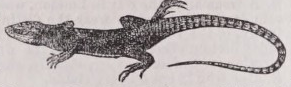
Most of the European lizards with four well-developed limbs belong to the genus Lacerta. They are of small size, and insectivorous. Their tongue is deeply cleft at the end, and is frequently exserted when the animal is in a state of excitement from fear or anger. As in all the lizards of the family Lacertidae, their tail is easily broken, and as readily reproduced, the reproduced portion often assuming a monstrous or double shape, so that the animal appears to be provided with two tails. Only three species occur in Great Britain (see fig, 2). The Common Lizard (Lacerta vivipara) frequents heaths and banks in England and Scotland, and is locally met with also in Ireland; it is ovoviviparous. Much scarcer is the second species, the Sand-Lizard (Lacerta agili s ) ι which is confined to some localities in the south of England, the New Forest and its vicinity; it does not appear to attain on English soil to the same size as on the Continent, where it abounds growing sometimes to a length of 9 inches. Singularly, α snake (Goronella laevis), also common on the Continent, and feeding principally on this lizard, has followed it across the British Channel, apparently existing in those localities only in which the sand-lizard has settled. This lizard is oviparous. The males differ by their brighter green ground colour from the females, which are brown, spotted with black. The third British species, the Green Lizard (Lacerta viridis), does not occur in England proper; it has found a congenial home in the island of Guernsey, but is there much less developed as regards size and beauty than in the countries south of the Alps and Pyrenees. This species is larger than the two preceding; it is green, with minute blackish spots. In Germany and France one other species only (Lacerta muralis) appears; but in the south of Europe the species of Lacerta are much more numerous, the largest and finest being L. ocellata, which grows to a length of 18 or 20 inches, and is brilliantly green, ornamented with blue eye-like spots on the sides. Even the small island-rocks of the Mediterranean, sometimes only a few hundred yards in diameter, are occupied by peculiar races of lizards, which of late years have attracted much attention from the fact that they, like other reptiles, have assumed under such isolated conditions a more or less dark, almost black, coloration.
Helodcrma horridum is a Mexican lizard, which in its native country has the reputation of being a most poisonous reptile. Its anterior teeth are, indeed, provided with a deep groove, as in many poisonous snakes, and the submaxillary gland is enormously developed. Sumichrast has recently proved by actual experiment on mammals the fatal effects of the bite of this lizard; and J. Stein, a traveller in Mexico, who was bitten in the finger, suffered from symptoms similar to those resulting from the bite of a poisonous snake. It thus appears that the fear in which it is held by the natives is not due merely to its hideous appearance, as was formerly believed. Tubercles of a dirty brown and yellow colour, with which its body is covered, give it the appearance of a leprous skin. It is about 20 inches long, and is known by the name of “Escorpion.”
The Glass-Snake (Pseudopus pαllasii) or Shettopusik (Russ.) is common in Dalmatia, Hungary, southern Russia, and the western parts of Central Asia. Externally it resembles a snake, the fore limbs being entirely absent, and the hind limbs reduced to small rudiments. It attains to a length of 2 or 3 feet, and feeds on insects, worms, mice, and small birds. In captivity it becomes perfectly tame. North America is inhabited by a very similar glasssnake (Ophisaurus), and North Africa by a third (Hyalosawrus). Limbless lizards are especially common in Australia, but their scutellation is so different from that of the glass-snakes of the northern hemisphere that they are placed in distinct families, which have been noticed in the systematic list (Pygopodidae, Aprasiidx, Lialidae).
The family of skinks also includes many genera with rudimentary limbs or without any, the Slow-Worm or Blind-Worm (Anguisfragilis) being the one most generally known. It is distributed over the greater part σf Europe, and rarely exceeds a length of 15 inches. Its eyes, although small, are perfectly developed and provided with eyelids. It is ovoviviparous; the young, in the first year of their life, differ considerably from the old in their coloration, the back being of a milk-white colour, with a black line down the middle. In the south of Europe it gradually disappears, and its place is taken by the similarly shaped Seps, a genus distinguished from Anguis by the presence of four very small rudiments of limbs, which have no function.
The Skink, which has given the name to the whole family, is a small lizard (Scincus officinalis) of 6 or 8 inches in length, common in arid districts of North Africa and Syria. A peculiarly wedge-shaped snout, and toes provided with strong fringes, enable this animal to burrow rapidly in...
[5,968 words — estimated reading time: 35 minutes]
לטאה, Levit. xi, 30. All interpreters agree that the original word here signifies a sort of lizard. Bochart takes it for that kind which is of a reddish colour, lies close to the earth, and is of a venomous nature.
[40 words — estimated reading time: 1 minute]