
A bird of the genus Hirundo, which forms its nest in buildings. It was formerly written by some authors martlet.
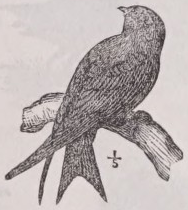
MARTIN (French, Martinet), the Hirundo urbica of Linnaeus and Chelidon urbica of modern ornithologists, a bird very well known throughout Europe, including even Lapland, where it is abundant, retiring in winter to the south of Africa. It also inhabits the western part of Asia, and appears from time to time in large flocks in India; but the boundaries of its range and those of at least one of its Eastern congeners cannot as yet be laid down. The Martin (or House-Martin, as it is often called, to distinguish it from the Sand-Martin presently to be mentioned) commonly reaches its summer-quarters a few days later than the Swallow (q.v.), whose habits its own so much resemble that heedless persons often disregard the very perceptible differences between them, the Martin’s white rump and lower parts being conspicuous as it flies or clings to its “loved mansionry” attached to our houses, for, as Shakespeare wrote—
“No jutty, frieze, Buttress, nor coign of vantage, but this bird Hath made his pendent bed and procreant cradle.”
—Macbeth, act i. sc. 6....
This nest, made of the same material as the Swallow’s, is, however, a far more difficult structure to rear, and a week or more is often occupied in laying its foundations— the builders clinging to the wall while depositing the mud of which it is composed. But, the base once securely fixed, the superstructure is often quickly added till the whole takes the shape of the half or quarter of a hemisphere, and a lining of soft feathers, mixed with a few bents or straws, fits it for its purpose. The Martin sets about building very soon after its return, and a nest that has outlasted the winter’s storms is almost at once reoccupied; though if a new nest be needed its construction often involves great delay, for any excess of wet or drought retards the operation, and the work is generally placed in such an exposed situation that heavy driving rains will frequently wash away the half-dried walls. However, the bird mostly perseveres against these and other untowardnesses, contriving in the course of the summer to raise a second or, rarely, a third brood of offspring—though it is certain that the latest broods often die in the nest—apparently through failure of food. Yet what seem to be adults of this species are observed in England every year so late as November, and there are several instances of its appearance within a few days of the winter solstice; but it is to be remarked that these late birds are almost certainly strangers, and not natives of the locality in which they are seen.
The Sand-Martin, Hirundo riparia of Linnaeus and Cotile riparia of modern writers, differs much in appearance and habits from the former. Its smaller size, mousecoloured upper surface, and jerking flight ought to render it easily recognizable from the other British Hirundinidx; but through carelessness it is seldom discriminated, and, being the first of the Family to return to its northern home, the “early Swallow” of newspaper-writers would seem to be nearly always of this species. Instead of the clay-built nest of the House-Martin, this bird bores, with a degree of regularity and an amount of labour rarely excelled in its Class, horizontal galleries in a natural or artificial escarpment. When beginning its excavation, it clings to the face of the bank, and with its bill loosens the earth, working from the centre outwards, assuming all sorts of positions—as often as not hanging head downwards. The form of the boring and its length depend much on the nature of the soil; but the tunnel may extend to 4, G, or even 9 feet. The gallery seems intended to be straight, but inequalities of the ground, and especially the meeting with stones, often cause it to take a sinuous course. At the end is formed a convenient chamber lined with a few grass stalks and feathers, the latter always beautifully arranged, and upon them the eggs are laid. The Sand-Martin has several broods in the year, and is much more regular than other Hirundinidae in its departure for the south. The kind of soil needed for its nestinghabits makes it a somewhat local bird; but no species of the Order Passeres has a geographical range that can compare with this. In Europe it is found nearly to the North Cape, and thence to the Sea of Okhotsk. In winter it visits many parts of India, and South Africa to the Transvaal territory. In America its range is even more extraordinary, extending (due regard being of course had to the season of the year) from Melville Island to Caiçara in Brazil, and from Newfoundland to Alaska.
The Purple Martin of America, Hirundo or Progne purpurea, requires some remarks as being such a favourite bird in Canada and in the United States. Naturally breeding in hollow trees, it readily adapts itself to the nest-boxes which are very commonly set up for its accommodation; but its numbers are in some years and places subject to diminution in a manner which has not yet been satisfactorily explained. The limits of its range in winter are not determined, chiefly owing to the differences of opinion as to the validity of certain supposed kindred species found in South America; but according to some authorities it reaches the border of Patagonia, while in summer it is known to inhabit lands within the Arctic Circle. The male is almost wholly of a glossy steel-blue, while the female is much duller in colour above, and beneath of a brownish-grey.
Birds that may be called Martins occur almost all over the world except in New Zealand, which is not regularly inhabited by any member of the Family. The ordinary Martin of Australia is the Hirundo or Hylochelidon nigricans of most ornithologists, and another and more beautiful form is the Ariel or Fairy-Martin of the same country, Hirundo or Lagenoplastes ariel. This last builds of mud a bottle-shaped nest, as does also the Bock-Martin of Europe, Hirundo or Biblis rupestris∙, but space fails wherein to tell more of these interesting birds. (a. n.)
MARTIN, St, bishop of Tours, was born of heathen parents at Sabaria (Stein am Anger) in Pannonia, about the year 316. When ten years of age he became a catechumen, and at fifteen, contrary to his own inclination, he entered the army. It was while he was stationed at Amiens that he divided his cloak with the beggar, and on the following night had the vision of Christ making known to his angels this act of charity to Himself on the part of “Martinus, still a catechumen.” Soon afterwards he received baptism, and, two years later, having been permitted to leave the army, he joined Hilary of Poitiers, who wished to make him a deacon, but at his own request ordained him to the humbler office of an exorcist. In the course of the years that followed he undertook a journey to Pannonia for the purpose of converting his parents, and was successful in bringing his mother within the pale of the church. For some time, doubtless during the Arian troubles, he lived, along with a presbyter friend, an ascetic life on the desert island of Gallinaria near Genoa; in 360 he was again with Hilary at Poitiers, and founded in the neighbourhood the monasterium Locociagense (Licugé). Here his miracles, which included more than one case of restoring the dead to life, were very numerous, and made him so famous that in 371 the people of Tours insisted on having him for their bishop. In this capacity he was extremely zealous and enérgetic in seeking to extirpate idolatry from his diocese and from France, and by example as well as by precept he did much for the spread of the monastic system. To obtain the privacy that he required for the maintenance of his personal religion, he established the monastery of Marmoutier-les-Tours (Martini monasterium) on the banks of the Loire. At Treves, in 385, he was importunate in his entreaties that the lives of the Priscillianist heretics should be given them, and he ever afterwards refused to hold ecclesiastical fellowship with those bishops who had sanctioned their execution. He died at Candes about the year 400, and is commemorated by the Roman Church on November 11 (duplex). He is the patron saint of France, and of the cities of Mainz and Würzburg. The Life by his disciple Sulpicius Severus is practically the only source we have for his biography, but it is full of legendary matter and chronological inaccuracies. The feast of St Martin (Martinmas) took the place of an old pagan festival, and inherited some of its usages (such as the Martinsmännchen, Martinsfeuer, Martinshorn, and the like, in various parts of Germany); by this circumstance is most probably to be explained the fact that he is regarded as the patron of drinking and jovial meetings, as well as of reformed drunkards.
MARTIN, John (1789-1854), a popular ‘English painter, was born at Haydon Bridge, near Hexham, on the 19th of July 1789. On account of his early interest in art he was apprenticed by his father to a coachbuilder to learn heraldic painting, but owing to a quarrel the indentures were cancelled, and he was placed under Bonifacio Musso, an Italian artist, father of the well-known enamel painter Charles Musso. With his master Martin removed to London in 1806, where he married at the age of nineteen, and led a struggling life, supporting himself by giving drawing lessons, and by painting in water colours, and on china and glass. His leisure was occupied in the study of perspective and architecture. His first picture, Sadak in Search of the Waters of Oblivion, was executed in a month. It was exhibited in the Royal Academy of 1812, and sold for fifty guineas. It was followed by the Expulsion (1813), Paradise (1813), Clytie (1814), and Joshua (1815). In 1821 appeared the famous Belshazzar’s Feast, which excited much favourable and hostile comment, and was awarded a prize of £200 at the British Institution, where the Joshua had previously carried off a premium of £100. Then came the Destruction of Herculaneum (1822), the Creation (1824), the Eve of the Deluge (1841), and a long series of other Biblical and imaginative subjects, many of which are widely known through engravings. In 1832-33 Martin received £2000 for drawing and engraving a fine series of designs to Milton, and along with Westall he produced a set of Bible illustrations. He was also much occupied with schemes for the improvement of London, and published various pamphlets and plans dealing with the metropolitan water supply, sewage, dock, and railway systems. During the last four years of his life he was engaged upon his large subjects of the Judgment, the Day of Wrath, and the Plains of Heaven. He was attacked with paralysis while painting, and died in the Isle of Man on the 17th of February 1854.
The bold originality of Martin’s productions startled and attracted the public, but they are without the qualities of solid execution and truth to nature upon which a lasting fame in the arts must be built. His figures are badly drawn, his colouring is hot and unpleasant. To most of his professional brethren his works seemed theatrical and tricky; and the best lay critics of his time, like Charles Lamb, were disposed to deny that they evinced true imaginative power. His popularity may be said to have culminated in 1828, the year of his Fall of Nineveh; since then it has been gradually declining.
MARTIN I., pope, succeeded Theodore I., in June or July 649. He had previously acted as papal apocrisiarius at Constantinople, and was held in high repute for learning and virtue. Almost his first official act was to summon a synod (the first Lateran) for dealing with the Monothelite heresy. It met in the Lateran church, was attended by one hundred and five bishops (chiefly from Italy, Sicily, and Sardinia, a few being from Africa and other quarters), held five sessions or “secretarii” from the 5th to the 31st of October 649, and in twenty canons condemned the Monothelite heresy, its authors, and the writings by which it had been promulgated. In this condemnation were included, not only the “Ecthesis” or exposition of faith of the patriarch Sergius for which the emperor Heraclius had stood sponsor, but also the “Typus” of Paul, the successor of Sergius, which had the support of the reigning emperor (Constans II.). Martin was very energetic in publishing the decrees of his Lateran synod in an encyclieal, and Constans replied by enjoining his exarch to seize the pope, should he persist in this line of conduct, and send him prisoner to Constantinople. These orders were found impossible of execution for a considerable space of time, but at last Martin was arrested in the Lateran (June 15, 653), hurried out of Rome, and conveyed first to Naxos and subsequently to Constantinople (September 17, 654). After suffering an exhausting imprisonment and many public indignities, he was ultimately banished to Cherson, where he arrived on March 26, 655, and died on the 16th of September following. His successor was Eugenius I. A full account of the events of his pontificate will be found in Hefele’s Conciliengeschichte, vol. iii., 1877.
MARTIN II. See Marinus I.
MARTIN III. See Marinus II.
MARTIN IV., pope from 1281 to 1285, was the successor of Nicholas III. He was a native of Touraine, born about 1210, and his proper name was Simon de Brion. After holding various offices at Rouen and Tours, he was made chancellor of France by Louis IX. in 1260, and cardinal by Urban IV. in 1261. He acted as legate for this pope and also for his successor Clement IV. in the negotiations for the assumption of the crown of Sicily by Charles of Anjou, and he is supposed also to have stimulated the ambition of Philip III. for the imperial dignity in 1273. After the death of Nicholas III. (August 1280) Charles of Anjou was able to secure the election of Cardinal Simon by the conclave at Viterbo (February 22, 1281). The Romans declined to receive him within their walls, and he was crowned at Orvieto. At the instance of Charles, whose tool he had become, he in November 1281 excommunicated the emperor Michael Palaeologus, who stood in the way of the French projects against Greece, —an act by which the union of the Eastern and Western churches was rendered impossible. For three years after the Sicilian Vespers in 1282 all the spiritual and material resources at his command were in vain employed on behalf of his patron against Peter of Aragon. He died at Perugia on March 25, 1285, and was succeeded by Honorius IV.
MARTIN V. (Otto di Colonna), pope from 1417 to 1431, was elected on St Martin’s day at Constance by a conclave consisting of twenty-three cardinals and thirty delegates of the council, which after deposing John XXIII. had long experienced much perplexity from the conflicting claims of Gregory XII. and Benedict XIII. The son of Agapito Colonna and Catarina Conti, born about 1368, he belonged to one of the oldest and most distinguished families of Rome, became apostolic protonotary under Urban VI., was created cardinal-deacon by Innocent VII., and in 1410 was the delegate of Alexander V. to hear the appeal which had been taken in that year to the papal see by John .Huss. He was justly esteemed for his moderation, learning, uprightness, and business capacity, but he failed to achieve, as he might have done, the honour of being a reforming pope. His first act after his election was to publish a brief confirming all the regulations made by his predecessors with regard to the papal chancery,—regulations which had long been the subject of just complaint. When the “nations” of the council pressed their plans for reform, Martin submitted a counter scheme, and ultimately entered into negotiations for separate concordats, for the most part vague and illusory, with Germany, England, and France. He left Constance at the close of the council (May 1418), but travelled slowly through Italy, lingered at Florence, and did not venture to enter Rome until September 1420, when his first task was to seek to restore it to the prosperity and order to which it had become a stranger. In accordance with the decree of Constance, confirmed by himself, ordering that councils should be held every five years, he in 1423 summoned the council which met at Pavia and afterwards at Siena: it was ...somewhat poorly attended, and this circumstance gave the pope a pretext for dissolving it as soon as it had come to the resolution that “internal church union by reform ought to take precedence of external union.” It was prorogued for seven years, and then met at Basel; shortly after its opening Martin died of apoplexy, on February 20, 1431. His successor was Eugenius IV.
MARTINA FRANCA, a city of Italy in the province of Lecce, 18 miles north of Taranto, on a hill near the sources of the Tara. It was a fief of the Caraccioli family, and dates from a comparatively modern epoch. The ducal palace is one of the finest buildings of its kind in the south of Italy, somewhat similar in style of architecture to the Palazzo Pamfili in Naples. The population of the city was 13,088 in 1861; that of the commune has increased from 16,637 in that year to 19,257 in 1881.
MARTINEAU, Harriet (1802-1876), English woman of letters, was born at Norwich, where her father was a manufacturer. The family was of Huguenot extraction, but had adopted Unitarian views. Her education, which included Latin and French, as well as domestic accomplishments, was received partly at home, and partly under a Mr Perry, to whose lessons in logical English composition she ascribed something of her later clearness of thought and statement. The atmosphere of her home was industrious, intellectual, and' austere; she herself was clever, weakly, and unhappy, and was, moreover, already growing deaf. At the age of fifteen the state of her health and temper led to a prolonged visit to her father’s sister, Mrs Kentish, who kept a school at Bristol. Here, in the companionship of amiable and talented people, her life became happier. Here, also, she fell under the influence of the Unitarian minister, Dr Carpenter, from whose instructions, she says, she derived “an abominable spiritual rigidity and a truly respectable force of conscience strangely mingled together.” From 1819 to 1830 she again resided chiefly at Norwich. The first part of this period was mainly spent in quiet and almost secret study and in needlework. About her twentieth year her deafness became confirmed, and she habitually from that time used an ear trumpet. In 1821 she began to write anonymously for the Monthly Repository, a Unitarian periodical, and was assured by her brother that authorship was her proper career. A little later she published Devotional Exercises and Addresses, Prayers, and Hymns....
In 1826 her father died, leaving a bare maintenance to his wife and daughters. His death had been preceded by that of his eldest son, and was shortly followed by that of the young man to whom Harriet was engaged. Mrs Martineau and her daughters soon after lost all their means by the failure of the house where their money was placed. Harriet had to earn her living, and, being precluded by her deafness from teaching, took up authorship in earnest and toiled with incredible industry. She reviewed for the Repository at the rate of £15 a year, wrote stories (afterwards collected as Traditions of Palestine), gained in one year (1830) three essay-prizes of the Unitarian Association, and eked out her income by needlework. In 1831 she was seeking a publisher for a series of tales designed as Illustrations of Political Economy. After many failures she accepted very disadvantageous terms, and the first number appeared amidst gloomy prognostications from the publisher. The sale, however, was immediate and enormous, the demand increased with each new number, and from that time her literary success was secured. In 1832 she moved to London; she at once became the fashien, and her acquaintance was eagerly sought. Till 1834 she continued to be occupied with her political economy series and with a supplemental series of Illustrations of Taxation. Four stories dealing with the poor-law came out about the same time. These tales, direct, lucid, written without any appearance of effort, and yet practically effective, display the characteristic qualities of their author’s style. In 1834, when the whole series was complete. Miss Martineau paid a long visit to America. Here her open adhesion to the Abolitionist party, then small and very unpopular, gave great offence, which was deepened by the publication, soon after her return, of Society in America and a Retrospect of Western Travel. An article in the Westminister Review, “r Γhe Martyr Age of the United States,” introduced English readers almost for the first time to the struggles of the Abolitionists. In these American writings Miss Martineau shows less than her usual calmness and judicial common sense, but it will scarcely be denied that there was some ground for her vehemence. The American books were followed by a novel, Deerbrook,— a story of middle class country life, lacking the delicate humour of Miss Austen or the touch of farce that enlivens Miss Edgeworth’s tales, but delightfully clear in style, wholesome in spirit, and well sustained in point of interest. To the same period belong two or three little handbooks, forming parts of a Guide to Service. The veracity of her Maid of all Work led to a widespread belief, which she regarded with some complacency, that she had once been a maid of all work herself.
In 1839, during a visit to the Continent, Miss Martineau’s health, which had long been bad, broke down entirely. She retired to solitary lodgings in Tynemouth, and remained a prisoner to her couch till 1844. She was still busy, and, besides a novel {The Hour and the Man), published some tales for children, and Life in the Sick-room. These volumes contain some of her best work, and possess a charm of tender feeling to balance the somewhat cold rationality that predominates in most of Miss Martineau’s writing. During this illness she for a second time declined a pension on the civil list, fearing to compromise her political independence. Her letter on the subject was published, and some of her friends raised a small annuity for her soon after.
In 1844 Miss Martineau underwent a course of mesmerism, and in a few months was restored to health. Her recovery excited much discussion and controversy.
She herself felt no doubt either of its reality or of its being due to mesmerism, and not unnaturally resented the incredulity of others. She eventually published an account of her case in sixteen Letters on Mesmerism, a proceeding which caused great offence to some members of her family. On finding herself set free from the bondage of ill-health, she removed to Ambleside, where she built herself the house in which the greater part of her after life was spent. In 1845 she published three volumes of Forest and Game Lazo Tales, in which the ιhethod of her political economy series was again applied. In 1846 she made an Eastern tour with some friends. She was abroad for eight months, visiting Egypt, Palestine, and Syria, and on her return published Eastern Life. The tendency of this work is to display humanity passing through one after another of the world’s historic religions, the conception of the Deity and of Divine government becoming at each step more and more abstract and indefinite. The ultimate goal Miss Martineau believed to be a philosophic atheism, but this belief she did not expressly declare in Eastern Life, considering it to be outside the province of that book. She published about this time Household Education, expounding the modern theory, in which freedom and rationality, rather than command and obedience, are regarded as the most effectual instruments of education. Her practical interest in all schemes of instruction led her to start a series of lectures, addressed at first to the school children of Ambleside, but afterwards extended, at their own desire, to their elders. The subjects of these lectures were sanitary principles and practice, the histories of England and North America, and the scenes of her Eastern travels. At the request of Mr Charles Knight she wrote for him, in 1849, The History of the Thirty Years' Peace,— a characteristic instance of Miss Martineau’s remarkable powers of labour. “From the first opening of the books to study for the history to the depositing of the MS. of the first volume at press was,” she says, “exactly six months. The second volume took six months to do.”
In 1851 Miss Martineau edited a volume of Letters on the Laws of Man's Nature and Development. Its form is that of a correspondence between herself and Mr H. G. Atkinson (in which the latter has much the larger share), and it expounds that doctrine of philosophical atheism to which Miss Martineau had, in Eastern Life, depicted the course of human belief as tending. The existence of a first cause is not denied, but is declared unknowable, and the authors, while regarded by others as denying it, certainly considered themselves to be affirming the doctrine of man’s moral obligation. Mr Atkinson was a zealous exponent of mesmerism, and the prominence given to the topics of mesmerism and clairvoyance no doubt tended to heighten the disapprobation with which the book was received. The reviewers were almost unanimous in condemnation, and the publication caused a lasting division between Miss Martineau and some of her friends.
The new philosophical bent of her studies directed Miss Martineau’s attention to the works of Comte, and she undertook a condensed English version of the Philosophie Positive. It appeared in 1853, and to most readers is more useful and intelligible than the original. She had begun in the previous year to write articles, chiefly biographical, for the Daily News. Among these were the Letters from Ireland, written during a visit to that country in the summer of 1852. She also wrote a considerable number of essays upon different manufactures for Household Words, and another series for the same periodical upon the treatment of blindness, deafness, idiotcy, &c., besides a Guide to Windermere, followed afterwards by a Complete Guide to the Lahes. She had been for many years a contributor to the Westminister Review, and was one of the little band of supporters whose pecuniary assistance, in 1854, prevented its extinction or forced sale. In the early part of 1855 Miss Martineau found herself suffering from heart disease. Having always felt it one of her duties to write her autobiography, and believing the time before her to be but brief, she now at once set about this task, and on its completion caused the book to be printed that it might be ready for speedy publication at her death. But her life, which she supposed to be so near its close, was prolonged for other twenty years, her death not taking place until 1876.
These years were by no means idle. She continued to contribute to the Daily News, for which she wrote in all more than 1600 articles, and to the Westminster Review, as well as to other papers, and her biographical sketches were collected and reprinted from the Daily News in a volume which has justly become one of the best-known of her works. In point of style it is probably the most excellent of them all. The form and method leave nothing to be desired, and the perception of character is shrewd, sincere, and, roughly speaking, reliable. But in reading the book we feel that the biographies, divided by the editor into groups of royal, political, &c., fall far more naturally into two larger classes,—the biographies of persons whom Miss Martineau liked, and the biographies of persons whom she disliked. All are doubtless in a sense true, as all photographs are true, but the difference between a flattering and an unflattering photograph is considerable.
She also produced two books on the government of India, and was continually occupied in promoting schemes of reform and benevolence. Her poorer neighbours owed much to her kindly and enlightened efforts, and her servants found in her a friend as well as a mistress. Her long and busy life bears the consistent impress of two leading characteristics,—industry and sincerity. Her work was invariably sound, and its motive invariably respectable. The verdict which she records on herself in the autobiographical sketch left to be published by the Daily News is probably very near to that which will be recorded by future judgment. She says,—“Her original power was nothing more than was due to earnestness and intellectual clearness within a certain range. With small imaginative and suggestive powers, and therefore nothing approaching to genius, she could see clearly what she did see, and give a clear expression to what she had to say. In short, she could popularize while she could neither discover nor invent.” Her judgment on large questions was clear and sound, and was always the judgment of a mind naturally progressive and Protestant. Mentally she was a true daughter of her Huguenot ancestors. But it is impossible to read her autobiography without suspecting that she was subject to considerable prejudices, especially in her judgment of persons, and that her temper, particularly in earlier life, was unamiable, hard, and unforgiving. She seems, indeed, to have possessed the sort of disposition which shows to much greater advantage in its relation to juniors, inferiors, and dependants than in its relations to elders and superiors, and which therefore appears more amiable in the closing than in the opening years of life. Her autobiography reveals also a weakness which was perhaps unavoidable. The publication of her political economy tales brought her into great and sudden notice; many persons of high position, official and otherwise, desired to enlist her advocacy on the part of their particular projects. She found her help much courted, and much help eagerly proffered to her. Her deafness, which suffered her to hear only what was directly addressed to herself, assisted to make her a central figure, and to induce the belief that hers was one of the most potent if not actually the most potent voice in English politics. Her deafness was in another direction probably advantageous. It led her to find solitude easier than most companionship, and saved her from many distractions of attention. It may indeed fairly be surmised that but for her deafness she could never have found time to achieve the amazing quantity of work that she did, while the courageous, cheerful, and unobtrusive spirit in which she bore her infirmity remains an example and an encouragement to all her fellow-sufferers. (C. BL. )
MARTINI, Giovanni Battista (1706-1784), the most learned musician of the 18th century, was bornât Bologna on April 25, 1706. His father, Antonio Maria Martini, a violinist, taught him very early the elements of music, and to play the violin: at a later period he learned singing and harpsichord playing from Padre Pradieri, and counterpoint from Antonio Riccieri. Having received his education in classics from the fathers of the oratory of San Filippo Neri, he afterwards entered upon a noviciate at the Franciscan monastery at Lago, at the close of which he was received into that order on September 11, 1722. Continuing his studies in the theory and practice of music with great zeal, he in 1725, though only nineteen years of age, received the appointment of chapelmaster in the Franciscan church at Bologna, where his compositions soon attracted much attention. At the invitation of amateurs and professional friends he now opened a school of musical composition at which in the course of his long life several celebrated musicians were trained, including Paolucci, Sabbatini, Ruttini, Zanotti, Sarti, Ottani, and Stanislas Mattei; as a teacher he consistently declared his preference for the traditions of the old Roman school of musical composition (see Music). Padre Martini was a zealous and indefatigable collector of musical literature, and is alleged to have been the possessor of the most extensive musical library ever formed. After a lingering illness he died at Bologna on August 4, 1784. His Elogio was published by Pietro della Valle at Bologna in the same year....
The greater number of Martini’s sacred compositions remain unprinted. The Liceo of Bologna possesses the MSS. of two oratorios; and a requiem, with some other pieces of church music, are now in Vienna. Litaniae atque antiphonae Jinales B. V. Mariae were published at Bologna in 1734, as also twelve Sonate d'intavolatura ; six Sonate per V organo cd il cembalo in 1747; and Duetti da Camera in 1763. Martini’s most important works are his Storia della Musica (Bologna, 1757-81) and his Saggio di Contrapunto (Bologna, 1774-75). The former, of which the three published volumes relate wholly to ancient music, and thus represent a mere fragment of the author’s vast plan, exhibits immense reading and industry, but it is written in a dry and unattractive style, and is overloaded with matter which cannot be regarded as historical. At the beginning and end of each chapter occur puzzle-canons, some of which are exceedingly difficult; Cherubini solved the whole of them. The Saggio is a very learned and valuable work, containing an important collection of examples from the best masters of the old Italian and Spanish schools, with excellent explanatory notes. It treats chiefly of the tonalities of the plain chant, and of counterpoints constructed upon them. Besides being the author of several controversial works, Martini drew up a Dictionary of Ancient Musical Terms, which appeared in the second volume of G. B. Doni’s Works ; he also published a treatise on The Theory of Numbers as applied to Music.
MARTINI, Simone (1283-1344), called also Simone di Martino, and more commonly, but not correctly, Simon Memmi, was born in 1283. He followed the manner of painting proper to his native Siena, as improved by Duccio, which is essentially different from the style of Giotto and his school, and the idea that Simone was himself a pupil of Giotto is therefore wide of the mark. The Sienese style is less natural, dignified, and reserved than the Florentine; it has less unity of impression, has more tendency to pietism, and is marked by exaggerations which are partly related to the obsolescent Byzantine manner, and partly seem to forebode certain peculiarities of the fully developed art which we find prevalent in Michelangelo. Simone, in especial, tended to an excessive and rather affected tenderness in his female figures; he was more successful in single figures and in portraits than in large compositions of incident. He finished with scrupulous minuteness, and was elaborate in decorations of patterning, gilding, &c.
The first known fresco of Simone is the vast one which he executed in the hall of the Palazzo Pubblico in Siena,— the Madonna Enthroned, with the Infant, and a number of angels and saints; its date is 1315, at which early period of his life he was already an artist of repute throughout Italy. In S. Lorenzo Maggiore of Naples he painted a life-sized picture of King Robert crowned by his brother,
Lewis, bishop of Toulouse; this also is ex'ant, but much damaged. In 1320 he painted for the high altar of the church of St Catharine in Pisa the Virgin and Child between six saints; above are archangels, apostles, and other figures. The compartmented portions of this work are now dispersed, some of them being in the academy of Siena. Towards 1321 he executed for the church of St Dominic in Orvieto a picture of the bishop of Savona kneeling before the Madonna attended by saints, now in the Fabricceria of the cathedral. Certain frescos in Assisi in the chapel of St Martin, representing the life of that saint, ascribed by Vasari to Puccio Capanna, are now, upon strong internal evidence, assigned to Sijnone. He painted also, in the south transept of the lower church of the same edifice, figures of the Virgin and eight saints. In 1328 he produced for the Sala del Consilio in Siena a work of a very different character—a striking equestrian portrait of the victorious general Guidoriccio Fogliani de’ Ricci.
Simone had married in 1324 Giovanna, the daughter of Memmo (Guglielmo) di Filippuccio. Her brother, named Lippo Memmi, was also a painter, and was frequently associated with Simone in his work; and this is the only reason why Simone has come down to us with the familyname Memmi. »They painted together in 1333 the Annunciation which is now in the Uffizi gallery. Simone kept a bottega (or shop), undertaking any ornamental work commissioned of him, and his gains were large. In 1339 he settled at the papal court in Avignon, where he made the acquaintance of Petrarch and Laura; and he painted for the poet a portrait of his lady, which has not come down to us; it gave occasion for two of Petrarch’s sonnets, in which Simone is highly eulogized. He also illuminated for the poet a copy of the Comment of Servius upon Virgil, now preserved in the Ambrosian library of Milan. He was largely employed in the decorations of the papal buildings in Avignon, and several of his works still remain —in the cathedral, in the hall of the consistory, and, in the two chapels of the palace, the stories of the Baptist, and of Stephen and other saints. One of his latest productions (1342) is the picture of Christ Found by his Parents in the Temple, now in the Liverpool Gallery. Simone died in Avignon in July 1344.
From this account of Simone’s principal works it will be perceived that those with which his name and fame are most generally identified are no longer regarded as his. These are the compositions, in the Campo Santo of Pisa, from the legend of S. Ranieri, and the Assumption of the Virgin; and the great frescos in the Cappellone degli Spagnuoli, in S. Maria Novella, Florence, representing the Triumph of Religion through the work of the Dominican order, &c. Some of the works in question can be proved to have been done many years after Simone’s death, and the others belong to a different school and style of art.
MARTINIQUE, one of the West India islands, belonging to the chain of the Lesser Antilles, and constituting a French colony, lies 33 miles south of Dominica and 22 north of Saint Lucia, between 14° 23' and 14° 52' N. lat. and 63° 6' and 63° 31' W. long. The greatest length is 43 miles, the mean width 19; and the surface comprises 244,090 acres, or 380 square miles. A cluster of volcanic mountains in the north, a similar group in the south, and a line of lower heights between them, form the backbone of the island, which culminates in the north-west in Mont Pelée (4430 feet), and has altogether a much more irregular and strongly marked relief than it presents to the eye,—the deep ravines and precipitous escarpments with which it abounds being reduced in appearance to gentle undulations by the drapery of the forests. Of the numerous streams which traverse the few miles of country between the watershed and the sea, about seventy or eighty are of considerable size, and in the rainy season become deep and too often destructive torrents. The east coast of the island, exposed to the full sweep of the Atlantic, is a succession of inlets, headlands, islands, and rocks; the south coast is much more regular, but bold and steep; and the west alone presents, in the bay of Fort de France, a stretch of mangrove swamp. Of the total area, about 83,990 acres are under cultivation, 83,843 occupied by forest and savanna, and 68,837 by fallow. On an average, according to the returns for 1874-78 inclusive, 47,440 acres are devoted to the sugar crop, 1290 to coffee, 640 to cotton, and 1660 to cocoa. The mean annual temperature is 81° in the coast region,—the monthly mean for June being 83°, and that of January 77°. Of the annual rainfall of 87 inches, August has the heaviest share ...(11 '3 inches), though the rainy season extends from June to October; March, the lowest, has 3 - 7. Martiniqueenjoys a remarkable immunity from hurricanes; half a century may pass without serious disaster from such a visitation. In 1878 there were 162,861 inhabitants (77,782 males, 85,079 females) in the island, which is thus nearly as densely peopled as Belgium. Since 1848 the increase amounts to about 42,800. Of the twenty-five communes, fourteen have more than 5000 inhabitants; the largest are Saint Pierre (23,909), Fort de France (15,414), Lamentin (13,409), and François (10,297). The great mass of the population consists of Creole negroes and half-castes of various grades, ranging from the “Saccatra,” who has hardly retained any trace of Caucasian blood, to the so-called “Sangmêlé,” with his mere suspicion of negro commixture. Marriage is frequently ignored, and of the births no less than 66 per cent, are illegitimate.
Fort de France, the chief town, a place of about 11,000 inhabitants, stands on a bay on the west coast. Since the earthquake of 1839 nearly all the houses are of wood, and have only one story; the streets are laid out with great regularity. An abundant supply of water was introduced in 1856. St Pierre, the commercial centre of the island, with about 20,000 inhabitants, lies farther north on the same coast. It consists of a lower and an upper town,—the one close and unhealthy, and the other for the most part well-ventilated and pleasant.
Martinique, also called Madiana or Mantinino, was discovered by Columbus 15th June 1502. It was at that time inhabited by Caribs (Galibis) who had expelled or incorporated an older stock. In 1635 a Norman captain, D’Enambuc, from St Christopher’s, took possession of the island, and in 1637 his nephew Duparquet became captain-general of the colony, now numbering seven hundred men. In 1654 welcome was given to three hundred Jews expelled from Brazil, and by 1658 there were at least five thousand people exclusive of the Câribs, who were soon after exterminated. Purchased by the French Government from Duparquet’s children for 120,000 livres, Martinique was assigned to the West India Company, butin 1674 it became part of the royal domain. The habitants (French landholders) at first devoted themselves to the cultivation of cotton and tobacco; but in 1650 sugar plantations were commenced, and in 1726 the coffee plant was introduced by Desclieux, who, when water ran short during his voyage to the island, shared his scanty allowance with his seedlings. Slave labour having been introduced, there were 72,000 blacks in the island by 1736. Martinique has several times been occupied by the English Captured by Rodney in 1762, it was next year restored to the French; but after the conquest by Sir John Jervis and Sir Charles Grey in 1794 it was retained for eight years · and seized again in 1809, it was not surrendered till 1814.
See Renonard, Stat.de la'.Martinique, 1822; Sidney Daney, Hist. de la Martinique, 1816; E. Rufz, Studes hist, et slat, sur la population de la Martinique; Pai don, La Martinique, 1877; H. Rev, Étude sur la col. de la Martinique, 1881.
MARTINSBURG, a town of the United States, the capital of Berkeley county, West Virginia, lies on a plateau above the Tuscarora Creek, in the Shenandoah valley, 80 miles west of Washington. A station on the Baltimore and Ohio Railroad, and a terminus of the Cumberland Valley Railway, Martinsburg is the seat of extensive machineshops belonging to the former company, which were sacked by the Confederates in 1861. The population, 4863 in 1870, was 6335 in 1880.