Rake
[Noun]
Webster's Dictionary 1828
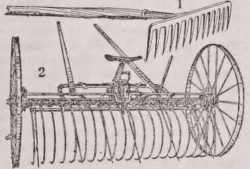
1. An instrument consisting of a head-piece in which teeth are inserted, and a long handle; used for collecting hay or other light things which are spread over a large surface, or in gardens for breaking and smoothing the earth.
3. The projection of the upper parts of a ship, at the height of the stem and stern, beyond the extremities of the
keel. The distance between a perpendicular line from the extremity of stem or stern to the end of the
keel, is the length of the rake; one the fore-rake, the other the rake-
aft.
4. The inclination of a mast from a perpendicular direction.
Rake
[Verb intransitive]
Webster's Dictionary 1828
1. To
scrape; to
scratch into for finding something; to search minutely and meanly; as, to rake into a
dunghill.
2. To search with minute inspection into every part.
4. To pass with violence or rapidity.
5.
Pas could not stay, but over him did rake
6. To seek by
raking; as, to rake for oysters.
8. To
incline from a perpendicular direction; as, a mast rakes
aft.
Rake
[Verb transitive]
Webster's Dictionary 1828
1. Properly, to
scrape; to
rub or
scratch with something rough; as, to rake the ground.
2. To gather with a rake; as, to rake hay or barley.
3. To clear with a rake; to smooth with a rake; as, to rake a bed in a garden; to rake land.
4. To collect or draw together something scattered; to gather by violence; as, to rake together wealth; to rake together
slanderous tales; to rake together the
rabble of a town.
5. To
scour; to search with eagerness all corners of a place.
6. The statesman rakes the town to find a plot.
7. In the military art, to
enfilade; to fire in a direction with the length of any thing; particularly in naval engagement, to rake is to
cannonade a ship on the stern or head, so that the
8. balls range the whole length of the deck. Hence the phrase, to rake a ship fore and
aft.
9. To rake up, applied to fire, is to cover the fire with ashes.
Rake
[Noun]
Webster's Dictionary 1913
1. An
implement consisting of a
headpiece having teeth, and a long handle at right angles to it, -- used for collecting hay, or other light things which are spread over a large surface, or for breaking and smoothing the earth.
2. A toothed machine drawn by a horse, -- used for collecting hay or grain; a
horserake.
3. A
fissure or mineral vein
traversing the strata vertically, or nearly so; -- called also rake-vein.
4. The inclination of anything from a perpendicular direction; as, the rake of a roof, a
staircase, etc.
5. the inclination of a mast or
funnel, or, in general, of any part of a vessel not perpendicular to the
keel.
Rake
[Verb intransitive]
Webster's Dictionary 1913
1. To use a rake, as for searching or for collecting; to
scrape; to search minutely.
2. To pass with violence or rapidity; to
scrape along.
3. To
incline from a perpendicular direction; as, a mast rakes
aft.
Rake
[Verb transitive]
Webster's Dictionary 1913
1. To collect with a rake; as, to rake hay; -- often with up; as, he
raked up the fallen leaves.
2. To collect or draw together with laborious industry; to gather from a wide space; to
scrape together; as, to rake together wealth; to rake together
slanderous tales; to rake together the
rabble of a town.
3. To pass a rake over; to
scrape or
scratch with a rake for the purpose of collecting and clearing off something, or for
stirring up the soil; as, to rake a
lawn; to rake a flower bed.
5. To
scrape or
scratch across; to pass over quickly and lightly, as a rake does.
6. To
enfilade; to fire in a direction with the length of; in naval engagements, to
cannonade, as a ship, on the stern or head so that the balls range the whole length of the deck.
Raker
[Noun]
Webster's Dictionary 1913
1. One who, or that which, rakes
2. A person who uses a
rake.
3. A machine for
raking grain or hay by horse or other power.
4. A gun so placed as to
rake an enemy's ship.
5. See Gill rakers, under 1st Gill.