
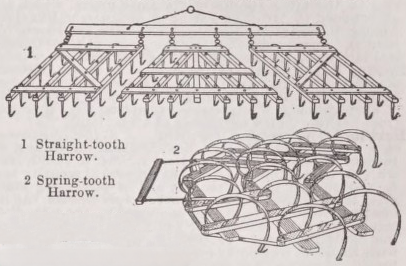
An instrument of agriculture, formed of pieces of timber sometimes crossing each other, and set with iron teeth. It is drawn over plowed land to level it and break the clods, and to cover seed when sown.
HARROW-ON-THE-HILL, a village of Middlesex, England, 10 miles N.W. of London, derives the latter part of its name from its position on a hill which rises from the surrounding plain to the height of about 200 feet. On the summit, and forming a conspicuous landmark, is the church of St Mary, said to have been founded by Lanfranc, archbishop of Canterbury, in the reign of William I., but of the original building very little is now left. Harrow is chiefly celebrated for its school, founded in 1571 by John Lyon, a yeoman of the neighbouring village of Preston who had yearly during his life set aside 20 marks for the education of poor children of Harrow. Though the charter was granted by Queen Elizabeth in 1571, and the statutes drawn up by the founder in 1590, two years before his death, it was not till 1611 that the first building was opened for scholars. Lyon originally settled about two-thirds of his property on the school, leaving the remainder for the maintenance of the highway between London and Harrow, but in the course of time the values of the respective endowments have changed, and while the road commissioners receive about £3500, the school’s share is only about £1600. In 1660 the headmaster, taking advantage of a concession in Lyon’s statutes, began to receive “foreigners,” t.e., boys from other parishes, who were to pay for their education. From this time the prosperity of the school may be dated. In 1809 the parishioners of Harrow appealed to the Court of Chancery against the manner in which the school was conducted, but the decision, while it recognized their privileges, confirmed the right of admission to foreigners. At present foundationers receive their education at a slightly cheaper rate than foreigners; there are none who are taught gratis. The ...government of the school was originally vested in six persons of standing in the parish, who had the power of filling vacancies in their number by election among themselves; but under the Public Schools Act of 1868 the governing body now consists of the surviving members of the old board, besides six new members who are elected respectively by the Lord Chancellor, the universities of Oxford, Cambridge, and London, the Royal Society, and the assistant masters of the school. There is a considerable number of scholarships in connexion with the school to both the great English universities, some to special colleges, othere to colleges in the choice of the holders. The general mode of instruction and discipline is modelled on that of Eton, where most of the former headmasters of Harrow were educated. Originally an exclusively classical school, mathematics became in 1837 a compulsory study at Harrow; modern languages, compulsory on the upper f0rm3 only since 1851, were extended to the whole school in 1855; while English history and literature began to be more especially studied about 1869. Science, music, and drawing are now also taught. Among the famous men who have been educated here may be mentioned Bruce, the Abyssinian traveller, Sir William Jones, the Orientalist, Dr Parr, who was born at Harrow, Admiral Rodney, Sheridan, Byron, Peel, Theodore Hook, Lord Palmerston, Lord Herbert of Lea, the earl of Shaftesbury, and Archbishop Trench. Comparatively little change was made in the school buildings till 1819, when the new portion was begun; but since that time improvements and additions have steadily increased. In 1839 a school-chapel was consecrated; but this has been gradually replaced by a handsomer edifice completed in 1857. The Vaughan library was built in 1861-63, and a hospital for the boys in 1865. A new speech room, a gymnasium, and laboratories have been erected out of the Lyon Tercentenary Fund, subscribed since 1871. The population of the parish in 1871 was 8537, and of the local board district 4997.