
A degenerate dog; and in reproach, a worthless man.
Word of the Day: Catachrestical
The state of being curable; curableness.
That may be healed or cured; admitting a remedy; as acurable wound or disease; a curable evil.
Capable of being cured; admitting remedy.
A large gallinaceous bird of the American genera Crax, Ourax, etc., of the family Cracidae.
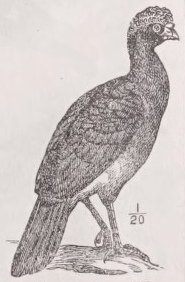
Curassow
Encyclopedia Britannica
CURASSOW(Cracinae), a group of gallinaceous birds forming one of the sub-families of Cracidae, the species of which are among the largest and most splendid of the game birds of South America, where they may be said to represent the pheasants and grouse of the Old World. They are large, heavy birds, many of them rivalling the turkey in size, with short wings, long and broad tail, and strong bill. In common with the family to which they belong, they have the hind toe of the foot placed on a level with the others, thus resembling the pigeons, and unlike the majority of gallinaceous birds. With the exception of a single species found north of Panama, the curassows are confined to the tropical forests of South America, east of the Andes, and not extending south of Paraguay. They live in small flocks, and are arboreal in their habits, only occasionally descending to the ground, while always roosting and building their nests on the branches of trees. Their nests are neat structures, made of slender branches interlaced with stems of grass, and lined internally with leaves. They feed on fruits, seeds, and insects. They are said to be domesticated in several parts of South America, and Bates states that when journeying up the Amazon he was amused “at the excessive and almost absurd tameness of a fine curassow turkey (Mitua tuberosa)f which ran about one of the planter’s houses in which he happened to stay. Large numbers of these birds were, according to Temminck, brought to Holland from Dutch Guiana towards the end of last century, and got so completely acclimatized and domesticated as to breed in confinement like ordinary poultry; but the establishments in w hich these were kept were broken up during the troubles that followed on the French Revolution. Their flesh is said to ...be exceedingly white and delicate, and this, together with their size and the beauty of their plumage, would make the curassows an important gain to the poultry yards of Europe, should they yet be successfully reared. The sub-family of curassows contains four genera and twelve species, all confined to South America, with the exception of Crax globicera— a Central American species, which extends northward into Mexico. This bird is about 3 feet in length, of a glossy black colour, with green and purple reflections over the whole body, excepting the abdomen and tail coverts, which are white. In common with the other species of this genus its head bears a crest of feathers curled forward at the tips, which can be raised or depressed at will. The female is of a reddish colour, although varying greatly in this respect, and was until lately described as a separate species—the Red Curassow. In another species, Crax incommoda, the greater part of the black plumage is beautifully varied with narrow transverse bars of white. The Galeated Curassow fPauxi galeata) is peculiar in having a large blue tubercle, hard and stony externally, but cellular within, and resembling a hen’s egg in size and shape, situated at the base of the bill. It only appears after the first moulting, and is much larger in the male than in the female.
9th ed. Encyclopædia Britannica, vol. 6, p. 709
[537 words — estimated reading time: 4 minutes]
[537 words — estimated reading time: 4 minutes]
A cuirass or breastplate.
1. A clergyman in the church of England, who is employed to perform divine service in the place of the incumbent, parson or vicar. He must be licenced by the bishop or ordinary, and having no fixed estate in the curacy, he may be removed at pleasure. But some curates are perpetual.
2. One employed to perform the duties of another.
Curate
Encyclopedia Britannica
CURATE (from the Latin curare, to take care of), properly a presbyter who has the cure of souls within a parish, being the Latin equivalent of the Greek parochus. The term curate is used in this general sense in certain rubrics of the Anglican Prayer Book, in which it is applied equally to rectors and vicars as to perpetual curates. In a more limited sense it is applied in the Church of England to the incumbent of a parish who has no endowment of tithes, as distinguished from a perpetual vicar, who has an endowment of small tithes, which are for that reason sometimes styled vicarial tithes. The origin of such unendowed curacies is traceable to the fact that benefices were sometimes granted to religious houses pleno jure, and with liberty for them to provide for the cure; and when such appropriations were transferred to lay persons, being unable to serve themselves, the appropriators were required to nominate a clerk in full orders to the ordinary for his licence to serve the cure. Such curates, being not removable at the pleasure of the appropriators, but only on due revocation of the licence of the ordinary, came to be entitled perpetual curates. The term “curate” in the present day is almost exclusively used to signify a clerk who is assistant to an incumbent; and a clerk in deacon’s orders is competent to be licensed by a bishop to the office of such assistant curate. The consequence of this misuse of the term “curate” has been that the title of “perpetual curate” has fallen into desuetude in the Anglican Church, some inconvenience being found to result from the indiscriminate application of the term “curate,” in the case of perpetual curacies, both to the incumbent of the parish and to his assistant curate, and an Act of Parliament (31 and 32 Viet, ...c. 117) has accordingly been passed to authorize such incumbents to style themselves vicars. The Act provides as follows :—
“The incumbent of the church of every parish or new parish for ecclesiastical purposes, not being a rector, who is or shall be authorized to publish banns of matrimony in such church, and to solemnize therein marriages, churches, and baptisms, according to the laws and canons in force in this realm, and who is or shall be entitled to take, receive, and hold for his own sole use and benefit the entire fees arising from the performance of such offices without any reservation thereout, shall from and after the passing of this Act, for the purposes of style and designation, but not for any other purpose, be deemed and styled the vicar of such church and parish or new parish, as the case may be, and his benefice shall for the same purpose be styled and designated a vicarage.”
9th ed. Encyclopædia Britannica, vol. 6, p. 709
[468 words — estimated reading time: 3 minutes]
[468 words — estimated reading time: 3 minutes]
A curacy.
Relating to the cure of diseases; tending to cure.
Relating to, or employed in, the cure of diseases; tending to cure.
1. One who hast he care and superintendence of any thing.
2. A guardian appointed by law.
3. Among the Romans, a trustee of the affairs and interests of a person emancipated or interdicted. Also, one appointed to regulate the price of merchandize in the cities, and to superintend the customs and tributes.
4. In the United Provinces, or Holland, the curator of a University superintends the affairs of the institution, the administration of the revenues, the conduct of the professors, etc.
1. One who has the care and superintendence of anything, as of a museum; a custodian; a keeper.
The office of a curator.
CuraÇoa
Encyclopedia Britannica
CURAÇOA, or Curaçao, an island in the Caribbean Sea, lying off the north coast of Venezuela, in 12° N. lat., 69° W. long. It is 40 miles in length from N.W. to S.E., and 10 in average breadth; the area is 212 square miles. The island is hilly and deficient in water, being wholly dependent upon the rains; yet, owing to the industry of the Dutch planters, considerable quantities of sugar, cotton, indigo, tobacco, and maize are raised. A peculiar variety of orange, the Citrus Λurantium curassuviensis, grows abundantly, and furnishes the distinguishing ingredient in the liqueur which takes its name from the island. The principal export is salt. The shores, which are bold, are in some places deeply indented, and present several harbours, the chief of which is Santa Anna, on the south-west side of the island. The entrance to this, which is narrow, is protected by Fort Amsterdam and other batteries; but the harbour itself is large and secure, and is the port of the chief town Curaçoa, or Willemstad. The population in 1875 amounted to 23,972, about one-third being emancipated negroes. All belonged to the Roman Catholic Church, except about 2000 Protestants and 1000 Jews. The island was settled by the Spaniards about 1527, and was captured by the Dutch in 1634. It was taken by the English in 1798 and again in 1806, but was restored in 1814 to the Dutch, in whose possession it has since remained.
9th ed. Encyclopædia Britannica, vol. 6, p. 709
[250 words — estimated reading time: 2 minutes]
[250 words — estimated reading time: 2 minutes]
Animal Roget’s Thesaurus §366
N. animal, animal kingdom, fauna, brute creation, beast, brute, creature, critter, wight, created being, creeping thing, living thing, dumb animal, dumb creature, zoophyte, mammal, bird, reptile, amphibian, fish, crustacean, shellfish, mollusk, worm, insect, arthropod, microbe, microbe, animalcule, alligator, crocodile, saurian, dinosaur, snake, serpent, viper, eft, asp, aspick, frog, toad, trout, bass, tuna, muskelunge, sailfish, sardine, mackerel, ant, mosquito, bee, honeybee, tardigrade, spider, biped, quadruped, flocks and herds, live stock, domestic animals, wild animals, game, ferae naturae, beasts of the field, fowls of the air, denizens of the sea, black game, black grouse, blackcock, duck, grouse, plover, rail, snipe, horse, cattle, kine, ox, bull, bullock, cow, milch cow, calf, heifer, shorthorn, sheep, lamb, lambkin, ewe, ram, tup, pig, swine, boar, hog, sow, steer, stot, tag, teg, bison, buffalo, yak, zebu, dog, cat, dog, hound, pup, puppy, whelp, cur, mongrel, house dog, watch dog, sheep dog, shepherd's dog, sporting dog, fancy dog, lap dog, toy dog, bull dog, badger dog, mastiff, blood hound, grey hound, stag hound, deer hound, fox hound, otter hound, harrier, beagle, spaniel, pointer, setter, retriever, newfoundland, water dog, water spaniel, pug, poodle, turnspit, terrier, fox terrier, skye terrier, dandie dinmont, collie, feline, puss, pussy, grimalkin, gib cat, tom cat, fox, reynard, vixen, stag, deer, hart, buck, doe, roe, caribou, coyote, elk, moose, musk ox, sambar, bird, poultry, fowl, cock, hen, chicken, chanticleer, partlet, rooster, dunghill cock, barn door fowl, feathered tribes, feathered songster, singing bird, dicky bird, canary, warbler, finch, aberdevine, cushat, cygnet, ringdove, siskin, swan, wood pigeon, vermin, varmint, pest
Adj. animal, zoological equine, bovine, vaccine, canine, feline, fishy, piscatory, piscatorial, molluscous, vermicular, gallinaceous, rasorial, solidungulate, soliped
Bad Man Roget’s Thesaurus §949
N. bad man, wrongdoer, worker of iniquity, evildoer, sinner, the wicked, bad example, villain, rascal, scoundrel, miscreant, budmash, caitiff|, wretch, reptile, viper, serpent, cockatrice, basilisk, urchin, tiger|, monster, devil, devil incarnate, demon in human shape, nana sahib, hellhound, hellcat, rakehell, bad woman, jade, jezebel, scamp, scapegrace, rip, runagate, ne'er-do-well, reprobate, scalawag, scallawag, rou, rake, sadist, skeesicks*, skeezix*, limb, one who has sold himself to the devil, fallen angel, ame damnee, vaurien, mauvais sujet, loose fish, sad dog, rounder*, lost sheep, black sheep, castaway, recreant, defaulter, prodigal, rough, rowdy, hooligan, tough, ugly customer, mean mother, ruffian, bully, meanie, jonathan wild, hangman, incendiary, arsonist, fire bug, thief, murderer, terrorist, culprit, delinquent, crook, hoodlum, hood, criminal, thug, malefactor, offender, perpetrator, perp, disorderly person, misdemeanant, outlaw, scofflaw, vandal, felon, convict, prisoner, inmate, jail bird, ticket of leave man, multiple offender, blackguard, polisson, loafer, sneak, rapscallion, rascallion, cullion, mean wretch, varlet, kern, ame-de- boue, drole, cur, dog, hound|, whelp|, mongrel|, lown|, loon, runnion, outcast, vagabond, rogue, ronian, scum of the earth, riffraff, arcades ambo
Int. sirrah, phr, acherontis pabulum, gibier de potence
King James Bible KJV Bible
Berean Standard Bible BSB Bible
265 KJV and 276 BSB verses contain “cur” — showing the first 20. Show all 340 verses (searchable)
My father peradventure will feel me, and I shall seem to him as a deceiver; and I shall bring a curse upon me, and not a blessing.
Let people serve thee, and nations bow down to thee: be lord over thy brethren, and let thy mother’s sons bow down to thee: cursed be every one that curseth thee, and blessed be he that blesseth thee.
And he that curseth his father, or his mother, shall surely be put to death.
Anyone who curses his father or mother must surely be put to death.
Moreover thou shalt make the tabernacle with ten curtains of fine twined linen, and blue, and purple, and scarlet: with cherubims of cunning work shalt thou make them.
“You are to construct the tabernacle itself with ten curtains of finely spun linen, each with blue, purple, and scarlet yarn, and cherubim skillfully worked into them.
The five curtains shall be coupled together one to another; and other five curtains shall be coupled one to another.
Five of the curtains are to be joined together, and the other five joined as well.