
1. A kind of shoe, consisting of a sole fastened to the foot. The Greek and Roman ladies wore sandals made of a rich stuff, ornamented with gold or silver.
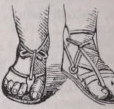
at first, were only soles tied to the feet with strings or thongs; afterward they were covered; and at last they called even shoes sandals. When Judith went to the camp of Holofernes, she put sandals on her feet; and her sandals ravished his eyes, Judith x, 4; xvi, 9. They were a magnificent kind of buskins proper only to ladies of condition, and such as dressed themselves for admiration. But there were sandals also belonging to men, and of mean value. We read, “If the man like not to take his brother’s wife, then let his brother’s wife go up to the gate unto the elders, and say, My husband’s brother will not perform the duty of a husband’s brother; then shall his brother’s wife come unto him, in the presence of the elders, and loose his shoe from off his foot, and spit in his face; and shall say, So shall it be done unto that man that will not build up his brother’s house. And his name shall be called in Israel, The house of him who hath had his shoe loosed,” Deuteronomy xxv, 7. A late writer observes that the word rendered “shoe,” usually means “sandal,” that is, a mere sole fastened on the foot in a very simple manner; and that the primary and radical meaning of the word rendered _face_, is surface, the superficies of any thing. Hence he would submit, that the passage may be to the following purpose: The brother’s wife shall loose the sandal from off the foot of her husband’s brother; and shall spit upon its face or surface, (that is, of the shoe,) and shall say, &c. This ceremony is coincident with certain customs among the Turks. We are told that in a complaint against her own husband, for withholding himself from her intimacy, the wife when before the judge takes off her own shoe, and spits upon it; but in case of complaint against her ...husband’s brother, she takes off his shoe and spits upon it. The business of untying and carrying the sandals being that of a servant, the expressions of the Baptist, “whose shoes I am not worthy to bear,” “whose shoe latchet I am not worthy to unloose,” was an acknowledgment of his great inferiority to Christ, and that Christ was his Lord. To pull off the sandals on entering a sacred place, or the house of a person of distinction, was the usual mark of respect. They were taken care of by the attendant servant. At the doors of an Indian pagoda, there are as many sandals and slippers hung up, as there are hats in our places of worship.
SANDALWOOD, a fragrant wood obtained from various trees of the natural order Santalaceae and from the genera Santalum and Fusanus. The principal commercial source of sandalwood is Santalum album, L., a native of India, but it is also yielded by S. Freycinetianum, Gaud., and S. pyrularium, A. Gray, in the Hawaiian Islands, S. Homei, Seem., and S. austro-caledonicum, Viell., in New Caledonia, and S. insulare, Bert., in Tahiti. The wood of S latifolium, Benth., and also that of Fusanus spicatus, R. Br., have been exported from south-west Australia, and that of Eremophila Mitchelli, of the natural order Myoporineae, from Queensland, but these have little odour and are chiefly used for cabinet work. Sandalwood is also said to be produced in Nossi-Bé, and has been imported into London from Zanzibar, and into Germany from Venezuela, but of the botanical source of these varieties little is at present known. The use of sandalwood dates as far back at least as the 5th century B.c., for the wood is mentioned under its Sanskrit name “chandana” in the Nirukta, the earliest extant Vedic commentary. It is still extensively used in India and China, wherever Buddhism prevails, being em ployed in funeral rites and religious ceremonies; comparatively poor people often spend as much as 50 rupees on sandalwood for a single cremation. Until the middle of the 18th century India was the only source of sandalwood. The discovery of a sandalwood in the islands of the Pacific led to a considerable trade of a somewhat piratical nature, resulting in difficulties with the natives, often ending in bloodshed, the celebrated missionary John Williams, amongst others, having fallen a victim to an indiscriminate retaliation by the natives on white men visiting the islands. The loss of life in this ...trade was at one time even greater than in that of whaling, with which it ranked as one of the most adventurous of callings. About the year 1810 as much as 400,000 dollars is said to have been received annually for sandalwood by Kamehameha, king of Hawaii. The trees consequently have become almost extinct in all the well-known islands, except New Caledonia, where the wood is now cultivated. Sandalwood of inferior quality derived from Fusanus acuminatus was exported from south-west Australia in 1884 to the extent of 2620 tons, valued at an average of about £8 per ton, genuine sandalwood being worth in China from £12 to £40 per ton.
In India sandalwood is largely used in the manufacture of boxes, fans, and other ornamental articles of inlaid work, and to a limited extent in medicine as a domestic remedy for all kinds of pains and aches. The oil is largely used as a perfume, few native Indian attars or essential oils being free from admixture with it. In the form of powder or paste the wood is employed in the pigments used by the Brahmans for their distinguishing caste-marks.
During the last few years oil of sandalwood has largely replaced copaiba, both in the United Kingdom and on the Continent, in the treatment of various diseases of the mucous membrane. Three varieties are distinguished in trade—East-Indian, Macassar, and West-Indian. The first-named is derived from S. album, the second probably from another species of Santalum, and the third from a wood imported from Puerto Cabello in Venezuela. Bucida capitata, a Combretaceous plant, is known in the West Indies as sandalwood; but the odour of the wood as well as of the oil, which is quite distinct from that of the true sandalwood, has more resemblance to that of a Myroxylon. Inferior qualities of the oil are said to be adulterated in Germany with the oil of red cedar wood (Juniperus virginiana).
In India sandalwood is produced in the dry tracts of country in Mysore and Coimbatore, north and north-west of the Nilgiri Hills, also farther eastward in the districts of Salem and North Arcot, where the tree grows from the sea-level up to an elevation of 3000 feet. In the first-named district the wood is a Government monopoly and can only be felled by the proper officers, this privilege having been retained since 1770, when it was conferred by treaty with Hyder Ali on the East India Company. The Mysore sandalwood is shipped from Mangalore to the extent of about 700 tons annually, valued at £27,000. In the Madras Presidency—although there is now no monopoly—sandalwood, by the careful management of the forest department, has been made to yield an increasing revenue to the Government, as much as 547½ tons having been furnished by the reserved forests in 1872-3. The tree is propagated by seeds, which, however, must be placed where they are intended to grow, since the seedlings will not bear transplantation, probably on account of deriving their nourishment parasitically by means of tuberous swellings attached to the roots of other plants. The trees are cut down when between eighteen and twenty-five years old, at which period they have attained their maturity, the trunks being then about one foot in diameter. The felling takes place at the end of the year, and the trunk is allowed to remain on the ground for several months, during which time the white ants eat away the valueless sapwood but leave the fragrant heartwood untouched. The heartwood is then sawn into billets about 2 or 2½ feet long. These are afterwards more carefully trimmed at the forest depôts, and left to dry slowly in a close warehouse for some weeks, by which the odour is improved and the tendency of the wood to split obviated. An annual auction of the wood takes place, at which merchants from all parts of India congregate. The largest pieces are chiefly exported to China, the small pieces to Arabia; and those of medium size are retained for use in India. China imported into the treaty ports 66,237 piculs (of 133 1 / 3 lb) of sandalwood in 1872. As much as 700 tons are annually imported into Bombay from the Malabar coast, of which about 450 tons are again exported. The oil, which is distilled chiefly at Mangalore from the roots and chips, is also imported into Bombay to the extent of 12,000 lb annually.
Red Sandalwood, known also as Red Sanders Wood, is the product of a small Leguminous tree, Pterocarpus santalinus, native of Southern India, Ceylon, and the Philippine Islands. The wood is obtained principally from Madras, in certain parts of which province it is regularly cultivated, coming into the market in the form of irregular billets of heartwood, 3 or 4 feet in length. A fresh surface of the wood has a rich deep red colour, which on exposure, however, assumes a dark brownish tint. Under the influence of alkaline solutions, alcohol, or strong acetic acid, red sandalwood yields up to 16 per cent. of a resinoid body, santalin or santalic acid C 15 H 14 O 5 (?), which substance is the tinctorial principle of the wood. Santalin is quite insoluble in cold water; it neutralizes alkalies, and with them forms uncrystallizable salts. In its pure condition santalin forms minute prismatic crystals of a beautiful ruby colour. The wood also contains small proportions of colourless crystalline principles—santal, C 8 H 6 O 3 , and pterocarpin, C 17 H 6 O 5 —and of an amorphous body having the formula C 17 A 18 O 6 . In mediaeval times red sandalwood possessed a high reputation in medicine, and it was valued as a colouring ingredient in many dishes. Now it is a little used as a colouring agent in pharmacy, its principal application being in wool-dyeing and calico-printing. Several other species of Pterocarpus, notably P. indicus, contain the same dyeing principle and can be used as substitutes for red sandalwood. The barwood and camwood of the Guinea Coast of Africa, presumably the produce of one tree, Baphia nitida Pterocarpus angolensis of Do Candolle), called santal rouge d’Afrique by the French, are also in all respects closely allied to the red sandalwood of Oriental countries.
See Seemann, Flora Vitiensis. pp. 210-215; Pharm. Journ. and Trans., 1885-86; Pharmacographia, 2d ed , p. 599; Dymock, Materia Medica of Western India, p. 617; Jour. Soc. Arts, 1875, p. 641; Seemann, Voyage of the “Herald," 1853, p. 83; Seemann, Jour. Botany, 1864, p. 218; Erskine, Islands of the W . Pacific, 1853, p. 143, 326, 390, and Appendix, p. 478, 486: Martin, Natives of the Tonga Islands, 1817, pp. 319-333; Birdwood, Bombay Products, p. 306; Madras Jury Reports, 1857; Hawkes, Report on Oils of India, p. 38.