The term tobacco appears not to have been a commonly used original name for the plant, and it has come to us from a peculiar instrument used for inhaling its smoke by the inhabitants of Hispaniola (San Domingo). The instrument, described by Oviedo (Histoña de las Indias Occidentales, Salamanca, 1535), consisted of a small hollow wooden tube shaped like a Y, the two points of which being inserted in the nose of the smoker, the other end was held into the smoke of burning tobacco, and thus the fumes were inhaled. This apparatus the natives called “tabaco but it must be said that the smoking pipe of the continental tribes was entirely different from the imperfect tabaco of the Caribees. Benzoni, on the other hand, whose Travels in America (1542-56) were published in 1565, says that the Mexican name of the herb was “tabacco.”
The tobacco plant itself was first brought to Europe in 1558 by Francisco Fernandes, a physician who had been sent by Philip II. of Spain to investigate the products of Mexico. By the French ambassador to Portugal, Jean Nicot, seeds were sent from the Peninsula to the queen, Catherine de’ Medici. The services rendered by Nicot in spreading a knowledge of the plant have been commemorated in the scientific name of the genus Nicotiaηa. At first the plant was supposed to possess almost miraculous healing powers, and was designated “herba panacea,” “herba santa,” “sana sancta Indorum”; “divine tobacco” it is called by Spenser, and “our holy herb nicotian” by William Lilly. While the plant came to Europe through Spain, the habit of smoking it was initiated and spread through English example. Ralph Lane, the first governor of Virginia, and Sir Francis Drake brought with them in 1586, from that first American possession of the English crown, the implements and materials of tobacco smoking, which they handed over to Sir Walter Raleigh. Lane is credited with having been the first English smoker, and through the influence and example of the illustrious Raleigh, who “tooke a pipe of tobacco a little before he went to the scaffolde,” the habit became rooted among Elizabethan courtiers. During the 17th century the indulgence in tobacco spread with marvellous rapidity throughout all nations, and that in the face of the most resolute opposition of statesmen and priests, the “counter-blaste” of a great monarch, penal enactments of the most severe description, the knout, excommunication, and capital punishment.
The species of Fhicοtiαnα number about fifty, but those of which the leaves are used as sources of, tobacco are few. With the exception of two species, one native of New Caledonia, the other proper to Australia, they are all of American origin. They form two well-defined groups, the first of which is characterized by the possession of an elongated corolla tube, red in colour, the plants having a single unbranched stalk which attains a height of from 5 to 7 feet; while to the second group belong such as have a swollen corolla tube of a greenish-yellow colour, and a much-branched stem reaching a height of only from 2 to 5 feet. The type of the first group is the Virginian Tobacco, N. Tabacum, while the best known representative of the second is the Green Tobacco, A r . rustica. These two species, together with their numerous varieties, and with the Persian Tobacco, N. persica,— the source of the famous Tumbeki or Shiraz tobacco,—are the sole sources of commercial tobacco. A r . Tabacum is the species from which the tobaccos of Cuba, the United States, and the Philippine Islands, and the Latakia of Turkey, are derived, and it is thus the source of not only the greater proportion of the tobacco of commerce but also the most highly prized and valuable of its varieties. A r . rustica, originally a native of Brazil, is cultivated to a considerable extent in South Germany, Hungary, and the East Indies.
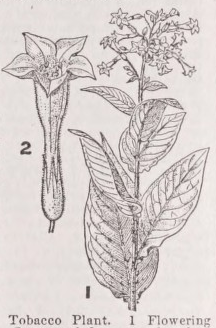
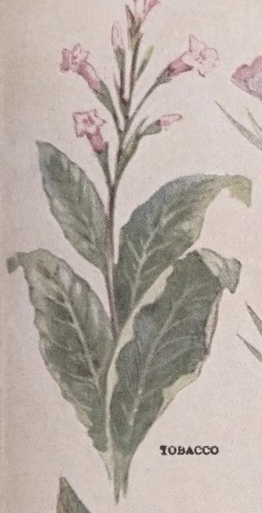
The Virginian tobacco-plant, W. Tabacιιm, is a coarse rankgrowing annual, with a simple unbranched cylindrical stem which attains a height of 6 feet and upwards, terminating in a panicle of pink flowers. It has alternate simple oblong lanceolate leaves, those at the lower part of the stem being slightly stalked, and of large size, reaching to two feet in length, while the upper are semi-amplexicaul and of variable outline. The seeds are brown in colour, with a rough surface, of minute size, and exceedingly numerous, as many as 40,000 having been counted on a single plant. The whole of the green parts of the plant are covered with long soft hairs which exude a viscid juice, giving the surface a moist glutinous feeling. The hairs are multicellular, and of two kinds, one branching and ending in a fine point, while the other, unbranched, terminates in a clump of small cells. Stomata occur on both surfaces of the leaves, and, with the peculiar hair structure, render the microscopic appearance of the plant highly characteristic.
Tobacco will flourish over wide areas and in very dissimilar climates, but it is best suited for regions having a mean temperature of not less than 40° F. and where early autumn frosts do not occur. It develops the most highly appreciated qualities in tropical lands possessed of a comparatively dry climate. Tobacco is a most exhausting crop, and requires rich and abundant manuring, the character of which exercises a distinct influence on the quality of the product. A crop grown under such widely different conditions of climate and agriculture as is the case with tobacco must of necessity be subject to varied treatment both in cultivation and in curing, and here we can refer only to the general features of the growing and securing of the crop.
In European cultivation, the tobacco-seed is sown in a hotbed about the end of March. The seed-beds are kept covered with damp straw or withered leaves till the seedlings appear above the ground, after which the covering is removed, and, to protect the young plants from frost, to which they are extremely sensitive, the beds are covered at night with mats. So soon as the plants can be handled, they are picked out in rows in a garden bed, where they remain protected from night frost till they have developed five or six leaves and have a height of 3 to 4 inches. They are then ready for transplanting, by preference in moist weather, into prepared drills 20 to 25 inches apart in the field. The transplanting is done about the end of May, or earlier in localities free from night frosts, and in dry weather the field is plentifully soused with liquid manure. The plants are carefully weeded and attended to, and the soil is frequently stirred with narrow hoes until the period when they show symptoms of flowering. This may be when they are only 3 feet high, or not until« they have reached their proper heightjof 6 or 8 feet; but the flowers must not be allowed to form, except in the case of a few plants left purposely for seed. To obtain fine and strong leaves on the plant is the great object of the cultivator, and a fine tobacco plant ought to have from eight to twelve large succulent leaves. Cultivators commonly diminish the number of leaves by “topping” or breaking off the top, under the idea that the remaining ones will aflbrd the strongest tobacco. Suckers or shoots near the root are carefully removed, and everything's done to concentrate the strength of the plant in the leaves. Every leaf injured by insects is removed, and the crop is watched until the leaves have a yellowish tint and begin to droop, when they are fit to be gathered. This is usually in September, so that the plants, from the time of their insertion on the mounds, have occupied the ground four months, during which time they have been subject to many vicissitudes,—from the attacks of insects, from a disease called “firing,” caused by the long continuance of very wet or very dry weather, and from the occurrence of autumn frosts while the crop is yet in the field.
In the harvesting of the tobacco crop several distinct’methods are followed. In ordinary European cultivation the ripe leaves are separated from the standing stalks in the field. The three lower root-leaves are first stripped off and laid, face downward, around the root to wilt, after which they are bundled and carried to the barn. Afterwards the remainder of the leaves are separated, working from the top downwards, and, similarly, they are spread on the ground till by λvilting they lose their brittleness. They are then bundled and packed, tops upward, closely on the floor of the barn for some time to sweat, by which the uniform ripening and subsequent favourable drying are promoted. The bundles are carefully watched to prevent overheating, which would blacken and injure the leaves. In the tobacco-growing districts of the United States the entire plant is cut down in the field close to the ground, then the stalks are spitted on long rods or laths, care being taken to keep the leaves from touching each other, and on these rods they are carried and hung in the barn or curing-house for drying.
The curing of the leaves which follows has for its objects the drying and preservation of the tobacco, and, by a process of slow fermentation, the modification of certain of the leaf constituents, and the development of the characteristic aroma of the substance. Subject to various minor modifications, the process of curing is carried out either slowly by the air-cure process or rapidly by firecuring. The European cultivators, who generally cure by the slow process, either spit the leaves through the middle on a long rod or string them on a cord, taking care to keep each leaf from touching its neighbour. These rods∣or cords of leaves are suspended in a barn or curing-shed in a way which allows the free circulation of the air, and at the same time brings the whole contents of the shed equally under the drying influence of the air currents. When the weather is clear and dry, free circulation of the air is in every way promoted, but on humid days the moist air is excluded and sometimes artificial heat is required to prevent mildew and rotting of the leaves. Under favourable circumstances the tobacco will be dry and ready for further treatment in from six to eight weeks, and the leaves should then have a fine bright warm brown colour.
In the United States the quick-drying process by artificial heat is employed principally for the preparation of export tobacco. Formerly the heat was obtained by means of an open charcoal fire within the curing-barn, but now the structure is heated by a system of flues which permits of the burning of any kind of fuel. For dark shipping tobacco, the entire plants, cut down close to the ground, are immediately housed, and at once dried off. Red shipping qualities are prepared by leaving the cut stems either in the field or hung on scaffolds in the barns for a few days to wilt and wither in the air, after which they are dried by artificial heat. In the treatment of both dark and red kinds the temperature within the barn is gradually raised till it reaches 170° F., and the drying is complete in from four to five days.
By whichever way treated, the tobacco-leaf at this stage is brittle, and cannot be handled without crumbling to powder. The contents of the barn are therefore left till moist weather occurs, and then by the admission of atmospheric air the leaf blades absorb moisture and become soft and pliant. In this condition the leaves are stripped from the stems, sorted into qualities, such as “lugs,” or lower leaves, “firsts,” and “seconds.” These are made up into “hands,” or small bundles of from six to twelve leaves. Each bundle is tied round with a separate leaf, and in this condition the tobacco is ready for bulking for fermentation.
For fermentation the tobacco, whether in bundles, hands, or separate leaves, is piled up or bulked on the floor in a barn into a solid stack to the height of 5 or 6 feet. Within this stack a process of fermentation is quickly set up, and the temperature of the mass rises steadily till it reaches about 130° F. Great care is now taken to prevent overheating, and to secure the uniform fermentation of all the tobacco. The pile is from time to time taken down and rebuilt, the tobacco from the top going to the bottom, and that exposed at the edges being turned in to the centre. In from three to five weeks the fermentation should be sufficiently carried out, and the leaves then have a nice uniform brown colour. The cured stack may in this condition be piled up in store without fear of further fermentative activity, till, with increasing summer heat, it is subject to the May sweat, which renders further watchfulness necessary.
The components of tobacco, like those of all vegetable matters, arrange themselves under the three heads of water, mineral acids and bases (which pass into the ash on combustion), and organic substances. According to an investigation carried out by Beauchef in Gay-Lussac’s laboratory, the amount of ash from 100 parts of matter dried at 100° C. is in the roots 6 to 8, in the stems 10 to 13, and in the ribs and leaves 18 to 22 per cent. The greater part of the ash consists of insoluble salts, principally carbonate of lime. The soluble part consists largely of potash salts (KC1, K 2 C0 s , K 2 SO 4 ), which may amount to from 5 to 35 percent., and it is remarkable that tobacco contains no soda. In addition to the mineral salts proper, tobacco contains salts of ammonia and nitrates. In the leaf the proportion of nitrates is greater in the rib than in the laminae. In the former it may amount to as much as 10 per cent, (calculating the nitric acid as KNO 3 ). According to Schloesing {Ann. Chim. Phys., [3], xl. 479), the proportion of (combined) nitric acid in tobacco has nothing to do with its combustibility, that is, the length of time a lighted cigar will glow spontaneously. This quality is a function chiefly of the potash present in combination with' organic acids. An incombustible tobacco, i.e., a tobacco which does not keep a glowing ash, contains its organic acids in the form of lime and magnesia salts. The explanation is that, while organic potash salts, being fusible, yield when heated a porous charcoal which glows readily, the corresponding infusible lime salts yield a compact charcoal which is far less combustible. A combustible tobacco can be rendered incombustible by the incorporation of sulphate or chloride of calcium or magnesium. By cultivation experiments in a potash-free soil, it has been ascertained that chloride of potassium used as a manure does not add to the organic potash salts in the leaves, but the sulphate, carbonate, and nitrate do give up their potash for the formation of organic salts.
Subjoined is an enumeration of the proximate organic components of tobacco leaves, and their relative proportions in 100 parts, according to the numerous analyses made in the laboratories of the French state tobacco factories :—
Nicotine, C 10 Hι 4 N 2 , a liquid volatile alkaloid, from 1 ‘5 to 9 per cent.
Essential oil,—according to Schloesing, an important element in the flavour of tobacco, although its proportion is exceedingly small.
Nicotianine, a solid camphor-like body to which, according to other authorities, the odour of tobacco is principally due.
Malic and citric acids, together 10-14 per cent., calculated as anhydrides.
Acetic acid, very little in fresh leaves, but increasing in their fermentation. In snuff it may rise to 3 per cent.
Oxalic acid, 1 to 2 per cent.
Pectic acid, about 5 per cent.
Resins, fats, and other bodies extractable by ether, 4 to 6 per cent.
Sugar, little in the leaves, more in the stems; in the fermentation it disappears.
Cellulose, 7 to 8 per cent.
Albuminoids, calculated from the nitrogen not present as nicotine, nitrates, or ammonia, about 25 per cent.
Excepting the nicotine, the several organic components of the leaves develop, roughly speaking, pari passu until fructification, when certain components are attracted to the fruit, suffering chemical changes while so moving. The nicotine determines the strength of a tobacco, but not its flavour or aroma. The manure supplied to a tobacco field does not increase the proportion of nicotine, but affects only the weight of the crop. The percentage of nicotine in the leaves may to some extent be modified in cultivation,—plants wide apart developing few leaves, but these thick, fleshy, and rich in nicotine, while closely packed plants throw out numerous but thin and membranous leaves having little nicotine. The proportion of nicotine present increases with the age of the plant. Schloesing found in leaves at various stages of growth the following percentage of nicotine :—May 25 (very young leaves), 0'79; July 18, 1*21; Aug. 6, 193; Aug. 27, 2 27; Sept. 8, 3 36; Sept. 25, 4∙32.
Regarding the changes which take place in the manufactured leaf, we take the case of snuff, because with it the chemical changes are carried farthest, and yet, qualitatively speaking, they are of the same nature as those which smoking tobacco undergoes. In the fermentation begun in curing and continued in the sauced leaf, the malic and citric acids and the nicotine undergo partial oxidation. The oxalate of lime and the pectates remain almost unchanged, and there are formed, of intermediate (not fully oxidized) bodies, ammonia, acetic acid, and black humic acid, the last giving to snuff its dark colour. A little methyl-alcohol is also at the same time formed. At this stage the tobacco-leaf is acid in reaction; but after it is powdered, and again submitted for a prolonged period to a slow fermentation in air-tight boxes, it becomes decidedly alkaline by the ammonia, because, while acetic acid continues to be formed and the ammonia and nicotine remain what they are, the malic and citric acids are progressively destroyed. Unless snuff contains free ammonia it is “flat,” and destitute of pungency.
As to the composition of tobacco smoke, numerous investigations have been made. Kissling {Dvng. Polyt. Jour., ccliv. 234-246), experimenting on cigars, found that a large proportion of the nicotine passes unaltered into the smoke. Dealing with a tobacco containing 3 , 75 per cent, of nicotine, he recovered from the smoke 52 Ό2 per cent, of the total nicotine consumed, while in the unconsumed remains of the tobacco the proportion of nicotine was increased to 5'03 per cent. With a second sample of tobacco, having likewise 3 - 75 per cent, of nicotine, the smoke yielded only 27 ’ 83 per cent, of the total nicotine consumed, and the percentage in the unconsumed remains was raised to 4 - 51. From a tobacco containing only 0’30 of nicotine he recovered 84’23 of nicotine in the smoke. The composition of tobacco smoke is highly complex, but beyond nicotine the only substances found in appreciable quantities are the lower members of the picoline series.
The commercial varieties and the sources of supply of leaftobacco are exceedingly numerous. Special qualities of tobacco, as of wines, &c., belong to particular localities, outside of which they cannot be cultivated. These tobaccos are therefore natural monopolies. Moreover, as is also the case...