
A musical instrument with four strings, played with a bow; a fiddle; one of the most perfect and most powerful instruments that has been invented.
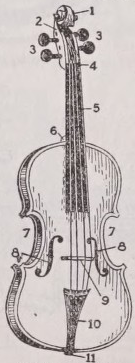
VIOLIN, a stringed instrument employed in orchestral and chamber music. The body is a resonant box, composed of a belly, back, and six ribs, all shaped out of thin wood to various curves, the belly and back being scooped out of solid slabs, and the ribs planed and bent. The whole is glued together upon six internal blocks. Pine is used for the belly, maple for the other parts. The external surface is covered with a fine hard varnish of a brown, red, orange, or yellow colour, which renders the box more resonant. To this box is glued a solid neck or handle, slightly inclined to the plane of the box, and along the whole instrument four gut strings are stretched by means of as many pegs and a tail-piece. They are tuned in fifths, thus— and set in vibration with a bow, strung with horsehair well rubbed with rosin, which is held in the right hand, the scale being completed by stopping the strings with the fingers of the left hand, in which the instrument is held, on an ebony finger-board glued to the handle, and projecting over the body of the fiddle. The movable bridge, across which the strings are strained, forms the spring or mechanical centre of the violin, and answers to the reed in wood wind-instruments. It has two feet, of which the treble or right-hand one rests firmly on that part of the belly which is supported by a sound-post resting on the back, thus forming a rigid centre of vibration, while the bass or left-hand foot, resting on the freely-vibrating part of the belly, communicates to it, and through it to the air in the box, the vibrations which the bow excites in the strings. The belly is strengthened, and its vibration regulated and increased, by a longitudinal bar glued inside it exactly under the bass foot of the bridge. Two incisions in the belly, called ...sound-holes, from their letting out the sound, also facilitate and modify the vibration. The middle pair of ribs on each side have an inward curvature, to afford the bow better access to the strings. The superficial area of the belly is divided by the bridge into two approximately equal parts, for an obvious acoustical reason; but the upper half is longer and narrower than the lower, which is relatively short and broad. This device gives greater length to the vibrating portion of the strings, and hence greater compass to the instrument. It also brings the bowing place on the strings nearer to the player.
The violin, as the name imports, is a modified form of the viol, an instrument constructed on exactly similar principles, though different in every detail. It dates from the middle of the 16th century; the viol was perfected somewhat earlier. During two centuries the two instruments were in use contemporaneously; but the violin class gradually drove the viols from the field, on the principle, which governs the general history of musical instruments, of the “survival of the loudest.” The primitive viol is a modified form of the lute; and the lute is an adaptation of the small lyre of classical antiquity, the name of which (fidicula) survives in both groups of the common names for bowed instruments (fidicula, fidula, fideille, vielle, fidel, vedel, fiedel, fiddle; in the Romance group, vidula, viula, viola, violino, violone, violoncello). The fidicula or lyre consisted of a resonant box, having a yoke (jugum or transtillum) instead of a neck, and one string for each note. Obviously, by substituting for the jugum a handle or neck, and thus enabling the fingers of the left hand to stop the strings at will, the number of strings and the tension on the box could be diminished, the scale of notes increased, and the task of the right hand facilitated. By this improvement the class of instruments denominated lyre developed into the lute class; and by other improvements upon the original basis it developed into the harp.
The origin of the peculiar mechanism which, when added to the lute, produced the viol, viz., the movable bridge, sound-post, and bow, is obvious. The bow is a development of the plectrum employed for sounding the lyre. The bridge was borrowed from the Greek κανών, or monochord. Movable bridges (ύπαγωγεῐς, subductaria, ponticuli) were employed to divide the monochord so as to produce the intervals of the various scales. The sole use of this instrument being to train the ear of singers, it may well be supposed that musicians would endeavour to render the tone continuous, the better to support the voice; and this could be readily done by substituting for the plectrum a common military bow, with the string well rubbed with rosin, —a substance largely used by the Greeks and Italians. This supposition is confirmed by the fact that the marine trumpet, the most primitive of bowed instruments, is simply a bowed monochord. Although we can point to no pictorial representation of the bow as applied to musical instruments earlier than the 10th or 11th century, it is reasonable to conclude that the bridge and bow were adapted to the monochord and fidicula during the later empire. A substitute for the bow was afterwards found in the rosined wheel and handle, doubtless first applied to the monochord, afterwards perfected in the large mediaeval organistrum, and still employed in the smaller vielle or hurdy-gurdy. The bow, however, held and still holds its ground as the most convenient means of producing continuous tone from stringed instruments. The substitution of a hank of horse-hair for the single bowstring dates from very early times.
Except the marine trumpet or bowed monochord, we find in Europe no trace of any large bowed instruments before the appearance of the viol in the 15th century. The geige, crowd, rebec, and fidel, as the small bowed instruments of the Middle Ages were variously called, were small enough to be rested on the shoulder during performance, and were usually rather smaller than the modern violin. It is not easy to assign each of these names to any particular form of instrument. They all had in common a resonant box, either circular, oval, or semi-pearshaped, a handle with a finger-board, a tail-piece, a bridge, and from two to four strings tuned to fourths or fifths. The pegs were set vertically to the handle above the fingerboard, as in the modern guitar. The bow, which was short and clumsy, had a considerable curvature, and the string a high tension. None of these instruments can have had a deeper compass than a boy’s voice. The use of the fidel in the hands of the troubadours, to accompany the adult male voice, explains the attempts which we trace in the 13th century to lengthen the oval form of the instrument. A contrary curvature, as in the guitar, was then given to the sides of the resonant box, to enable the bow to reach the strings of the enlarged instrument. This may be denominated the troubadour’s fiddle.
The invention next to be described formed the turning-point in the history of bowed instruments. In order to keep in place the ribs of the troubadour’s fiddle, with their troublesome contrary flexures, side-blocks inside the instrument were probably used. By cutting these blocks with an angle towards the outside, dividing each side rib into three smaller ones, and giving the middle one on each side a contrary curve so as to meet the upper and lower ribs at an angle on the block, the resonant box was greatly strengthened, its construction became easier, and it became possible to make instruments of indefinitely larger size. Corner-blocks thus converted the fidel into the viol. Single corner-blocks (contrary flexures being still given to the upper ribs) were sometimes used, and often occur later on; but double corner-blocks came at once into general use, and resulted in the construction of the viol in several sizes. The mediaeval fiddle appears originally to have had a perfectly flat belly like the lute. It must early have been discovered that a belly scooped out to a slight curve offered greater resistance to the pressure of the strings transmitted by the bridge. Bellies thus scooped out probably came into general use with the invention of corner-blocks. The back continued to be, and in the viol family has always been, a piece of flat joinery. Theoretically, no doubt, this is right; for a scooped-out back is false in construction, as there is nothing for the arch of the back to carry. But, as a back thus modelled and forming a duplicate of the belly, as in the violin, produces a much more powerful tone, this consideration has come to be disregarded.
The viol is an instrument, or rather family of instruments, of merit and interest, though now superseded by the violin, with the exception of the double bass, which still survives as a practical instrument. The following are the points in which the viol differs from the violin :— [table]
In the matter of 4 and 7 a few viols, made after the violin had been perfected, and chiefly Italian, follow the violin. The modern double bass also follows the violin in these points and in 5. The viol was made in three main kinds,—discant, tenor, and bass,—answering to the cantus, medius, and bassus of vocal music. Each of these three kinds admitted of some variation in dimensions, especially the bass, of which three distinct sizes ultimately came to be made—(1) the largest, called the concert bass viol; (2) the division or solo bass viol, usually known by its Italian name of viola da gamba; and (3) the lyra or tablature bass viol. The normal tuning of the viols, as laid down in the earliest books, was adapted from the lute to the bass viol, and repeated in higher intervals in the rest.
The fundamental idea, as in the lute, was that the outermost strings should be two octaves apart—hence the intervals of fourths with a third in the middle. The highest, or discant viol, is obviously not a treble but an alto instrument, the three viols answering to the three male voices. As a treble instrument, not only for street and dance music, but in orchestras, the rebec or geige did duty until the invention of the violin, and long afterwards. The discant viol first became a real treble instrument in the hands of the French makers, who converted it into the quinton. The double bass, the largest of the viols, is not a legitimate member of the family, having no corresponding voice, and being from the purely musical point of view superfluous. It appeared, however, concurrently with the bass, as soon as the invention of corner-blocks made it possible to construct bowed instruments of a size only limited by the possibility of playing them. As the discant viol is determined in size by the proportions of the bent arm, the tenor viol by the height above the knee of a sitting player, the bass by a relative height when the instrument is held between the knees, instead of supported on them, so the double bass is determined in size by the height of the standing figure, the bottom of the resonant box resting on the ground. In this respect it corresponds with the marine trumpet, which afforded an obvious hint for its construction. Originally it was made for six strings, the tuning being as follows
In imitation probably of the largest register of pipes on the improved organs which were then being built, the double bass viol was used as a sub-bass. For this purpose the three highest strings were probably soon found to be useless, and they must have been very liable to break; and, as the pressure of useless strings impairs the resonance of the instrument, they seem to have been gradually dropped. The three lowest strings are the same as those used for the modern double bass.
The earliest use of the viols was to double the parts of vocal concerted music; they were next employed in special compositions for the viol trio written in the same compass. Many such works in the form of “fantasies” or “fancies,” and preludes with suites in dance form, by the masters of the end of the 16th and 17th centuries, exist in manuscript; a set by Orlando Gibbons, which are good specimens, has been published by the English Musical Antiquarian Society. Later, the viols, especially the bass, were employed as solo instruments, the methods of composition and execution being based on those of the lute. Most lute music is in fact equally adapted for the bass viol, and vice versa. In the 17th century, when the violin was coming into general use, constructive innovations began which resulted in the abandonment of the trio of pure six-stringed viols. Instruments which show these innovations are the quinton, the lyre, and the viola d’amore. The first-mentioned is of a type intermediate between the viol and the violin. In the case of the discant and tenor viol the lowest string, which was probably found to be of little use, was abandoned, and the pressure on the bass side of the belly thus considerably lightened. The five strings were then spread out, as it were, to the compass of the six, so as to retain the fundamental principle of the outer strings being two octaves apart. This was effected by tuning the lower half of the instrument in fifths like the violin and the upper half in fourths. This innovation altered the tuning of the treble and tenor viols, thus— One half of the instrument was therefore a viol, the other half a violin, the middle string forming the division. The tenor viol thus improved was called in France the quinte, and the treble corresponding to it the quinton. From the numerous specimens which survive it must have been a popular instrument, as it is undoubtedly a substantially excellent one. The relief in the bass, and the additional pressure caused by the higher tuning in the treble, gave it greater brilliancy, without destroying the pure, ready, and sympathetic tone which characterizes the viol. While the tendency in the case of the discant and tenor was to lighten and brighten them, the reverse process took place in that of the bass. The richer and more sonorous tones of the viola da gamba were extended downwards by the addition of a string tuned to double bass A, thus— Marais, a French virtuoso, is usually credited with this improvement; and this extended compass is recognized in the classical viola da gamba writings of Sebastian Bach and De Caix d’Hervelois. The result, however, was not universally satisfactory, for Abel used the six-stringed instrument; and the seven strings never came into general use in England, where the viola da gamba was more generally employed and survived longer than elsewhere.
The want of positive power, which is the weakness of the viol and ultimately drove it from the field, must have been early noticed on a comparison of its delicate tones with the harsher notes of the rebec. Hardly had the viol appeared, when makers cast about for means of augmenting its tone. One way of doing this was by additional strings in unisons, fifths, and octaves, a device which had been already employed in the small fiddles of the Middle Ages, and is identical in principle with the augmentation of diapason tone on the organ by means of other registers. The double or treble strung viol, in various sizes, was known as the lyre (Italian, accordo) ; but this multiplication of strings proceeds on a false principle, for each additional string diminishes the resonance of the box, and at the same time hardens the tone and increases the task of the player. More ingenious and successful was the invention of sympathetic metal strings, usually steel, laid under the finger-board, as close as possible to the belly, and speaking by consonance with the notes produced on the bowed strings. From this resonance by sympathy the viol thus strung acquired the general name of viola d'amore. The original viola da gamba when so strung came to be called the viola bastarda∙, the seven-stringed bass, with an elaborately perfected sympathetic apparatus, was well known in the 18th century by the name of the bordone or baritone, and was a favourite instrument with musical epicures. Instruments made on this principle are found in all sizes; even kits are met with having sympathetic strings (sordino d'amore). Violins with sympathetic strings (usually five) are more rare; the viola d’amore chiefly used was of tenor size and compass. Originally tuned as to its bowed strings like the pure tenor viol, an additional string was given it, and the so-called “harp-way” tuning adopted, thus— , The sympathetic strings were attached to ivory pegs driven into the bottom block, passed through the lower part of the bridge, or over a low bridge of their own, as near as possible to the surface of the belly, under the fingerboard, and were strained to pitch either by means of additional pegs, or, better, by wrest-pins driven into the sides of the peg box and tuned by a key. Originally six, seven, or eight sympathetic strings were used, which were tuned to the diatonic scale of the piece in performance. Later, a chromatic set of twelve strings was employed; and instruments are met with having a double set (24) of chromatic strings, two for each semitone in the scale. With thirty-one strings to be kept in perfect tune, the task of the player must have been arduous indeed; and it is not strange that instruments so elaborate and troublesome were abandoned. In a moist climate like that of Great Britain it is practically impossible to keep a viola d’amore in playing order, the steel strings being in most of their length covered by the fingerboard and out of reach, while the slightest rust impairs the resonance, and much rust renders the instrument completely useless.
The improvements which were to develop an ultimate bowed instrument for permanent musical use proceeded in the opposite direction to the lyre and viola d’amore: they consisted in increasing yet more the resonance of the box, by making it lighter and more symmetrical and by stringing it more lightly, instead of more heavily. This was really falling back on primitive principles, for the hints were certainly derived from old extant specimens of the crowd and the geige. Existing pictures prove that the oval and the circular geige were made with nearly flat backs and bellies of correlative pattern; and it was natural to seek to reproduce their more powerful tone in the viol by giving it shallower ribs and a back modelled like the belly, and by assimilating the top of the instrument, where the handle is added, to the bottom. This change at once transformed the box of the viol into that of the violin, and the transformation was completed by rejecting the lute tuning with its many strings and tuning the instrument by fifths, as the geige and rebec had always been tuned. The tenor viol was apparently the first instrument in which the change was made, about the middle of the 16th century, and it was so successful that it was quickly applied to the treble and bass instruments.
The question so often mooted, Who invented the violin? may therefore be dismissed. The instrument was produced by applying to the viol certain principles borrowed from its smaller predecessors. It would be equally correct to say that it was produced by applying to the geige other principles borrowed from the viol. Tradition indicates one of the Tieffenbrückers, a German family whose members for more than a century were famous lute-makers in Venetia and Lombardy, as the inventor. The earliest instrument of the violin type known to the present writer is a tenor made by Fr. Linaroli of Bergamo, at Venice, in 1563; and the earliest makers whose authentic works have descended to us in considerable numbers are Gaspar da Salò and Maggini, both of Brescia.
An important distinction should be mentioned which divides violins into two classes, known respectively as the “high” and the “flat” model. On this subject much has been said and written; but it has not been discussed scientifically, nor has the prevalence of one model over the other at different times and in different places been accounted for. It is understood that, while the flat model, which has now practically driven the high model from the field, yields a tone that is more powerful and travels further, the high model yields a tone which comes out more readily, and is softer and more flute-like, although less capable of light and shade. The high model is less convenient for the player, because when the instrument is rested on the clavicle the strings are at a greater altitude in relation to the right arm, which accordingly requires to be raised. Hence the high...