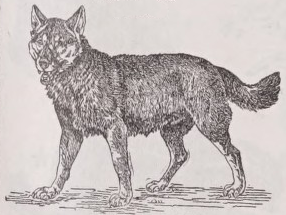
WOLF. The zoological position and general characters of the wolf (Canis lupus) are described in the article Mammalia (vol. xv. p. 438), where the difficulties that naturalists meet with in separating and defining the numerous variations of the animals called wolves, dogs, jackals, and foxes are shown. The true wolves are (excluding some varieties of the domestic dog) the largest members of the genus, and have a wide geographical range, extending over nearly the whole of Europe and Asia, and North America from Greenland to Mexico, but they are not found in South America or Africa, being replaced in both of these continents by various species of jackals and foxes. As might be expected from this extensive range, and the varied character of the climatic conditions of the countries they inhabit, they present great diversities of size, length and thickness of fur, and coloration, although resembling each other in all important structural characters. These differences have given rise to a supposed multiplicity of species, expressed by the names of C. lupus, C. lycaon (Central Europe), C. laniger and C. niger (Tibet), C. pallipes (India), C. occidentalis, C. nubilis, C. mexicanus, &c., of North America, but it is very doubtful whether these ought to be distinguished as other than local varieties. In North America there is a second distinct smaller species, called the coyote or prairie wolf (Canis latrans), and perhaps the Japanese wolf (C....
hodophylax) may also be distinct, although, except for its smaller size and shorter legs, it is scarcely distinguishable from the common species. Though generally distributed throughout the Indian peninsula, the wolf is not found in Ceylon nor in Burmah and Siam. The ordinary colour of the wolf is a yellowish or fulvous grey, but specimens have been met with almost pure white and others entirely black. In northern countries the fur is longer and thicker, and the animal generally larger and more powerful than in the southern portion of its range. Its habits are similar everywhere, and it is still, and has been from time immemorial, especially known to man in all the countries it inhabits as the devastator of his flocks of sheep. Wolves do not catch their prey by lying in ambush, or stealing up close to it, and making a sudden spring as the cat tribe do, but by fairly running it down in open chase, which their speed and remarkable endurance enable them to do, and usually, except during summer, when the young families of cubs are being separately provided for by their parents, they assemble in troops or packs, and by their combined and persevering efforts are able to overpower and kill even such great animals as the American bison. It is singular that such closely allied species as the domestic dog and the Arctic fox are among the favourite prey of wolves, and, as is well known, children and even full-grown people are not unfrequently the objects of their attack when pressed by hunger. Notwithstanding the proverbial ferocity of the wolf in a wild state, many instances are recorded of animals taken when quite young becoming perfectly tame and attached to the person who has brought them up, when they exhibit many of the ways of a dog. They can, however, rarely be trusted by strangers.
The history of the wolf in the British Isles, and its gradual extirpation, has been thoroughly investigated by Harting in his work on Extinct British, Animals, from which the following account is abridged. To judge by the osteological remains which the researches of geologists have brought to light, there was perhaps scarcely a county in England or Wales in which, at one time or another, wolves did not abound, while in Scotland and Ireland they must have been still more numerous. The fossil remains which have been discovered in Britain are not larger than, nor in any way to be distinguished from, those of European wolves of the present day. Wolf-hunting was a favourite pursuit of the ancient Britons as well as of the Anglo-Saxons. In Athelstan’s reign these animals abounded to such an extent in Yorkshire that a retreat was built by one Acehom, at Flixton, near Filey, wherein travellers might seek refuge if attacked by them. As is well known, great efforts were made by King Edgar to reduce the number of wolves in the country, but, notwithstanding the annual tribute of 300 skins paid to him during several years by the king of Wales, he was not altogether so successful as has been commonly imagined. In the reign of Henry III. wolves were sufficiently numerous in some parts of the country to induce the king to make grants of land to various individuals upon the express condition of their taking measures to destroy these animals wherever they could be found. In Edward II.’s time, the king’s forest of the Peak, in Derbyshire, is especially mentioned as infested with wolves, and it was not until the reign of Henry VII. (1485-1509) that wolves appear to have become finally extinct in England. This, however, is rather a matter of inference from the cessation of all mention of them in local records than from any definite evidence of their extirpation. Their last retreat was probably in the desolate wolds of Yorkshire. In Scotland, as might be supposed from the nature of the country, the wolf maintained its hold for a much longer period. There is a well-known story of the last of the race being killed by Sir Ewen Cameron of Lochiel in 1680, but there is evidence of wolves having survived in Sutherlandshire and other parts into the following century (perhaps as late as 1743), though the date of their final extinction cannot be accurately fixed. In Ireland, in Cromwell’s time, wolves were particularly troublesome, and said to be increasing in numbers, so that special measures were taken for their destruction, such as the offering of large rewards for their heads, and the prohibition (in 1652) of the exportation of “wolf-dogs,” the large dogs used for hunting the wolves. The active measures taken then and later reduced their numbers greatly, so that towards the end of the century they became scarce, but, as in the case of the sister island, the date of their final disappearance cannot now be ascertained. It has been placed, upon the evidence of somewhat doubtful traditions, as late as 1766.
It is entirely owing to their insular position that the British Islands have been able to clear themselves of these formidable and destructive animals, for the neighbouring country of France, with no natural barriers to prevent their incursions from the vast continent to the east, is still liable every winter to visits from numbers of them, as the following figures indicate. Government rewards were paid in 1883 for 1316 wolves destroyed, in 1884 for 1035, in 1885 for 900, and in 1886 for 760. The increase of the reward just before the first-named date seems thus to have had some effect in lessening the number. (W. H. F. )
WOLF, Friedrich August (1759-1824), was born in 1759 at Hainrode, a little village not far from Nordhausen, in the province of Hanover. His father, who was village schoolmaster and organist, was in his way an enthusiast in education, and gave his son whatever advantage is to be gained by the earliest possible cultivation. In time the family removed to Nordhausen, and there young Wolf went to the grammar school, where he soon acquired all the Latin and Greek that the masters could teach him, besides learning French, Italian, Spanish, and music. This, however, was in the earlier and (as he himself regarded it) the idler part of his schooltime. He presently took his education into his own hands, devoted himself entirely to classics, borrowed books wherever he could, and rapidly stored his young and powerful memory with their contents. The precocity of his attainments was only equalled by the force of will and confidence in his own powers which characterized him throughout life.
After two years of solitary study, at the age of eighteen, Wolf went to the university of Göttingen. His first act there was a prophecy—one of those prophecies which spring from the conscious power to bring about their fulfilment. He had to choose his “faculty,” and chose one which then existed only in his own mind, the faculty of “philology.” What is even more remarkable, the omen was accepted. He carried his point, and was enrolled as he desired.
Wolf’s relations with Heyne, who was then the chief ornament of Göttingen, form an unpleasant chapter, which may well be passed over here. Heyne was a scholar of little force or originality, but he was one of those who, by their power of assimilating and transmitting the thoughts of others, often rise to the highest reputation. Wolf soon left him, and fell back upon the university library, from which he borrowed with his old avidity.
During the years 1779-83 Wolf was a schoolmaster, first at Ilfeld, then at Osterode. His success as a teacher was striking, and he found time to publish an edition of the Symposium,, which excited notice, and led to his promotion to a chair in the Prussian university of Halle.
The moment was a critical one in the history of education. The literary impulse of the Renaissance was almost spent; scholarship had become dry and trivial. A new school, that of Locke and Rousseau, sought to make teaching more modern and more human, but at the sacrifice of mental discipline and scientific aim. Wolf was eager to throw himself into the contest on the side of antiquity. In Halle (1783-1807), by the force of his will and the enlightened aid of the ministers of Frederick the Great, he was able to carry out his long-cherished ideas, and found the science of philology. By one of England’s insular aberrations, the word “philology” threatens to.be confined to the study of the forms of language. Wolf defined it to be “knowledge of human nature as exhibited in antiquity.” The matter of such a science, he held, must be sought in the history and education of some highly cultivated nation, to be studied in written remains, works of art, and whatever else bears the stamp of national thought or skill. It has therefore to do with both history and language, but primarily as a science of interpretation, in which historical facts and linguistic facts take their place in an organic whole. Such was the ideal which Wolf had in his mind when he established tlιe philological seminarium at Halle.
Wolf’s writings make little show in a library, and were always subordinate to his teaching. During his time at Halle he published his commentary on the Leptines (1789) —which suggested to his pupil, Aug. Boeckh, the Public Economy of Athens— and a little later the Prolegomena to Homer (1795). This book, the work with which his name is chiefly associated, was thrown off in comparative haste to meet an immediate need. It has all the merits of a great piece of oral teaching—command of method, suggestiveness, breadth of view. The reader does not feel that he has to do with a theory, but with great ideas, which are left to bear fruit in his mind (see Homer).
The Halle professorship ended tragically, and with it the happy and productive period of Wolf’s life. He was swept away, and his university with him, by the deluge of the French invasion. A painful gloom oppressed his remaining years (1807-24), which he spent at Berlin. He became so fractious and intolerant as to alienate some of his warmest friends. He gained a place in the department of education, through the exertions of W. von Humboldt. When this became unendurable, he once more took a professorship. But he no longer taught with his old success; and he wrote very little. His most finished work, the Darstellung der Altertumswissenschaft, though published at Berlin (1807), belongs essentially to the Halle time. At length his health gave way. He was advised to try the south of France. He got as far as Marseilles, and was laid in the classic soil of that ancient Hellenic city.
The chief source of this sketch has been the admirable article by Mr Mark Pattison in the North British Revieιυ of June 1865, soon (we believe) to be reprinted by the Clarendon Press. Since the date of that article Wolf’s Kleine Schriften have been edited by G. Bernhardy (Halle, 1869). The works not included in that collection are the Prolegomena, the Letters to Heyne (Berlin, 1797), the commentary on the Leptines (Halle, 1789), and a translation of the Clouds of Aristophanes (Berlin, 1811). To these must be added the Vorlesungen on ∏iad i,-iv., taken from the notes of a pupil, and edited by Usteri (Bern, 1830). (D. B. Μ.)

[1,181 words — estimated reading time: 7 minutes]
זאב, in Arabic, _zeeb_, Gen. xlix, 27; Isa. xi, 6; lxv, 25; Jer. v, 6; Ezek. xxii, 27; Zeph. iii, 3; Hab. i, 8; λύκος, Matt. vii, 15; x, 16; Luke x, 3; John x, 12; Acts xx, 29; Eccles. xiii, 17. M. Majus derives it from the Arabic word _zaab_ or _daaba_, “to frighten;” and hence, perhaps, the German word _dieb_, “a thief.” The wolf is a fierce, strong, cunning, mischievous, and carnivorous quadruped; externally and internally so nearly resembling the dog, that they seem modelled alike, yet have a perfect antipathy to each other. The Scripture observes of the wolf, that it lives upon rapine; is violent, bloody, cruel, voracious, and greedy; goes abroad by night to seek its prey, and is a great enemy to flocks of sheep. Indeed, this animal is fierce without cause, kills without remorse, and by its indiscriminate slaughter seems to satisfy its malignity rather than its hunger. The wolf is weaker than the lion or the bear, and less courageous than the leopard; but he scarcely yields to them in cruelty and rapaciousness. His ravenous temper prompts him to destructive and sanguinary depredations; and these are perpetrated principally in the night. This circumstance is expressly mentioned in several passages of Scripture. “The great men have altogether broken the yoke and burst the bonds; wherefore, a lion out of the forest shall slay them, and a wolf of the evenings shall spoil them,” Jer. v, 6. The rapacious and cruel conduct of the princes of Israel is compared by Ezekiel, xxii, 27, to the mischievous inroads of the same animal: “Her princes in the midst thereof are like wolves ravening the prey, to shed blood, to destroy lives, to get dishonest gain;” and Zephaniah, iii, 3, says, “Her princes within her are roaring lions, her judges are evening ...wolves: they gnaw not the bones till the morrow.” Instead of protecting the innocent and restraining the evil doer, or punishing him according to the demerit of his crimes, they delight in violence and oppression, in blood and rapine; and so insatiable is their cupidity, that, like the evening wolf, they destroy more than they are able to possess. The dispositions of the wolf to attack the weaker animals, especially those which are under the protection of man, is alluded to by our Saviour in the parable of the hireling shepherd: “The wolf catcheth them, and scattereth the flock,” Matt. vii, 15. And the Apostle Paul, in his address to the elders of Ephesus, gives the name of this insidious and cruel animal to the false teachers who disturbed the peace and perverted the faith of their people: “I know this, that after my departing shall grievous wolves enter in among you, not sparing the flock,” Acts xx, 29.
[464 words — estimated reading time: 3 minutes]
WOLF-FISH. See Sea-Wolf.
[5 words — estimated reading time: 1 minute]
WOLFE, Charles (1791-1823), author of The Burial of Sir John Moore, born in Dublin in 1791, was an Irish clergyman, curate of Ballyclog, in Tyrone, and afterwards of Donoughmore. The poem seems to have been written when Wolfe was still a student in Trinity College, Dublin, and it originally appeared in an Irish newspaper (the Newry Telegraph) in 1817. The initials C. W. were affixed to it at first, but as it was quoted from newspaper to newspaper these were dropped, and, eventually finding its way into the Edinburgh Annual Register, it was claimed for and by as many people as Punch’s famous advice to those about to marry. Wolfe’s Trinity College friends came to the rescue, and one of them (Archdeacon Russell) wrote a memoir which, in spite of its being one of the dullest memoirs ever written, went through at least eight editions—a curious testimony to the popularity of the poem. Wolfe died of consumption at Cork in 1823, at the early age of thirty-two....
WOLFE, James (1727-1759), the hero of Quebec, was the son of Lieutenant-General Edward Wolfe, and was born in the vicarage of Westerham, Kent, on January 2, 1727. At an early age he evinced a keen interest in the adventures and achievements of war, and at thirteen accompanied his father to Cartagena. Obtaining a commission as ensign in the 12th regiment of foot in 1741, he embarked for Flanders on the 10th May of the following year, and during the campaign of 1743, in which he acted as adjutant, he was present at the battle of Dettingen. Having exhibited, in addition to high courage, a rare talent for command, he received while yet a youth a commission, on 3d June 1744, as captain in the 4th or king’s regiment of foot, and shortly afterwards was made brigade-major. In this capacity he took part in the suppression of the rebellion of 1745, being present both at Falkirk and at Culloden. In January 1747 he sailed for the Continent, and for his valour at the battle of Lawfeldt on the 2d July he received the public thanks of the commander-in-chief, the duke of Cumberland. On 5th January 1749 he was gazetted major of the 20th regiment, and in the following year he became lieutenant-colonel. In this position he began to manifest those great qualities as a commander which were the secret of his success, and, while introducing into the regiment that perfect discipline necessary to the highest proficiency, secured the personal affection of almost every soldier. In the luckless Rochefort expedition he was quartermaster-general, and by his dashing gallantry attracted the special notice of Pitt. When therefore it was decided in 1758 to send an expedition to Cape Breton under Amherst, Wolfe was appointed by Pitt brigadier-general. Under the eye of Amherst and Admiral Boscawen he conducted the landing at Louisburg through a heavy surf and in face of the well-directed fire of the enemy. He himself was the first to land, and forming his division into compact order attacked and carried with the bayonet the nearest French battery, after which he formed the camp. Chiefly through his ardent energy the siege operations were brought to a successful issue after an investment of six months. Wolfe then eagerly urged an attack on Quebec, expressing his determination to leave the service if nothing further was to be done. Pitt not only acted on his advice, but selected him as the leader of the difficult and almost chimerical enterprise. Quebec, besides being strongly fortified, was occupied by forces which greatly outnumbered those placed at Wolfe’s disposal. Moreover, Montcalm the French commander had an open country behind him for supplies, and was only called upon to protract the defence behind his ramparts till the resources of the besiegers were exhausted. It was incumbent on Wolfe to force Montcalm to give battle, and this could only be effected by manoeuvres of the most daring kind. After bombarding the city from the heights of Point Levi, Wolfe made an attempt, 29th June 1759, to attack Montcalm’s camp in front, but his instructions were not carried out with sufficient accuracy, and foreseeing that irretrievable disaster was imminent he found it necessary after the attack had begun to recall his troops and retire. As the enemy were now on their guard against a second attack of a similar kind, Wolfe saw that the problem must be solved by some other method, and after some time spent in careful consideration he hit upon a still more daring plan. In the evening of the 12th September with 5000 men he silently descended the St Lawrence in boats, and, scaling the heights of Abraham in the darkness, drew up his forces on the plains so as to cut off Montcalm’s supplies. The audacity of the movement was too much for Montcalm’s patience. On his attention being called to it he exclaimed “Oui, je les vois où. ils ne doivent pas être; je vais les écraser.” But the genius of Wolfe was equal to the occasion. With calm self-possession he forbade a single shot to be fired till the enemy were within thirty yards. The crushing volleys with which they were then met, followed by an impetuous attack with the bayonet, was decisive of the action. While leading a charge at the head of the Louisburg grenadiers, Wolfe had one of his wrists shattered by a shot, but wrapping a handkerchief round it he kept on. Another shot struck him, and he still advanced, when a third lodged in his breast. While he was lying in a swoon some one near him exclaimed, “They run; see how they run !” “Who run 1” demanded Wolfe, like one roused from sleep. “The enemy,” was the answer; “they give way everywhere.” Wolfe then signified that a regiment should be sent down to Charles river to cut off their retreat, and on learning that his orders had been obeyed he turned on his side, and murmured as his last words, “Now God be praised, I will die in peace.” Montcalm, the French commander, was mortally wounded in the same action, and died soon afterwards. By the surrender of Quebec Canada was lost to the French.
See Wright, Life of Major-General James Wolfe (1864), and Parkman, Montcalm and Wolfe (2 vols., 1884).
[172 words — estimated reading time: 1 minute]
WOLFENBÜTTEL, a small town in the duchy of Brunswick, is situated on both banks of the Oker, 7 miles to the south of Brunswick. It contains various minor tribunals, some schools, and a small garrison; and it carries on a few unimportant manufactures (machinery, copper goods, linen, cork, preserves, &c.). Wolfenbüttel, in fact, may be accepted as tolerably representative of the average dull German provincial town, clinging more or less faithfully to the traditions of the period when it was the residence of the ducal family. It owes its chief interest to its connexion with Lessing, who was ducal librarian there from 1770 till his death in 1781. The old library building, designed in 1723 in imitation of the Pantheon at Rome, contains a marble statue of the poet. The library, including 300,000 printed books and 7000 MSS., has, however, been transferred to a large new Renaissance edifice, opened in October 1887. It is especially rich in copies of the Bible and in books of the early Reformation period. Opposite the old library is the palace, occupied since 1835 by a theatre, a law court, and a seminary. The ducal burial-vault is in the church of St Mary. There are two other Evangelical churches and a Roman Catholic church in Wolfenbüttel, and perhaps the only other noteworthy building is the large prison. The ancient fortifications have been converted into promenades, once a favourite resort of Lessing. In 1885 the population of Wolfenbüttel, including the suburbs of Auguststadt and Juliusstadt, was 13,455. The “Wolfenbüttel Fragments” are alluded to under Lessing, vol. xiv. p. 481; see also Reimarus....
A castle is said to have been founded on the site of Wolfenbüttel by a margrave of Meissen about 1046. When this began in 1267 to be the residence of the early Brunswick or Wolfenbüttel line of counts, a town gradually grew up around it. In 1542 it was taken by the Saxons and Hessians, who however evacuated it five years later after the battle of Mühlberg. In the Thirty Years’ War, in June 1641, the Swedish, under Wrangel and Konigsmark, defeated the Austrians under the archduke Leopold at Wolfenbüttel. The town passed wholly into the possession of the Brunswick-Wolfen-biittel family in 1671, and for nearly one hundred years enjoyed the distinction of being the ducal capital. In 1754, however, Duke Charles transferred the ducal residence to Brunswick, a blow from which Wolfenbüttel has never recovered.
[417 words — estimated reading time: 3 minutes]
WOLFF, Caspar Friedrich (1733-1794), who is justly reckoned the founder of modern embryology, was born at Berlin in 1733, and studied anatomy and physiology under Meckel, and later at Halle, where he graduated in medicine in 1759, his thesis being his famous Theoria Generationis. After serving as a surgeon in the Seven Years’ War, he wished to lecture on anatomy and physiology in Berlin; but being refused permission he accepted a call from the empress Catherine to become professor of those subjects at the academy of St Petersburg, and acted in this capacity until his death in 1794.
While the theory of “evolution” in the crude sense of a simple growth in size and unfolding of organs all previously existent in the germ was in possession of the field, his researches on the development of the alimentary canal in the chick first clearly established the converse view, that of epigenesis, i.e. i of progressive formation and differentiation of organs from a germ primitively homogeneous (see Embryology, vol. viii. p. 165). He also largely anticipated the modern conception of embryonic layers, and is said even to have foreshadowed the cell theory. It is certain that he discerned, long before Goethe, the leafy homology of the parts of flowers....
WOLFF, Christian (1679-1754), is an important figure in the history of philosophy, and his life has more dramatic interest than is usually the case with an academic teacher. He was the son of a tanner, and was born at Breslau on the 24th January 1679. His father had dedicated him before his birth to a life of learning, having been disappointed himself in similar aspirations, and Wolff accordingly received a gymnasium training in Breslau, whence he proceeded in 1699 to the university of Jena. Mathematics and physics formed at first his chief attraction, to which he soon added philosophy. He studied the Cartesian philosophy as well as the works of Grotius and Pufendorf, but was chiefly influenced by Tschirnhausen’s Medicina Mentis. In 1703 he qualified as privat-docent in the university of Leipsic, where he lectured till 1706, when he was called as professor of mathematics to Halle. Before this time he had made the acquaintance of Leibnitz, of whose philosophy his own system is a modification. In Halle Wolff limited himself at first to mathematics, but on the departure of a colleague he annexed physics, and presently included in his lectures all the main philosophical disciplines. He followed the example of Thomasius in lecturing in German instead of Latin. This fact, and the remarkable clearness of his exposition, caused his class-rooms to be crowded. He also became known as a writer to a wider circle, and was made member of the Royal Society of London and the Academy of Berlin. But the claims which Wolff advanced on behalf of the philosophic reason appeared impious to his theological colleagues. Halle was the headquarters of Pietism, which, after a long struggle against the rigidity of the older Lutheran dogmatism, had itself assumed the characteristics of a new orthodoxy. This orthodoxy, represented by Joachim Lange and A. H. Francke, considered the cause of supernaturalism endangered by a philosophy which professed by the unassisted reason to present the whole universe as a rational and necessarily determined system. Wolff’s professed ideal was to base theological truths on evidence of mathematical certitude. Personal grounds accentuated the bitterness. Strife broke out openly in 1721, when Wolff, on the occasion of laying down the office of pro-rector, delivered an oration “On the Moral Philosophy of the Chinese,” in which he praised the purity of the moral precepts of Confucius, pointing to them as an evidence of the power of human reason to attain by its own efforts to moral truth. The attacks and accusations in connexion with this address were unsuccessful at the time, but Wolff continued to give offence to his colleagues, and to Lange in particular, by his action in the filling up of university chairs, and in 1723 a disappointed pupil, a docent in the same university, published a hostile criticism upon Wolff’s system, at the instigation, it is said, of Lange. This was contrary to university etiquette and statute, and Wolff somewhat injudiciously appealed to the Government for an interdict upon such attacks. He succeeded in obtaining this, but his enemies retaliated by sending to court a united representation of the dangerous character of his views. Through a worthless courtier, they gained the ear of the king, Frederick William I., by a concrete example, which touched him most nearly. If one of His Majesty’s famous grenadiers at Potsdam should desert, the king would have no right, it was represented, upon the principles of Wolff, to punish the man, seeing that he only did what it was necessarily predetermined that he should do. The result of this representation was swifter and more drastic than "Wolff’s bitterest enemies had calculated on. On the 13th November 1723 a cabinet order arrived in Halle deposing Wolff from his office, and commanding him to leave Halle and quit Prussian territory within forty-eight hours on pain of a halter. The same day Wolff passed into Saxony, and presently proceeded to Marburg, to which university he had received a call before this crisis. The landgrave of Hesse received him with every mark of distinction, and the circumstances of his expulsion drew universal attention to his philosophy. It was everywhere discussed, and over two hundred books and pamphlets appeared for or against it before 1737, not reckoning the systematic treatises of Wolff and his followers. The seventeen years which Wolff spent at Marburg witnessed the publication of his chief works, and the rise of his philosophy to almost undisputed sway throughout Germany. His earlier treatises were, like his lectures, composed in German :—a treatise on logic, called Vernünftige Gedanken von den Kräften des menschlichen Verstandes (1712); a meta physic, Vernünftige Gedanken von Gott, der Welt, und der Seele des Menschen, auch aller Dinge überhaupt (1719); treatises on ethics and politics with similar titles (1721); three on the philosophy of nature (1723-4-5), followed by an encyclopaedic review of his system in 1726. From that time he began to go over the same ground more fully and methodically in a series of Latin works. The logic, ontology, cosmology, and empirical psychology appeared between 1728 and 1732, followed by the rational psychology and natural theology in 1734. Meanwhile, after some years the king of Prussia made overtures to Wolff to return, and in 1739, by the irony of events, a cabinet order prescribed the study of the Wolffian philosophy to all candidates for ecclesiastical preferment. In 1740 Frederick William died suddenly, and one of the first acts of his successor, Frederick the Great, was to recall Wolff to Halle on the most flattering and advantageous terms. His entry into Halle on the 6th of December 1740 partook of the nature of a triumphal procession. In 1743 he became chancellor of the university, and in 1745 he received the title of “freiherr” from the elector of Bavaria. But, though he was thus loaded with honours, and his philosophy everywhere triumphant, he found that he had outlived his power of attracting the academic youth. His matter was no longer fresh, nor were his own powers what they had been when he left Halle seventeen years before, and he had the bitter experience of lecturing to empty class-rooms. He died on the 9th April 1754, in the seventy-sixth year of his age, fourteen years after his return to Halle.
The Wolffian philosophy held almost undisputed sway in Germany till it was displaced by the Kantian revolution. It is essentially a common-sense adaptation or watering-down of the Leibnitian system; or, as we can hardly speak of a system in connexion with Leibnitz, Wolff may be said to have methodized and reduced to dogmatic form the thoughts of his great predecessor, which often, however, lose the greater part of their suggestiveness in the process. Since his philosophy disappeared before the influx of new ideas and the appearance of more speculative minds, it has been customary to dwell almost exclusively on its defects—the want of depth or freshness of insight, and the aridity of its neoscholastic formalism, which tends to relapse into verbose platitudes. But this is to do injustice to Wolff’s real merits. These are mainly his comprehensive view of philosophy, as embracing in its survey the whole field of human knowledge, his insistence everywhere on clear and methodic exposition, and his confidence in the power of reason to reduce all subjects to this form. To these must be added that he was practically the first to “teach philosophy to speak German.” It will be seen that these merits concern the form rather than the matter of philosophy, the latter being mainly derived from Leibnitz, with some modifications in the sense of the older scholastic Aristotelian ism. The Wolffian system retains the determinism and optimism of Leibnitz, but the monadology recedes into the background, the monads falling asunder into souls or conscious beings on the one hand and mere atoms on the other. The doctrine of the pre-established harmony also loses its metaphysical significance, and the principle of sufficient reason introduced by Leibnitz is once more discarded in favour of the principle θf. contradiction which Wolfl' seeks to make the fundamental principle of philosophy. Philosophy is defined by him as the science of the possible, and divided, according to the two faculties of the human individual, into a theoretical and a practical part. Logic, sometimes called philosophia rationalis, forms the introduction or propaedeutic to both. Theoretical philosophy has for its parts ontology or philosophia prima, cosmology, rational psychology, and natural theology; ontology treats of the existent in general, psychology of the soul as a simple non-extended substance, cosmology of the world as a whole, and rational theology of the existence and attributes of God. These are best known to philosophical students by Kant’s treatment of them in the Critique of Pure Reason. Practical philosophy is subdivided into ethics, economics, and politics. Wolff’s moral principle is the realization of human perfection.
[209 words — estimated reading time: 2 minutes]
WOLFRAM VON ESCHENBACH, mediaeval German poet, lived in the latter part of the 12th and the early part of the 13th century. Little is known about the facts of his life, and such knowledge as we possess is derived wholly from his own writings. He belonged to a poor but noble family. He speaks of himself as a Bavarian, and refers to the count of Wertheim as his feudal lord. His home was the castle of Eschenbach (near Ansbach), and in the churchyard at Eschenbach what was said to be his grave was shown as late as the beginning of the 17th century. He spent some time at the court of Hermann, landgrave of Thuringia, where he met Walther von der Vogel weide, to whom he makes two references in his works. Wolfram survived Hermann, who died in 1216. His residence at the Thuringian court led to his being included among the poets who were afterwards said to have taken part in a great competition for poetic supremacy at the Wartburg. Wolfram seems to have been happily married, and to have had children. In politics he was a supporter of the emperor Otho IV. He understood French, but could neither read nor write....
His greatest work is Parzival, an epic poem completed between 1205 and 1215. It combines the story of the Holy Grail with incidents from the legends of southern France about the old princes of Anjou and from the legendary history of Arthur and the Knights of the Round Table. To Wolfram’s contemporary, Gottfried of Strasburg, the style of this poem seemed abstract and obscure; aud Parzival certainly lacks the lightness and grace of Gottfried’s masterpiece Tristan. It has, however, high imaginative qualities, and, regarded as a whole, is the most splendid achievement in the literature of Germany during the period of Middle High German. Even in Wolfram’s day the poem produced a profound impression, and in the 15th century it was still so warmly appreciated that it was one of the earliest works made accessible to the public through the invention of printing. The principal authority used by Wolfram seems to have been the Conte del Gral of Chrestien de Troyes. He mentions, besides this work, a poem by Kiot, a Provençal poet; but nothing is known of Kiot, and it may be that he never really existed. Whatever may have been the sources of Parzival, Wolfram gave to everything he borrowed from others a wholly new character, impressing upon it strongly the mark of his own great ideal spirit. Besides his chief work and various lyrics he composed two epic fragments, Titurel and Willehalm, the former before Parzival, the latter after. Titurel, a love-tale, belongs to the same cycle of legends as the story of Parzival, and, so far as form is concerned, it is the brightest and most artistic of Wolfram’s works. Willehalm presents the legendary history of St William of Orange, a contemporary of Charlemagne. The so-called third part of this poem was continued by Ulrich von Tiir-heim about 1250, the first part by Ulrich von dem Tiirlin between 1252 and 1278.
A complete edition of wolfram’s works was issued by Lachmann in 1833. Bartsch afterwards published, with notes, an edition of Ραrzirαl and Titurel. There are renderings into modern German by San-Marte and Simrock. See San-Marte’s Parziυal-Studieη, and essays by Bartsch, Pfeiffer, Rochat, and Zingerle in Pfeiffer’s Germania.
[581 words — estimated reading time: 4 minutes]