
An evergreen tree of the genus Taxus, valued for its wood or timber.
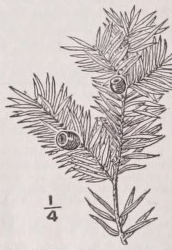
YEW. This tree (Taxus) belongs to a genus of Coniferae in which the ordinarily woody cone is represented by a fleshy cup surrounding a single seed. Usually it forms a low-growing tree of very diverse habit, but generally with dense spreading branches, thickly covered with very dark green linear leaves, which are given off' from all sides of the branch, but which, owing to a twist in the base of the leaf, become arranged in a single series on each side of it. The trees are usually dioecious: the male flowers are borne on one individual and the female on another, although instances occur in which flowers of both sexes are formed on the same tree. The male flowers are more or less globular and occur in the axils of the leaves. They consist of a number of overlapping brownish scales, gradually increasing in size from below upwards and surrounding a naked stalk that bears at its summit a head of anthers. Each anther has a flat five-lobed top, something like a shield; from its under surface five, six, or more pollen cases hang down, and these open lengthwise to liberate the globose pollen-grains. Each flower thus consists of a number of monadelphous stamens; but, according to the older view of its structure, each stamen constitutes of itself a single flower, the whole mass being considered as an amentaceous inflorescence or catkin of numerous monandrous flowers. The female flowers are also placed each separately in the axil of a leaf, and consist of a number of overlapping scales, as in the male. These scales surround a cup which is at first shallow, green, and thin, but which subsequently becomes fleshy and red, while it increases so much in length as almost entirely to conceal the single straight seed. It is clear that the structure of the female flower differs from that of ...most conifers; but the structure of the wood and other characters forbid its being separated from them except as a subdivision (Taxaceae).
The poisonous properties, referred to by classical writers such as Caesar, Virgil, and Livy, reside chiefly if not entirely in the foliage. This, if eaten by horses or cattle, especially when it has been cut and thrown in heaps so as to undergo a process of fermentation, is very injurious. The leaves have also been used for various medicinal purposes, but are seldom employed now. The succulent portion of the yew berry is quite harmless; but it is probable that some noxious principle is contained in the seed. As, however, it is hard and disagreeable to the taste, the danger from this source is not great. As a timber tree it is used for cabinet-work, axle-trees, bows, and the like, where strength and durability are required.
The yew occurs wild over a very large area of the northern hemisphere. In north-eastern America and in Japan trees are found of a character so similar that by some botanists they are all ranged under one species. The varieties grown in the United Kingdom are very numerous, one of the most striking being that known as the Irish yew,—a shrub with the pyramidal or columnar habit of a cypress, in which the leaves spread from all sides of the branches, not being twisted, as they usually are, out of their original position. In the ordinary yew the main branches spread more or less horizontally, and the leaves are so arranged as to be conveniently exposed to the influence of the light; but in the variety in question the branches are mostly vertical, and the leaves assume a direction in accordance with the ascending direction of the branches.
The yew is a favourite evergreen tree, either for planting separately or for hedges, for which its dense foliage renders it well suited. The wood is very hard, close-grained, and of a deep red brown colour internally. Its younger branches, owing to their toughness, were formerly used for bows. The planting of the yew in churchyards was at one time supposed to have been done with a view to the supply of yew staves. But, while importation from abroad was fostered, there seems to have been no statute enforcing the cultivation of the yew in Great Britain; on the other hand, a statute of Edward I. (cited in Gard. Chron., 6th March 1880) states that the trees were often planted in churchyards to defend the church from high winds. Be this as it may, yews of huge size and great antiquity still exist in various parts of the country in the vicinity of churches. Some of these are of historic interest; but it is hardly prudent to cite either the measurements or the allegations as to age, the circumstances under which the estimates were framed being different in each case. Accurate comparative measurements made on a uniform plan would be very serviceable. The Crowhurst yew, mentioned by Evelyn as 30 feet in circumference, was still in existence in 1876 (Gard. Chron., 22d July 1876). The large yew at Ankerwyke near Staines, with a trunk 27⅔ feet in circumference, might well have been in existence in 1215, when Magna Charta was signed. Considerable interest also attaches to the fine yew in Buckland churchyard near Dover, which in 1880 was removed to a distance of 60 yards. The trunk had been split so that it had a direction nearly parallel with the soil. This huge tree was moved with a ball of soil round its roots, 16 feet 5 inches by 15 feet 8 inches, by 3 feet 6½ inches in depth, the weight of the entire mass being estimated at 56 tons. The dimensions of the tree in 1880 were as follows—“circumference of the main trunk, 22 feet; of the upright portion of the trunk, 6 feet 10 inches; second horizontal trunk, 10 feet 10 inches; do., south limb forking off at 9 feet from the main trunk, 7 feet 10 inches; do., west limb forking off at 9 feet from the main trunk, 8 feet 8 inches; extent of branches from centre of main trunk southwards, 30 feet 10 inches, and from north to south 48 feet; they extend from the main trunk westward 33 feet.” The tree was replanted so that the horizontal portions were replaced in their original erect position and the natural symmetry restored Hard. Chron., 1st May 1880).