
A surplice or vestment of white linen, reaching to the feet, worn by the Romish clergy. Also a Turkish coin, called also an asper, value one hundred and twelve mills.
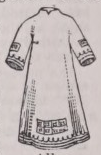
ALB, or Albe, a vestment of white linen, hanging down to the feet, worn by priests at all the more solemn services of the church. It corresponds to the surplice of the English clergy, the difference being that the alb is closer in the sleeves, and bound at the waist by a girdle. In the ancient church it was customary for the neophytes who were baptized on Easter-day to wear an alb for the eight days following, and hence the Sunday after Easter was called Dominica in Albis.
ALBA, the ancient Alba Pompeia, a town of Italy, in the province of Cuneo, situated on the Tanaro, 30 miles S.E. of Turin. It is the seat of a bishop, and contains a cathedral, founded in 1486, as well as other churches and religious establishments. It has a large trade in cattle, and the surrounding district is very fertile, producing silk, wine, oil, grain, and fruits, and also marble and rock-salt. Population of the commune (1865), 9687.
ALBA LONGA, the most ancient town in Latium, was situated 15 miles S.E. from Rome, on a ridge between the mountain and the lake that were both called from it Albanus. It derived its name probably from its elevated or Alpine situation, the story of the white sow discovered by Aeneas on landing (Virgil, Aeneid, iii. 390- 392) being of course mythical. Little beyond the bare fact of its existence for a considerable period as the foremost town in Latium can be accepted as strictly historical. According to the legendary accounts, it was founded by Ascanius, the son of Aeneas, 300, or, as a later version has it, 360 years before the foundation of Rome. Fourteen kings, whose names are all preserved, are said to have reigned over it in succession. The names, however, are evidently an invention, having probably this substratum of historic truth, that the ruling family belonged to the Silvian gens. The city was destroyed by the Romans under Tullus Hostilius, and its inhabitants removed to Rome. Several of the patrician families, such as the Julii, Curiatii, Servilii, Tullii, Quintii, ascribed their origin to these immigrants from Alba.
ALBACETE, one of the new provinces of Spain, was formed in 1833 out of districts taken from Murcia and New Castile. It is bounded on the N. by Cuença, on the E. by Valencia and Alicant, on the S. by Murcia, and on the W. by Ciudad Real and Jaen. The area is 5971 square miles. The province is generally hilly, some of the peaks of the sierras rising to a height of 5000 feet; but it contains rich plains and many fertile valleys. The principal rivers are the Mundo in the southern and the Jucar in the northern part of the province; and there are numerous smaller streams. Some parts of the country have a bare appearance, being destitute of wood, but the neighbourhood of Alcarez is covered with fruit trees, and presents the aspect of a garden. Agriculture is in a tolerably prosperous state, more advanced than in the centre of Castile, but less so than in the rich districts of Murcia and Valencia. Cereals, pulse, and fruits of all kinds are produced, as well as wine of fair quality, and excellent honey. Saffron also is produced in large quantities, and some attention is given to the keeping of silk-worms. Many of the inhabitants devote themselves to the rearing of cattle, sheep, and goats. The bulls of Albacete are in request for bull-fights; there is a good breed of mules, and the horses of the province have long mounted the Spanish cavalry. Manufactures are confined to the spinning of hemp, and the making of coarse cloths, porcelain, earthenware, and cutlery. There are several distilleries, and a considerable trade in wood. The district is rich in minerals, including silver, iron, copper, zinc, sulphur, gypsum, and coal; but, excepting stones and marble for building purposes, they are little wrought. In addition to agricultural produce, small quantities of zinc, iron, and ...sulphur are exported. There are numerous mineral springs, chiefly sulphureous, and hot as well as cold, at various places in the province. Among the chief towns are Albacete, Chinchilla, Bonillo, and Alcarez. The railway from Madrid to Valencia traverses the province, and at Chinchilla a line branches southward to Murcia.
The state of education throughout the province is very low. In the town of Albacete, where it is best, little more than half the population can read; while at Yeste, where it is worst, the proportion is only 1 in 15. The graver crimes are of infrequent occurrence; but the inhabitants always wear arms, and offences against the person are numerous. Population in 1867, 221,444.
Albacete, a town of Spain, capital of the above province, is situated about 140 miles S.E. of Madrid, and is a station on the railway between Madrid and Valencia. It is surrounded by a fertile plain, and has considerable trade in saffron and in the agricultural products of the district. A great market, chiefly for the sale of cattle, is held annually in September, and extends over several days. The town is well built, and has several churches, two hospitals, and a normal school. At one time it had an extensive trade in cutlery, from which it received the name of the Sheffield of Spain. This manufacture has been very much reduced by the importation of cutlery from England and Germany, but Albacete is still famous for its daggers, which are held in high repute and much worn by the Spaniards. They are formidable weapons, of coarse manufacture, but with richly-ornamented handles, and frequently bear proverbial inscriptions suitable to their murderous appearance. Population, 15,150.
ALBAN, St, usually styled the protomartyr of Britain, was born at Verulamium, and flourished towards the end of the third century. In his youth he took a journey to Rome in company with Amphibalus, a monk of Caerleon, and served seven years as a soldier under the Emperor Diocletian. On his return home he settled at Verulamium, and, influenced by the example and instructions of Amphibalus, renounced the errors of paganism, in which he had been educated, and became a convert to the Christian religion. It is generally agreed that Alban suffered martyrdom during the great persecution in the reign of Diocletian; but authors differ as to the precise date. Bede, who gives a full account of the event, fixes it in 286; some refer it to the year 296; while Usher reckons it amongst the events of 303. Between 400 and 500 years after St Alban’s death, Offa, king of the Mercians, built a large and stately monastery near Verulamium to his memory, and around it the present town of St Albans was gradually erected.
ALBANI, or Albano, Francesco (1578-1660), a celebrated Italian painter, was born at Bologna. His father was a silk merchant, and intended to bring up his son to the same occupation; but Albani was already, at the age of twelve, filled with so strong an inclination for painting, that on the death of his father he devoted himself entirely to art. His first master was Denis Calvart, with whom Guido Reni was at the same time a pupil. He was soon left by Calvart entirely to the care of Guido, and contracted with him a close friendship. He followed Guido to the school of the Caracci; but after this, owing to mutual rivalry, their friendship began gradually to cool. They kept up for a long time a keen competition, and their mutual emulation called forth some of their best productions. Notwithstanding this rivalry, they still spoke of each other with the highest esteem. Albani, after having greatly improved himself in the school of the Caracci, went to Rome, where he opened an academy and resided for many years. Here he painted, after the designs of Annibal Caracci, the whole of the frescoes in the chapel of St Diego in the church of San Giacomo degli Spagnuoli. His best frescoes are those on mythological subjects, of which there is a large number in the Verospi Palace, now Torlonia. On the death of his wife he returned to Bologna, where he married a second time, and resided till his death in the enjoyment of much domestic happiness and general esteem. His wife and children were very beautiful, and served him for models. But while thus studying from nature, his love of artificial refinement and conventional expression was so great, that even his best works are deficient in breadth and vigour, as well as in unaffected grace and natural feeling. The learning displayed in the ...composition of his pictures, and their minute elaboration and exquisite finish, gave them great celebrity, and entitle them to a distinctive place among the products of the Bolognese school.
“In point of original invention,” says Lanzi, "Albani is superior to Domenichino, perhaps to any other of the school; and in his representation of female forms, according to Mengs, he has no equal. By some he is denominated the Anacreon of painting. Like that poet, with his short odes, so Albani, from his small paintings, acquired great reputation; and as the one sings Venus and the Loves, and maids and boys, so does the artist hold up to the eye the same delicate and graceful subjects. Nature, indeed, formed, the perusal of the poets inclined, and fortune encouraged his genius for this kind of painting; and possessing a consort and twelve children, all of surprising beauty, he was at the same time blest with the finest models for the pursuit of his studies. He had a villa most delightfully situated, which further presented him with a variety of objects enabling him to represent the beautiful rural views so familiar to his eye.
A great number of his works are at Bologna. Among the most celebrated of his pictures are the “Four Seasons “Diana and Venus,” in the Florentine gallery; the “Toilet of Venus,” in the Louvre; “Venus landing at Cythera,” in the Ghigi palace at Rome, &c. Among the best of his sacred subjects are a “St Sebastian” and an “Assumption of the Virgin,” both in the church of St Sebastian at Rome.· He was among the first of the Italian painters to devote himself to the painting of cabinet pictures.
ALBANIA, a country of considerable extent, which though frequently ruled by turbulent and nearly independent chiefs, ranks as one of the provinces of the Turkish empire. The tract of land to which this name is now applied extends from 39° to 43° N. lat., and from 18° 24' to 21° 48' E. long.; from the Gulf of Cattaro in the north to the Gulf of Arta in the south, and from the coast of the Adriatic Sea and Ionian Sea on the west to an irregular ill-defined line inland towards the east, roughly indicated in its northern part by the Tchar Dagh, the ancient Scardus, a part of the Haemus or Balkan range, and southwards by the Pindus chain, or rather the portions of it now called the mountains of Sagori, Metzovo, and Suh. Within these limits is included the ancient Epirus, corresponding to the southern part of the country now comprehended under the general name of Albania, and divided from Albania, properly so called, by the river Voyutza or Viosa, which enters the Adriatic a few miles north of Avlona. Albania, therefore, is bounded on the N. by Dalmatia, Montenegro (from which it is separated by the river Moroka), and Bosnia; on the E. by Servia and the Turkish province of Rum-ih, in which Macedonia, or the greater part of it, is included; and on the S. by Hellas or Northern Greece, which was the Turkish province of Livadia before Greece regained its independence, and from which it is separated by the river Garla or Suli. The superficial area of Albania is estimated at about 18,944 square miles, and it has a coast-line of about 280 miles from north to south, without reckoning indentations, &c. It nowhere extends more than 100 miles from the sea, and in the southern part not more than 30 miles....
According to the most recent division of the Turkish empire into eyalets, sanjaks, and Evas, Albania is comprehended in three eyalets, namely, Uskub or Uskup in the north; Roumelia, which also includes part of Macedonia, in the centre; and Yania, corresponding pretty nearly to the ancient Epirus, in the south. The chief towns of these eyalets are respectively Scutari, Monastir, and Joannina, sometimes written Janina or Yanina; and these divisions are therefore spoken of by some writers as the pashaliks of Scutari, Monastir, and Joannina. The divisions chiefly recognised by the Albanians themselves are those formed by the varieties of the native tribes. Colonel Leake, who is considered one of the best informed authorities on this head, divides them into the Ngege or Ghegides, whose principal towns are Dulcigno, Scutari, and Durazzo; the Toske or Toskides, who occupy Berat and Elbasan; the Liape, a poor and predatory race, who inhabit the mountains between the Toske and Delvino; and the Tsami, who inhabit the most southerly district, and whose principal towns are Suli and Paramithia. The country is mountainous, the interior being traversed by a range which forms a prolongation of the Dinaric Alps, and which is continued southwards in the Pindus range. These mountains, from which numerous spurs are thrown out to the east and west, run in a direction from north to south, parallel to the course of the Tchar Dagh. Along the southern part of the coast-line, and parallel with it, run the Khimara mountains, known to the ancients as the Acro-ceraunian range, terminating northwards in the bold headland of Cape Glossa. There are three lakes of great size in Albania—Scutari in the north, Okhrida in the centre, and Joannina in the south. The rivers for the most part are short, and run, generally speaking, from east to west, or in a north-westerly direction. The Moroka and Zenta enter the lake of Scutari, which is connected with the sea by the Boyana, that flows into the Adriatic near Dulcigno. The White Drin, flowing in a southerly direction, and the Black Drin, running northwards from Lake Okhrida, form the head streams of the Drin. The principal streams in addition to these are the Skombia, Voyutza, Calamas, Arta, and Gurla (the ancient Acheron), with its tributary the Vuvó (the ancient Cocytus). The climate is generally healthy, though cold and bleak in the highlands; the warmer regions along the coast are also frequently visited by cold northerly winds.
Albania includes not only the ancient Epirus, but also part of the ancient Macedonia, Illyria, and Chaonia. This country was in early times, as now, distinguished by the rude valour of its inhabitants. Its remote situation, and the want of union among its tribes, generally prevented it from acting any conspicuous part in Grecian politics. The only remarkable exception occurs in the reign of Pyrrhus, king of Epirus (296-272 b.c. ), who was justly ranked among the greatest captains of antiquity. After his death the country was again split into a number of petty states, which were unable to resist the united strength of Macedon; and to that kingdom Epirus continued subject till both were alike subdued by the Roman arms (167 b.c.)
It was during the time of the Greek empire that the name of Albania was first given to this district. During the decline of the empire the Albanians gradually rose to distinction, and at last to independence. Their valour enabled them to maintain their ground against the Bulgarians, who had occupied all the neighbouring districts of Greece. Nor were they less successful against the Turks, a more formidable enemy. Under the command of the celebrated George Castriot, called by the Turks Scanderbeg, they baffled all the efforts of Mahomet II., the conqueror of Constantinople. That powerful monarch entered Albania only to experience a succession of defeats, and was at length compelled to acknowledge its independence by a formal treaty. On the death of Scanderbeg, the Turks redoubled their efforts against Albania, which was at length reduced to a state of nominal subjection. The siege of Scutari, in 1478, formed the termination of this memorable struggle. The subjection, however, was always the imperfect; revolts were frequent, and the inhabitants of mountainous districts still preserved their independence. It was the motives of pay and plunder, rather than compulsion, that brought these hardy soldiers into the Turkish ranks. In proportion as the Ottoman empire declined in vigour, its hold of Albania became less firm; and the vigorous and enterprising genius of Ali Pasha again converted this dependency into what might almost be called a separate kingdom.
In the grand insurrection of Greece (1821-1829), the Albanians, accustomed to view with disdain the Ottoman yoke, showed a considerable disposition to make common cause with the Greeks, and their co-operation would have almost ensured success. But the Greeks, imprudently and unhappily, could not divest themselves of the feelings of enmity cherished during the long series of wars which Ali had waged against them. At the siege of Tripolizza (October 5, 1821) overtures were made to them by a corps of 3000 Albanians, who formed part of the garrison; but the Greeks, having succeeded in entering the place, began a dreadful and indiscriminate massacre, in which the Albanians were not spared. At the siege of Arta, although the capture was much facilitated by the coming over of a corps of Albanians, the Greeks treated them extremely ill. The Albanian nation was thus forcibly thrown into the arms of the Porte, to which it has since continued nominally subject. The allegiance of the Albanians, however, to Turkey rests on a very precarious basis even at the present day, and, it will be remembered, in the Crimean war many Albanian chiefs fought under the Russian flag against the combined forces of England, France, and Turkey.
The inhabitants of Albania are estimated at 1,200,000, of whom a considerable proportion are Turks and Greeks; but the basis of the population consists of the original race, called Arnauts. About half of the entire population are Mahometans; of the other moiety, about 520,000 belong to the Greek Church, and the remainder to the Latin Church. The conversion of those who profess Mahometanism has been, however, very imperfect, and chiefly induced by political motives. In every family the males usually go to the mosque, the females to church; and some members of a family are seen in the most amicable manner eating from the same table, and even from the same plate, meats forbidden to the others. With the Turks, accordingly, infidel and Albanian are terms nearly synonymous. The native Albanian is of middle stature; his face is oval, with high cheek-bones; his neck long; his chest full and broad. His air is erect and majestic to a degree which never fails to strike the traveller. He holds in utter contempt that dissimulation which is characteristic of the Greek, and, unlike the Turk, he is gay, lively, and active. Averse, however, to regular industry, his whole delight is in arms and plunder. He goes constantly armed; and there are few Albanians who have not, in the prime of their life, belonged to some of the numerous bands of robbers who infest the mountains of their native country, of Thessaly, and of Macedonia. This occupation carries with it no disgrace: it is common for the Albanian to mention circumstances which occurred “when he was a robber.” In proportion as the trade of robbing becomes overstocked, part of those engaged in it seek employment in the service of the sultan and the different pashas throughout the Turkish empire, by all of whom the Alba nians are regarded as the most valuable of their troops.
This fierce and haughty race display a greater degree of contempt for the female sex than is usual even among the most barbarous nations. The females are literally regarded as inferior animals, and treated accordingly; but in the country districts they are not confined or veiled, as is customary in Mahometan countries.
The national costume of the Albanians is handsome in appearance, and bears some resemblance to the Highland dress. It consists of a cotton shirt; a white woollen fustanella or kilt, which reaches to the knees; a jacket; a sash round the waist, in which pistols and a yataghan are commonly carried; coloured leggings; sandals; and a red cap, round which some twist a shawl or scarf. The chiefs and wealthy Albanians generally wear a jacket and vest of velvet, richly embroidered with gold, and metal greaves over their leggings, which are usually made of fine scarlet cloth. The poorer classes, though picturesque in appearance, are extremely dirty in their habits, and seldom change their clothes. As a protection from the weather, every Albanian has a capote, or rough shaggy mantle with a hood attached, and usually made of horse-hair stuff or coarse woollen cloth. The dress of the females is more various, and often fantastical. A singular custom prevails among the girls of stringing together the pieces of money which they have collected for their portion, and wearing them upon their heads. Some of them have their hair hanging down in braids to a great length, loaded with this species of ornament.
Scutari, on the lake of that name, is now considered the chief town of Albania. It is the centre of a large inland trade, and contains about 40,000 inhabitants. Prisrend, in the north-east, is noted for its manufactures of fire-arms and cutlery, and has a population of 25,000. Monastir, or Bitolia, although the capital of the eyalet of Roumelia, is not, strictly speaking, within the confines of Albania. It has a large transit trade between eastern and western Turkey. Joannina, with 36,000 inhabitants, situated on the south-west shore of a lake of the same name, was the capital of Albania in the time of Ali Pasha, and was his stronghold as well as the seat of his government. The other important towns of the interior are Jacova, Tirana, Okhrida, Elbasan, Delvino, and Metzovo. The principal seaports and river-ports are Dulcigno, Durazzo, Parga, Prevesa, and Arta.
The commerce of Albania is chiefly carried on through Arta and Prevesa, on the north side of the entrance to the Gulf of Arta. The principal merchants, however, are Greeks residing at Joannina, among whom a very active commercial spirit appears to prevail. The exports consist almost entirely of unmanufactured produce, live stock, and provisions, and comprise valonia (the cup of the acorn of the Valonia oak, used in tanning), raw silk, cheese, raw hides, drugs, dye-woods, sheep, horses, and salted meats. Notwithstanding its mountainous character, the fertility of its plains affords a surplus of grain, of which a considerable quantity is sent to Italy, the Ionian Isles, Malta, and other places. The vine, olive, pomegranate, orange, lemon, mulberry, and fig are also cultivated. Wool is exported, chiefly unmanufactured, but partly also wrought into coarse cloth. Other important articles of export are oil, tobacco of good quality, cotton, and cotton yarn. Some cargoes of wood for building and firewood are annually sent to Malta. The chief imports consist of woollen cloths, used for winter coverings. For this purpose the preference is given to a coarser and cheaper kind than any that is usually manufactured in Great Britain. This is supplied from Germany. Fire-arms, cutlery, gunpowder, hardware, coffee, and sugar are also imported. The manufactures of Albania are few and unimportant, being almost entirely confined to capotes, embroidery on cloth and velvet, fire-arms and cutlery to a limited extent, and gun aud pistol stocks—all for home consumption.
See the Joumey through Albania and Turkey of Mr J. Cam Hobhouse (Lord Broughton); Travels in the Ionian Isles, Albania, &c., by Sir Henry Holland, who resided for some time in the capacity of physician at the court of Ali Pasha; Rev. T. S. Hugnes’s Travels in Sicily, Greece, and Albania; Leake’s Travels in Northern Greece; Mrs Mary A. Walker’s Through Macedonia to the Albanian Lakes.
ALBANIA, in Ancient Geography, a country of Asia, bounded, according to Strabo, on the W. by Iberia, on the E. by the Caspian Sea, on the N. by Sarmatia, on the S. by Armenia and the river Cyrus (Kour). The country formerly called Albania corresponds with the modern Daghistan, Schirvan, and Leghistan, and is extremely fertile, owing to the alluvial deposits made by the river Cyrus. The ancient historians describe the Albanians as tall, strong-bodied, and, generally speaking, of a very graceful appearance. The Albanians were originally a nomad race, and never devoted themselves to agriculture or commerce. They became known to the Romans during Pompey’s expedition in pursuit of Mithridates (65 b.c. ), against which they opposed a force of 60,000 infantry and 22,000 cavalry. Though Pompey exacted from them a nominal submission, they continued practically independent.
ALBANO, a town and lake in the Campagna di Roma, Italy, about 14 miles S.E. of Rome. The town is much admired for the picturesque scenery around it. It is well built, and the Roman aqueduct and other monuments of antiquity are in tolerable preservation. It contains a cathedral, and there are many handsome villas of the Roman nobles in the vicinity. Population, 6400. The lake of Albano, lying to the N.E. of the town, occupies the crater of an extinct volcano, and is of a beautiful oval form, surrounded with high wooded banks, and about 7 miles in circumference. It has long been an object of attraction to the painter and the traveller. In the fourth century of ancient Rome, during the siege of Veii, there was an extraordinary rise of the waters of this lake, and the oracle declared that there was no hope of success against Veii while the Alban lake was allowed thus to swell. This prompted the Romans to drain it by a tunnel cut through the rock, a mile and a half in length, 4 feet wide, and 6 high, which is still perfect. This outlet keeps the surface of the lake at the height of 920 feet above the level of the sea. Monte Cavo, the ancient Albanus, rises on the eastern side of the lake to a height of 3000 feet, and commands a magnificent prospect. On its summit stood the famous temple of Jupiter Latialis.
ALBANY, a city of the United States, capital of the state of New York and of the county of Albany, picturesquely situated in a beautiful and fertile country on the western bank of the Hudson, 145 miles from New York. It is, for an American city, irregularly laid out, and much of its architecture is poor, although it contains several very fine buildings, and many of its more recently made streets are broad and handsome. The Capitol, a brown stone edifice, 115 feet by 90, built in 1807, faces a square called Capitol Park; and opposite it, on the eastern side of the square, are the State Hall and City Hall, both constructed of white marble. There are several beautiful churches, including a large Roman Catholic cathedral. Among the literary and scientific institutions of Albany may be mentioned the university, incorporated in 1852, giving instruction in most branches of education, especially practical science and law; a medical college; an academy, and other schools of various grades; a large observatory; the state library, with about 90,000 volumes; and the Albany Institute for the collection and diffusion of scientific information. Albany is an important centre of trade, being situated at the point where the united Erie and Champlain canals join the Hudson, and possessing good railway communication with most cities of the United States. The chief articles of commerce are timber, wheat, barley, wool, and tobacco, enormous quantities of which, especially of the first-mentioned, pass through the city annually. Besides its transit trade, its numerous foundries, its breweries, carriage and hat manufactories, and tanneries are of importance. In 1873, 536 vessels (83 sailing and 352 unrigged vessels and 101 steamers), of 68,682 tons, belonged to the port. Albany was founded by ...the Dutch in 1623, and is thus one of the oldest European settlements in the United States, dating sixteen years after that of Jamestown in Virginia. It was captured by the British in 1664, who changed its name from Beaverwyck or Williamstadt in honour of the Duke of York and Albany. It received its charter in 1686, and became the capital of the state of New York in 1797. It is governed by a mayor and twenty aldermen, and is divided into ten wards. Population in 1870, 69,422; number of families, 14,105; and of dwellings, 8748.
ALBANY, Louisa Maria Caroline, Countess of, daughter of Prince Gustavus Adolphus of Stolberg-Gedern, was born at Mons on the 27th Sept. 1753, and assumed the title of Albany in 1772, when she married the Pretender, Charles Edward, grandson of James II. of England. Her husband was much older than herself, and their union proved very unhappy. There were no children, and the Pretender, who was a confirmed drunkard, treated his wife with such brutality that her health and even her life were endangered. In 1780 she obtained a legal separation, and entrusted herself to the care of her husband’s brother, the Cardinal of York, who placed her in a convent, and afterwards removed her to his own house at Rome. Here she was frequently visited by the poet Alfieri, who made her the object of what seems to have been the only pure attachment of his life, and who, according to his own avowal, was indebted to her influence for all that was best in his works. (See Alfieri.) In 1788 she was freed from her bonds by the death of the Pretender, and in the same year she is said to have been secretly married to Alfieri. For the remainder of her life she resided at Florence, where she continued to be known as Countess of Albany, and distinguished herself as a patroness of literary men and artists. Alfieri died at her house in 1803, and in 1810 she caused a monument to his memory, by Canova, to be erected in the church of San Croce. With the death of the Cardinal of York in 1807 the Stuart line became extinct, and the countess, who died on the 29th January 1824, was the last who was known by the name of Albany. She was buried beside Alfieri in the church of San Croce.
ALBATEGNI, an Arabian astronomer, whose proper name is Mohammed Ibn Jábir Ibn Senán Abú Abdillah, derived this appellation from Batan in Mesopotamia, his native town, of which he is said to have been chief. His astronomical observations extended from 877 a.d. to his death in 929, and were principally conducted at Rakkah or Aracta, on the Euphrates, and at Antioch in Syria. His principal work, Zidje Sabi, the original MS. of which is in the Vatican, was published in a Latin translation by Plato Tiburtinus at Nuremberg in 1537, under the title De Scientia Stellarum, and reprinted at Bologna in 1645. Among the unpublished works of Albategni are commentaries on the Almagest and Makalat of Ptolemy, and a Treatise on Astronomy and Geography. Instead of the tables of Ptolemy, which were imperfect, he computed new ones; these were adapted to the meridian of Rakkah, and were long used as the best among the Arabs. Albategni gives the motion of the sun’s apogee since Ptolemy’s time, as well as the motion of the stars, which he estimated at 1° in 70 years. He makes the obliquity of the ecliptic 23° 35'. His determination of the length of the tropical year is more exact than that of Ptolemy, being only 2m. 26s. short. Upon his observations were founded the Al-phonsine tables of the moon’s motion. He first substituted sines for chords, and also introduced into trigonometry the use of tangents and versed sines. On account of his discoveries, the chief of which is the motion of the sun’s apogee, he has been called the Arabian Ptolemy, and has been placed by some at the head of Arabian astronomers.
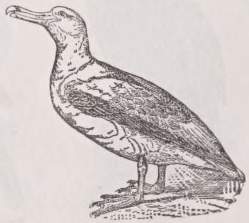
ALBATROSS, a genus of aquatic birds {Diomedea), closely allied to the Petrels and Gulls, belonging to the family of Longipennatoe, or long-winged birds, in the order Natatores. In the name Diomedea, assigned to them by Linnaeus, there is a reference to the mythical metamorphosis of the companions of the Greek warrior Diomedes into birds. They have the beak large, strong, and sharp-edged, the upper mandible terminating in a large hook; the wings are narrow and very long; the feet have no hind toe, and the three anterior toes are completely webbed. Of the three species that the genus includes the best known is the Common or Wandering Albatross {D. exulans), which occurs in all parts of the Southern Ocean, and in the seas that wash the coast of Asia to the south of Behring Strait. It is the largest and strongest of all sea-birds. The length of the body is stated at 4 feet, and the weight at from 15 to 25 lb. It sometimes measures as much as 17 feet between the tips of the extended wings, averaging probably from 10 to 12 feet. Its strength of wing is very great. It often accompanies a ship for days—not merely following it, but wheeling in wide circles round it—without ever being observed to alight on the water, and continues its flight, apparently untired, in tempestuous as well as in moderate weather. It has even been said to sleep on the wing, and Moore alludes to this fanciful “cloud-rocked slumbering” in his Fire Worshippers. It feeds on small fish and on the animal refuse that floats on the sea, eating to such excess at times that it is unable to fly, and rests helplessly on the water. The colour of the bird is a dusky white, the back being streaked transversely with black or brown bands, and the wings darker than the rest of the body. The flesh, though hard, ...dry, and unsavoury, is eaten by the inhabitants of Kamtchatka, who also capture the bird for its entrails, which they inflate for net-floats, and its long wing-bones, which they manufacture into various articles, particularly tobacco-pipes. The albatross lays one egg; it is white, with a few spots, and is about 4 inches long. In breeding-time the bird resorts to solitary island groups, like the Crozet Islands and the elevated Tristan da Cunha, where it has its nest—a natural hollow or a circle of earth roughly scraped together—on the open ground. The early explorers of the great Southern Sea cheered themselves with the companionship of the albatross in its dreary solitudes; and the evil hap of him who shot with his cross-bow the bird of good omen is familiar to readers of Coleridge’s Dime of the Ancient Mariner.
ALBAY, a town of Luzon, the chief of the Philippine Islands, in 13° 22' N. lat. and 123° 52' E. long. It is the capital of the fertile province of the same name, and the residence of the governor, and has an active trade. Close to the town is an active volcano by which it has been frequently devastated. Population, 13,115.