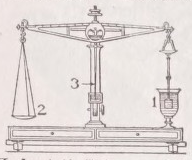
BALANCE. For the measurement of the “mass” of (i.e., of the quantity of matter contained in) a given body we possess only one method, which, being independent of any supposition regarding the nature of the matter to be measured, is of perfectly general applicability. The method—to give it at once in its customary form—consists in this, that after having fixed upon a unit mass, and procured a sufficiently complete set of bodies representing each a known number of mass-units (a “set of weights ”), we determine the ratio of the weight of the body under examination to the weight of the unit piece of the set, and identify this ratio with the ratio of the masses. Machines constructed for this particular modus of weighing are called balances. Evidently the weight of a body as determined by means of a balance—and it is in this sense that the term is always used in everyday life, and also in certain sciences, as, for instance, in chemistry—is independent of the magnitude of the force of gravity; what the merchant (or chemist) calls, say, a “pound” of gold is the same at the bottom as it is at the top of Mont Blanc, although its real weight, i.e., the force with which it tends to fall, is greater in the former than it is in the latter case.
To any person acquainted with the elements of mechanics, numerous ideal contrivances for ascertaining which of two bodies is the heavier, and for even determining the ratio of their weights, will readily suggest themselves; but there would be no use in our noticing any of these many conceivable balances, except those which have been actually realised and successfully employed. These may be conveniently arranged under six heads....
1. Spring Balances. — The general principle of this class of balances is that when an elastic body is acted upon by a weight suspended from it, it undergoes a change of form, which, caeteris paribus, is the greater the greater the weight. The simplest form of the spring balance is a straight spiral of hard steel (or other kind of elastic) wire, suspended by its upper end from a fixed point, and having its lower end bent into a hook, from which, by means of another hook crossing the first, the body to be weighed is suspended,— matters being arranged so that even in the empty instrument the axis of the spiral is a plumb-line. Supposing a body to be suspended at the lower hook, it is clear that the point where the hooks intersect each other will descend from the level it originally occupied, and that it must fall through a certain height h before it can, by itself, remain at rest. This height, provided the spiral was not strained beyond its limit of elasticity {i.e., into a permanent change of form), is proportional to the weight P of the body, and consequently has to the mass Μ the relation Λ = cyM, where c is a constant and g the acceleration of gravity. Hence, supposing in a first case h and Μ to have been h' and M', and in a second case, h!' and M*, we have h': h" :: <7′M′: f'W; and it is only as long as g is the same that we can say K : h! ’ ∙. : M': Μ*. Spring balances are very extensively used for the weighing of the cheaper articles of commerce and other purposes, where a high degree of precision is not required. In this class of instruments, to combine compactness with relatively considerable range, the spring is generally made rather strong; and sometimes the exactitude of the reading is increased by inserting, between the index and that point the displacement of which serves to measure the weight, a system of levers or toothed wheels, constructed so as to magnify into convenient visibility the displacement corresponding to the least difference of weight to be determined. Attempts to convert the spring balance into a precision instrument have scarcely ever been made; the only case in point known to the writer is that of an elegant little instrument constructed by Professor Jolly, of Munich, for the determination of the specific gravity of solids by immersion, which consists of a long steel-wire spiral, suspended in front of a vertical strip of silvered glass bearing a millimetre scale. To read off the position of equilibrium of the index on the scale, the observing eye is placed in such a position that the eye, its image in the glass, and the index are in a line, and the point on the scale noted down with which the index apparently coincides.
2. Chain Balances. — This invention of Wilhelm Weber’s having never, so far as we know, found its way into actual practice, we confine ourselves to an illustration of its principle. Imagine a flexible string to have its two ends attached to the two fixed points C and D (fig. 1), forming the terminal points of a horizontal line CD shorter than the string. Suppose two weights to be suspended, the one at a point A, the other at a point B of the string; the form of the polygon CDBA will depend, caeteris paribus, on the ratio of the two weights. Assuming, for simplicity’s sake, CA to be equal to DB, then, if the weights are equal, say, each = P units, the line AB will be horizontal. But if now, say, the weight at B be replaced by a heavier weight Q, the point A will ascend through a height h, the point B will descend through a lesser height h' in accordance with equation PΛ = QΛ', and the angle between what is now the position of rest of the base line A'B', and the original line AB will depend on the ratio of P: Q. The exact measurement of this angle would be difficult, but it would be easy to devise very exact means for ascertaining whether or not it was horizontal, and, if not, whether it slanted down the one way or the other; and thus the instrument might serve to determine whether P was equal to, or greater or less than, Q; and this obviously is all that is required to convert the contrivance into an exact balance.
3. Lever Balances. — This class of balances, being more extensively used than any other, forms the most important division of our subject. There is a great variety of lever balances; but they are all founded upon the same principles, and it is consequently expedient to begin by summing up these into one general theory.
Theory of the Lever Balance (fig. 2).—In developing the “theory” of a machine, the first step always is and must be that we substitute for the machine as it is a fictitious machine, which, while it closely corresponds in its working to the actual thing, is free from its defects. In this sense what now follows has to be understood. Imagine an inflexible beam suspended from a stand in such a manner that, while it can rotate freely about a certain horizontal axis fixed in its position with respect to both the stand and the beam, and passing through the latter somewhere above its centre of gravity, it cannot perform any other motion. Imagine the beam at each end to be provided with a vertical slit, and each slit to be traversed by a rigid line fixed in the beam in such a situation that both lines are parallel to, and in one and the same plane with, the axis of rotation; and suppose the mass of the beam to be so distributed that the line connecting the centre of gravity S with its projection 0 on the axis of rotation stands perpendicular on that plane. Suppose now two weights, P' and P", to be suspended by means of absolutely flexible strings, the former from a point A on the rigid line in the left, the other from a point B on the rigid line in the right slit, and clearly, whatever may be the effect, it will not depend on the length of the strings. Hence we may replace the two weights by two material points situated in A and B, and weighing P' and P* respectively. But two such points are equivalent, statically, to one point (weighing P' + P") situated somewhere in D within the right line connecting A with B. Suppose the beam to be arrested in its “normal position” (by which we mean that position in which AB stands horizontal and the line SO is a plumb-line), and then to be released, the statical effect will depend on the situation of the point D, and this situation, supposing the ratio l': I" to be given, on the ratio P': P' ’. If P ’ l' = P" I", D lies in the axis of rotation; the beam remains at rest in its normal position, and, if brought out of it, will return to it, being in stable equilibrium. This at once suggests two modes of constructing the instrument and two corresponding methods of weighing.
First Method.— We so construct our instrument that while ΐ is constant, I" can be made to vary and its ratio to ΐ be measured. In order then to determine an unknown weight P', we suspend it at the point pivot A; we then take a standard weight P" and, by shifting it forwards and backwards on AB, find that particular position of the point of suspension B, at which P* exactly counterpoises P'. We I" I" then read off y , and have P' = P*y. But, practically, the body to be weighed cannot be directly suspended from A, but must be placed in a pan suspended from A, and consequently the weight p 0 of the pan and its appurtenances would always have to be deducted from the total weight P', as found by the experiment, to arrive at the weight of the object p ≈ P' - p 0 . Hence, what is actually done in practice is so to shape the right arm that its back coincides with the line AB, and to lay down on it a scale, the degrees of which are equal to one another, and to l' (or some convenient submultiple or multiple of l') in length, and so to adjust p 0 and number the scale, that when the sliding weight P" is suspended at the zero-point, it just counterpoises the pan; so that when now it is shifted successively to the points 1, 2, 3 . . . p, it balances exactly 1, 2, 3 . . . p units of weight placed in the pan. This is the principle of the common steel-yard, which, on account of the rapidity of its working, and as it requires only one standard weight, is very much used in practice for rough weighings, but which, when carefully constructed and adjusted, is susceptible of a very considerable degree of precision. In the case of a precision steel-yard, it is best so to distribute the mass of the beam that the right arm balances the left one + the pan, to divide that arm very exactly into, say, only 10 equal parts, and instead of one sliding weight of P" units to use a set of standards weighing P ,, , τ ⅛ P", τ ⅛ σ P", 10 1 0 σ P", &c. The great difficulty is to ensure to the heavier sliding weights a sufficiently constant position on the beam. To show the extent to which this difficulty can be overcome it may be stated that in an elegant little steel-yard, constructed by Mr Westphal of Celle (for the determination of specific gravities), which we had lately occasion to examine, even the largest rider, which weighs about 10 grammes, was so constant in its indications that, when suspended in any notch, it always produced the same effect to within less than 3 0 1 0 - σ th of its value.
Second Method.— We so construct our instrument that both l' and Γ have constant values, and are nearly or exactly equal to each other, and provide it with pans, whose weights p 0 ' and pf are so adjusted against each other that p' l' = pfl', and, consequently, the empty instrument is at rest in its normal position. We next procure a sufficiently complete set of weights, i.e., a set which, by properly combining the several pieces with one another, enables us to build up any integral multiple of the smallest difference of weight δ we care to determine, a set, for instance, which virtually contains any term of the series 0Ό01, 0Ό02, 0.003 100'000 grammes. In order now to determine an unknown weight p', we place it, say, in the left pan, and then, by a series of trials, find that combination of standards p>' which, when placed in the right pan, establishes equilibrium to within ± δ. Evidently— ∕-fci≡ d).
In the case of purely relative weighings, there is nothing to
Γ ∕ I" ∖ hinder us from adopting y units (e.g., y grammes! as our unit of mass, and simply to identify the relative value of p' with the number p'. But even if we want to know the absolute value of p in true grammes, we need not know the numerical value of —. AU we have to do is, after
Γ ’ having determined the value of p' in terms of y, to reverse the positions of object and standards, and, in a similar manner, to ascertain the value p 1 " which now counterpoises the unknown weight p' lying in the right pan. Obviously p' ^P" γ= Pi" (pΥ≈p"pι'∙> and P' = *Jp v p"> for which expression, if the two arms are very nearly of equal length, we may safely substitute p' = ⅛(p" +p 1 "). Or, instead of at once finding the counterpoise for p' in standards, we may first counterpoise it by means of shot or other material placed in the opposite pan, and then find out the number of grammes p" which has to be substituted for p' to again establish absolute equilibrium. Evidently p' = p". This (in reference to the ideal machine meant to be realised) is the theory of the common balance as we see it working in every grocer’s shop, and also that of the modern precision balance, which, in fact, is nothing but an equal-armed beam and scales refinedly constructed. In the case of the latter class of balances the inconvenience involved in the use of very small weights may be avoided (and is generally avoided) by dividing the right arm of the beam, or rather the line AB, into 10 equal parts, and determining differences of less than, say, 0Ό1 gramme by means of a sliding weight possessing that value. But evidently, instead of dividing the whole length of the right arm, it is better to divide some portion of it which is so situated that the rider can be shifted from the very zero to the “10,” and so to adjust the rider, that when it is shifted successively from 0 to 1, 2, 3 . . . n it is the same as if 1, 2, 3 . . . n tenths of its weight were placed in the right pan. The rider in this case must, of course, form part and parcel of the beam. It is singular that none of our precision-balance makers have ever thought of this very obvious improvement on the customary system. In the very excellent instrument made by Messrs Becker and Company of New York, this, it is true, is realised partially in a rider weighing 12 milligrammes and a beam divided into 12 equal parts (instead of 10 and 10 respectively); but this does not enable one to shift the rider to where it would indicate from 0 to say -⅛ or 1 ⅛∙ of a milligramme. Whichever of these modes of weighing we may adopt, we must have an arrangement to see whether the balance is in its normal position, and it is desirable also to have some means to enable us, in the course of our trials, to form at least an idea as to the additional weight which would have to be added to the standards on the pan (or to be taken away) in order to establish equilibrium. To define the normal position, all that is required is to provide the beam with a sufficiently long “needle,” the axis of which is parallel to the line OS, and which plays against a circular limb fixed to the stand and constructed so that the upper edge of the limb coincides very nearly with rhe path of the point of the vibrating needle, and to graduate the limb so that, as fig. 2 shows, the zero point indicates the normal position of the beam. In order to see how the graduation must be made to be as convenient as possible a means for translating deviations of the needle into differences of weight, let us assume the balance to be charged with P' grammes from A and with P" + Δ grammes from B, and P' and P" to satisfy the equation P' l' = P"Z ’ '. The two weights P' and P' being equivalent to one point P' + P" in the axis of rotation, the effect is the same as if these two weights did not exist and the beam was only under the influence of two weights, viz., the weight W of the beam acting in S and the weight Δ acting in B. But this comes to the same as if both W and Δ were replaced by one point weighing W + Δ, and situated somewhere at C o between, and on a line with, B and S. Hence, supposing the beam to be first arrested in its normal position and then to be left to itself, the right arm will go down and not be able by itself to remain at rest before it has reached that position in which C o lies vertically below the axis of rotation. Coeteris paribus C o will be the nearer to B, and consequently the angle α, through which the beam (and with it the needle) has to turn to assume what now is its position of stable equilibrium, will be the greater the greater Δ is, and for the same Δ and W the angle of deviation will be the greater the less the distance s of the centre of gravity of the beam S is from the axis of rotation. The former proposition enables one in a given case to form an idea of the amount Δ which has to be taken away from the right pan to establish equilibrium. To find the exact mathematical relation between Δ and the corresponding angle α, let us remember that the position of C o is the same whatever may be the direction of gravity with regard to the beam. Assuming gravity to act parallel to OS, we have (W + Δ) CC 0 = ΔZ", where C stands for the projection of C o on OS. Assuming, secondly, gravity to act parallel to the line OB, we have (W + Δ). C0 = W. OS;
CC 0 ÷ ∕O<
CO Ws v '
Obviously, the right way of graduating the limb is to place the marks so that their radial projections on the tangent to the circle at the zero-point divide that line into parts of equal length. In the Ordinary balance where Z" is a constant, the factor — has a constant value, which can be determined by one experiment with a known Δ—always supposing that in the instrument used the requirements of our theory were exactly fulfilled. In good precision balances they are fulfilled, to such an extent at least, that although the factor named is not absolutely constant, but a function of P, it can be looked upon as a relative constant, so that by determining the deviations produced by a given Δ, say Δ = 1 milligramme, for a series of charges (z.e., values of P"), one is enabled to readily convert deviations of the needle, as read off on the scale, into differences of weight. This method is very generally followed in the exact determinations of weights as required in chemical assaying, in the adjusting of sets of weights, &c. Only, instead of letting the needle come to rest and then reading off its position, what is done is to note down 2, 3, 4 . . . n consecutive excursions of the needle, and from the readings (α 1 , a i , α 3 , a i . . . α β ) to calculate the position a 0 where the needle would come to rest...

[7,609 words — estimated reading time: 45 minutes]
BALANCE OF POWER. The theory of the Balance of Power may be said to have exercised a preponderating influence over the policy of European statesmen for more than two hundred years, that is, from the Treaty of Westphalia until the middle of the present century; and to have been the principal element in the political combinations, negotiations, and wars which marked that long and eventful period of modem history. It deserves, therefore, the attentive consideration of the historical student, and, indeed, the motive cause of many of the greatest occurrences would be unintelligible without a due estimate of its effects. Even down to our own times it has not been without an important influence; for the Crimean War of 1854 was undertaken by England and France for no other object than to maintain the balance of power in Eastern Europe, and to prevent the aggrandisement of Russia by the dismemberment of the Ottoman empire and the conquest of Constantinople. Nevertheless there is, perhaps, no principle of political science, long and universally accepted by the wisest statesmen, on which modem opinion has, within the last twenty years, undergone a greater change; and this change of opinion is not merely speculative, it has regulated and controlled the policy of the most powerful states, and of none more than of Great Britain, in her dealings with the continent of Europe. At the date of the publication of the last edition of this work, the theory of the balance of power was believed to be so firmly established, both by reason and experience, that it was laid down, in the forcible words of Earl Grey, that “the poorest peasant in England is interested in the balance of power, and that this country ought to interfere whenever that balance appeared to be really in danger.” At the ...present time no English statesman would lay down that proposition categorically; and probably no European statesman would be prepared to act upon it. In proportion as the theory of the balance of power has lost much of its former authority, the doctrine of non-intervention has gained strength and influence, and this has been accepted at the present day both by Whig and Tory ministers, so that no strong difference of opinion can at the present time be said to exist in the British nation on the subject. Within the last fifteen years political changes of extraordinary magnitude have been brought about in Europe by force of arms and by revolutions. In former times such changes would certainly have led to a general war, on the principle that it was essential to maintain the relative strength and independence of states, and to support the fabric of European policy. But, under the policy of non-intervention, the effects of these contests have been confined to the states which were directly engaged in them; and the other powers of Europe have maintained a cautious neutrality, which has probably not lessened their own strength, and which has saved the world from a general conflagration.
The theory of the balance of power rested on several assumptions. It was held, more especially from the time of Grotius, in the early part of the 17th century, that the states of Europe formed one grand community or federal league, of which the fundamental principle and condition was the preservation of the balance of power; that by this balance (in the words of Vattel) was to be understood such a disposition of things, as that no one potentate or state shall be able absolutely to predominate and prescribe laws to the others; that all were equally interested in maintaining this common settlement, and that it was the interest, the right, and the duty of every power to interfere, even by force of arms, when any of the conditions of this settlement were infringed or assailed by any other member of the community. The principle can hardly be more tersely expressed than in the words of Polybius (lib. i. cap. 83): “Neque enim ejusmodi principia contemnere oportet, neque tanta cuiquam astruenda est potentia, ut cum eo postea de tuo quamvis manifesto jure disceptare ex aequo non queas.” Or, to borrow the language of Fénelon in his Instructions, drawn up by him for the guidance of the Duc de Bourgogne, “This attention to maintain a sort of equality and equipoise between neighbouring nations is the security of the general tranquillity. In this respect all neighbouring nations, trading with each other, form one great body and a sort of community. Thus, Christendom is a kind of universal republic, which has its interests, its fears, and its precautions to be taken. All the members of this great body owe it to one another for the common good, and owe it to themselves for the security of their country, to prevent the progress of any other members who should seek to overthrow this balance, which would turn to the certain ruin of all the other members of the same body. Whatever changes or affects this general system of Europe is too dangerous, and draws after it infinite mischiefs.” Whatever may be the value of these philanthropic principles, history reminds us that when they were most loudly professed they were most frequently violated, and that no cause of war seems to have been so frequent or so fatal as the spurious pretext of restoring peace and defending the general tranquillity of the world. Thus, it was to balance the power of the house of Austria that Cardinal Richelieu flung France into the quarrels of Germany in the Thirty Years’ War, and even lent her aid to the Protestant cause. It was to balance the encroaching and aggressive power of Louis XIV. that numerous combinations were formed between England, Austria, and Holland, which, after nearly half a century of almost uninterrupted contests and bloodshed, ended in the peace of Utrecht. The pretext of Frederick II., when he was meditating some act of rapine, generally was that he believed some hostile combination had been formed against him, which it was wise to anticipate. In short, no cause of war has been more frequently alleged and acted upon, than that a proper consideration for the balance of power rendered it necessary to take forcible measures to avert some remote or hypothetical danger.
It is obviously a maxim, not only of policy but of common sense and human nature, that the weak should combine to protect themselves against the strong, and that when the independence of minor states is threatened by the ambition or the overwhelming superiority of a power aiming at universal empire, they will do wisely to unite for the purposes of self-defence and resistance. Frederick II. himself says, in his Anti-Machiavel, where he laid down precepts which he did not practise, “When the excessive aggrandisement of one power threatens to overwhelm all others, it is the part of wisdom to oppose barriers to its encroachments, whilst there is yet time to stay the torrent. The clouds are seen to gather, the lightning announces a coming storm, and the sovereign who is unable to contend against the tempest will, if he is wise, unite himself with all those who are menaced by the same common danger. Had the kings of Egypt, Syria, and Macedonia confederated together against the Roman power, they would not have fallen under its oppressive yoke; an alliance prudently contracted, and a war carried on with energy, would have saved the ancient world from universal despotism.” So too, Hume, in his celebrated Essay on the Balance of Power, endeavours to show that the ancients were familiar with the principle both as statesmen and historians, and, for example, he avers that whoever will read Demosthenes’s oration for the Megalopolitans, will see the utmost refinements on this principle that ever entered into the head of a Venetian or European speculatist.
But with great respect to these illustrious authorities, they appear to have discussed, under the name of the balance of power, a principle which might more fitly be termed a theory of warlike alliances. The object of the balance of power, rightly understood, is not to carry on war with success, but to avoid war altogether, by establishing a common interest and obligation in the maintenance of the conditions of peace. When war is declared, public law is suspended, and each state must be guided by what it conceives to be its own interest and duty. If the theory of the balance of power has any value at all, it is not in the hour of violence and bloodshed, when the fate of nations may be decided on a field of battle, but rather in those negotiations which must eventually terminate the contest, which commonly bring together for that purpose the representatives of all the belligerents, and which are designed to provide against the recurrence of these calamities.
The ablest and most eloquent champion of the system of equipoise in the present century was the Chevalier von Gentz, who published his Fragments upon the Balance of Power in Europe in 1806, under the influence of the catastrophe which had subjugated the Continent, and who subsequently took an active part at the Congress of Vienna in the attempts to constitute a new system of European policy. Gentz defines the balance of power as “a constitution subsisting between neighbouring states more or less connected with one another, by virtue of which no one among them can injure the independence or essential rights of another, without meeting with effectual resistance on some side, and consequently exposing itself to danger.” And he rests this constitution on four propositions :—(1.) That no state must ever become so powerful as to coerce all the rest; (2.) That every state which infringes the conditions is liable to be coerced by the others; (3.) That the fear of coercion should keep all within the bounds of moderation; and (4.) That a state having attained a degree of power to defy the union should be treated as a common enemy. He argues that by a strict adherence to these principles wars would be averted, excessive power restrained, and the independent existence of the humblest members of the confederacy secured. But, for the reasons we have previously assigned, it is a fallacy to suppose that even the civilised states of Europe have ever naturally formed a confederacy, or that their relations are governed by common rules of action, recognised alike by all of them. That theory supplies a very insecure basis for the balance of power and the maintenance of peace. The law of nations, not being imposed or sanctioned by any supreme and sovereign authority, is, in fact, reducible to the general laws' of morality, which ought to regulate the dealings of mankind, except when it has been expressed and established in the form of a contract, binding on all the parties to that obligation. To determine the true character and limits of the balance of power, we must have recourse, not to vague general principles, but to positive law, framed in the shape of international contracts, which are termed treaties, and which have been sanctioned at different epochs of modern history by a congress of states. This historical treatment of the subject leads us to more tangible and solid ground; and it will be seen that on these occasions more especially attempts have been made to establish a balance of power in Europe upon the basis of general treaties; and that these attempts have been rewarded by considerable, though not by permanent, success in the 17th, 18th, and 19th centuries.
The first idea of a general congress, to put an end to the horrors of the Thirty Years’ War, and to adjust the conflicting claims of rival creeds and hostile princes, appears to have originated with the emperor of Germany in 1640. The attempt to restore peace by the authority of the Germanic Diet had failed. It became necessary to have recourse to mediating powers, and after a protracted preliminary negotiation, the Congress of Münster or Westphalia opened on the 11th July 1643,—the Catholic and Protestant belligerents being represented on the one hand, and the mediating powers, France, Sweden, Venice, and the Pope, on the other. We do not propose in this place to follow the train of these complicated negotiations. It is enough for our present purpose to remark that the great treaty which resulted from them, and was signed on the 24th October 1648, became the basis of the public law of Europe, and the first official recognition, of the existence of a European balance of power. The conditions established in Germany left the Catholic, the Lutheran, and the Reformed Churches in possession of their respective independence, whilst they relieved the minor princes from their strict dependence on the empire; but, above all. they conferred on France and Sweden, as mediating powers, the right of intervention for the purpose of upholding the provisions of the treaty. In other words, the balance which had been established between the states of Central Europe was regulated by external weights, which could be brought to bear upon it. The result of this combination, due mainly to Cardinal Mazarin, was certainly injurious to the unity and independence of Germany, and it tended to aid the aggressive and dictatorial power of Louis XIV. Nevertheless, the fundamental principles of the Treaty of Westphalia were recognised and renewed as the conditions of the general peace of Europe down to the French Revolution; they were not wholly absent from the minds of the negotiators at Vienna in 1815; and they only received their death-blow from the hand of the Prussian Government in 1866 and 1870. Whatever might be the merits of the Treaty of Westphalia, it had not that of securing to Europe an unbroken or durable peace; and even the territorial relations of France and Germany were altered within thirty years of that time by the conquest of Franche Comté and Alsace. But the wars of Louis XIV. were not general wars, until he engaged in the fatal attempt to place his grandson on the throne of Spain, and to unite the two crowns in the house of Bourbon. Efforts had been made, in view of the approaching extinction of the Spanish branch of the house of Austria, to preserve the balance of power by a timely partition of the vast dominions of the Spanish empire—a remarkable example of an attempt to prevent a formidable catastrophe by an equitable arrangement. But it may be doubted whether any arrangement in which so little account was taken of the wishes and traditions of nations could possibly have succeeded; and it unquestionably failed, because Louis XIV. did not hesitate to repudiate the treaties he had signed, and to avail himself of the last will and testament of Charles II., which had been extorted from the Spanish court by his intrigues. That event raised again the whole question of the balance of power in Europe. It was received as a doctrine of political faith that the union of the French and Spanish crowns in one family must be fatal to the independence of all other states; that it would replace the Stuarts upon the throne of England, and establish the ascendency of France and the Catholic party over Europe. It was therefore resisted by a coalition, of which England, Austria, and Holland were the principal members. France was at length reduced to the lowest point of humiliation, and in 1709 peace might have been obtained on every point but one. Louis refused to turn his arms against his own grandson, and the war continued till 1715. Philip V. retained the Spanish crown, and the relations of all the European states were once more adjusted with legal nicety at Utrecht. Great pains were taken to provide, by a system of renunciations, against the possibility of the union of the crowns of France and Spain on the same head, because it was held that such a contingency would be fatal to the balance of power in Europe. But these precautions did not prevent the conclusion, at a later period, of the family compact between the two branches of the house of Bourbon, which was regarded as a lasting danger to other countries, and was opposed by the whole strength of Britain and the genius of Chatham. The peace of Utrecht was denounced by Parliament and detested by the nation as an inglorious termination of a glorious war, and its authors were consigned to obloquy and exile; but it secured the peace of Europe for thirty years; it reduced the power of France; and had it not been for the German dominions of the house of Hanover, it might have been still longer before England was drawn into another war.
Hitherto the political system of Europe had comprised little more than the states of France, Austria, Spain, Sweden, and Holland, with the occasional intervention of Great Britain, more for the defence of the interests of others than of her own. But the 18th century witnessed a total change in the politics of the world. A new empire, Russia, arose in the north, under the genius of Peter and of Catherine; the ambition and military skill of Frederick II. raised Prussia from a secondary member of the German empire to a powerful and independent kingdom; the colonial empires of Spain, France, and Britain had extended their territorial interests to the continents of Asia and America, and to the eastern and the western isles, insomuch that wars, begun in Europe, soon raged on the banks of the Ganges and the St Lawrence; and the declaration of independence of the United States of America called into beiDg a new and powerful people of the future. The partition of Poland, which was commenced in 1772, marked a new era of aggressive revolutionary policy; it was a gross invasion of the principle of the balance of power, effected by three powers, jealous of their respective strength, but indifferent to the rights of an independent nation and to the opinion of Europe. That lawless act was the prelude to more violent attacks on the sovereignty and nationality of many countries, for before the century closed the French Revolution, and the wars that followed it, crushed to atoms the ancient fabric of Europe. Whilst events of this magnitude were occurring in the world, it is obvious that the theory of the balance of power was entirely displaced and dislocated. New elements were at work over a far wider area; new sources of power and influence were opened of far more importance than those territorial and dynastic questions which occupied the statesmen of Münster and of Utrecht; ancient land-marks were swept away; minor states were annihilated; and the temporary domination of Napoleon over a great portion of the continent of Europe seemed to have overthrown the balance of power for ever. In those dark and evil days pubhc writers like Gentz and Mackintosh still maintained the principle that peace could only be restored by a due recognition of the rights and independence of every nation, and England adhered inflexibly to the policy of combining the scattered elements of Europe against the common enemy. Half a dozen times over these coalitions failed; but they succeeded at last, and this country had the glory of playing no inconsiderable part in the restoration of the liberties of all other nations against foreign aggression. Great as were the cost and the burden of that tremendous war, we still hold that the prodigious power of France and the boundless ambition of Napoleon left us no honourable alternative but to pursue it; and, as Mr Fox himself discovered when he conducted the negotiations of 1806, it was impossible to conclude peace with France without basely surrendering the whole interests of Europe to universal oppression, and without exposing this country to be at last the victim of a power which had devoured all the rest. The principle of the balance of power, in the sense of mutual defence, was never asserted with greater energy than it was by this country in that struggle, and we do not regret it. “As long,” says Bacon, “as men are men, and as long as reason is reason, a just fear will be a just cause of a preventive war; but especially if it be part of the case that there be a nation that is manifestly detected to aspire to new acquests, then other stateβ assuredly cannot be justly accused for not paying for the first blow, or for not adopting Polyphemus’s courtesy, to be the last that shall be eaten up. ”— {Speech concerning a }f r ar with Spain.}
Upon the fall of Napoleon in 1814 it became the common interest, and the universal desire, of all the sovereigns and nations of Europe to restore peace upon a settled basis, to re-establish the authority of public law, to reinstate the rightful owners in the possessions and dominions they had been forcibly deprived...
[6,219 words — estimated reading time: 40 minutes]