Scale
[Noun]
Webster's Dictionary 1828
1. The
dish of a balance; and hence, the balance itself, or whole instrument; as, to turn the scale
2. Long time in even scale the battle hung.
3. But in general, we use the plural, scales, for the whole instrument.
4. The scales are turn'd; her kindness weights no more now than my vows.
6. The small shell or crust which composes a part of the covering of a fish; and hence, any thin layer or leaf
exfoliated or separated; a thin
lamin; as scales of iron or of bone.
7. The scales of fish consist of alternate layers of membrane and
phosphate of lime. The scales of serpents are composed of a
horny membrane, without the
calcarious phosphate.
8. A
ladder; series of steps; means of ascending. [Latin
scala.]
9. The art of storming a place by mounting the wall on ladders; an
escalade, or
scalade.
10. A mathematical instrument of wood or metal, on which are marked line and figures for the purpose of measuring distances, extent or proportions; as a plain scale; a
diagonal scale
11. Regular
gradation; a series rising by steps or degrees like those of a
ladder. Thus we speak of the scale of being, in which man occupies a higher rank than brutes, and angels a higher rank than man.
12. Any instrument, figure or scheme, graduated for the purpose of measuring extent or proportions as a map drawn by a scale of half an inch to a league.
13. In music, a
gamut; a diagram; or a series of lines and spaces rising one above another, on which notes are placed; or a scale consists of the regular gradations of sounds. A scale may be limited to an
octave, called by the Greeks a
tetrachord, or it may extend to the compass of any voice or instrument.
14. Any thing graduated or marked with degrees at equal distances.
Scale
[Verb intransitive]
Webster's Dictionary 1828
1. To separate and come off in thin layers or lamins.
2. The old shells of the
lobster scale off.
Scale
[Verb transitive]
Webster's Dictionary 1828
1. To
climb, as by a
ladder; to
ascend by steps; and applied to the walls of a fortified place, to mount in
assault or storm.
3. [from scale a balance.] To measure; to compare; to weight.
4. [from scale the covering of a fish.] to strip or clear of scales; as, to scale a fish.
5. To take off in thin lamins or scales.
6. To
pare off a surface.
7. If all the mountains were scaled, and the earth made even -
8. In the north of England, to spread, as manure or loose substances; also, to
disperse; to waste.
9. In
gunnery, to clean the inside of a cannon by the
explosion of a small quantity of powder.
Scale
[Noun]
Webster's Dictionary 1913
1. The
dish of a balance; hence, the balance itself; an instrument or machine for weighing; as, to turn the scale; -- chiefly used in the plural when applied to the whole instrument or apparatus for weighing. Also used
figuratively.
4. Hence, any layer or leaf of metal or other material, resembling in size and thinness the scale of a fish; as, a scale of iron, of bone, etc.
5. One of the small scalelike structures covering parts of some invertebrates, as those on the wings of
Lepidoptera and on the body of
Thysanura; the
elytra of certain annelids. See
Lepidoptera.
6. A scale insect. (See below.)
7. A small
appendage like a rudimentary leaf, resembling the scales of a fish in form, and often in arrangement; as, the scale of a
bud, of a pine cone, and the like. The name is also given to the
chaff on the stems of
ferns.
9. An
incrustation deposit on the inside of a vessel in which water is heated, as a steam boiler.
10. The thin oxide which forms on the surface of iron forgings. It consists essentially of the magnetic oxide, Fe3O4. Also, a similar coating upon other metals.
11. A
ladder; a series of steps; a means of ascending.
12. Hence, anything graduated, especially when employed as a measure or rule, or marked by lines at regular intervals.
13. A mathematical instrument, consisting of a slip of wood, ivory, or metal, with one or more sets of spaces graduated and numbered on its surface, for measuring or laying off distances, etc., as in drawing,
plotting, and the like. See
Gunter's scale.
14. A series of spaces marked by lines, and representing
proportionately larger distances; as, a scale of miles, yards, feet, etc., for a map or plan.
16. The graduated series of all the tones, ascending or descending, from the
keynote to its
octave; -- called also the
gamut. It may be repeated through any number of octaves. See
Chromatic scale,
Diatonic scale, Major scale, and Minor scale, under
Chromatic,
Diatonic, Major, and Minor.
17.
Gradation; succession of ascending and descending steps and degrees; progressive series; scheme of comparative rank or order; as, a scale of being.
18. Relative dimensions, without difference in proportion of parts; size or degree of the parts or components in any complex thing, compared with other like things; especially, the relative proportion of the linear dimensions of the parts of a drawing, map, model, etc., to the dimensions of the corresponding parts of the object that is represented; as, a map on a scale of an inch to a mile.
Scale
[Verb intransitive]
Webster's Dictionary 1913
1. To separate and come off in thin layers or
laminae; as, some sandstone scales by exposure.
3. To lead up by steps; to
ascend.
Scale
[Verb transitive]
Webster's Dictionary 1913
1. To
weigh or measure according to a scale; to measure; also, to
grade or vary according to a scale or system.
2. To strip or clear of scale or scales; as, to scale a fish; to scale the inside of a boiler.
3. To take off in thin layers or scales, as
tartar from the teeth; to
pare off, as a surface.
5. To clean, as the inside of a cannon, by the
explosion of a small quantity of powder.
Having the wings covered with small scalelike structures, as the
Lepidoptera;
scaly-winged.
Any one of numerous species of marine annelids of the family Polynoidae, and allies, which have two rows of scales, or
elytra, along the back. See Illust. under
Chaetopoda.
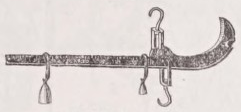
1. The lever or beam of a balance; the lever of a platform scale, to which the
poise for weighing is applied.
2. A weighing apparatus with a sliding weight, resembling a
steelyard.
1. A thin slip of wood used to
justify a page.
2. A thin
veneer of leaf of wood used for covering the surface of articles of furniture, and the like.
Scaled
[Adjective]
Webster's Dictionary 1828
Scaled
[Participle passive]
Webster's Dictionary 1828
Ascended by ladders or steps; cleared of scales; pared; scattered.
Scaled
[Adjective]
Webster's Dictionary 1913
1. Covered with scales, or scalelike structures; -- said of a fish, a
reptile, a
moth, etc.
2. Without scales, or with the scales removed; as, scaled
herring.
3. Having feathers which in form, color, or arrangement somewhat resemble scales; as, the scaled
dove.
Scalene
[\N]
Webster's Dictionary 1828
1. SCALE'NE ,
2. SCALE'
NOUS, adjective [Gr. oblique, unequal.]
3. A scalene triangle, is one whose sides and angles are unequal.
Scalene
[Adjective]
Webster's Dictionary 1913
1. Having the sides and angles unequal; -- said of a triangle.
2. Having the axis inclined to the base, as a cone.
3. Designating several triangular muscles called scalene muscles.
4. Of or pertaining to the scalene muscles.
Scalene
[Noun]
Webster's Dictionary 1913
A triangle having its sides and angles unequal.
Scaler
[Noun]
Webster's Dictionary 1913
One who, or that which, scales; specifically, a
dentist's instrument for removing
tartar from the teeth.