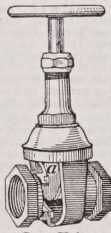
1. A large door which gives entrance into a walled city, a castle, a temple, palace or other large edifice. It differs from door chiefly in being larger. gate signifies both the opening or passage, and the frame of boards, planks or timber which closes the passage.
2. A frame of timber which opens or closes a passage into any court, garden or other inclosed ground; also, the passage.
3. The frame which shuts or stops the passage of water through a dam into a flume.
1. A large door or passageway in the wall of a city, of an inclosed field or place, or of a grand edifice, etc.; also, the movable structure of timber, metal, etc., by which the passage can be closed.
2. An opening for passage in any inclosing wall, fence, or barrier; or the suspended framework which closes or opens a passage. Also, figuratively, a means or way of entrance or of exit.
3. A door, valve, or other device, for stopping the passage of water through a dam, lock, pipe, etc.
4. The places which command the entrances or access; hence, place of vantage; power; might.
5. In a locktumbler, the opening for the stump of the bolt to pass through or into.
6. The channel or opening through which metal is poured into the mold; the ingate.
7. The waste piece of metal cast in the opening; a sprue or sullage piece.
8. A way; a path; a road; a street (as in Highgate).
is often used in Scripture to denote a place of public assembly, where justice was administered, Deut. xvii, 5, 8; xxi, 19; xxii, 15; xxv, 6, 7, &c. One instance of these judgments appears in that given at the gate of Bethlehem, between Boaz and a relation of Naomi, on the subject of Ruth, chap. iv, 2; another in Abraham’s purchase of a field to burySarah, Gen. xxiii, 10, 18. The gate of judgment is a term still common to the Arabians to express a court of justice, and even introduced by the Saracens into Spain. “I had several times,” says Jacob, “visited the Alhambra, the ancient palace and fortress of the Moorish kings: it is situated on the top of a hill, overlooking the city, and is surrounded by a wall of great height and thickness. The entrance is through an archway, over which is carved a key, the symbol of the Mohammedan monarchs. This gate, called the gate of judgment, according to eastern forms, was the place where the kings administered justice.” In Morocco, the gate is still the place where judgment is held. “All complaints,” says Host, “are brought, in the first instance, to the cadi, or governor, who, for that purpose, passes certain hours of the day in the gate of the city, partly for the sake of the fresh air, and partly to see all those who go out; and, lastly, to observe a custom which has long prevailed, of holding judgment there. The gate is contrived accordingly, being built like a square chamber, with two doors, which are not directly opposite to each other, but on two adjoining sides, with seats on the other sides. In this manner David sat between two gates,” 2 Sam. xviii, 24. Gate sometimes signifies power, dominion, almost in the same sense as the Turkish emperor’s palace is called the _Porte_. God promises Abraham that his ...posterity shall possess the gates of their enemies, their towns, their fortresses, Genesis xxii, 17. Jesus Christ says to Peter, “Thou art Peter; and on this rock will I build my church, and the gates of hell shall not prevail against it,” Matt. xvi, 18. This may mean either the powers of hell, or invisible spirits; or simply death,--the church shall be replenished by living members from generation to generation, so that death shall never annihilate it.
Solomon says, “He that exalteth his gate seeketh destruction.” The Arabs are accustomed to ride into the houses of those they design to harass. To prevent this, Thevenot tells us that the door of the house in which the French merchants live at Rama was not three feet high, and that all the doors of that town are equally low. Agreeably to this account, the Abbé Mariti, speaking of his admission into a monastery near Jerusalem, says, “The passage is so low, that it will scarcely admit a horse; and it is shut by a gate of iron, strongly secured in the inside. As soon as we entered, it was again made fast with various bolts and bars of iron: a precaution extremely necessary in a desert place, exposed to the incursions, and insolent attacks of the Arabs.” Mr. Drummond says, that in the country about Roudge, in Syria, “the poor miserable Arabs are under the necessity of hewing their houses out of the rock, and cutting very small doors or openings to them, that they may not be made stables for the Turkish horse, as they pass and repass.” And thus, long before him, Sandys, at Gaza, in Palestine: “We lodged under an arch in a little court, together with our asses; the door exceeding low, as are all that belong unto Christians, to withstand the sudden entrance of the insolent Turks.” “To exalt the gate,” would consequently be to court destruction. Morier says, “A poor man’s door is scarcely three feet in height; and this is a precautionary measure to hinder the servants of the great from entering it on horseback; which, when any act of oppression is intended, they would make no scruple to do. But the habitation of a man in power is known by his gate, which is generally elevated in proportion to the vanity of its owner. A lofty gate is one of the insignia of royalty: such is the _Allan Capi_, at Ispahan, and _Bob Homayan_, or the _SublimePorte_, at Constantinople. It must have been the same in ancient days; the gates of Jerusalem, Zion, &c, are often mentioned in the Scripture, with the same notion of grandeur annexed to them.”
GATES, Horatio (1728-1806), an American general, was born at Maldon in Essex, England, in 1728. He entered the English army at an early age, and soon obtained considerable promotion. He was severely wounded while accompanying General Braddock in his unfortunate expedition against the French settlements on the Ohio in 1755, and he took part in the expedition against Martinico in January 1762. After the peace of 1763 he purchased an estate in Virginia, where he resided till the commencement of the revolutionary war in 1775, when he was named by congress adjutant-general. In 1776 he was appointed to command the army on Lake Champlain; but, his conduct there not having been approved of, he was superseded in’the following spring; yet in August he was sent to oppose General Burgoyne, whom he totally defeated on the 16th of October, and compelled to surrender his whole army,— an achievement which was, however, largely due to the previous manoeuvres of Schuyler, whom Gates superseded. After obtaining the chief command in the southern districts, Gateβ was totally defeated at Camden, in South Carolina, by Lord Cornwallis, on the 16th of August 1780. On this account he was superseded by General Greene; but an investigation into his conduct terminated in acquitting him fully and honourably of all blame, on the ground that his defeat had been unavoidable in the disorganized state of the army under his command. After this he again retired to his Virginian estate, whence he removed to New York in 1800. On his arrival he was immediately admitted to the freedom of the city, and then elected a member of the State legislature. Before his departure from Virginia he granted emancipation to his slaves, accompanying their manumission with a provision for those who needed assistance. He ...died on the 10th of April 1806.
9th ed. Encyclopædia Britannica, vol. 10, p. 108 [304 words — estimated reading time: 2 minutes]
GATESHEAD, a municipal and parliamentary borough and market-town of England, county of Durham, is situated on the right bank of the Tyne, opposite Newcastle, of which it practically forms a part, being united with it by three bridges. The town consists of two principal and nearly parallel streets, from which others diverge in various directions. A great fire which occurred in 1854 was taken advantage of for the carrying out of improvements in the old part of the town, and it is now much less crowded than formerly. In the suburbs there are a considerable number of fine mansions. The parish church, recently restored, is an ancient cruciform edifice surmounted by a lofty tower; and several of the other churches and chapels are handsome buildings. The Wesleyan and Primitive Methodists, the Congregationalists, Baptists, Presbyterians, and Roman Catholics are all represented. The town possesses a fine cemetery, a well laid out public park, a new town-hall, a grammar school, a hospital (St Edmund’s) for fifteen indigent persons, a reformatory, a mechanics’ institute, and a dispensary. There are large iron works (including foundries and factories for engines, boilers, chains, and cables), shipbuilding yards, glass manufactories, chemical, soap, and candle works, brick and tile works, breweries and tanneries. The town also contains the principal depot of the North-Eastern Railway, with large stores and locomotive works. Extensive coal mines exist in the vicinity; and at Gateshead Fell are large quarries for grindstones, which are much esteemed and are exported to all parts of the world....
The large number of Roman relics found at Gateshead would seem to indicate that it was originally an outwork of the Roman station at Newcastle. The name is mentioned as early as 1080, and in 1164 the bishop of Durham granted to its burgesses equal privileges with those of Newcastle. On the dissolution of the see of Durham in 1552, an Act was passed for uniting the town to the borough of Newcastle, but on the restoration of the rights of the bishopric it was again placed under that jurisdiction, being governed, from 1317 to 1695, with the exception of that short intermission, by a bailiff nominated by the bishop. From 1695 to 1826, when it became a municipal borough, it was governed by two stewards, elected by the inhabitants. Gateshead returns one member to parliament. The population of the municipal borough, which in 1861 was 33,587, was 48,627 in 1871.
9th ed. Encyclopædia Britannica, vol. 10, p. 108 [408 words — estimated reading time: 3 minutes]
A passage through a fence or wall; a gate; also, a frame, arch, etc., in which a gate in hung, or a structure at an entrance or gate designed for ornament or defense.
N. beginning, commencement, opening, outset, incipience, inception, inchoation, introduction, alpha, initial, inauguration, debut, le premier pas, embarcation, rising of the curtain, maiden speech, outbreak, onset, brunt, initiative, move, first move, narrow end of the wedge, thin end of the wedge, fresh start, new departure, origin, source, rise, bud, germ, egg, rudiment, genesis, primogenesis, birth, nativity, cradle, infancy, start, inception, creation, starting point, dawn, evolution, title-page, head, heading, van, caption, fatihah, entrance, entry, inlet, orifice, mouth, chops, lips, porch, portal, portico, propylon, door, gate, gateway, postern, wicket, threshold, vestibule, propylaeum, skirts, border, first stage, first blush, first glance, first impression, first sight, rudiments, elements, outlines, grammar, alphabet, abce
V. begin, start, commence, conceive, open, dawn, set in, take its rise, enter upon, enter, set out, embark in, incept, initiate, launch, inaugurate, inchoate, rise, arise, originate, usher in, lead off, lead the way, take the lead, take the initiative, head, stand at the head, stand first, stand for, lay the foundations, found, set up, set on foot, agoing, set abroach, set the ball in motion, apply the match to a train, broach, open up, open the door to, get underway, set about, get to work, set to work, set to, make a beginning, make a start, handsel, take the first step, lay the first stone, cut the first turf, break ground, break the ice, break cover, pass the rubicon, cross the rubicon, open fire, open the ball, ventilate, air, undertake, come into existence, come into the world, make one's debut, take birth, burst forth, break out, spring up, spring forth, crop up, pop up, appear, materialize, begin at the beginning, begin ab ovo, begin again, begin de novo, start afresh, make a fresh start, take it from the top, shuffle the cards, reshuffle the cards, resume, recommence
Adv. at the beginning, in the beginning, &c. n, first, in the first place, imprimis, first and foremost, in limine, in the bud, in embryo, in its infancy, from the beginning, from its birth, ab initio, ab ovo, ab incunabilis, ab origine
Phr. let's get going, let's get this show on the road, up and at 'em, aller anfang ist schwer, dimidium facti qui coepit habet, omnium rerum principia parva sunt
And there came two angels to Sodom at even; and Lot sat in the gate of Sodom: and Lot seeing them rose up to meet them; and he bowed himself with his face toward the ground;
Now the two angels arrived at Sodom in the evening, and Lot was sitting in the gateway of the city. When Lot saw them, he got up to meet them, bowed facedown,
That in blessing I will bless thee, and in multiplying I will multiply thy seed as the stars of the heaven, and as the sand which is upon the sea shore; and thy seed shall possess the gate of his enemies;
I will surely bless you, and I will multiply your descendants like the stars in the sky and the sand on the seashore. Your descendants will possess the gates of their enemies.
And Ephron dwelt among the children of Heth: and Ephron the Hittite answered Abraham in the audience of the children of Heth, even of all that went in at the gate of his city, saying,
Now Ephron was sitting among the sons of Heth. So in the presence of all the Hittites who had come to the gate of his city, Ephron the Hittite answered Abraham,
And they blessed Rebekah, and said unto her, Thou art our sister, be thou the mother of thousands of millions, and let thy seed possess the gate of those which hate them.
And they blessed Rebekah and said to her, “Our sister, may you become the mother of thousands upon thousands. May your offspring possess the gates of their enemies.”
And unto Hamor and unto Shechem his son hearkened all that went out of the gate of his city; and every male was circumcised, all that went out of the gate of his city.
All the men who went out of the city gate listened to Hamor and his son Shechem, and every male of the city was circumcised.
But the seventh day is the sabbath of the LORD thy God: in it thou shalt not do any work, thou, nor thy son, nor thy daughter, thy manservant, nor thy maidservant, nor thy cattle, nor thy stranger that is within thy gates:
but the seventh day is a Sabbath to the LORD your God, on which you must not do any work—neither you, nor your son or daughter, nor your manservant or maidservant or livestock, nor the foreigner within your gates.
And for the gate of the court shall be an hanging of twenty cubits, of blue, and purple, and scarlet, and fine twined linen, wrought with needlework: and their pillars shall be four, and their sockets four.
The gate of the courtyard shall be twenty cubits long, with a curtainembroidered with blue, purple, and scarlet yarn, and finely spun linen. It shall have four posts and four bases.
Then Moses stood in the gate of the camp, and said, Who is on the LORD’S side? let him come unto me. And all the sons of Levi gathered themselves together unto him.
So Moses stood at the entrance to the camp and said, “Whoever is for the LORD, come to me.” And all the Levites gathered around him.
And he said unto them, Thus saith the LORD God of Israel, Put every man his sword by his side, and go in and out from gate to gate throughout the camp, and slay every man his brother, and every man his companion, and every man his neighbour.
He told them, “This is what the LORD, the God of Israel, says: ‘Each of you men is to fasten his sword to his side, go back and forth through the camp from gate to gate, and slay his brother, his friend, and his neighbor.’”
And the hanging for the gate of the court was needlework, of blue, and purple, and scarlet, and fine twined linen: and twenty cubits was the length, and the height in the breadth was five cubits, answerable to the hangings of the court.
The curtain for the entrance to the courtyard was embroidered with blue, purple, and scarlet yarn, and finely spun linen. It was twenty cubits long and, like the curtains of the courtyard, five cubits high,
And the sockets of the court round about, and the sockets of the court gate, and all the pins of the tabernacle, and all the pins of the court round about.
the bases for the surrounding courtyard and its gate, and all the tent pegs for the tabernacle and its surrounding courtyard.
The hangings of the court, his pillars, and his sockets, and the hanging for the court gate, his cords, and his pins, and all the vessels of the service of the tabernacle, for the tent of the congregation,
the curtains of the courtyard with its posts and bases; the curtain for the gate of the courtyard, its ropes and tent pegs, and all the equipment for the service of the tabernacle, the Tent of Meeting;
This site uses cookies to remember your display preferences (search sources and editions, Bible version, auto-link, images, light/dark theme). No personal data whatsoever is collected. Privacy Policy