1. preterit tense and participle passive won. [G.]
2. To gain by success in competition or contest; as, to win the prize in a game; to win money; to win a battle, or to win a country. Battles are won by superior strength or skill.
1. To gain by superiority in competition or contest; to obtain by victory over competitors or rivals; as, to win the prize in a gate; to win money; to win a battle, or to win a country.
3. To gain over to one's side or party; to obtain the favor, friendship, or support of; to render friendly or approving; as, to win an enemy; to win a jury.
4. To come to by toil or effort; to reach; to overtake.
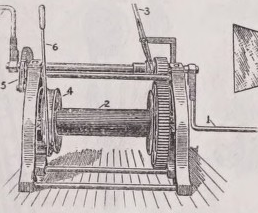
2. A reel used in dyeing, steeping, or washing cloth; a winch. It is placed over the division wall between two wince pits so as to allow the cloth to descend into either compartment. at will.
WINCHESTER, a city, and a parliamentary and municipal borough, of Hampshire, England, is situated on the river Itchen, 66 miles south-west of London by the London and South Western Railway. The Caer Gwent (White City) of the Britons and Venta Belgarum of the Romans, Winchester was a town of much importance in early times, mainly on account of its central position on the Roman high roads in the south of England. Temples to Apollo and Concord stood within the precincts of the present cathedral close; but in the 3d century the place is said to have become one of the chief centres of the early Celtic Christians. The Saxon invaders at the end of the 5th century treated the Roman name Venta as if it were a femininesubstantive, and, transforming it into “Winte,” called the town Winte-ceaster, “the City of the Winte;” hence the modern name Winchester. Throughout the Saxon period the city was one of the highest importance: early in the 6th century it became the capital of Wessex; and the kings of Wessex were crowned and usually buried in the cathedral. Even after the formation of the united kingdom of Anglia by Egbert, the great witan was still held in Winchester. It was also one of the chief centres for the coining of money under the pre-Norman kings: in the time of Athelstan it contained six mints, while London possessed only three. Even after the Norman Conquest many sovereigns were crowned and many parliaments held here; the celebrated Statutes of Winchester were passed in a parliament held in 1285. The city continued to be a favourite royal residence, and Henry II. rebuilt the palace on a larger scale. This same king gave it its first regular charter of incorporation (1184). In the Middle Ages Winchester was famed for its wool trade and textile fabrics; in the 14th ...century it was the chief wool mart of England and had an extensive trade with France, Belgium, and Holland. In the 15th century its prosperity began to decline. In Cromwell’s time the city suffered severely from a siege, during which Winchester Castle was dismantled. Charles II. began to build a palace on the site of this fortress, after designs by Sir ChristopherWren, but the death of the king prevented the work from being completed.
The first Christian church at Winchester is said to have been destroyed during the persecution of Aurelian, and rebuilt in 293. It was again burned by the Saxons in 495. St Swithun held the episcopate from 852 to 862, and enlarged the cathedral. The foundations of the adjacent abbey church of Hyde, in which some of the Saxon kings were buried, were discovered in 1886 close to the north side of the cathedral nave. The cathedral church was at one time associated with a priory of secular canons, but St Ethelwold, bishop from 963 to 984, suppressed the secular foundation and built a Benedictine abbey in its place. A wholly new cathedral was begun by Bishop Walkelin (1070-98), and in 1093 the eastern portion was consecrated jointly to St Peter, St Paul, and St Swithun. The two Norman transepts and the low central tower still exist, as does also the very curious early crypt, east of the crossing. This is a low vaulted structure partly supported by a central row of columns; it has an apsidal termination, and is surrounded by an ambulatory, out of which a second smaller apse extends eastwards,—apparently a survival of the “confessio” of the earlier cathedral. The whole of the Norman nave was pulled down and rebuilt on a more magnificent scale by William of Wykeham at the end of the 14th century; the work was completed after his death by means of a large bequest. The choir was also remodelled in the 14th century and again much altered by Bishop Fox (1501-28).
In plan Winchester cathedral consists of a nave, two transepts, choir, and retro-choir, all with aisles. A large lady chapel extends still further eastwards. The length of the whole building is no less than 546 feet, thus being greater than that of any other church in England, with the exception of St Albans, which measures about the same length. One of its chief beauties is the magnificent teredos behind the high altar; this consists of a lofty wall, the full width of the choir, pierced by two processional doors, and covered with tiers of rich canopied niches, which once contained colossal statues. A cross of plain ashlar stone in the centre shows where an immense silver crucifix was once attached; and a plain rectangular recess above the altar once contained a massive silver-gilt retable, covered with cast and repoussé statuettes and reliefs, an elaborate work of the most costly magnificence. A second stone screen, placed at the interval of one bay behind the great reredos, served to enclose the small chapel in which stood the magnificent gold shrine, studded with jewels, the gift of King Edgar, which contained the body of St Swithun. In the choir is the plain tomb of William II., and under many of the arches of the nave and choir are a number of very elaborate chantry chapels, each containing the tomb of its founder. Some of these have fine recumbenteffigies, noble examples of English mediaeval sculpture; the most notable are the monuments of Bishops Edingdon, Wykeham, Waynflete, Cardinal Beaufort, Langton, and Fox. The font of black marble is an interesting example of 11th-century art; its sides are covered with curious reliefs representing scenes from the life of St Nicholas. A good deal of very magnificent 14th-century stained glass still exists at Winchester.
Winchester College was built from 1387 to 1393 by William of Wykeham (q.v.). The foundation of the school consisted of a warden, ten fellows, three chaplains, seventy scholars, and sixteen choristers. Its fine chapel, hall, cloister, and other buildings still exist in good preservation. About a mile distant from the town stands the hospital of St Cross, founded in 1136 by Henry de Blois, bishop of Winchester, to provide board and lodging for 13 poor men and a daily dinner for 100 others. It was enlarged and mostly rebuilt by Cardinal Beaufort, 1405-47. The buildings are still in a good state of preservation, including the simple but very stately cruciform chapel, built about the year 1180, which in plan resembles a fine parochial church. The whole place has been much injured by so-called “restoration.”
Winchester suffered greatly in the plague of 1666, and its population was much reduced. At present its prosperity chiefly depends on the presence of the cathedral, the college, and its barracks, which accommodate about 2000 men. The city has several good schools and the usual public and charitable institutions. From the 23d year of Edward I. it returned two members to parliament until 1885, when it lost one member. The population of the municipal and parliamentary borough (area 1032 acres) was 16,366 in 1871 and 17,780 in 1881. (j. h. μ.)
WINCHESTER, a city and the county seat of Frederick county, Virginia, United States, is situated in the Shenandoah valley, about 700 feet above sea-level, and on a branch of the Baltimore and OhioRailroad. It lies about 67 miles west-north-west of Washington. The surrounding country is rich and fertile, devoted to agriculture and cattle-raising, for which Winchester serves as a centre of supply and distribution. The city has manufactories of shoes, furniture, gloves, &c., and some iron foundries and tanneries. The population in 1880 was 4958 (1517 coloured). In 1888 it was estimated at over 5000.
Winchester was laid out as a town in 1752 and incorporated in 1779. It has had a very slow growth, and during the Civil War it suffered severely from the armies of both combatants.
9th ed. Encyclopædia Britannica, vol. 24, p. 596 [1,181 words — estimated reading time: 7 minutes]
WINCKELMANN, Johann Joachim (1717-1768), historian of ancient art and the founder of scientific archaeology, was born at Stendal in the Altmark (Prussia) on 9th December 1717. His father was a poor shoemaker, and in his early years Winckelmann had to contend with great difficulties. With a passion for knowledge, however, he combined a resolute will; and by acting for some time as amanuensis to an old and blind rector he contrived to pass through the necessary courses of instruction at school. In 1737 he attended a gymnasium at Berlin and the school at Salzwedel, and in the following year he went as a student of theology to the university of Halle. He took little real interest in theology, and such interest as he had -was quenched partly by the influence of the philosophy of Wolff, partly by the unfavourable impression made upon him by the Pietists. Through his connexion with the chancellor Von Ludewig he was led to enter upon the study of German history; he devoted himself also with great enthusiasm to the study of Greek literature. He thought of becoming a physician, and began to attend medical classes at Jena; but the accomplishment of this scheme was beyond his means, and he was obliged to accept a tutorship near Magdeburg. In 1743 he was made associate-rector of a school at Seehausen in the Altmark, and this appointment he held for five years. He then went to Dresden, where he acted as librarian and general assistant to Count Henry Von Bünau, for whose history of the Holy Roman empire he collected materials. The treasures in the Dresden gallery awakened in his mind an intense interest in art, which was deepened by association with various artists, and especially with Oeser, who afterwards exercised so powerful an influence over Goethe when Goethe was a young ...student at Leipsic. Winckelmann’s study of ancient literature had inspired him with a strong desire to visit Rome, and now he sought, through the papal nuncio Archinto, to obtain the appointment of librarian to Cardinal Passionei. Nothing could be done for him, however, unless he joined the Roman Catholic Church; this condition, after long hesitation; he ultimately decided to comply with.
In 1755 Winckelmann gave the first indication of his genius by the publication of his Gedanken über die Nachahmung der griechischen Werke in Malerei und Bildhauerkunst. This was followed by a pretended attack on the work, and a defence of its principles, nominally by an impartial critic. In the Gedanken Winckelmann suggested most of the doctrines he afterwards developed; and the book was warmly admired not only for the new ideas it contained but for the power and charm of its style. One good result of the impression it produced was that Augustus III., elector óf Saxony and king of Poland, was induced to grant him a pension of 200 thalers, that he might have an opportunity of prosecuting his studies in Rome. He arrived in Rome in November 1755, and, with the exception of some brief intervals, remained there during the rest of his life. He became librarian to Cardinal Archinto, and also received much kindness from Cardinal Passionei; and after their death he was received as librarian and as a friend into the house of Cardinal Albani, who was forming his magnificent collection in his villa at Porta Salara. In 1763, while retaining this position, Winckelmann was made prefect of antiquities.
From the time of his arrival in Rome he devoted himself earnestly, at first with the aid of his friend Raphael Mengs, to the study of Roman antiquities, and he gradually acquired what was then an unrivalled knowledge of ancient art. In 1760 appeared his Description des Pierres Gravées du Feu Baron de Stosch, embodying the results of much work at Florence, where he had spent nine months in cataloguing the engraved gems collected by his friend Baron von Stosch. He published in 1762 Anmerkungen über die Baukunst der Alten, including an account of the temples at Paestum. In 1758 and 1762 Winckelmann visited Naples for the purpose of studying the treasures excavated at Pompeii and Herculaneum; and from his Sendschreiben von den herculanischen Entdeckungen (1762) and his Nachricht von den neuesten herculanischen Entdeckungen (1764) scholars obtained their first authentic information about those groups of antiquities. Winckelmann again visited Naples in 1765 and 1767, and wrote for the use of the electoral prince and princess of Saxony his Briefe an Biaηconi, which were published, eleven years after his death, in the Aηtologia Romana. For several years his energies were devoted chiefly to the preparation of his masterpiece, the Geschichte der Kunst des Alterthums, which was issued in 1764. It at once commanded attention and was soon recognized as a book that would take a permanent place in the literature not only of Germany but of Europe. In this great work Winckelmann sets forth both the history of Greek art and the principles on which it seemed to him to be based. He also presents a glowing picture of the conditions, political, social, and intellectual, which tended to fostercreative activity in ancient Greece. The fundamental idea of his theory is that the end of art is beauty, and that this end can be attained only when individual and characteristic features are strictly subordinated to the artist’s general scheme. According to Winckelmann, the true artist, selecting from nature the phenomena fitted for his purpose, and combining them through the imagination, creates an ideal type marked in action by “noble simplicity and calm greatness,”—an ideal type in which normal proportions are maintained, particular parts, such as muscles and veins, not being permitted to break the harmony of the general outlines. In the historical part he used not only the works of art he himself had studied but the scattered notices on the subject to be found in ancient writers; and his wide knowledge and active imagination enabled him to offer many fruitful suggestions as to periods about which he had little direct information. The materials for the study of Greek art which have been recovered since Winckelmann’s time have compelled archaeologjsts to reject some of his conclusions, to modify others, and to present the subject as a whole in a somewhat different light; but the writer was penetrated by so fine an enthusiasm, his style is at once so strong, so graceful, and so animated, and his descriptions of particular works of art are so vivid and true, that his book can never wholly lose its freshness. It marked an epoch by indicating the spirit in which the study of Greek art should be approached, and the methods by which investigators might hope to attain to solid results. To Winckelmann’s contemporaries the work came as a revelation, and it exercised a profound influence on the best minds of the age. Goethe studied it eagerly, and it was read with intense interest by Lessing, who had found in a statement in the ear!iest of Winckelmann’s works the starting-point for his Laocoon.
Winckelmann contributed various admirable essays to the Bibliothek der Schonen Wissenschaften ; and in 1766 he published his Versuch einer Allegorie, which, although containing the results of much thought and reading, is not conceived in a thoroughly critical spirit. Of far greater importance was the splendid work entited Monumenti Antichi Inediti (1767-68), prefaced by a Trattato Prelimi-ηare, presenting a general sketch of the history of art. The plates in this work are representations of objects which had either been falsely explained or not explained at all. Winckelmann’s explanations were of the highest service to archaeology, by showing that in the case of many works of art which had been supposed to be connected with Roman history the ultimate sources of inspiration were to be found in Homer.
In 1768 Winckelmann left Rome with the Italian sculptor Cavaceppi, intending to visit Germany. But he went no farther than to Vienna, where he was received with honour by Maria Theresa. At Trieste on his way back to Italy he made the acquaintance of a man called Arcangeli, to whom he showed some gold coins that had been given to him by the empress; Arcangeli’s cupidity was excited, and during the night he entered Winckelmann’s room, and, after having tried to throttle him, stabbed him five times. Winckelmann died of his wounds on 8th June 1768. His murderer was caught and executed.
Winckelmann ranks among the foremost writers of the 18th century, and it is hardly possible to overrate the services rendered by him to archaeology and the study of ancient art. With wide learning and an extraordinary power of accurate observation he combined imagination and feeling, and through him the modern world obtained for the first time something like a true conception not only of particular works of Greek art but of the general intellectual movement from which they sprang. If many of his ideas have now been abandoned, that is to a large extent due to the fact that scholars and thinkers were put upon the right track by his researches. His character as a man corresponded to his greatness as a writer. No difficulty was formidable enough to deter him from working out his vast schemes; and in relation to his friends and in general social intercourse he was distinguished by a noble generosity of spirit and thorough honesty of purpose.
An edition of his works was begun by Fernow in 1808 and completed by Meyer and Schulze (1808-20). There is an admirable study of his character and work in Goethe’s Winckelmann und sein Jahrhundert (1805), to which contributions were made by Meyer and Wolf. The best biography of Winckelmann is the one by Justi, 2 vols., Leipsic, 1866-72.
9th ed. Encyclopædia Britannica, vol. 24, p. 597 — signed J. SI. [1,636 words — estimated reading time: 10 minutes]
1. Air in motion with any degree of velocity, indefinitely; a current of air. When the air moves moderately, we call it a light wind or a breeze; when with more velocity, we call it a fresh breeze, and when with violence, we call it a gale, storm or tempest. The word gale is used by the poets for a moderate breeze, but seamen use it as equivalent to storm. Winds are denominated from the point of compass from which they blow; as a north wind; an east wind; a south wind; a west wind; a southwest wind etc.
2. The four winds, the cardinal points of the heavens.
3. Come from the four winds, O breath, and breathe upon these slain. Ezekiel 37:9 .
4. This sense of the word seems to have had its origin with the orientals, as it was the practice of the Hebrews to give to each of the four cardinal points the name of wind
5. Direction of the wind from other points of the compass than the cardinal, or any point of compass; as a compass of eight winds.
6. Breath; power of respiration.
7. If my wind were but long enough to say my prayers, I would repent.
8. Air in motion form any force or action; as the wind of a cannon ball; the wind of a bellows.
9. Breath modulated by the organs or by an instrument.
10. Their instruments were various in their kind, some for the bow, and some for breathing wind
15. Flatulence; air generated in the stomach and bowels; as, to be troubled with wind
16. The name given to a disease of sheep, in which the intestines are distended with air, or rather affected with a violent inflammation. It occurs immediately after shearing.
17. Down the wind decaying; declining; in a state of decay; as, he went down the wind [Not used.]
18. To take or have the wind or to get wind to be divulged; to become public. The story got wind or took wind
19. In the winds eye, in seamens language, towards the direct point from which the wind blows.
20. Between wind and water, denoting that part of a ships side or bottom which is frequently brought above water by the rolling of the ship, or fluctuation of the waters surface.
21. To carry the wind in the manege, is when a horse tosses his nose as high as his ears.
22. Constant or perennial wind a wind that blows constantly from one point of the compass; as the trade wind of the tropics.
23. Shifting, variable or erratic winds, are such as are changeable, now blowing from one point and now from another, and then ceasing altogether.
24. Stated or periodical wind a wind that constantly returns at a certain time, and blows steadily from one point for a certain time. Such are the monsoons in India, and land and sea breezes.
25. Trade wind a wind that blows constantly from one point, such as the tropical wind in the Atlantic.
8. A direction from which the wind may blow; a point of the compass; especially, one of the cardinal points, which are often called the four winds.
9. A disease of sheep, in which the intestines are distended with air, or rather affected with a violent inflammation. It occurs immediately after shearing.
10. Mere breath or talk; empty effort; idle words.
1. To turn completely, or with repeated turns; especially, to turn about something fixed; to cause to form convolutions about anything; to coil; to twine; to twist; to wreathe; as, to wind thread on a spool or into a ball.
The Hebrews, like us, acknowledge four principal winds, Ezek. xiii, 16–18: the east wind, the north wind, the south wind, and the west wind, or that from the Mediterranean sea. See WHIRLWIND.
Having the power of breathing impaired by the rupture, dilatation, or running together of air cells of the lungs, so that while the inspiration is by one effort, the expiration is by two; affected with pulmonaryemphysema or with heaves; -- said of a horse.
V. acquire, get, gain, win, earn, obtain, procure, gather, collect, pick, pickup, glean, find, come upon, pitch upon, light upon, scrape up, scrape together, get in, reap and carry, net, bag, sack, bring home, secure, derive, draw, get in the harvest, profit, make profit, draw profit, turn a quick profit, turn to profit, turn to account, make capital out of, make money by, obtain a return, reap the fruits of, reap an advantage, gain an advantage, turn a penny, turn an honest penny, make the pot boil, bring grist to the mill, make money, coin money, raise money, raise funds, raise the wind, fill one's pocket, treasure up, realize, clear, produce, take, get back, recover, regain, retrieve, revendicate, replevy, redeem, come by one's own, come by, come in for, receive, inherit, step into a fortune, step into the shoes of, succeed to, get hold of, get between one's finger and thumb, get into one's hand, get at, take possession, come into possession, enter into possession, be profitable, pay, answer, accrue
And God created great whales, and every living creature that moveth, which the waters brought forth abundantly, after their kind, and every winged fowl after his kind: and God saw that it was good.
So God created the great sea creatures and every living thing that moves, with which the waters teemed according to their kinds, and every bird of flight after its kind. And God saw that it was good.
A window shalt thou make to the ark, and in a cubit shalt thou finish it above; and the door of the ark shalt thou set in the side thereof; with lower, second, and third stories shalt thou make it.
You are to make a roof for the ark, finish its walls a cubit from the top, place a door in the side of the ark, and build lower, middle, and upper decks.
In the six hundredth year of Noah’s life, in the second month, the seventeenth day of the month, the same day were all the fountains of the great deep broken up, and the windows of heaven were opened.
In the six hundredth year of Noah’s life, on the seventeenth day of the second month, all the fountains of the great deep burst forth, and the floodgates of the heavens were opened.
They, and every beast after his kind, and all the cattle after their kind, and every creeping thing that creepeth upon the earth after his kind, and every fowl after his kind, every bird of every sort.
they and every kind of wild animal, livestock, crawling creature, bird, and winged creature.
And God remembered Noah, and every living thing, and all the cattle that was with him in the ark: and God made a wind to pass over the earth, and the waters asswaged;
But God remembered Noah and all the animals and livestock that were with him in the ark. And God sent a wind over the earth, and the waters began to subside.
And they made their father drink wine that night: and the firstborn went in, and lay with her father; and he perceived not when she lay down, nor when she arose.
So that night they got their father drunk with wine, and the firstborn went in and slept with her father; he was not aware when she lay down or when she got up.
And it came to pass on the morrow, that the firstborn said unto the younger, Behold, I lay yesternight with my father: let us make him drink wine this night also; and go thou in, and lie with him, that we may preserve seed of our father.
The next day the older daughter said to the younger, “Look, I slept with my father last night. Let us get him drunk with wine again tonight so you can go in and sleep with him and we can preserve our father’s line.”
And they made their father drink wine that night also: and the younger arose, and lay with him; and he perceived not when she lay down, nor when she arose.
So again that night they got their father drunk with wine, and the younger daughter went in and slept with him; he was not aware when she lay down or when she got up.
And it came to pass, when he had been there a long time, that Abimelech king of the Philistines looked out at a window, and saw, and, behold, Isaac was sporting with Rebekah his wife.
When Isaac had been there a long time, Abimelech king of the Philistines looked down from the window and was surprised to see Isaac caressing his wife Rebekah.
And he said, Bring it near to me, and I will eat of my son’s venison, that my soul may bless thee. And he brought it near to him, and he did eat: and he brought him wine, and he drank.
“Serve me,” said Isaac, “and let me eat some of my son’s game, so that I may bless you.” Jacob brought it to him, and he ate; then he brought him wine, and he drank.
Therefore God give thee of the dew of heaven, and the fatness of the earth, and plenty of corn and wine:
May God give to you the dew of heaven and the richness of the earth— an abundance of grain and new wine.
This site uses cookies to remember your display preferences (search sources and editions, Bible version, auto-link, images, light/dark theme). No personal data whatsoever is collected. Privacy Policy