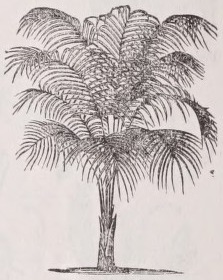
PALM. From their noble aspect, and perhaps from the surpassing utility of several of the members of the group, the Palms (Palmaceae) have been termed the princes of the vegetable kingdom. Neither the anatomy of their stems nor the conformation of their flowers, however, entitles them to any such high position in the vegetable hierarchy. Their stems are not more complicated in structure than those of the common butcher’s broom (Ruschs') ; their flowers are for the most part as simple as those of a rush (Juncus). For all that, palms have always had great interest, not only for botanists, but also for the general public, in the latter case by reason of the historical and legendary interest connected with them no less than from their beauty and economic value. The order Palmaceae is characterized among monocotyledonous plants by the presence of a stem very frequently unbranched, and bearing a tuft of leaves at the extremity only, or with the leaves scattered, these leaves, often gigantic in size, being usually firm in texture and branching in a pinnate or palmate fashion. The flowers are borne on simple or branching spikes, very generally protected by a spathe or spathes, and each consists typically of a perianth of six greenish, somewhat inconspicuous segments in two rows, with six stamens, a pistil of 1-3 carpels, each with a single ovule and a succulent or dry fruit never dehiscent (figs. 1, 2). The seed consists almost exclusively of perisperm or albumen in a cavity in which is lodged the relatively very minute embryo (fig. 3). These are the general characteristics by which this very well-defined order may be discriminated, but, in a group containing considerably more than a thousand species, dispersed widely and at different elevations throughout the tropics of both ...hemispheres, with stragglers in subtropical and even in warm temperate regions, it may well be imagined that deviations from the general plan of structure occur with some frequency. As the characteristic appearances of palms depend to a large extent upon these modifications, some of the more important among them may briefly be noticed.
Taking the stem first, we may mention that it is in very many palms relatively tall, erect, unbranched, regularly cylindrical, or dilated below so as to form an elongated cone, either smooth, or covered with the projecting remnants of the former leaves, or marked with circular scars indicating the position of those leaves which have now fallen away. In other cases the stem is very slender, short, erect, prostrate, or scandent by means of formidable hooked prickles which, by enabling the plant to support itself on the branches of neighbouring trees, also permit the stem to grow to a very great length and so to expose the foliage to the light and air above the tree-tops of the dense forests these palms grow in, as in the genus Calamus. In some few instances the trunk, or that portion of it which is above ground, is so short that the plant is in a loose way called “stemless” or “acaulescent,” as in Geonoma, and as happens sometimes in the solitary species found in a wild state in Europe, Chamaerops humilis. In many species the trunk is covered over with a dense network of stiff fibres, often compacted together at the free ends into spines. This fibrous material, which is so valuable for cordage, consists of the fibrous tissue of the leaf-stalk, which in these cases persists after the decay of the softer portions. It is very characteristic of some palms to produce from the base of the stem a series of adventitious roots which gradually thrust themselves into the soil and serve to steady the tree and prevent its overthrow by the wind. The underground stem of some species, e.g., of Calamus, is a rhizome, or root-stock, lengthening in a more or less horizontal manner by the development of the terminal bud, and sending up lateral branches like suckers from the root-stock, which form dense thickets of cane-like stems. The branching of the stem above ground is unusual, except in the case of the Doum Palm of Egypt (Hyphsene ∖ and, when present, is probably the result of some injury to the terminal bud at the top of the stem, in consequence of which buds sprout out from below the apex.
The internal structure of the stem does not differ fundamentally from that of a typical mo nocotyledonous stem, the taller, harder trunks owing their hardness not only to the fibrous or woody skeleton but also to the fact that, as growth goes on, the originally soft cellular tissue through which the fibres run becomes hardened by the deposit of woody matter within the cells, so that ultimately the cellular portions become as hard as the woody fibrous matters proper.
The leaves of palms are either arranged at more or less distant intervals along the stem, as in the canes (Calamus, <fcc.), or are approximated in tufts at the end of the stem, thus forming those noble crowns of foliage which are so closely associated with the general idea of a palm. In the young condition, while still unfolded, these leaves, with the succulent end of the stem from which they arise, form “the cabbage,” which in some species is highly esteemed as an article of food.
The adult leaf very generally presents a sheathing base tapering upwards into the stalk or petiole, and this again bearing the lamina or blade. The sheath and the petiole are very often provided with stout spines; and when, in course of time, the upper parts of the leaf decay and fall off the base of the leaf-stalk and sheath often remain, either entirely or in their fibrous portions only, which latter constitute the investment to the stem already mentioned. In size the leaves vary within very wide limits, some being only a few inches in extent, while those of the noble Caryota may be measured in tens of feet. In form the leaves of palms are very rarely simple; usually they are more or less divided, sometimes, as in Caryota, extremely so. In Geonoma Verschaff eltia, and some others, the leaf splits into two divisions at the apex and not elsewhere; but more usually the leaves branch regularly in a palmate fashion as in the fan-palms Latania, Chamaerops, Sabal, <fcc., or in a pinnate fashion as in Areca, Kentia, Calamus, ⅛lo,. The form of the segments is generally more or less linear, but a very distinct appearance is given by the broad wedge-shaped leaflets of such palms as Caryota, Martinezia, or Mauritia. These forms run one into another by transitional gradations; and even in the same palm the form of the leaf is often very different at different stages of its growth, so that it is a difficult matter to name correctly seedling or juvenile palms in the condition in which we generally meet with them in the nurseries, or even to foresee what the future development of the plant is likely to be. Like the other parts of the plant, the leaves are sometimes invested with hairs or spines; and, in some instances,, as in the magnificent Ceroxylon andicola, the under surface is of a glaucous white or bluish colour.
The inflorescence of palms consists generally of a fleshy spike like that of an Arum, either simple or much branched, studded with numerous, sometimes extremely numerous, flowers, and enveloped by one or more sheathing bracts called “spathes.” These parts may be small, or they may attain relatively enormous dimensions, hanging down from amid the crown of foliage like huge tresses, and adding greatly to the noble effect of the leaves.
As to the individual flowers, they are usually small, greenish, and insignificant; their general structure has beeh mentioned already. Modifications from the typical structure arise from differences of texture, and specially from suppression of parts, in consequence of which the flowers are very generally unisexual (figs. 1, 2), though the flowers of the two sexes are generally produced on the same tree (monoecious), not indeed always in the same season, for a tree in one year may produce all male flowers and in the next all female flowers. Sometimes the flowers are modified by an increase in the number of parts; thus the usually six stamens may be represented by 12 to 24 or even by hundreds. The carpels are usually three in number, and more or less combined; but they may be free, and their number may be reduced to two or even one. In any case each carpel contains but a single ovule.
Owing to the sexual arrangements before mentioned, the pollen has to be transported by the agency cf the wind or of insects to the female flowers. This is facilitated sometimes by the elastic movements of the stamens and anthers, which liberate the pollen so freely at certain times that travellers speak of the date-palms of Egypt (Phoenix dactylifera) being at daybreak hidden in a mist of pollen grains. In other cases fertilization is effected by the agency of man, who removes the male flowers and scatters the pollen over the fruit-bearing trees. This practice has been followed from time immemorial; and it afforded one of the earliest and most irrefragable proofs by means of which the sexuality of plants was finally established. The fruit which results from this process of fertilization is various: sometimes, as in the common date, it is a berry with a fleshy rind enclosing a hard stony kernel, the true seed; sometimes it is a kind of drupe as in the cocoa-nut, Cocos nucifera, where the fibrous central portion investing the hard shell corresponds to the fleshy portion of a plum or cherry, while the shell or nut corresponds to the stone of stone-fruits, the seed being the kernel. Sometimes, as in the species of Sagus, Raphia, &c., the fruit is covered with hard, pointed, reflexed shining scales, which give it a very remarkable appearance.
The seed varies in size, but always consists of a mass of perisperm, in which is imbedded a relatively very minute embryo (fig. 3). The hard stone of the date is the perisperm, the white flesh of the cocoa-nut is the same substance in a softer condition; the so-called “vegetable ivory” is derived from the perisperm of Phytelephas.
Hooker, who in his recent revision of the genera follows the work of his predecessors Martius, Wendland, and Drude, enumerates about one hundred and thirty-two genera of the order ranged under five tribes, distinguished by the nature of the foliage, the sexual conditions of the flower, the seed umbilicate or not, the position of the raphe, &c. Other characters serving to distinguish the minor groups are afforded by the habit, the position of the spathes, the “aestivation” of the flower, the nature of the stigma, the ovary, fruit, &c.
It is impossible to overestimate the utility of palms. They furnish food, shelter, clothing, timber, fuel, building materials, sticks, fibre, paper, starch, sugar, oil, wax, wine, tannin, dyeing materials, resin, and a host of minor products, which render them most valuable to the natives and to tropical agriculturists. The Cocoa-nut Palm, Cocos nucifera, and the Date Palm, Phoenix dactylifera, have been treated under separate headings. Sugar and liquids capable of becoming fermented are produced by Caryota urens, Cocos nucifera, Borassus flabelliformis, Rhapis vinifera·, Arenga saccharifera, Phoenix silvestris, Mauritia vinifera, &c. Starch is procured in abundance from the stem of the Sago Palm, Sagus Rumphii, and other species. The seeds of Blais guineensis of western tropical Africa yield, when crushed and boiled, “palm oil.” Cocoa-nut oil is extracted from the cocoa-nut. Wax is exuded from the stem of Ceroxylon andicola and Copernicia cerifera. A variety of ti dragon’s blood,” a resin, is procured from Calamus Draco and other species. Edible fruits are yielded by the date, the staple food of some districts of northern Africa. The cocoa-nut is a source of wealth to its possessors, and many of the species are valued for their “cabbage”; but, as this is the terminal bud whose removal causes the destruction of the tree, this is a wasteful article of diet unless care be taken by judicious planting to avert the annihilation of the supplies. The famous “coco de mer,” or double cocoa nut, whose floating nuts might have suggested the twin steamboats, and are the objects of so many legends and superstitions, is known to science as Lodoicea Sechel- larum. The tree is peculiar to the Seychelles, where it is used for many useful purposes. Its fruit is like a huge plum, containing a stone or nut like two cocoa-nuts (in their husks) united together. These illustrations must suffice to indicate the numerous economic uses of palms.
The only species that can be cultivated in the open air in England, and then only under exceptionally favourable circumstances, are the European Fan-Palm, Chamarops humilis, the Chusan Palm, C. Fortunei, of which speci mens may be seen out of doors at Kew, Heckfield, Osborne, &c., and the Chilian Jubaea spectabilis. The date-palm now so commonly planted along the Mediterranean coast is the common Date-Palm; but this does not ripen its fruit north of the African coast. There are several low growing palms, such as Rhaρis flabelliformis, Chamaerops humilis, &lc., which are suited for ordinary green-house culture, and many of which, from the thick texture of their leaves, are enabled to resist the dry and often gas-laden atmosphere of living rooms. Many species are now cultivated for the special purpose of the decoration of apartments, particularly the very beautiful Cocos Weddelliana. But, to gain anything like an idea of the magnitude and majestic character of palms, a visit to such establishments as the palm stoves at Kew, Edinburgh, or Chatsworth is necessary. In some instances, as in the famous Talipot Palm, Borassus flabelliformis, the tree does not flower till it has arrived at an advanced age and acquired a large stature, and, having produced its flowers, it dies like an annual weed. (μ. t. μ.)