
A long or continued arch; a walk arched above.
Word of the Day: Catachrestical
1. A series of arches with the columns or piers which support them, the spandrels above, and other necessary appurtenances; sometimes open, serving as an entrance or to give light; sometimes closed at the back (as in the cut) and forming a decorative feature.
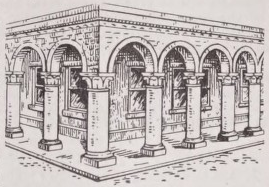
2. A long, arched building or gallery.
3. An arched or covered passageway or avenue.
Arcade
Encyclopedia Britannica
ARCADE (Fr. arcade, arcature, Ital. areata, Ger. Botengang), in street architecture a covered way or passage, either open at the side with a range of pilla r s, or completely-covered over. The finest arcades of this description are to be found in Paris. Some have open sides, such as those in the Rue de Rivoli, Palais Royal, and Old Place Royal; others, such as the Passages des Panaromas, Jouffroy, and de Princes, are covered passages, and form convenient thoroughfares. A few, like the Passages Choiseul and do l’Opera, are favourite lounges. They are all more or less lined with elegant shops. There are two specimens of covered passage-arcades in London, the Burlington and Lowther, but they are very inferior in style to those in Paris. The arcade which runs round three sides of the Square of St Mark at Venice is the finest of its kind. In Gothic architecture the term signifies a range of arches, supported on columns or piers, and either open or attached to a wall. The word is used in contradistinction to colonnade, -which is a range of columns carrying level entablatures. The oldest known in England is probably that of the old refectory in Westminster Abbey, the work of the Confessor (fig. 1). Examples of attached arcades may be seen at St John’s, Devizes (fig. 2), at Canterbury and Amiens, and at Notre Dame, Paris; of detached arcades, at Wells, Lucca, and Pisa; of arcades over piers and arches, at Lincoln; of arcades, the openings of which form seats or canopied stalls (which is very common in chapter-houses), at Lichfield. Arcades are found both inside and outside mediaeval buildings. If under the windows inside a building, their columns generally rest on a stone seat or bench table. Sometimes the arcades are pierced here and there to form windows. Sometimes the ...triforium is a series of arcades, as in parts of Canterbury, Exeter, Beverley, St John’s, Chester, and many other examples. In detached arcades, a very pleasing effect is often produced by placing the columns, which are attached to the wall, opposite the centre of the opening instead of immediately behind the front column, so as to alternate and enhance the effect of the perspective, as at Wells. The intersections of arcades of interlaced circular arches, as at St John’s, Devizes, and at Canterbury, were at one time supposed to have been the origin of the Gothic or pointed arch. Many of the cathedrals abroad have arcaded fronts, as at Pisa. That at Lucca has a range of double arcades, one behind the other, the columns alternating, as may also be seen at Wells and Lincoln. (For examples of arcades, see Parker’s Glossary of Architecture, and Viollet le Due’s Dictionnaire, vol. i. )
9th ed. Encyclopædia Britannica, vol. 2, p. 325
[465 words — estimated reading time: 3 minutes]
[465 words — estimated reading time: 3 minutes]
Abode Roget’s Thesaurus §189
N. abode, dwelling, lodging, domicile, residence, apartment, place, digs, pad, address, habitation, where one's lot is cast, local habitation, berth, diggings, seat, lap, sojourn, housing, quarters, headquarters, resiance|, tabernacle, throne, ark, home, fatherland, country, homestead, homestall, fireside, hearth, hearth stone, chimney corner, inglenook, ingle side, harem, seraglio, zenana, household gods, lares et penates, roof, household, housing, dulce domum, paternal domicile, native soil, native land, habitat, range, stamping ground, haunt, hangout, biosphere, environment, ecological niche, nest, nidus, snuggery, arbor, bower, &c. 191, lair, den, cave, hole, hiding place, cell, sanctum sanctorum, aerie, eyrie, eyry, rookery, hive, covert, resort, retreat, perch, roost, nidification, kala jagah, bivouac, camp, encampment, cantonment, castrametation, barrack, casemate, casern, tent, building, chamber, xenodochium, tenement, messuage, farm, farmhouse, grange, hacienda, toft, cot, cabin, hut, chalet, croft, shed, booth, stall, hovel, bothy, shanty, dugout, wigwam, pen, barn, bawn, kennel, sty, doghold, cote, coop, hutch, byre, cow house, cow shed, stable, dovecote, columbary, columbarium, shippen, igloo, iglu, jacal, lacustrine dwelling, lacuslake dwelling, lacuspile dwelling, log cabin, log house, shack, shebang*, tepee, topek, house, mansion, place, villa, cottage, box, lodge, hermitage, rus in urbe, folly, rotunda, tower, chateau, castle, pavilion, hotel, court, manor-house, capital messuage, hall, palace, kiosk, bungalow, casa, country seat, apartment house, flat house, frame house, shingle house, tenement house, temple, hamlet, village, thorp, dorp, ham, kraal, borough, burgh, town, city, capital, metropolis, suburb, province, country, county town, county seat, courthouse, ghetto, street, place, terrace, parade, esplanade, alameda, board walk, embankment, road, row, lane, alley, court, quadrangle, quad, wynd, close, yard, passage, rents, buildings, mews, square, polygon, circus, crescent, mall, piazza, arcade, colonnade, peristyle, cloister, gardens, grove, residences, block of buildings, market place, place, plaza, anchorage, roadstead, roads, dock, basin, wharf, quay, port, harbor, quarter, parish, assembly room, meetinghouse, pump room, spa, watering place, inn, hostel, hostelry, hotel, tavern, caravansary, dak bungalow, khan, hospice, public house, pub, pot house, mug house, gin mill, gin palace, bar, bar room, barrel house*, cabaret, chophouse, club, clubhouse, cookshop, dive, exchange, grill room, saloon, shebeen, coffee house, eating house, canteen, restaurant, buffet, cafe, estaminet, posada, almshouse, poorhouse, townhouse, garden, park, pleasure ground, plaisance, demesne, cage, terrarium, doghouse, pen, aviary, barn, stall, zoo
V. take up one's abode, inhabit
Phr. eigner hert ist goldes werth, "even cities have their graves", ubi libertas ibi patria, home sweet home
Curvature Roget’s Thesaurus §245
N. curvature, curvity, curvation, incurvature, incurvity|, incurvation, bend, flexure, flexion, flection, conflexure|, crook, hook, bought, bending, deflection, deflexion, inflection, inflexion, concameration, arcuation, devexity|, turn, deviation, detour, sweep, curl, curling, bough, recurvity, recurvation, sinuosity, kink, carve, arc, arch, arcade, vault, bow, crescent, half-moon, lunule, horseshoe, loop, crane neck, parabola, hyperbola, helix, spiral, catenary, festoon, conchoid, cardioid, caustic, tracery, arched ceiling, arched roof, bay window, bow window, sine curve, spline, spline curve, spline function, obliquity
V. be curved, curve, sweep, sway, swag, sag, deviate, curl, turn, reenter, render curved, flex, bend, curve, incurvate, inflect, deflect, scatter, refract (light) 420, crook, turn, round, arch, arcuate, arch over, concamerate, bow, curl, recurve, frizzle, rotundity, convexity
Adj. curved, curviform, curvilineal, curvilinear, devex|, devious, recurved, recurvous, crump, bowed, vaulted, hooked, falciform, falcated, semicircular, crescentic, sinusoid, parabolic, paraboloid, luniform, lunular, semilunar, conchoidal, helical, double helical, spiral, kinky, cordiform, cordated, cardioid, heart shaped, bell shaped, boat shaped, crescent shaped, lens shaped, moon shaped, oar shaped, shield shaped, sickle shaped, tongue shaped, pear shaped, fig shaped, kidney- shaped, reniform, lentiform, lenticular, bow-legged, oblique, circular, aduncated, arclike, arcuate, arched, beaked, bicorn, bicornuous, bicornute, clypeate, clypeiform, cymbiform, embowed, galeiform, hamate, hamiform, hamous, hooked, linguiform, lingulate, lobiform, lunate, navicular, peltate, remiform, rhamphoid, rostrate, rostriferous, rostroid, scutate, scaphoid, uncate, unguiculate, unguiform
Opening Roget’s Thesaurus §260
N. hole, foramen, puncture, perforation, fontanel, transforation, pinhole, keyhole, loophole, porthole, peephole, mousehole, pigeonhole, eye of a needle, eyelet, slot, opening, aperture, apertness, hiation, yawning, oscitancy, dehiscence, patefaction|, pandiculation, chasm, embrasure, window, casement, abatjour, light, sky light, fan light, lattice, bay window, bow window, oriel, dormer, lantern, outlet, inlet, vent, vomitory, embouchure, orifice, mouth, sucker, muzzle, throat, gullet, weasand, wizen, nozzle, placket, portal, porch, gate, ostiary|, postern, wicket, trapdoor, hatch, door, arcade, cellarway, driveway, gateway, doorway, hatchway, gangway, lich gate, way, path, thoroughfare, channel, passage, passageway, tube, pipe, water pipe, air pipe, vessel, tubule, canal, gut, fistula, adjutage, ajutage, ostium, smokestack, chimney, flue, tap, funnel, gully, tunnel, main, mine, pit, adit, shaft, gallery, alley, aisle, glade, vista, bore, caliber, pore, blind orifice, fulgurite, thundertube, porousness, porosity, sieve, cullender, colander, cribble, riddle, screen, honeycomb, apertion, perforation, piercing, terebration, empalement, pertusion|, puncture, acupuncture, penetration, key, opener, master key, password, combination, passe-partout
V. open, ope, gape, yawn, bilge, fly open, perforate, pierce, empierce|, tap, bore, drill, mine, tunnel, transpierce, transfix, enfilade, impale, spike, spear, gore, spit, stab, pink, puncture, lance, stick, prick, riddle, punch, stave in, cut a passage through, make way for, make room for, uncover, unclose, unrip, lay open, cut open, rip open, throw open, pop open, blow open, pry open, tear open, pull open
Adj. open, perforated, perforate, wide open, ajar, unclosed, unstopped, oscitant, gaping, yawning, patent, tubular, cannular, fistulous, pervious, permeable, foraminous, vesicular, vasicular, porous, follicular, cribriform, honeycombed, infundibular, riddled, tubulous, tubulated, piped, tubate, opening, aperient
Int. open sesame
No Bible verses found for "Arcade".