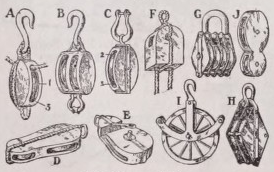
BLOCK MACHINERY. A block is a case with its contained pulley or pulleys, by means of which weighty objects are hoisted or lowered with facility. There is nothing in the appearance of a block which, to an unpractised eye, would seem to require any stretch of mental ingenuity or of manual dexterity to manufacture. It is a machine apparently so rude in its structure, and so simple in its contrivance, that the name was probably given to it from its general resemblance to a log ot wood, as is obviously the case with a butcher’s block, a barber’s block, the block of the executioner, &c. Of the two constituent parts of a ship’s block, the external shell and the internal sheave, every carpenter might make the one, and every turner the other; but still block-making is a separate branch of trade, and it is necessary that it should be, for the whole effici ency of the block depends upon the proper proportions being observed between the various parts and the accuracy with which they are adjusted.
It would appear that it was the enormous quantity of blocks consumed in the course of a long protracted war that first called the attention of the Admiralty or Navy Board to the possibility of some reduction being made in the expense of so important an article, and to the imprudence of depending entirely on a single contractor. On these considerations, it seems to have been the intention of Government to introduce, among other improvements in Portsmouth Dockyard about 1801, a set of machines for making blocks there. About this time, too, Mr Brunel had completed a working model of certain machines for constructing, by an improved method, the shells and sheaves of blocks. This model was submitted to the inspection of the lords commissioners of the Admiralty, and it was decided to adopt Mr Brunel’s more ingenious machinery.
The advantages to be gained were those common to all cases in which machine work supersedes hand labour, and consisted in the fact that, after the proper sizes of each part had been determined by careful calculation and experience, the machine could be made to observe these sizes with unerring accuracy, and so avoid all variations due to the carelessness or ignorance of the workman; these considerations are in blocks, perhaps more than in most things, of the utmost importance. Another advantage was, that the blocks could be made by Brunei’s machinery about 30 per cent, cheaper than hand-made blocks had been previously obtained by contract, and the importance of this to the Admiralty in those days, when all ships were so heavily rigged, having no steam to supplement their sail power, will be sufficiently seen when it is stated that the remuneration which Brunel was to receive for his invention was agreed to be the savings of one year, and that these savings were estimated at £16,621; in addition to this he received an allowance of a guinea a day for about six years while engaged on the work, and was paid £1000 for his working model—the total amount paid to Brunel for the invention amounting to about £20,000.
The process may be described as follows :—Pieces of wood are cut roughly to the size of the block, and the first operation is then performed by the boring-machine, which bores a hole for the pin, and one, two, or three holes, as the case may be, for single, double, or treble blocks, to receive the first stroke of the mortising chisel; the block is next taken to the mortising-machine, where the mortise or mortises for the sheaves are cut; after this, to a circular saw, conveniently arranged for cutting off the corners and so preparing the block for the shaping-machine, which consists principally of two equal and parallel circular wheels moving on the same axis, to which one of them is firmly fixed, but on which the other is made to slide; so that these two wheels may be placed at any given distance from each other, and blocks of any size admitted between their two rims or peripheries. For this purpose, both rims are divided into ten equal parts, for the reception of ten blocks, which are firmly fixed between the two wheels. When the double wheel with its ten attached blocks is put in motion, the outer surface of the blocks, or those which are farthest from the centre, strike against the edge of a chisel or gouge fixed in a movable frame, which, being made to slide in a curved direction in the line of the axis, cuts those outward faces of the blocks to their proper curvature. A contrivance is attached to the cutting tool which allows of the curvature being altered in any required way. One side being shaped, the ten blocks are then, by a single operation, each turned one fourth part round, and another side is exposed to the cutting instrument moving in the same direction as before. A third side is then turned outwards, and after that the fourth side, when the whole ten blocks are completely shaped.
The velocity with which the wheels revolve, and the great weight with which their peripheries are loaded, would make it dangerous to the workmen or bystanders, if, by the violence of the centrifugal force, auy of the blocks should happen to be thrown off from the rim of the wheels; to prevent the possibility of such an accident, an iron cage or guard is placed between the workman and the machine.
The last operation is performed by the scoring-machine, which cuts a groove to receive the binding or strapping of the block. The binding may be of iron or rope, and is very frequently of wire rope.
The Sheaves.— The machinery employed for making this part of the block consists of a circular saw, by which the log is cut into plates of the thickness required for the sheaves, according to their several diameters. These plates are next carried to a crown saw, which bores the central hole, and at the same time reduces them to a perfect circle of the assigned diameter. The sheave, thus shaped, is next brought to the coahing-machine, a piece of mechanism not inferior in ingenuity to the shaping machine for the shells. A small cutter, in traversing round the central hole of the sheave, forms a groove for the insertion of the coak or bush, the shape of which is that of three semicircles, not concentric with each other, nor with the sheave, but each having a centre equally distant from that of the sheave. The manner in which the cutter traverses from the first to the second, and from this to the third semicircle, after finishing each of them, is exceedingly ingenious. So very exact and accurate is this groove cut for the reception of the metal coak, and so uniform in their shape and size are the latter cast, the casting being made not in sand but in iron moulds, that they are invariably found to fit each other so nicely that the tap of a hammer is sufficient to fix the coak in its place. The coaks are cast with small grooves or channels in the inside of their tubes, which serve to retain the oil or grease for the pins.
The sheave, with its coak thus fitted in, is now taken to the drilling-machine, which is kept in constant motion. In casting the coaks a mark is left in the centre of each of the three semicircles. This mark is applied by a boy to the point of the moving drill, which speedily goes through the two coaks and the intermediate wood of the sheave. Rivets are put in these holes and clenched by hand. The next operation is performed by the faxing-machine, which has two cutters, so arranged as to finish the side and groove the edge simultaneously; then the hole for the pin is enlarged to its exact size by the broaching-machine. The pins, which form a very important part of the block, are now made at Portsmouth, not of iron but of steel, carefully tempered by special appliances. They are turned by a self-acting lathe, and are then reduced to the exact required diameter, and polished in the pin-polishing machine. They are also, in this machine, subjected to a proof strain proportional to their sectional area, and thus the strength of the pin is guaranteed.
The blocks are invariably made of English elm, the grain of the wood running lengthways of the block; but in Germany recently, blocks have been made with the grain of the wood running across the block, the reason being that they are less likely to be split by the pressure on the pin of the sheave. The sheaves are made of lignum vitae.
Three machines of each description for each operation, up to and including the facing-machine, are required. The smallest sized machines will make blocks of from 4 inches to 7 inches in length, the second size from 8 inches to 11 inches, and the largest from 12 inches to 17 inches. Two sizes of the broaching-machine, and one pin-polishing machine, are sufficient. Blocks larger than 17 inches are made by hand, 26 inches being the largest used in the Royal Navy.
As will be seen from the foregoing account, all machine-made blocks are cut out of a solid piece of wood; whereas hand-made blocks, larger than about 8 inches, are usually made in pieces, filled in at the ends and riveted together. It is questionable whether a block so made is not stronger than one cut out of the solid, as in the latter case the short-grained wood at the ends of the mortises is very liable to give way. In hand-made blocks the brass coak or tail of the sheave is not made of the peculiar shape described for machine-made blocks, but is usually of a circular shape.
The machinery for Portsmouth Dockyard, on Brunel’s plans, was made by Maudslay, whose firm—now the very eminent firm of Maudslay Sons and Field—has since supplied block-making machinery to the Spanish, Turkish, and Russian Governments, and also to Chatham Dockyard; the last mentioned, however, has never been used, as the machinery at Portsmouth is capable of supplying all the dockyards, the demand for blocks being much less for the steamships and ironclads than it was formerly for the old sailing ships. The first cost of this machinery is so great that no private firm has yet ventured to set it up, and the whole of the blocks used in merchant ships are made by hand-labour, assisted by a lathe and two or three other simple mechanical contrivances. (τ. μ.)