1. The pap or nipple of a cow or other beast. It is applied to a human female in contempt, but seems to have been used formerly of the human breast without reproach.
DUGDALE, Sir William (1605-1686), an eminent English antiquary, the only son of John Dugdale, who belonged to an old Lancashire family, but had sold his property in that county and bought the estate of Shustoke, near Coleshill, in Warwickshire, was born on the 12 th September 1605. He received the early part of his education from Thomas Sibley, a curate near Shustoke, and attended from his tenth to his fifteenth year the Free School at Coventry, whence returning to his father, he read with him for some time law and history. In compliance with his father’s wish, who was old and infirm, and desired to see him married before he died, he was married at the early age of seventeen to the daughter of a gentleman in the county of Stafford. He lived in his wife’s father’s house until the death of his own father in 1624, and soon thereafter went to reside at Fillongley, near Shustoke, an estate formerly purchased for him by his father. In 1625 he purchased the manor of Blyth, in the parish of Shustoke, and, preferring it as a place of residence, removed thither in 1626. His inclination to the study of antiquities manifested itself at an early age, and received its first encouragement from Samuel Roper, a barrister of Lincoln’s Inn. After his settlement at Blyth Hall he made the acquaintance of some gentlemen interested in antiquities, who enabled him to obtain a sight of the old “deeds and evidences” of the county families of Warwickshire, and “divers antient writings of consequence,” with the view of his writing a history of that county. In 1635 he accompanied Sir Simon Archer to London, and was by him introduced to Sir Henry Spelman, which led to his acquaintance with Thomas, earl of Arundell, then earl marshal of England, by whom he was, in 1638, created a ...pursuivant of arms extraordinary by the name of Blanche Lyon, and in 1639 rouge-croix pursuivant in ordinary. About this time he agreed to write his work on Monastery Foundations, and, having a lodging in the Herald’s Office, he now spent much of his time in London in order to augment his collections out of the record j of the Tower and other places in the city. In 1641 Sir Christopher Hatton, a member of the House of Commons, dreading the near approach of the revolutionary storm which soon thereafter broke over England, and the ruin that might then ensue, got him to make exact drafts of all the monuments in Westminster Abbey and the principal churches in England, including Peterborough, Ely, Norwich, Lincoln, Newark, Beverley, Southwell, Kingston-upon-Hull, York, Selby, Chester, Lichfield, Tamworth, and Warwick. He received and obeyed, in June 1642, the summons of Charles I. to attend him at York, whither, on the outbreak of the revolution, the king had betaken himself for the sake of greater security. Learning the spread of the revolution in Warwickshire, Charles deputed him to summon to surrender the castle of Banbury, in Oxford, and the castle of Warwick, which were being rapidly filled with ammunition and rebels. Banbury obeyed, but Warwick, being better prepared, contemned the summons and its inmates were proclaimed traitors. He also summoned the city of Coventry; and, accompanying Sir Richard Willys as guide, he was present at the battle of Cudworth Field, the result of which he communicated to the king. He remained at Oxford with the king till the surrender of the garrison in 1646, and witnessed the battle of Edgehill, of the field of which he made afterwards an exact survey, noting how the armies were drawn up, and where and in what direction the various movements took place, and marking the graves of the slain. In November 1642 he was admitted M.A. of the university, and in 1644 the king created him Chester-Herauld. While at Oxford he made a journey to Worcester, where—with the purpose of increasing his collections for his history of Warwickshire—he perused the registers of the bishop and of the dean and chapter; and during his Oxford leisure he applied himself also to the search for antiquities in the libraries and in the private houses. When Oxford surrendered he continued his antiquarian researches in London along with Richard Dodsworth for their joint work on the monasteries, which was published successively in single volumes in 1655, 1664, and 1673. At the Restoration he obtained the office of Norroy king-at-arms, and in 1677 was created garter principal king-at-arms, and was knighted. He died at Blyth Hall, 10th February 1686.
Besides the works on Warwickshire, published in 1656, and Μoηαstieoη Anglieαnum, republished in 6 vols, in 1817-30, and again in 8 volumes in 1846, Sir William Dugdale is the author of History of St Paul's Cathedral (1658), the Baronage of England (3 vols. 1675-6), and other works of less importance. His life, written by himself up to 1678, with his diary and correspondence, and an index to his manuscript collections, was edited by William Hamper, and puolished in 1827.
9th ed. Encyclopædia Britannica, vol. 7, p. 516 [855 words — estimated reading time: 5 minutes]
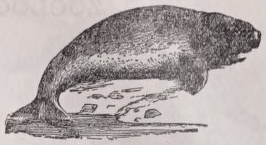
DUGONGfHalicore), a genus of herbivorousCetacea, forming, along which the Sea-Cows {Manatus), and the now extinct Rhytinα, the sub-order Sirenia. In this genus the head is small, and is abruptlytruncated in front, the snout being remarkably obtuse and furnished with bristles. The intermaxillary bones are enormously developed, and from these proceed two large incisor teeth or tusks, which are well developed in the male, but which in the female are arrested in their growth, and remain concealed beneath the surface. There are never more than five molar teeth on each side of either jaw, or twenty in all, and these are flat on the grinding surface. The flippers are unprovided with nails, and the tail is broad, and differs from that of the manatee in being crescent-shaped instead of rounded. The bones are very hard and firm, and take a polish equal to that of ivory. The dugongs frequent the shallow waters of the tropical seas, extending from the east coast of Africa north of the mouth of the Zambesi river, along the shores of the Indian, Malayan, and Australian seas, where they may be seen basking on the surface of the water, or browsing on submarine pastures of Algae and Fuci, for which tho thick obtuse lips and truncatedsnout preeminently fit them. They are gregarious, feeding in large numbers in localities where they are not often disturbed. The female produces a single young one at a birth, and is remarkable for the great affection it shows for its offspring, so that when the young dugong is caught there is no difficulty in capturing the mother with it. There are two species—the Indian Dugong (Halicore indicus) and the Australian Dugong (Halicore australis). The former is very abundant along the shores of the Indian Ocean, and is captured in large numbers by the ...Malayans, who esteem its flesh as a great delicacy; while the lean portions, especially of young specimens, are regarded by Europeans even as excellent eating. It is generally taken by spearing, the main object of the hunter being to raise the tail out of the water, when the animal becomes perfectly powerless. It seldom attains a length of more than 8 or 10 feet. The Australian Dugong is a larger species, attaining sometimes a length of 15 feet. It occurs along the Australian coast from Moreton Bay to Cape York, and is highly valued by the natives, who hunt for it with spears, and gorge themselves with its flesh, when they are fortunate enough to secure a carcase. In recent years the oil obtained from the blubber of this species has been largely used in Australia as a substitute for cod-liver oil. It does not contain iodine, but is said to possess all the therapeutic qualities of cod-liver oil without its nauseous taste. A full grown dugong yields from 10 to 12 gallons of oil, and this, according to Bennet, “forms in cold weather a thick masβ, and requires to be melted before a fire previously to being used.” According to the same authority, the flesh of the Australian dugong is easy of digestion, the muscular fibre when fresh resembling beef, and when salted having the flavour of excellent bacon. In the earliest Australian dugong fishery, natives were employed to harpoon these cetaceans; they soon, however, became too wary to allow themselves to be approached near enough for this purpose, and the harpoon was abandoned for the net. The latter is spread at night, and in its meshes dugongs are caught in considerable numbers. The skin is nearly half an inch thick, and can be made into gelatine or glue.
9th ed. Encyclopædia Britannica, vol. 7, p. 516 [610 words — estimated reading time: 4 minutes]
DUGUAY-TROUIN, René (1673-1736), a famous French admiral, was the son of a sea captain, and was born at St Malo on the 10th June 1673. He was originally intended for the church, and studied with that view at Rennes and Caen; but on the breaking out of the war with England and Holland in 1689 he obtained leave to enter the marine. Accordingly he embarked in the capacity of a volunteer on board a small vessel of 18 guns, equipped by his family, and during the first three months his courage was tried by a violent tempest, an imminentshipwreck, the boarding of an English ship, and the threatened destruction of his own vessel by fire. The following year, as a volunteer in a vessel of 28 guns, he carried off the honours in a bloodycombat with an English fleet of five merchant vessels. The courage he then showed was so remarkable that in 1691, at the age of eighteen, he obtained the command of a frigate of 14 guns, when, having been thrown by a tempest on the coast of Ireland, he burned two English ships in the river Limerick. In 1694 his vessel of 40 guns was captured by the English, and, being taken prisoner, he was confined in the castle of Plymouth, where, however, he made love to the daughter of the jailer, and by her aid managed to escape. He then obtained command of a vessel of 48 guns, and made a capture of English vessels on the Irish coast. In 1696 he made a brilliant capture of Dutch vessels, and the king hearing an account of the affair raised him in 1697 to the rank of captain of a frigate. In 1704-5 he desolated the coasts of England. In 1706 he was raised to the rank of captain of a vessel of the line. In 1707 he was made chevalier of the order cf St Louis, and captured the greater part of an English convoy of troops and munitions bound for Portugal. His most ...glorious action was the capture in 1711 of Rio Janeiro, on which he imposed a heavy contribution. In 1715 he was made chief of a squadron, and in 1728 commander of the order of St Louis and lieutenant-general. In 1731 he commanded a squadron for the protection of French commerce in the Levant. He died 27th September 1736.
9th ed. Encyclopædia Britannica, vol. 7, p. 517 [402 words — estimated reading time: 3 minutes]
For all the wells which his father’s servants had digged in the days of Abraham his father, the Philistines had stopped them, and filled them with earth.
So the Philistines took dirt and stopped up all the wells that his father’s servants had dug in the days of his father Abraham.
And Isaac digged again the wells of water, which they had digged in the days of Abraham his father; for the philistines had stopped them after the death of Abraham: and he called their names after the names by which his father had called them.
Isaac reopened the wells that had been dug in the days of his father Abraham, which the Philistines had stopped up after Abraham died. And he gave these wells the same names his father had given them.
And he removed from thence, and digged another well; and for that they strove not: and he called the name of it Rehoboth; and he said, For now the LORD hath made room for us, and we shall be fruitful in the land.
He moved on from there and dug another well, and they did not quarrel over it. He named it Rehoboth and said, “At last the LORD has made room for us, and we will be fruitful in the land.”
And it came to pass the same day, that Isaac’s servants came, and told him concerning the well which they had digged, and said unto him, We have found water.
On that same day, Isaac’s servants came and told him about the well they had dug. “We have found water!” they told him.
My father made me swear, saying, Lo, I die: in my grave which I have digged for me in the land of Canaan, there shalt thou bury me. Now therefore let me go up, I pray thee, and bury my father, and I will come again.
my father made me swear an oath when he said, ‘I am about to die. You must bury me in the tomb that I dug for myself in the land of Canaan.’ Now let me go and bury my father, and then return.”
The princes digged the well, the nobles of the people digged it, by the direction of the lawgiver, with their staves. And from the wilderness they went to Mattanah:
The princes dug the well; the nobles of the people hollowed it out with their scepters and with their staffs.” From the wilderness the Israelites went on to Mattanah,
Also he built towers in the desert, and digged many wells: for he had much cattle, both in the low country, and in the plains: husbandmen also, and vine dressers in the mountains, and in Carmel: for he loved husbandry.
Since he had much livestock in the foothills and in the plain, he built towers in the desert and dug many cisterns. And since he was a lover of the soil, he had farmers and vinedressers in the hill country and in the fertile fields.
And they took strong cities, and a fat land, and possessed houses full of all goods, wells digged, vineyards, and oliveyards, and fruit trees in abundance: so they did eat, and were filled, and became fat, and delighted themselves in thy great goodness.
They captured fortified cities and fertile land and took houses full of all goods, wells already dug, vineyards, olive groves, and fruit trees in abundance. So they ate and were filled; they grew fat and delighted in Your great goodness.
They have prepared a net for my steps; my soul is bowed down: they have digged a pit before me, into the midst whereof they are fallen themselves. Selah.
They spread a net for my feet; my soul was despondent. They dug a pit before me, but they themselves have fallen into it! Selah
This site uses cookies to remember your display preferences (search sources and editions, Bible version, auto-link, images, light/dark theme). No personal data whatsoever is collected. Privacy Policy