
A measure of different lengths in different countries, used chiefly for measuring cloth. The ells chiefly used in Great Britain are the English and Flemish. The English ell is three feet and nine inches, or a yard and a quarter. The Flemish ell is 27 inches, or three quarters of a yard. The English is to the Flemish as five to three. In Scotland, an ell is 37 2/10 English inches.
Word of the Day: Catachrestical
1. A measure for cloth; -- now rarely used. It is of different lengths in different countries; the English ell being 45 inches, the Dutch or Flemish ell 27, the Scotch about 37.
2. See L.
A fresh-water tortoise (Chelopus marmoratus) of California; -- used as food.
Pertaining to, or derived from, gallnuts or gallic acid; as, ellagic acid.
See Helleborin.
Ellenborough
Encyclopedia Britannica
ELLENBOROUGH, Edward Law, Baron (1750- 1818), chief-justice of the Court of King’s Bench, was born on the 16th November 1750, at Great Salkeld, in Cumberland, of which place his father, afterwards bishop of Carlisle, was at the time rector. Educated at the Charterhouse school and at St Peter’s College, Cambridge, he passed as third wrangler, and was soon afterwards elected to a fellowship at Trinity. In spite of his father’s strong wish that he should take orders, he chose the legal profession, and on quitting the university was entered at Lincoln’s Inn. After spending five years as a “special pleader under the bar,” he was called to the bar in 1780. He chose the Northern Circuit, and in a very short time obtained a lucrative practice and a high reputation. In 1787 he was appointed principal counsel for Warren Hastings in the celebrated impeachment trial before the House of Lords, and the ability with which he conducted the defence was universally recognized. He had commenced his political career as a Whig, but, like many others, he saw in the French Revolution a reason for changing sides, and became a supporter of Pitt. On the formation of the Addington ministry in 1801, he was appointed attorneygeneral, and in the following year he succeeded Lord Kenyon as chief-justice of the King’s Bench. On being raised to the bench he was created a peer, taking his title from the village of Ellenborough in Cumberland, where his maternal ancestors had long held a small patrimony. In 1806, on the formation of Lord Grenville’s ministry “of all the talents,” Lord Ellenborough declined the offer of the Great Seal, but accepted a seat in the Cabinet. His doing so while he retained the chief-justiceship was much criticised at the time, and, though not without ...precedent, is open to obvious objections on constitutional grounds. As a judge he had grave faults, though his decisions displayed profound legal knowledge, and in mercantile law especially were reckoned of high authority. He waβ harsh and overbearing to counsel, and in the political trials which were so frequent in his time showed an unmistakable bias against the accused. In the trial of Hone for blasphemy in 1817, Ellenborough directed the jury to find a verdict of guilty, and their acquittal of the prisoner is generally said to have hastened his death. He resigned his judicial office in November 1818, and died on the 13th December following.
ELLENBOROUGH, Edward Law, Earl of (1790— 1871), the eldest son of Baron Ellenborough, noticed above, was born in 1790, was educated at Eton and St John’s College, Cambridge, and represented the subsequently disfranchised borough of St Michael’s in the House of Commons, until the death of his father in 1818 gave him a seat in the House of Lords. He was twice married; his only child died young; his second wife was divorced by Act of Parliament in 1830. By the friendship of the duke of Wellington, which he retained all through his Indian career, Lord Ellenborough was appointed lord privy seal, and then president of the Board of Control, in the year 1828. In 1834 and in 1841 for a few weeks he again held the latter office, the duties of which at once made him familiar with the affairs of India, and gave him control over the court of directors. Sir Robert Peel appointed him governor-general with the Queen’s approval. He discharged the duties of the high position from the 28th February 1842 to the 15th June 1844, when the directors exercised their power of recalling him. He finally left Calcutta on the 1st August 1844. His Indian administration of two and a half years, or half the usual term of service, was from first to last a subject of hostile criticism. His own letters sent monthly to the Queen, and his correspondence with the duke of Wellington, published in 1874 after his death, enable us to form an intelligent and impartial judgment of his meteorlike career. The events in dispute are his policy towards Afghanistan and the army and captives there, his conquest of Sind, and his campaign in Gwalior. He was fortunate in having as his private secretary Captain (afterwards Sir Henry) Durand, the accomplished engineer officer and statesman, who died in 1871 when lieutenant-governor of the Punjab. Although he was absorbed in military and foreign politics, his administration was fertile in peaceful reforms, due to his colleague, Mr Wilberforce Bird, who purged the police, put down state lotteries, and prohibited slavery, with Ellenborough’s hearty support.
The impartial study of Lord Ellenborough’s correspond ence in the light of the records and criticisms of the times must confirm the contemporary verdict against him on the questions of Afghanistan and Sind, and may lead us to approve of his action in Gwalior. All through his brief Indian career, moreover, his severest critics must admire the splendour of his intellect (which put him in the first rank of orators in the House of Lords down almost to the year of his death), the purity of his public patronage, and the energy of his devotion to the service of his country. The same judgment which marked his later criticism of others was wanting when he held the almost irresponsible power of governor-general, to make his rule as useful as it was remarkable. If men like Durand and Wilberforce Bird helped him by the Dossession of the official and ethical virtues which he lacked, we must not forget that Sir Charles Napier led his Government and himself still farther to that extreme of rashness and impulse which was his baue. And against his only too apparent contempt or indifference for all things not military we must set the statesmanlike views expressed to the Queen and the duke of Wellington on the critical position of Great Britain in the East, and the necessity for strengthening it by military reforms. He repeated what the greater governor-general Wellesley had urged, but in vain, on the East India Gom-pany at the beginning of the century, and Dalhousie again in 1854-56. The penalty came in the mutiny campaigns of 1857, as it had been foreshadowed in the Cabul disasters of 1838-42.
It was to retrieve these disasters that Lord Ellenborough was sent out. If he had a difficult task, he found the tide of fortune just on the turn. In his proclamation of the 15th March 1842, as in his memorandum for the Queen dated the 18th, he stated with characteristic clearness and eloquence the duty of first inflicting some signal and decisive blow on the Afghans, and then leaving them to govern themselves under the sovereign of their own choice. Unhappily, when he left his council for Upper India, and learned the trifling failure of General England, he instructed Pollock and Nott, who were advancing triumphantly with their avenging columns to rescue the captives, to fall back. Not a word was said of the nine ladies, twenty officers, and fourteen children who were being pursued from prison to prison in the hills, in spite of the heroic efforts of one of their number, MajorGeneral Colin Mackenzie, who still survives, to secure their honourable release. Even such an object as “that of avenging our losses and re-establishing our military character in all its original brilliancy” w as declared not now to be justifiable. How this charge was received by the “illustrious” troops of Jellalabad and the advancing conquerors of Ghuznee and Akbar Khan, the Life of Pollock and the journals of the day testify. The shout of indignation was too much even for Ellenborough, but he only added to it derision when he shirked responsibility by directing Pollock and Nott to retire by the roundabout way of Cabul if they could! The army proved true to the governor-general’s earlier proclamation rather than to his later fears; the hostages were rescued, the scene of Sir Alexander Burnes’s murder in the heart of Cabul was burned down. Dost Mahomed was quietly dismissed from a prison in Calcutta to the throne in the Bala Hissar, and Ellenborough presided over the painting of the elephants for an unprecedented military spectacle at Ferozepore, on the south bank of the Sutlej. But this was not the only piece of theatrical display which capped with ridicule the horrors and the follies of these four years in Afghanistan. When Sultan Mahmoud, in 1024, sacked the Hindu temple of Somnauth on the north-west coast of India, he carried off, with the treasures, the richly-studded sandal-wood gates of the fane, and set them up in his capital of Ghuznee. The Mahometan puppet of the English, Shah Shooja, had been asked, when ruler of Afghanistan, to restore them to India; and what he had failed to do the Christian ruler of opposing Mahometans and Hindus resolved to effect in the most solemn and public manner. In vain had Major (now Sir Henry) Rawlinson proved that they were only reproductions of the original gates, to which the Ghuznee Moulvies clung merely as a source of offerings from the faithful who visited the old conqueror’s tomb. In vain did the Hindu sepoys show the most chilling indifference to the belauded restoration. Ellenborough could not resist the temptation to copy Napoleon’s magniloquent proclamation under the Pyramids. The desecrated or fraudulent folding doors—more “glorious trophy of successful warfare” than the heroic hostage3 whose names Lady Sale’s Journals, Mackenzie’s martyrlike courage, and ∖ incent Eyre’s book have made imperishable—were conveyed on a triumphal car to the fort of Agra, and there they lie among the old muskets to this day. That Somnauth proclamation was the first step towards its author’s recall, but it had the one good result of calling forth Lord Macaulay’s most brilliant philippic in the House of Commons on the 9th March 1843.
Hardly had Ellenborough issued his medal with tho legend « Pax Asiae Restituta” when he was at war with the Ameers of Sind. The tributary Ameers had on the whole been faithful, for Major (afterwards Sir James) Outram controlled them. But he had reported the opposition of a few, and Ellenborough ordered an inquiry. His instructions were admirable, in equity as well as energy, and if Outram had been left to carry them out all would have been welL But the duty was intrusted to Sir Charles Napier, with full political as well as military powers. And to add to the evil, Meer Ali Morad intrigued with both sides so effectually that he betrayed the Ameers on the one hand, while he deluded Sir Charles Napier to their destruction on the other. Ellenborough was led on till events were beyond his control, and his own just and merciful instructions were forgotten. Sir Charles Napier made more than one confession like this: “We have no right to seize Sind, yet we shall do so, and a very advantageous, useful, and humane piece of rascality it will be.” The battles of Meanee and Dubba, or Hydrabad, followed; and the Indus became a British river from Kurrachee to Mooltan, soon to be “red” to its source in the glaciers that fringe Kashgaria. Yet, writing to the Queen on the 27th June 1843, he formally pronounced his policy “at once just and expedient,” after remarking that “it would not be ungrateful to him to be relieved from a government which he has conduβted amidst uninterrupted misrepresentations and calumny.”
Sind had hardly been disposed of when troubles arose on both sides of the governor-general, who was then at Agra. On the north the disordered kingdom of the Sikhs was threatening the frontier. In Gwalior to the south, the feudatory Mahratta state, there were a strong and large mutinous army, a Ranee only twelve years of age, an adopted chief of eight, and factions in the council of ministers. Instead of citing the authority of the forgotten treaty of Burhanpore, the governor-general might have pled the public security—he did talk of “humanity ”—aβ a reason for demanding that the state should be intrusted to one regent. Our nominee proved incompetent, his rival showed himself a traitor; Tara Ranee was herself little more than a child; and the Praetorians controlled the whole. Ellenborough reviewed the danger in the unanswerable minute of 1st November 1845, aud told Sir Hugh Gough to advance. Further treachery and military licence rendered the battles of Maharaj pore and Punniar, fought on the same day, inevitable though they were, a surprise to the combatants. The governor-general, on his charger, exposed himself with characteristic rashness in the thick of the fight, and when it was over he regaled the wounded with oranges and gifts. The treaty that followed was as merciful as it was wise. The pacification of Gwalior also had its effect beyond the Sutlej, where anarchy was restrained for yet another year, and the work of civilization was left to Ellenborough’s two successors. The idol of the army, he did not leave India without a military banquet, which the duke of Wellington, in an official letter to the earl of Ripon, full of curious reminiscences, refused to condemn. Sir Robert Peel’s Government, which had sent him out, made him a viscount and earl, and put him at the head of the Admiralty. When again in his old office, as almost the last president of the Board of Control under Lord Derby, in 1858, he fell into his old impetuosity, by censuring Canning for the confiscation of Oudh, which would have been communistic if it had not proved nominal, and, so far, justified by political reasons. To save the Cabinet he resigned. But for this act of rashness, he might have enjoyed the task of carrying into effect the home constitution for the Government of India which he sketched in his evidence before the Select Committee of the House of Commons on Indian Territories on the 8th June 1852. Paying off his old score against the East India Company, he then advocated the abolition of the Court of Directors as a governing body, the opening of the Civil Service to the army, the transference of the government to the Crown, and the appointment of a council to advise the minister who should take the place of the president of the Board of Control. These suggestions of 1852 were carried out by his successor Lord Staιdey, now earl of Derby, in 1858, so closely even in details, that Lord Ellenborough must be pronounced the author, for good or evil, of the present home constitution of the Government of India. After his farewell to official life, the dash and the brilliancy of the earl of Ellenborough found a legitimate expression in his vigilant criticisms of Indian, and his broad and eloquent expositions of European, politics in the House of Lords. To the nation he bequeathed, as his only defence, the publication of his letters already referred to, “without introduction or comment.” He died at his seat, Southam House, near Cheltenham, on the 22d December 1871, at the age of eighty-one. The barony reverted to his nephew, the earldom becoming extinct. One of the most able, and certainly the most erratic, of all the governorsgeneral, he survived six of his successors. In many features of his character he resembled his distinguished father.
For the vexed facts of Ellenborough s career, and his always forcibly expressed opinions, see History of the Indian Administration (Bentley, 1874), edited by Lord Colchester; Minutes of Evidence taken before the Select Committee on Indian Territories, June 1852; volume i. of the Calcutta Review; the Friend of India, during the years 1842-45; and a curious little attack on his Gwalior policy by the Maharaja’s superintending surgeon, John Hope, The House of Scindeu: Ä Sketch (Longmans, 1863). General Colin Mackenzie’s pamphlets and Sir John Kaye’s writings throw further light on the treatment of the captives. The numerous books by and against Sir Charles Napier, on the conquest of Sind, should be consulted.
9th ed. Encyclopædia Britannica, vol. 8, p. 146
[414 words — estimated reading time: 3 minutes]
[414 words — estimated reading time: 3 minutes]
Alt. of Ellingeness
Alt. of Ellingeness
Ellesmere
Encyclopedia Britannica
ELLESMERE, Francis Egertox, First Earl of (1800-1857), born in London on the 1st January 1800, was the second son of the first duke of Sutherland. He was known by his patronymic as Lord Francis Leveson Gower until 1833, when he assumed the surname of Egerton alone, having succeeded on the death of his father to the estates which the latter inherited from the duke of Bridgewater. Educated at Eton and at Christ Church, Oxford, he entered parliament soon after attaining his majority as member for the pocket borough of Bletchingly, in Surrey. He afterwards sat for Sutherlandshire and for South Lancashire, which he represented when he was elevated to the peerage as Earl of Ellesmere and Viscount Brackley in 1846. In politics he was a moderate Conservative of independent views, as was shown by his supporting the proposal for establishing the university of London, by his making and carrying a motion for the endowment of the Roman Catholic clergy in Ireland, and by his advocating free trade long before Sir Robert Peel yielded on the question. Appointed a lord of the treasury in 1827, he held the post of chief secretary for Ireland from 1828 till July 1830, when he became secretary-at-war. Before the close of the year the administration was broken up, and Lord Francis Leveson Gower did not again hold office. Though he filled a place of some prominence in the political world, his claims to remembrance are founded chiefly on his services to literature and the fine arts. Ere he was twenty he printed for private circulation a volume of poems, which he followed up after a short interval by the publication of a very creditable translation of Goethe’s Faust, one of the earliest that appeared in England. It was accompanied by some happy translations of German lyrics and a few original ...poems. In 1839 he visited the Mediterranean and the Holy Land. His impressions of travel were recorded in his very agreeably written Mediterranean Sketches (1843), and in the notes to a poem entitled The Pilgrimage. He published several other works in prose and verse, all displaying a fine literary taste. His contributions to the Quarterly Reviere were published in a collected form after his death. His literary reputation secured for him the position of rector of Aberdeen University in 1841. Lord Ellesmere was a munificent and yet discriminating patron of artists. To the splendid collection of pictures which he inherited from the duke of Bridgewater he made numerous additions which greatly enriched it, and he built for it a noble gallery to which the public were allowed free access. His benelovence, while unobtrusive, was unfailing, and his manner had the charm of dignified and yet unaffected courtesy. Lord Ellesmere served as president of the Royal Geographical Society and as president of the Royal Asiatic Society. In 1853 he visited the United States as British commissioner to the Great Exhibition at New York. In 1855 he was made a K.G. He was one of the trustees of the National Gallery at the time of his death, which occurred on the 18th February 1857.
9th ed. Encyclopædia Britannica, vol. 8, p. 148
[522 words — estimated reading time: 3 minutes]
[522 words — estimated reading time: 3 minutes]
Ellichpur
Encyclopedia Britannica
ELLICHPUR (with Melghât), a district of British India, in the commissionership of East Berar, within the Hyderabad Assigned Districts, lies between 20° 51' and 21° 46' N. lat. and 76° 40' and 78° 30' E. long. It is bounded on the N. by the Tapti river and the Betul and Chindwârâ districts of the Central Provinces, on the E, by the WardhA river, on the S. by the Amrâoti district, and on the W. by the Nimâr and Akolâ districts. Together with Melghât, it now comprises an area of 2772 square miles, with a population of 344,358, of whom nine-tenths are Hindus. The entire northern half of the district consists of a succession of hills and valleys known as the Melghât or Gâwilgarh hills, a section of the Sâtpurâ Mountains. The main ridge or watershed of the Sâtpurâs runs through the district from east to west, attaining its greatest elevation at Bairât, 3987 feet above sea-level. The southern portion of the district is flat, and drained by numerous small streams flowing into the Wardhâ and Purnâ rivers. The only metalled road is that from Amrâoti to Ellichpur; but there are several other country roads, and fair weather tracks from village to village passable for eight months in the year. In the hill country, the chief passes are Mallârâ on the east and Dùlghât and Bingârâ on the west, none of which, however, are practicable for wheeled vehicles. The principal agricultural products are rice and wheat (of excellent quality), gram, pulses, and oilseeds, and these, together with ghi and forest timber, comprise the chief exports of the district. The imports are mainly English and country cloth, iron and copper utensils, tobacco, salt, sugar, &c. Ellichpur, the principal town, contains a population of 27,782. It was formerly the capital of the Mahometan ...governors of the Deccan, and a place of considerable importance.
9th ed. Encyclopædia Britannica, vol. 8, p. 148
[330 words — estimated reading time: 2 minutes]
[330 words — estimated reading time: 2 minutes]
Alt. of Ellingeness
See Elenge, Elengeness.
Elliotson
Encyclopedia Britannica
ELLIOTSON, Dr John, was born at. Southwark, London, towards the end of the last century. He studied medicine first at Edinburgh and then at Cambridge, in both which places he took the degree of M.D., and subsequently at the Borough Hospitals in London. In 1817 he obtained the post of assistant physician, and six years later that of physician at St Thomas’s Hospital. He there introduced clinical lecturing, a practice which, except at the London Hospital, was at the time nowhere in vogue in the metropolis. In 1831 he ceased lecturing at St Thomas’s, and was elected professor of the principles and practice of physic in London University; in 1834 he resigned the physicianship of the former institution, and accepted a similar post at the North London Hospital. In 1837 he espoused the cause of mesmerism, and thus eventually brought himself into collision with the medical committee of the hospital, a circumstance which led him, on December 28, 1838, to resign the offices held by him there and at the university. In spite of the discouragements he had received, he continued the practice of mesmerism, and became in 1849 physician of a mesmeric infirmary. He died July 29, 1868. Dr Elliotson was the discoverer of the communicability of glanders to the human subject, the treatment of neuralgia by acupuncture, and the fact that pain does not necessarily continue till death in cases of perforation or rupture of the stomach; he was the first to prove the value of quinine as an antiperiodic, of strong solution of silver nitrate in erysipelas, of prussic acid in gastrodynia and vomiting (Lancet, 1827, xi. p. 671), and as a means of preparing the stomach for other medicines, of cupric sulphate in chronic diarrhoea, and of creasote, potassium iodide, and ferrous carbonate in other ...diseases; and he was moreover one of the earliest among British physicians to advocate the employment of the stethoscope.
He wrote a translation of Blumenl·acli’s Institutiones Physio-logicce, 1817; Cases of the Hydrocyanic or Prussic Acid, 1820; Lectures on Diseases of the Heart, 1830; Principles and Practice of Medicine, 1839 (2nd ed. 1842), a work which has been translated into several languages; Human Physiology, 1840; and Surgical Operations in the Mesmeric State without Pain, 1843. He was the author of numerous papers in the Transactions of the Medico-Chirurgical Society, of which he was at one time president; and he also edited a mesmeric journal, The Zoist. He was a fellow both of the Royal College of Physicians and Royal Society, and the founder and president of the Phrenological Society.
9th ed. Encyclopædia Britannica, vol. 8, p. 148
[434 words — estimated reading time: 3 minutes]
[434 words — estimated reading time: 3 minutes]
Elliott
Encyclopedia Britannica
ELLIOTT, Ebenezer (1781—1849), thecorn-law rhymer, was born at Masborough, Yorkshire, on the 17th of March 1781. His father Ebenezer, a man of vigorous intellect but bigoted in his theological tendencies, exercised a powerful sway over the mind of the future poet. At school Ebenezer was considered a dull pupil; and his childhood was solitary. A touching autobiographic fragment, which appeared after his death in the Athenaeum for 1850, and is republished in Watkins’s life of the poet, gives a deeply interesting account of his early years. His imagination had an unhealthy craving for the horrible, and gloated over the faces of those who had died a violent death, till he was cured by the sight of a body floating in a canal, in an advanced state of decomposition. A more pleasing part of the autobiography tells of hi3 passion for making models of ships, kites, &c. In a very important sense the child was father of the man in Elliott’s case, for “even in those days,” he says, “I was a free trader, though I knew it not.” His father, exasperated at Ebenezer’s persistent indolence at school, put him into the foundry with which he was himself connected, where the manufacturing processes interested him. The sight of some fine botanical plates in Sowerby’s English Botany led him to love flowers, and to gather them as copies for drawing, although not to a taste for botany, “the classifications of which seemed tobe like preparations for sending flowers to prison” (Autobiography). In his Sunday rambles he encountered a snake, which fascinated him so much that he visited it weekly, and called it “my first snake-love.” This is probably the new form his love for what is generally considered loathsome assumed. These walks, by bringing him in contact with the ...beauty and freshness of nature, proved the foundation of his passion for poetry, which was first gratified by his brother Giles reading Thomson’s Seasons aloud to him. Acting on his first impulse, he rushed out into the garden to verify the description of the polyanthus and auricula; and his earliest poetic effusion was an imitation of Thomson. He now set about a systematic study of English grammar, but was greatly hindered by a memory singularly defective for rules and classifications, although so strong in other respects that he “almost knew the Bible by heart” when he was twelve years old, and could repeat three books of the Paradise Lost when he was sixteen. About the end of Ebenezer’s fourteenth year, a poor curate called Firth bequeathed his library to Mr Elliott—a circumstance which had a great influence on the development of the poet’s genius Barrow, λ oung, Shenstone, and Milton were special favourites; and, after he had studied them thoroughly, Shakespeare, Ossian, Junius, Schiller’s Bobbers, and Gibbon’s Decline and Fall were eagerly read. Elliott’s first published poem, The Vernal Walk, was soon followed by Night, or the Legend of Wharnclijfe, and the Tales of Night, embracing Bothwell and the Exile, dedicated respectively to Southey and Bulwer. Another volume contained Love, The Letter, They Met Again, and Withered Wild Flowers. Then came the epic fragment entitled Spirits and Men. The fruits of his thoughts on political subjects were seen in the lianter and the Corn-Law Rhymes, of which a third edition appeared in 1831. His other important poems are The Village Patriarch (1831), The Splendid Village, and the Corn Law Hymns. Many gems are to be found among his Miscellaneous Poems; but the dramas entitled Kerhoηah and Taurassdes are the least happy of his productions. After his death appeared More Prose and Verse in two volumes. His chief works were published between 1830 and 1836. He carried on business as an iron-founder in Sheffield for 20 years (1821-41), in which he was so successful that he retired to an estate at Great Houghton, near Barnsley, in 1841, where he resided till his death, which took place on the 1st of December 1849. A few weeks before he died, his daughter was married to John Watkins, his future biographer. Elliott lives in history by his determined opposition to the “bread-tax,” as he called the corn laws, the sad results of which he expressed in such terribly vivid lines as the following :—
“I bought his coffin with my bed,
My gown bought earth and prayer;
I pawn’d my mother’s ring for bread,
I pawn’d my father’s chair.”
Even when he reached comparative affluence himself, he remained the sturdy champion of the poor, whose representative in the Rhymes says :—
“And workhouse bread ne’er crossed my teeth,—
I trust it never will.”
Elliott’s poetry is stamped throughout by the grandeur of his personal character. Transparent sincerity and passionate earnestness meet us in every page. His poems are beautifully described by Carlyle as “hues of joy and harmony, painted out of troublous tears.” To be a reformer of the world was his ambition: and the purely literary spirit, which looks at life mainly as affording materials for artistic conceptions, was utterly foreign to his nature. Crabbe’s genius cast a spell over Elliott; although it can scarcely be said that a man of such rugged originality was a slavish imitator of any one. His works reflect the joy with which a poet escapes from the smoke, glare, and noise of city life to drink in the sweet air of country lanes and fields. Yorkshire scenery especially is embalmed in his verse. Although Elliott had no great respect for theological dogma, there is a genuine religious vein in his poetry. His works have engaged the pens of men endowed with loftier literary genius than his own, including Professor V ilson, Southey, Bui wer, and Carlyle.
In addition to the life by Watkins, there is a biography by January Searle; and an edition of his poems has been issued by his son, the Rev. E<lwin Elliott of St John s, Antigua.
9th ed. Encyclopædia Britannica, vol. 8, p. 149
[1,005 words — estimated reading time: 6 minutes]
[1,005 words — estimated reading time: 6 minutes]
1. An oval or oblong figure, bounded by a regular curve, which corresponds to an oblique projection of a circle, or an oblique section of a cone through its opposite sides. The greatest diameter of the ellipse is the major axis, and the least diameter is the minor axis. See Conic section, under Conic, and cf. Focus.
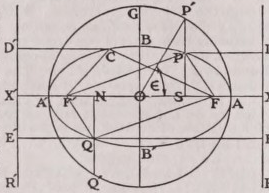
3. The elliptical orbit of a planet.
1. In geometry, an oval figure generated from the section of a cone, by a plane cutting both sides of it, but not parallel to the base.
1. Omission; a figure of syntax, by which one or more words, which are obviously understood, are omitted; as, the virtues I admire, for, the virtues which I admire.
2. An ellipse.
Length Roget’s Thesaurus §200
N. length, longitude, span, mileage, distance, # line, bar, rule, stripe, streak, spoke, radius, lengthening, prolongation, production, protraction, tension, tensure, extension, line, nail, inch, hand, palm, foot, cubit, yard, ell, fathom, rood, pole, furlong, mile, league, chain, link, arpent, handbreadth, jornada, kos, vara, astronomical unit, au, light-year, parsec, nanometer, nm, micron, micrometer, millimicron, millimeter, mm, centimeter, cm, meter, kilometer, km, pedometer, perambulator, scale
V. be long, stretch out, sprawl, extend to, reach to, stretch to, make a long arm, "drag its slow length along." render long, lengthen, extend, elongate, stretch, prolong, produce, protract, let out, draw out, spin out|, drawl, enfilade, look along, view in perspective, distend (expand) 194
Adj. long, longsome, lengthy, wiredrawn, outstretched, lengthened, sesquipedalian, interminable, no end of, macrocolous, linear, lineal, longitudinal, oblong, as long as my arm, as long as today and tomorrow, unshortened &c. (shorten )
Adv. lengthwise, at length, longitudinally, endlong, along, tandem, in a line, in perspective, from end to end, from stem to stern, from head to foot, from the crown of the head to the sole of the foot, from top to toe, fore and aft
King James Bible KJV Bible
Berean Standard Bible BSB Bible
2 KJV and 2 BSB verses contain “Ell”
And it came to pass in the days of Amraphel king of Shinar, Arioch king of Ellasar, Chedorlaomer king of Elam, and Tidal king of nations;
In those days Amraphel king of Shinar, Arioch king of Ellasar, Chedorlaomer king of Elam, and Tidal king of Goiim
With Chedorlaomer the king of Elam, and with Tidal king of nations, and Amraphel king of Shinar, and Arioch king of Ellasar; four kings with five.
against Chedorlaomer king of Elam, Tidal king of Goiim, Amraphel king of Shinar, and Arioch king of Ellasar—four kings against five.