
An animal that lives among grass, a species of Gryllus.
Word of the Day: Catachrestical
1. Any jumping, orthopterous insect, of the families Acrididae and Locustidae. The species and genera are very numerous. The former family includes the Western grasshopper or locust (Caloptenus spretus), noted for the great extent of its ravages in the region beyond the Mississippi. In the Eastern United States the red-legged (Caloptenus femurrubrum and C. atlanis) are closely related species, but their ravages are less important. They are closely related to the migratory locusts of the Old World. See Locust.
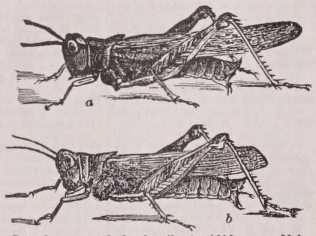
Grasshopper
Encyclopedia Britannica
GRASSHOPPER (French Sauterelle, Italian Grillo, German Grashüpfer, Heuschrecke, Swedish Gräshoppa), a collective term applied to certain orthopterous insects belonging to the families Locustidae and Acrydiidae, according to the now generally received classificatory views. They are especially remarkable for their saltatory powers, due to the great development of the hind legs, which are much longer than the others and have stout and powerful thighs, and also for their stridulation, which is not always an attribute with them of the male only. The distinctions between the two families may be briefly stated as follows the Locustidae have very long thread-like antennae, and four-jointed tarsi; the Acrydiidae have short stout antennae, and three-jointed tarsi. As the term “grasshopper” is almost synonymous with Locust, the subject will be more extensively treated under the latter heading (7. v.). Under both “grasshopper” and “locust” are included members of both families above-noticed, but the majority belong to the Acrydiidae in both cases. In Britain the term is chiefly applicable to the large green grasshopper {Locusta viridissima) common in most parts of the south of England, and to smaller and more obscure species of the genera Stenobotkrus, Gomphocerus, and Tettix, the latter remarkable for the great extension of the pronotum, which often reaches beyond the extremity of the body. All are vegetable feeders, and, as in all orthopterous insects, have an incomplete metamorphosis, so that their destructive powers are continuous from the moment of emergence from the egg till death. The notorious migratory locust {Pachytylus migratorrus) may be considered only an exaggerated grasshopper, and the too-famous Rocky Mountain locust {Caloptenus spretus) is still more ...entitled to the name. In Britain the species are not of sufficient size, nor of sufficient numerical importance, to do any great damage, and their cheerful “song” more than counteracts the slight mischief they may cause in devouring grasses and other plants. The colours of many of them assimilate greatly to those of their habitats; the green of the Locusta viridissima is wonderfully similar to that of the herbage amongst which it lives, and those species that frequent more arid spots are protected in the same manner. Yet many species have brilliantly coloured under-wings (though scarcely so in English forms), and during flight are almost as conspicuous as butterflies; but when settled it is nearly impossible to detect them, even although the spot where they dropped may have been carefully marked; and they rise again almost under the feet of the observer. Those that belong to the Acrydiidae mostly lay their eggs in more or less cylindrical masses, surrounded by a glutinous secretion, in the ground. Some of the Locustidae also lay their eggs in the ground, but others deposit them in fissures in trees and low plants, in which the female is aided by a long flattened ovipositor, or process at the extremity of the abdomen, whereas in the Acrydiidae there is only an apparatus of valves. The stridulation or “song” is mainly produced by friction of the hind legs against portions of the wings or wingcovers; but variation exists in the exact method. To a practised ear it is perhaps possible to distinguish the “song” of even closely allied species, and some are said to produce a sound differing by day and night. The British species are not numerous; tut in some parts of the world (and even in Europe) their numbers are very great, both in species and individuals.
9th ed. Encyclopædia Britannica, vol. 11, p. 60
[576 words — estimated reading time: 4 minutes]
[576 words — estimated reading time: 4 minutes]
Grasshopper
Watson's Biblical & Theological Dictionary
חגב, Lev. xi, 22; Num. xiii, 33; 2 Chron. vii, 13; Eccles. xii, 5; Isaiah xl, 22; 2 Esdras iv, 24; Wisdom xvi, 9; Eccles. xliii, 17. Bochart supposes that this species of the locust has its name from the Arabic verb _hajaba_, “to veil,” because, when they fly, as they often do, in great swarms, they eclipse even the light of the sun. “But I presume,” says Parkhurst, “this circumstance is not peculiar to any particular kind of locust: I should rather, therefore, think it denotes the _cucullated_ species, so denominated by naturalists from the _cucullus_, “cowl” or “hood,” with which they are furnished, and which distinguishes them from the other kinds. In Scheuchzer may be seen several of this sort; and it will appear that this species nearly resemble our grasshopper.” Our translators render the Hebrew word _locust_ in the prayer of Solomon at the dedication of the temple, 2 Chron. vii, 13, and with propriety. But it is rendered _grasshopper_, in Eccles. xii, 5, where Solomon, describing the infelicities of old age, says, “The grasshopper shall be a burden.” “To this insect,” says Dr. Smith, “the preacher compares a dry, shrunk, shrivelled, crumpling, craggy old man; his backbone sticking out, his knees projecting forward, his arms backward, his head downward, and the apophyses or bunching parts of the bones in general enlarged. And from this exact likeness, without all doubt, arose the fable of Tithonus, who, living to extreme old age, was at last turned into a grasshopper.” Dr. Hodgson, referring it to the custom of eating locusts, supposes it to imply that luxurious gratification will become insipid; and Bishop Reynolds, that the lightest pressure of so small a creature shall be uncomfortable to the aged, as not being able to bear ...any weight. Other commentators suppose the reference to the chirping noise of the grasshopper, which must be disagreeable to the aged and infirm, who naturally love quiet, and are commonly unable to bear much noise. It is probable that here, also, a kind of locust is meant; and these creatures are proverbially loquacious. They make a loud, screaking, and disagreeable noise with their wings. If one begins, others join, and the hateful concert becomes universal. A pause then ensues, and, as it were, on a signal given, it again commences; and in this manner they continue squalling for two or three hours without intermission. The Prophet Isaiah contrasts the grandeur and power of God, and every thing reputed great in this world, by a very expressive reference to this insect: Jehovah sitteth on the circle of the earth, and the inhabitants are to him as grasshoppers, Isaiah xl, 22. What atoms and inanities are they all before him, who sitteth on the circle of the immense heavens, and views the potentates of the earth in the light of grasshoppers, those poor insects that wander over the barren heath for sustenance, spend the day in insignificant chirpings, and take up their contemptible lodging at night on a blade of grass! See LOCUST.
Watson's Biblical & Theological Dictionary
[506 words — estimated reading time: 3 minutes]
[506 words — estimated reading time: 3 minutes]
Leap Roget’s Thesaurus §309
N. leap, jump, hop, spring, bound, vault, # saltation, ance, caper, curvet, caracole, gambade|, gambado|, capriole, demivolt, buck, buck jump, hop skip and jump, falcade, kangaroo, jerboa, chamois, goat, frog, grasshopper, flea, buckjumper, wallaby
V. leap, jump up, jump over the moon, hop, spring, bound, vault, ramp, cut capers, trip, skip, dance, caper, buck, buck jump, curvet, caracole, foot it, bob, bounce, flounce, start, frisk, jump about, trip it on the light fantastic toe, trip the light fantastic, dance oneself off one's legs, dance off one's shoes
Adv. on the light fantastic toe
Phr. di salto in salto
King James Bible KJV Bible
Berean Standard Bible BSB Bible
13 KJV and 7 BSB verses contain “Grasshopper”
And there we saw the giants, the sons of Anak, which come of the giants: and we were in our own sight as grasshoppers, and so we were in their sight.
For they came up with their cattle and their tents, and they came as grasshoppers for multitude; for both they and their camels were without number: and they entered into the land to destroy it.
And the Midianites and the Amalekites and all the children of the east lay along in the valley like grasshoppers for multitude; and their camels were without number, as the sand by the sea side for multitude.
Now the Midianites, Amalekites, and all the other people of the east had settled in the valley like a swarm of locusts, and their camels were as countless as the sand on the seashore.
If there be in the land famine, if there be pestilence, blasting, mildew, locust, or if there be caterpiller; if their enemy besiege them in the land of their cities; whatsoever plague, whatsoever sickness there be;
If there be dearth in the land, if there be pestilence, if there be blasting, or mildew, locusts, or caterpillers; if their enemies besiege them in the cities of their land; whatsoever sore or whatsoever sickness there be:
It is he that sitteth upon the circle of the earth, and the inhabitants thereof are as grasshoppers; that stretcheth out the heavens as a curtain, and spreadeth them out as a tent to dwell in:
He sits enthroned above the circle of the earth; its dwellers are like grasshoppers. He stretches out the heavens like a curtain, and spreads them out like a tent to dwell in.
They shall cut down her forest, saith the LORD, though it cannot be searched; because they are more than the grasshoppers, and are innumerable.
They will chop down her forest, declares the LORD, dense though it may be, for they are more numerous than locusts; they cannot be counted.
Thus hath the Lord GOD shewed unto me; and, behold, he formed grasshoppers in the beginning of the shooting up of the latter growth; and, lo, it was the latter growth after the king’s mowings.
This is what the Lord GOD showed me: He was preparing swarms of locusts just after the king’s harvest, as the late spring crop was coming up.
Thy crowned are as the locusts, and thy captains as the great grasshoppers, which camp in the hedges in the cold day, but when the sun ariseth they flee away, and their place is not known where they are.
And we pass away out of the world as grasshoppers, and our life is astonishment and fear, and we are not worthy to obtain mercy.
For them the bitings of grasshoppers and flies killed, neither was there found any remedy for their life: for they were worthy to be punished by such.