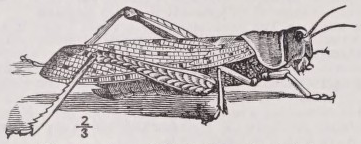
In Europe, and a greater part of the Old World, the best known migratory locust is that which is scientifically termed Pachytylus migratorvus, to which is attached an allied (but apparently distinct) species known as P. cinerascens. Another locust found in Europe and neighbouring districts is Caloptenus italicus, and still another, Acrydium peregrinum, has once or twice occurred in Europe (even in England in 1869), though it can only be considered a straggler, its home (even in a migratory sense) being more properly Africa and Asia. These practically include all the locusts of the Old World, though a migratory species of South Africa known as Pachytylus pardaliηus (presumed to be distinct from P. migratorius) should be mentioned. The Rocky Mountain locust of North America is Calοptenus spretus, and in that continent there occurs an Acrydium (A. americanum) so closely allied to A. peregrinum as to be scarcely distinct therefrom, though there it does not manifest migratory tendencies. In the West Indies and Central America the absolutely true A. peregrinum is also reported to occur.
As to general biology, a few words will suffice. The females excavate holes in the earth in which the eggs are deposited regularly arranged in a long cylindrical mass enveloped in a glutinous secretion. The young larvae hatch, and immediately commence their destructive career. As these insects are “hemimetabolic” (see Insects), there is no quiescent stage; they go on increasing rapidly in size, and as they approach the perfect state the rudiments of the wings begin to appear. Naturally in this stage they are incapable of flight, but their locomotive powers are nevertheless otherwise extensive, and their capacity for mischief very considerable, for their voracity is great. Once winged and perfect these powers become infinitely more disastrous, redoubled by the development of the migratory instinct. The laws regulating this instinct are not yet perfectly understood. Food and temperature have a great deal to do with it, and there is a tendency for the flights to take a particular direction, varied by the physical circumstances of the breeding districts. So likewise it is certain that each species has its area of constant location in which it always exists, and its area of extraordinary migration to the extremes of which it only occasionally extends. Perhaps the most feasible of the suggestions as to the causes of the migratory impulse is that locusts naturally breed in dry sandy districts in which food is scarce, and are thus impelled to wander in order to procure the necessaries of life; but against this it has been argued that swarms bred in a highly productive district in which they have temporarily settled will seek the barren home of their ancestors. Another ingenious suggestion is that migration is intimately connected with a dry condition of the atmosphere, urging them to move on until compelled to stop for food or procreative purposes. The distance particular swarms may travel depends upon a variety of circumstances, such as the strength of impulse, the quantity of food, and many other causes. Certain it is that 1000 miles may, in particularcases, be taken as a moderate estimate; probably it is often very much less, certainly sometimes very much more. As a rule the progress is only gradual, and this adds vastly to the devastating effects, which may be likened to those caused by a foreign army levying black-mail upon the inhabitants of an invaded country through which it is marching. When an extensive swarm temporarily settles in a district, all vegetation rapidly disappears, and then hunger urges them on another stage. Such is their voracity that it has been tolerably well ascertained that the large Old World species, although undoubtedly phytophagous, are often compelled by hunger to attack at least dry animal substances, and even cannibalism has been asserted as an outcome of the failure of all other kinds of food. The length of a single flight must depend upon circumstances. From certain individual peculiarities in the examples of Acrydium peregrvnum that were taken in England in 1869, it has been asserted that they must of necessity have come direct by sea from the west coast of Africa; and what is probably the same species has been seen in the Atlantic at least 1200 miles from land, in swarms completely covering the ship, and obscuring the air; thus, although it is no doubt usual for the swarms to rest during the night, it undoubtedly happens in certain cases that flight must be sustained for several days and nights together. The height at which swarms fly, when their horizontal course is not liable to be altered by mountains, has been very variously estimated at from 40 to 200 feet, or even in a particular case to 500 feet. A “dropping from the clouds” is a common expression used by observers when describing the apparition of a swarm. The extent of swarms, and the number of individuals in a swarm, are matters that must of necessity be purely speculative. That the sun may sometimes be utterly obscured, and the noise made hy the rustling of the wings be deafening, is confirmed by a multitude of observers. We prefer to decline the attempt to grapple with so vast a subject,—not unnaturally so when one observer says of a particular swarm that, when driven out to sea and drowned, the dead bodies washed up formed a bank 50 miles long and 3 or 4 feet high.
No special periodicity appears to have governed these flights (which, it is necessary to state, happily do not occur to an alarming extent every year), still an American writer (Mr Thomas) makes the interesting remark that the interim between the years of superlatively extraordinary appearance is both in Europe and America “very nearly a multiple of 11.”
In Europe the best known and ordinarily most destructive species is Pachytylus migratοrius (fig. 1), and it is to it that the numerous records of devastations in Europe mainly refer, but it is probably not less destructive in many parts of Africa and Asia. Eastern Europe, and especially the plains of southern Russia, appear to be more especially liable to its attacks. That the arid steppes of Central Asia are the home of this insect appears probable; still much on this point is enveloped in uncertainty. In any case the area of permanent distribution, according to Koppen (who published an elaborate memoir on the subject in 1871), is enormous, and that of occasional distribution is still greater. The former area extends from the parallel of 40° N. in Portugal, rising to 48° in France and Switzerland, and passing into Russia at 55°, thence continuing across the middle of Siberia, north of China to Japan; thence south to the Fiji Islands, to New Zealand, and North Australia; thence again to Mauritius and over all Africa to Madeira. But Koppen remarks that the southern distribution is uncertain and obscure. Taking exceptional distribution, it is well known that it occasionally appears in the British Isles, and has in them apparently been noticed as far north as Edinburgh; so also does it occasionally appear in Scandinavia, and it has probably been seen up to 63° N. in Finland. Looking at this vast area, it is easy to conceive that an element of uncertainty must always exist with regard to the exact determination of the species, and in Europe especially is this the case, because (as before stated) there exists an apparently distinct species, known as P. cinerascens, which Koppen does not take into account. This latter species is certainly the most common of the “locusts” occasionally found in the British Isles, and De Selys-Longchamps is of opinion that it breeds regularly in Belgium, whereas the true P. migratorius is only accidental in that country. In the case of this, as of all other locusts, it is impossible within the limits of this article to chronicle even the years of greatest abundance. That they are probably as destructive now as formerly appears within the bounds of belief. At any rate we read that only a year or two ago a detachment of Russian soldiers in Turcomania was so beset that a stampede at last took place, and eventually the men were held prisoners by the insects forty-eight hours until the villagers killed them and carried them away for manure, locomotion being as difficult as if the men had been on ice.
Acrydium peregrinum (fig. 2) can scarcely be considered even an accidental visitor to Europe; yet it has been seen in the south of Spain, and, most extraordinarily, in many examples spread over a large part of England in the year 1869. It is a larger insect than P. migratorius. No serious attempt to define the range of this species has yet been made, but there is every reason to believe that it is the most destructive locust throughout Africa and India and other parts of tropical Asia, and its ravages are not one whit less important than are those of P. migratorius. Presumably it is the species that, on more than one occasion, has been noticed in a vast swarm in the Atlantic, very far from land, and presumably also it occurs in the West Indies and some parts of Central America. But it has been already remarked that A. americamum of North America, although so closely allied as to be scarcely distinguishable, is said not to be migratory, and is therefore scarcely a true
“locust.” In the Argentine Republic a (possibly) distinct species (A. paranense) is the migratory locust.
Caloptenus italiens (fig. 3) is a smaller insect, with a less extended area of migration; and, though from this cause its ravages are not so notable, still the destruction occasioned in the districts to which it is limited is often scarce less than that of its more terrible allies. It is essentially a species of the Mediterranean district, and especially of the European side of that sea, yet it is also found in North Africa, and appears to extend far into southern Russia.
Caloptenus spretus (fig. 4) is the “Rocky Mountain locust” or ‘ ‘ hateful grasshopper” of the North American continent. Though a comparatively small insect, not so large as some of the grasshoppers of English fields, its destructiveness has procured for it within the last twenty years a notoriety scarcely excelled by that of any other. It is only recently that the persistent migration of American settlers westward extended into the home of this creature. Travellers and prospectors in these regions had previously spoken of enormous swarms of a destructive grasshopper as existing there, and no doubt these occasionally extended into regions already civilized, but the species was not recognized as distinct from some of its non-migratory congeners to which it is so closely allied as to require a practised entomological eye to separate it therefrom. As time drew on, the various “State entomologists” made it their special duty to 'report on the insect, and at length, in 1877, the matter had become so serious that Congress appointed a United States Entomological Commission to investigate the subject, and report upon the best (if any) means of counteracting the evil effects of the pest. The result, so far as published, consists of two enormous volumes, teeming with information, and taking up the whole subject of locusts both in America and the Old World. C. spretus has its home or permanent area in the arid plains of the central region east of the Rocky Mountains, extending slightly into the southern portion of British North America; outside this is a wide fringe to which the term sub-permanent is applied, and this is again bounded by the limits of only occasional distribution, the whole occupying a large portion of the North American continent; but it is not known to have crossed the Rocky Mountains westward, or to have extended into the eastern States.
As to remedial or preventive measures tending to check the ravages of locusts, little unfortunately can be said, but anything that will apply to one species may be used with practically all. One point is certain; direct remedies must always be of small avail. Something can be done (as is now done in Cyprus) by offering a price for all the egg-tubes collected, which is certainly the most direct manner of attacking them. Some little can be done by destroying the young larvae while yet in an unwinged condition, and by digging trenches in the line of march into which they can fall and be drowned or otherwise put an end to. Infinitesimally little can be done with the winged hordes having the migratory instinct upon them; starvation, the outcome of their own work, probably here does much. It has been shown that with all migratory locusts the breeding places, or true homes, are comparatively barren districts (mostly elevated plateaus); hence the progress of civilization and colonization, withits concomitant necessity for converting those heretofore barren plains into areas of fertility, may (and probably will) gradually lessen the evil.
Locusts, like all other animals, have their natural enemies. Many birds greedily devour them, and it has many times been remarked that migratory’swarms of the insects were closely followed by myriads of birds. Predatory insects of other orders also attack them, especially when they are in the unwinged condition. Moreover, like all other insects, they have still more deadly insect foes as parasites. Some attack the fully developed winged insect. But the greater part adopt the more insidious method of attacking the eggs. To such belong certain beetles, chiefly of the family Can- tharidae, and especially certain two-winged flies of the family Bombyliidae. These latter, both in the Old and New World, must prevent vast quantities of eggs from producing larvae. Popular ignorance on this subject is yet great, and within a few months before this article was written it was exemplified in a remarkable manner by a suggestion from the Government officials of Cyprus that a certain parasite known to be destructive to the eggs in Asia Minor might be introduced into the island, a suggestion immediately followed by the discovery that what is probably the same parasite already existed there.
A flight of locusts would appear not to be always an unmixed evil, even to man. The larger Old World species form articles of food with certain semi-civilized and savage races, by whom they are considered as delicacies, or as part of ordinary diet, according to the race and the method of preparation.
Literature.— Kirby and Spence, Introduction to Entomology, 7th ed., London, 1856; Koppen, “Die geographische Verbreitung der Wanderheuschrecke” in Geograph. Mittheilungen, vol. xvii., 1871; Gerstäcker, Die Wanderheuschrecke, Berlin, 1876; Reports of the United States Entomological Commission on the Rocky Mountain Locust, by Riley, Packard, Thomas, and others, 2 vols., washington, 1878-80. ⅛. M , L.)