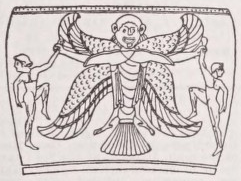
1. In antiquity, the harpies were fabulous winged monsters, having the face of a woman and the body of a vulture, with their feet and fingers armed with sharp claws. They were three in number, Aello, Ocypete, and Celeno. They were sent by Juno to plunder the table of Phineus. They are represented as rapacious and filthy animals.
1. A fabulous winged monster, ravenous and filthy, having the face of a woman and the body of a vulture, with long claws, and the face pale with hunger. Some writers mention two, others three.
HARPY, a large diurnal bird of prey, so named after the mythologicalmonster of the classical poets,—the Thrasaetus harpyia of modern ornithologists,—an inhabitant of the warmer parts of America from Southern Mexico to Brazil. Though known for more than two centuries, its habits have come very little under the notice of naturalists, and what is said of them by the older writers must be received with some suspicion. A cursory inspection of the bird, which is not unfrequently brought alive to Europe, its size, and its enormous bill and talons, at once suggest the vast powers of destruction imputed to it, and are enough to account for the stories told of its ravages on mammals, —sloths, fawns, peccaries, and spider-monkeys. It has even been asserted to attack the human race. How much of this is fabulous there seems no means at present of determining, but some of the statements are made by veracious travellers—D’Orbigny and Tschudi. It is not uncommon in the forests of the isthmus of Panama, and Mr Salvin says (Proc. Zool. Society, 1864, p. 368) that its flight is slow and heavy. Indeed its Owl-like visage, its short wings and soft plumage, do not indicate a bird of very active habits, but the weapons of offence with which, as above stated, it is armed, show that it must be able to cope with vigorous prey. Its appearance is sufficiently striking—the head and lower parts, except a pectoral band, white, the former adorned with an erectile crest, the upper parts dark grey banded with black, the wings dusky, and the tail barred; but the huge bill and powerful scutellated legs most of all impress the beholder. The precise affinities of the Harpy cannot be said to have been determined. By some authors it is referred to the Eagles, by others to the Buzzards, and by ...others again to the Hawks; but possibly the first of these alliances is thé most likely to be true. (a. n.)
9th ed. Encyclopædia Britannica, vol. 11, p. 491 [335 words — estimated reading time: 2 minutes]
V. be -severe, assume, usurp, arrogate, take liberties, domineer, bully, tyrannize, inflict, wreak, stretch a point, put on the screw, be hard upon, bear a heavy hand on, lay a heavy hand on, be down upon, come down upon, ill treat, deal hardly with, deal hard measure to, rule with a rod of iron, chastise with scorpions, dye with blood, oppress, override, trample under foot, tread under foot, tread upon, trample upon, tread down upon, trample down upon, crush under an iron heel, ride roughshod over, rivet the yoke, hold a tight hand, keep a tight hand, force down the throat, coerce, give no quarter
V. be parsimonious, grudge, begrudge, stint, pinch, gripe, screw, dole out, hold back, withhold, starve, famish, live upon nothing, skin a flint, drive a bargain, drive a hard bargain, cheapen, beat down, stop one hole in a sieve, have an itching palm, grasp, grab
Phr. desunt inopioe multa avaritiae omnia, "hoards after hoards his rising raptures fill", "the unsunn'd heaps of miser's treasures", words relating to the sentiment and moral powers
This site uses cookies to remember your display preferences (search sources and editions, Bible version, auto-link, images, light/dark theme). No personal data whatsoever is collected. Privacy Policy