
The fruit of the dog-rose, or wild brier.
Word of the Day: Catachrestical
2. A dance; esp., an informal dance of ball.
3. A climbing plant (Humulus Lupulus), having a long, twining, annual stalk. It is cultivated for its fruit (hops).
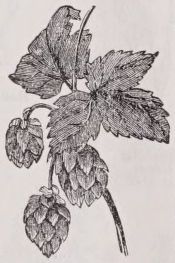
5. The fruit of the dog-rose. See Hip.
3. To dance.
4. To gather hops. [Perhaps only in the form Hopping, vb. n.]
To impregnate with hops.
Hop
Encyclopedia Britannica
HOP (German, Hopfen·, French, houblon), Humulus Lupulus, L., the sole representative of its genus, an herbaceous twining plant, belonging to the natural order Can-nabinαcece, which is by some botanists included in the larger group called Urticaceoe by Endlicher. It is of common occurrence in hedges and thickets in the southern counties of England, but is believed not to be native in Scotland. On the Continent it is distributed from Greece to Scandinavia, and extends through the Caucasus and Central Asia to the Altai Mountains. It is common, but doubtfully indigenous, in the northern and western States of North America, and has been introduced into Brazil, Australia, and the Himalayas....
It is a dioecious perennial plant, producing annually several long twining roughish striated stems, which twist from left to right, are often 15 to 20 feet long, and climb freely over hedges and bushes. The leaves are stalked, opposite, 3-5 lobed, and coarsely serrate, and bear a general resemblance to those of the vine, but are, as well as the whole plant, rough to the touch; the upper leaves are sometimes scarcely divided,.or quite entire. The stipules are interpetiolar, each consisting of two lateral ones united, or rarely with the tips free. The male inflorescence (fig. 1, A) forms a panicle; the flowers consist of a small greenish five parted perianth (a) enclosing five stamens, whose anthers (ά) open by terminal slits. The female inflorescence (fig. 1, B) is less conspicuous in the young state. The catkin or strobile consists of a number of small acute bracts, with two sessile ovaries at their base, each subtended by a rounded bractlet (c). Both the bracts and bractlets enlarge greatly during the development of the ovary, and form, when fully grown, the membranous scales of the strobile (fig. 2, a). The bracts can then only be distinguished from the bractlets by being rather more acute and more strongly veined. The perianth (fig. 1, tZ) is short, cup-shaped, undivided, and closely applied to the ovary, which it ultimately encloses. In the young strobile the two purple hairy styles (e) of each ovary project beyond the bracts. The ovary contains a single exalbuminous seed, containing a spirally-coiled embryo (fig. 2, b).
The ovary and the base of the bracts are covered with a yellowish powder, consisting of minute sessile grains (see vol. iv. p. 91, fig. 48) called lupulin or lupulinic glands (see vol. i. p. 381). These glands (fig. 2, c) are stated by Stoddart to be from - 2 ^- σ to τ ∣ π inch in diameter, like flattened subovate little saucers in shape, and attached to a short pedicel; by the expansion of the central portion during growth their apex ultimately becomes convex instead of concave. The upper or hemispherical portion consists of a delicate continuous membrane, and the lower part of tabular polyhedric cells. The stalk is not perceptible in the gland as found in commerce. When fresh the gland is seen to be filled with a yellowish or dark brown liquid; this on drying contracts in bulk and forms a central mass. The contents of these glands, according to Lermer, are chiefly wax (myricylic palmitate) and resins, one of which is crystalline and unites with bases; with these the bitter acid of hops is present in small proportion. It is to these lupulinic glands that the medicinal properties of the hop are chiefly due. By careful sifting, about 1 oz. may be obtained from 1 lb of hops, but the East Kent variety is said to yield more than the Sussex hops.
In hop gardens a few male plants, usually three or four to an acre, are sometimes planted, that number being deemed sufficient to fertilize the female flowers. It is stated, however, that the female plant produces sufficient male flowers for self-fertilization (Royle). The blossoms are produced in August, and the strobiles are fit for gathering from the beginning of September to the middle of October, according to the weather.
The cultivation of hops for use in the manufacture of beer dates from an early period. In the 8th and 9th centuries hop gardens, called “humularia” or “humuleta,” existed in France and Germany. In the herbarium of Λpuleius (1050 a.d.), the hop (“hymele”) is said to have been put in the usual drinks of England on account of its good qualities. Until the 16th century, however, hops appear to have been grown in a very fitful manner, and to a limited extent, generally only for private consumption; but after the commencement of the 17 th century the cultivation increased rapidly. At the present time England produces a larger quantity than any other country in Europe. Formerly several plants were used as well as hops to season ale, hence the name “alehoof” for Hepeta Glechoma, and “alecost” for Balsαmita vulgaris. The sweet gale, Myrica Gale, and the sage, Salvia offi,cinalis, were also similarly employed. Various hop substitutes, in the form of powder, have been offered in commerce of late years, most of which appear to have quassia as a chief ingredient.
The young tender tops of the hop are in Belgium cut off in spring and eaten like asparagus, and are forced from December to February. They are not only considered a delicacy, but valuable as a diet for anaemic, scrofulous, and rachitic persons.
Hops are extensively cultivated in parts of New England, New York, and Michigan, and most of the hops consumed in the United States are supplied by those districts. Although the hop was introduced into America nearly 250 years ago, and its cultivation encouraged by legislative enactments in 1657, it is only about seventy-five years since its culture was commenced on an extensive scale; but from that time the progress has been rapid, and hops have been grown in nearly every State in the Union. The amount produced in the United States was estimated in 1840 at 6196 bales, in 1850 at 17,485, in 1860 at 54,960, and in 18/0 at 127,283. As in England, the hop is subject to disease and blight, and in consequence the crop is variable; thus, in 1869, 69,463 bales were exported from New York and none imported, and in 1873 only 315 bales were exported and 20,885 imported. The English cluster and grape hops seem to be most generally cultivated in New York and Wisconsin. Hops are also grown largely in Belgium, Prussia, France, Wiirtemberg, and central Germany. In 1879 only 7153 cwts. of hops were exported from England chiefly to Australia and other British possessions, while 262,765 cwts. were imported, of which 108,306 cwts. were derived from the United States, 63,485 cwts. from Belgium, 50,567 from Germany, 26,796 from Holland, and smaller quantities from France and British North America. The first packages of hops collected in England often fetch an extravagant price, and are sometimes disposed of with remarkable celerity. The first pocket of hops gathered in 1879 is said to have been picked, dried, sent to London, sold by auction, subjected to hydraulic pressure, packed and banded with iron, covered with three coats of paint, and despatched to an Indian mail steamer—all within twenty-four hours. The better qualities are usually packed in fine and the inferior in coarse sacking. In Germany two varieties of the hop are distinguished, the August and the autumn hop, the former being preferred.
The stem of the hop abounds in fibre similar to that of hemp and flax, and has been used in Sweden in the production of a strong durable white cloth. Hitherto it has been usual to steep the stem in water during the whole winter in order to separate the fibre easily. A much quicker process has, however, been patented, by which the fibre can be speedily extracted. This process consists in boiling the stems first for three quarters of an hour in alkaline lye, and then, after rinsing in water, for the same time in acetic acid; the fibre is thus obtained in a state fit for bleaching. The leaves, stem, and root possess also an astringent property, and their use for tanning purposes was hence at one time patented in England. The leaves have also been recommended as fodder in the fresh state, mixed with other materials, and are said to increase the quantity and improve the quality of milk yielded by cows. The stems or “bine” are usually burned in the hop garden. The spent hops from breweries form excellent manure for light soils, and together with the leaves should be returned to the hop-gardens, the materials absorbed from the ground by the hop plant being thus in some measure restored to it.
By distillation with water, hops yield 0 ’ 9 per cent, of a volatile oil, of a greenish colour if from fresh, but reddish-brown if from old hops. Exposed to the air it resinifies. This oil, according to Personne, contains valerol, C 6 H 10 O, which soon passes into valerianic acid, 0 ’ 1 to 047 of this acid having been found by Méhu in the lupulinic glands. The unpleasant odour of old hops is due to this change, which may be prevented or retarded by exposure to the action of sulphurous acid gas. For medicinal use fresh hops which have neither undergone this change nor been treated with sulphurous acid should be used. For brewing purposes, according to Liebig, the use of sulphured hops is not objectionable. The bitter acid principle, C 32 H 50 O 7 , to which hops probably owe their tonic properties, although noticed by Payen, was first obtained in the pure state by Lermer in 1863. It crystallizes in large rhombic prisms, and is soluble in ether. It has been variously called lupulin, ]upuline, lupulite, and humulin. Griessmayer (1874) has shown that hops contain also in small proportion a liquid volatile alkaloid, not yet analysed, which has the odour of conia; to this alkaloid its narcotic property is perhaps due. The same chemist found tri methylamine in hops. Etti (1876-78) has found in the scales of the hop strobiles an astringent principle, hurnulοtaηηic acid, C 00 H 48 O 26 , which is incapable of precipitating gelatin, but which, when boiled in alcohol or water or heated to 130° C., changes to a red substance, phlobaplιeη, C 50 H 4β O 25 , whose solution in alcohol possesses that property. Etti likewise obtained a crystalline white and an amorphous brown resin, also malate, citrate,nitrate, phosphate, and sulphate of potassium, and pectic acid.
The use of hops in medicine dates from a very early period. Coles, in }As,History of Plants (1657), says—“They are good to cleanse the kidneys of gravel and provoke urine; they likewise open obstructions of the liver and spleen, and cleanse the blood and loosen the belly; and as they cleanse the blood, so consequently they help to cure eruptions of the skin.” Brooke’s Dispensatory^ 1753)recommends them also as an alterative, and as a remedy for hypochondriasis. Hops are, however, but little used in medicine at the present day, although official in the British and United Stites Pharmacopoeias. According to Bartholow hops increase the action of the heart, excite the cutaneous circulation, and cause diaphoresis. A slight cerebral excitement is first produced, soon followed by a disposition to sleep. Hops also possess some anaphrodisiac properties. The preparations used are the tincture, infusion, and extract, the oleoresin, and the lupulinic glands. The drug is generally employed either as a stomachic in dyspepsia, or to allay nervous irritability or cerebral excitement in delirium tremens, where the use of opium is inadmissible. A combination of the tinctures of lupulin and capsicum is said to be one of the best substitutes for alcoholic stimulants when their habitual use is to be discontinued. A pillow stuffed with hops forms a well-known domestic remedy for sleeplessness, and a bag of hops dipped in hot water is often used as an external application to relieve pain or inflammation, especially of the abdominal organs.
See Fliickiger and Hanbury, Phαrmαcοgrαρhiα, 2d ed., p. 551; Bentley and Trimen, Mcd. Plants, No. 230; Griessmayer, Amer. Journ. Pharm., Aug. 1876, p. 360; Etti, in Dingier’s Polyt. Jowrn. cexxvii. p. 491; ccxxviii. pp. 354, 357; Bartholow, Mat. Mcd., p. 362; Watson, Rural Encyclopaedia, ii. pp. 686-699; Darwin, Climbing Plants, p. 2; Scot, Perf,te Plalforme of a Hoppe Garden, 1576; Freake, Humulus Lupulus in Gout, 1806; La Belgique Horticole, 1851, t. i. 311; Perin, Culture du Houblon, Strasburg, 1874; and for details as to the cultivation and varieties and the picking and preparation of hops, and their employment in the making of beer, see Agriculture, vol. i. p. 381, and Brewing, vol. iv. pp. 272-273. (E. Μ. H.)
9th ed. Encyclopædia Britannica, vol. 12, p. 156
[2,141 words — estimated reading time: 13 minutes]
[2,141 words — estimated reading time: 13 minutes]
1. A desire of some good, accompanied with at least a slight expectation of obtaining it, or a belief that it is obtainable. hope differs from wish and desire in this, that it implies some expectation of obtaining the good desired, or the possibility of possessing it. hope therefore always gives pleasure or joy; whereas wish and desire may produce or be accompanied with pain and anxiety.
3. He wish'ed, but not with hope--
4. Sweet hope! kind cheat!
5. He that lives upon hope will die fasting.
6. Confidence in a future event; the highest degree of well founded expectation of good; as a hope founded on God's gracious promises; a scriptural sense.
7. A well founded scriptural hope is, in our religion, the source of ineffable happiness.
8. That which gives hope; he or that which furnishes ground of expectation, or promises desired good. The hope of Israel is the Messiah.
9. The Lord will be the hope of his people. Joel 3:16 .
10. An opinion or belief not amounting to certainty, but grounded on substantial evidence. The christian indulges a hope that his sins are pardoned.
11. A sloping plain between ridges of mountains. [Not in use.]
1. To cherish a desire of food, with some expectation of obtaining it, or a belief that it is obtainable.
2. HOPE for good success.
3. Be sober and hope to the end. 1 Peter 1:3 .
5. To place confidence in; to trust in with confident expectation of good.
6. Why art thou cast down, O my soul, and why art thou disquieted within me? hope thou in God. Psalms 43:5 .
1. To desire with expectation of good, or a belief that it may be obtained. But as a transitive verb, it is seldom used, and the phrases in which it is so used are elliptical, for being understood.
1. A sloping plain between mountain ridges.
2. A small bay; an inlet; a haven.
3. A desire of some good, accompanied with an expectation of obtaining it, or a belief that it is obtainable; an expectation of something which is thought to be desirable; confidence; pleasing expectancy.
4. One who, or that which, gives hope, furnishes ground of expectation, or promises desired good.
5. That which is hoped for; an object of hope.
1. To entertain or indulge hope; to cherish a desire of good, or of something welcome, with expectation of obtaining it or belief that it is obtainable; to expect; -- usually followed by for.
2. To place confidence; to trust with confident expectation of good; -- usually followed by in.
1. To desire with expectation or with belief in the possibility or prospect of obtaining; to look forward to as a thing desirable, with the expectation of obtaining it; to cherish hopes of.
2. To expect; to fear.
Hope
Encyclopedia Britannica
HOPE, Thomas(c. 1770-1831), the author of Anastasüis, born at London about 1770, was descended from a branch of an old Scotch family who for several generations were extensive merchants iu London and Amsterdam. About the age of eighteen he started on a tour through various parts of Europe, Asia, aud Africa, where he interested himself especially in architecture and sculpture, making a large collection of the principal objects which attracted his attention. On his return to London he purchased a house in Duchess Street, which he fitted up in a very ornamental and elaborate style, from drawings made by himself. In 1805 he published sketches of his furniture, accompanied by letterpress, in a folio volume, entitled Household Furniture and Decoration, which had considerable influence in effecting a change in the upholstery and interior decoration of houses. In 1809 he published the Costumes of the Ancients, and in 1812 Designs of Modern Costumes, works which display a large amount of special antiquarian research. He was also a munificent patron of the highest forms of art, and both at his London house and his country seat at Deepdene near Dorking he formed large collections of paintings, sculpture, and antiques. Thorwaldsen, the Danish sculptor, was indebted to him for the early recognition of his talents, and he also gave frequent employment to Chantrey and Flaxman. In 1819 he published anonymously his novel Anastasius, or Memoirs of a Modern Greek, written at the close of the 18i7t century, a work which, chiefly on account of the novel character of its subject, caused a great sensation. It was generally attributed to Lord Byron, but, though remarkable for the acquaintance it displays with Eastern life, and distinguished by considerable imaginative vigour and much graphic ...and picturesque description, its paradoxes are not so striking as those in which Lord Byron indulged; and, notwithstanding some eloquent and forcible passages, the only reason which warranted its ascription to him was the general type of character to which its hero belonged. Hope died February 3, 1831. He was the author of two works published posthumously,—the Origin and Prospects of Man, 1831, in which he indulged in speculations diverging widely from the usual orthodox opiuions, and an Historical Essay on Architecture, 1835, an elaborate description of the architecture of the Middle Ages, illustrated by drawings made by himself in Italy and Germany.
9th ed. Encyclopædia Britannica, vol. 12, p. 158
[395 words — estimated reading time: 3 minutes]
[395 words — estimated reading time: 3 minutes]
Desired with expectation.
1. Having qualities which excite hope; promising or giving ground to expect good or success; as a hopeful youth; a hopeful prospect.
2. Full of hope or desire, with expectation.
3. I was hopeful the success of your first attempts would encourage you to the trial of more nice and difficult experiments.
1. Full of hope, or agreeable expectation; inclined to hope; expectant.
2. Having qualities which excite hope; affording promise of good or of success; as, a hopeful youth; a hopeful prospect.
1. In a manner to raise hope; in a way promising good. He prosecutes his scheme hopefully
2. In a manner to produce a favorable opinion respecting some good at the present time. The young man is hopefully pious.
3. With hope; with ground to expect.
Promise of good; ground to expect what is desirable.
1. Destitute of hope; having no expectation of that which is desirable; despairing.
2. I am a woman, friendless, hopeless
3. Giving no ground of hope or expectation of good; promising nothing desirable; desperate; as a hopeless condition.
1. Destitute of hope; having no expectation of good; despairing.
2. Giving no ground of hope; promising nothing desirable; desperate; as, a hopeless cause.
3. Unhoped for; despaired of.
Without hope.
A state of being desperate, or affording no hope.
One that hopes.
One who hopes.
Hophni
Watson's Biblical & Theological Dictionary
See ELI.
Watson's Biblical & Theological Dictionary
[2 words — estimated reading time: 1 minute]
[2 words — estimated reading time: 1 minute]
1. Having hope; indulging desire of good with the expectation of obtaining it, or a belief that it is obtainable.
2. Confiding in.
With hope or desire of good, and expectation of obtaining it.
In a hopeful manner.
Hopkins
Encyclopedia Britannica
HOPKINS, Ezekiel (1633-1690), bishop of Londonderry, and a Calvinistic divine of some repute, was born at Stanford, Devon (where his father was curate), in 1633, was educated at Magdalen College, Oxford, where he identified himself with the Presbyterian party, and about 1660 became assistant to DrW. Spurstow of Hackney, the W.S. [UU.S.] of “Smectymnuus.” He was subsequently presented to the living of St Mary Woolnoth, London, which at the outbreak of the plague he exchanged for that of St Mary’s, Exeter. Having married a daughter of Lord Robartes, who in 1669 became lord-lieutenant of Ireland, he was soon afterwards promoted to the deanery of Raphoe, and in 1671 he was raised to the bishopric of that diocese. Translated to the see of Londonderry in 1681, he continued to discharge his episcopal functions until the period of the famous siege, when, after having vainly sought to inculcate the doctrine of passive resistance, he withdrew to London, where in 1689 he accepted the living of St Mary Aldermanbury. He died in June 1690.
His works, consisting chiefly of discourses, but including A practical Exposition of the Lord's Prayer and An Exposition of the Ten Commandments, were first published in a complete and uniform edition in 1701; they were reprinted in 4 vols, in 1809, with a Life prefixed, by Pratt, and again, in 2 vols., in 1841-44. Though marked by “strength of thought, originality of illustration, and felicity of style,” they are now but seldom read....
HOPKINS, Samuel (1721-1803), the theologian from whom the Hopkinsians or Hopkinsian Calvinists take their name, was born at Waterbury, Connecticut, on September 17, 1721. About his fifteenth year he entered Yale College, where he graduated in 1741; he afterwards studied divinity at Northampton with Jonathan Edwards; and in 1743 he was ordained pastor of the church at Housatonnuc (now Great Barrington), Massachusetts. There in the midst of a small settlement of only thirty families he laboured for six and twenty years, preaching, studying, and writing, until in 1769 he was dismissed from his office on the alleged ground of want of funds for his support. He next began to preach in Newport, Rhode Island, where, in 1770, he was settled as pastor of a small congregation, and where, with an interval from 1776 to 1780, caused by the occupation of the British, he continued to labour until about the close of the century. In 1799 he had an attack of paralysis, from which he never wholly recovered; but he continued to preach occasionally, and with unimpaired mental vigour, almost until his death, which occurred on December 20,1803.
While in vigour of intellect and in strength and purity of moral tone hardly inferior to Jonathan Edwards, Hopkins considerably excelled his master in force and energy of character. To him belongs the honour of having been one of the first to stir up and organize political action against slavery; and to his persistent though bitterly opposed efforts are chiefly to be attributed the law of 1774, which forbade the importation of negroes into New England, as also that of 1784, which declared that all children of slaves born after the following March should be free. He was the author of numerous pamphlets, addresses, and sermons; and he also published lives of Jonathan Edwards, Susannah Anthony, and Mrs Osborn. But his distinctive theological tenets are chiefly to be sought in his important work, the System of Theology, which, published in 1791, has had an influence hardly inferior to that exercised by the writings of Edwards himself. They may be summed up as follows :— (1) God is the efficient cause of all the volitions of the human heart, whether these be good or evil; (2) the guilt of Adam’s first sin lies upon Adam alone; moral corruption consists exclusively in the opposition offered by the human heart to the doing of that which it is really and fully capable of doing; (3) all virtue or true holiness consists in disinterested benevolence; (4) all sin consists in selfishness; (5) reconciliation and redemption are fundamentally distinct; the former opens the gate of mercy, the latter applies to individuals Christ’s saving benefits; (6) effectual calling consists in a willingness to allow himself to be saved, produced in the heart of the sinner by God; (7) although the righteousness of Christ is the sole ground of the sinner’s justification, yet is that righteousness not imputed; (8) repentance is prior in point of time to the exercise of faith in Christ.
. The works of Hopkins, first published in two volumes at Boston in 1791, appeared in a 2d edition in 1811. The latest and best edition is that of 1852, in three volumes, also publi-hed at Boston; to it there is prefixed a biographical sketch by Professor Park of Andover.
9th ed. Encyclopædia Britannica, vol. 12, p. 158
[251 words — estimated reading time: 2 minutes]
[251 words — estimated reading time: 2 minutes]
Hopkinsians
Watson's Biblical & Theological Dictionary
or HOPKINSONIANS, so called from the Rev. Samuel Hopkins, D.D., pastor of the first Congregational church at Newport, Rhode Island, North America, about A. D. 1770. Dr. Hopkins, in his sermons and tracts, made several additions to the sentiments previously advanced by the celebrated President Edwards, of New-Jersey College. The following is a summary of their distinguishing tenets:--...
That all true virtue or real holiness consists in disinterested benevolence. The object of benevolence is universal being, including God, and all intelligent creatures. It wishes and seeks the good of every individual, so far as is consistent with the greatest good of the whole, which is comprised in the glory of God, and the perfection and happiness of his kingdom. The law of God is the standard of all moral rectitude or holiness. This is reduced into love to God and to our neighbour; and universal good will comprehends all the love to God, our neighbour, and ourselves, required in the divine law, and therefore must be the whole of holy obedience. Let any person reflect on what are the particular branches of true piety, and he will find that disinterested affection is the distinguishing characteristic of each. For instance, all which distinguishes pious fear from the fear of the wicked consists in love. Holy gratitude is nothing but good will to God and man, ourselves included, excited by a view of the good will and kindness of God. Justice, truth, and faithfulness, are comprised in universal benevolence. So are temperance and chastity; for an undue indulgence of our appetites and passions is contrary to benevolence, as tending to hurt ourselves or others, and so opposite to the general good, and the divine command. In short, all virtue is nothing but love to God and our neighbour, made perfect in all its genuine exercises and expressions.
That all sin consists in selfishness. By this is meant an interested affection, by which a person sets himself up as the supreme or only object of regard; and nothing is lovely in his view, unless suited to promote his private interest. This self-love is, in its whole nature, and every degree of it, enmity against God: it is not subject to the law of God, and it is the only affection that can oppose it. It is the foundation of all spiritual blindness, and the source of all idolatry and false religion. It is the foundation of all covetousness and sensuality; of all falsehood, injustice, and oppression; as it excites mankind, by undue methods, to invade the property of others. Self-love produces all the violent passions, envy, wrath, clamour, and evil speaking; and every thing contrary to the divine law is briefly comprehended in this fruitful source of iniquity, self-love.
That there are no promises of regenerating grace made to the actions of the unregenerate. For as far as men act from self-love, they act from a bad end; for those who have no true love to God really fulfil no duty when they attend on the externals of religion. Also, that inability, which consists in disinclination, never renders any thing improper to be the subject of a command.
That the impotency of sinners, with respect to believing in Christ, is not natural, but moral; for it is a plain dictate of common sense, that natural impossibility excludes all blame. But an unwilling mind is universally considered as a crime, and not as an excuse; and is the very thing wherein our wickedness consists.--Also,
That in order to faith in Christ, a sinner must approve in his heart of the divine conduct, even though God should cast him off for ever; which, however, neither implies love to misery, nor hatred of happiness. But as a particle of water is small, in comparison of a generous stream, so the man of humility feels small before the great family of his fellow creatures. He values his soul; but, when he compares it to the great soul of mankind, he almost forgets and loses sight of it: for the governing principle of his heart is, to estimate things according to their worth. When, therefore, he indulges an humble comparison with his Maker, he feels lost in the infinite fulness and brightness of divine love, as a ray of light is lost in the sun, and a particle of water in the ocean. It inspires him with the most grateful feelings of heart, that he has opportunity to be in the hand of God, as clay in the hand of the potter; and as he considers himself in this humble light, he submits the nature and size of his future vessel entirely to God. As his pride is lost in the dust, he looks up with pleasure toward the throne of God, and rejoices, with all his heart, in the rectitude of the divine administration. He also considers that, if the law be good, death is due to those who have broken it; and “the Judge of all the earth cannot but do right,” Gen. xviii, 25. It would bring everlasting reproach upon his government to spare us, considered merely as in ourselves. When this is felt in our hearts, and not till then, we shall be prepared to look to the free grace of God, through Christ’s redemption.
That the infinitely wise and holy God has exerted his omnipotent power, in such a manner as he purposed should be followed with the existence and entrance of moral evil in the system: for it must be admitted, on all hands, that God has a perfect knowledge, foresight, and view of all possible existences and events. If that system and scene of operation, in which moral evil should never have existence, was actually preferred in the divine mind, certainly the Deity is infinitely disappointed in the issue of his own operations. Dr. Hopkins maintains, therefore, that “God was the author, origin, and positive cause of Adam’s sin:” yea, “that he is the origin and cause of moral evil, as really as he is of the existence of any thing that he wills.”
That the introduction of sin is, upon the whole, for the general good. For the wisdom and power of the Deity are displayed in carrying on designs of the greatest good: and the existence of moral evil has, undoubtedly, occasioned a more full, perfect, and glorious discovery of the infinite perfections of the divine nature, than could otherwise have been made to the view of creatures.
That repentance is before faith in Christ. By this, is not intended, that repentance is before a speculative conviction of the being and perfections of God, and of the person and character of Christ; but only, that true repentance is previous to a saving faith in Christ, by which the believer is united to Christ, and entitled to the benefits of his mediation and atonement. So Christ commanded, “Repent ye, and believe the Gospel;” and Paul preached “repentance toward God, and faith in our Lord Jesus Christ.”
That though men became sinners by Adam, according to a divine constitution, yet they were and are accountable for no sins but personal: for, (1.) Adam’s act, in eating the forbidden fruit, was not the act of his posterity; therefore they did not sin at the same time that he did. (2.) The sinfulness of that act could not be transferred to them afterward; because the sinfulness of an act can no more be transferred from one person to another, than an act itself. (3.) Therefore Adam’s act, in eating the forbidden fruit, was not the cause, but only the occasions of his posterity being sinners. Adam sinned, and now God brings his posterity into the world sinners.
That though believers are justified through Christ’s righteousness, yet his righteousness is not transferred to them. For personal righteousness cannot be transferred from one person to another, nor personal sin; otherwise the sinner would become innocent, and Christ the sinner. The Scripture, therefore, represents believers as receiving only the benefits of Christ’s righteousness in justification, or their being pardoned and accepted for Christ’s righteousness’ sake; and this is the proper Scripture notion of imputation. Jonathan’s righteousness was imputed to Mephibosheth, when David showed kindness to him for his father Jonathan’s sake, 2 Samuel ix, 7.
The Hopkinsians warmly advocate the doctrine of the divine decrees, not only particular election, but also reprobation; they hold also the total depravation of human nature, the special influences of the Spirit of God in regeneration, justification by faith alone, the final perseverance of the saints, and the consistency between entire freedom and absolute dependence; and therefore claim it as their just due, since the world will make distinctions, to be called Hopkinsian Calvinists. Calvinists, however, have demurred against several of these propositions, and a long and warm controversy was occasioned by them in the United States; to a few points of which we shall advert.--(1.) Selfishness, as confining our affections and exertions to ourselves, is confessedly a vice; but that self is not to be excluded from our affections, is evident even from the terms of the divine law,--“Thou shalt love thy neighbour as thyself.” And the Scriptures teach us, that “no man hateth his own flesh.” Such a “disinterested benevolence,” therefore, as implies no peculiar anxiety for our personal salvation and happiness, can never be required of us. A good man may and must be convinced, that God would be just in his final condemnation, considered out of Christ; but it is impossible to acquiesce in such a prospect; it is making holiness to consist in being satisfied with remaining for ever unholy, which is as impious as it is contradictory; and the strong and strange things which some Hopkinsonians have said on this subject, can only be accounted for from the love of paradox. (2.) The other principal point on which Calvinists dissent, is the making God “the author and efficient cause of sin.” It is true that the Doctor says elsewhere, that “in causing or originating sin, there is no sin;” this, however, is a position so dangerous, so unsupported, and so contrary to the common sense of mankind, that we may well shrink from it; and should risk no speculation that can implicate the divine character, or furnish an excuse for sin. “Is God unrighteous who taketh vengeance?” saith the Apostle. “God forbid! for how then shall God judge the world?” Rom. iii, 5, 6. Those who feel interested in the controversy, may be fully gratified in the “Contrast between Calvinism and Hopkinsianism,” by Ezra Styles Ely, A. M., (New-York, 1811,) and other American publications. In this country the controversy is but little known; but we may remark that the theory of Hopkins appears to be an attempt to unite some points of mystic theology with the Calvinism commonly received, and that where it differs from the latter system, it relieves no difficulty.
Watson's Biblical & Theological Dictionary
[58 words — estimated reading time: 1 minute]
[58 words — estimated reading time: 1 minute]
Leap Roget’s Thesaurus §309
N. leap, jump, hop, spring, bound, vault, # saltation, ance, caper, curvet, caracole, gambade|, gambado|, capriole, demivolt, buck, buck jump, hop skip and jump, falcade, kangaroo, jerboa, chamois, goat, frog, grasshopper, flea, buckjumper, wallaby
V. leap, jump up, jump over the moon, hop, spring, bound, vault, ramp, cut capers, trip, skip, dance, caper, buck, buck jump, curvet, caracole, foot it, bob, bounce, flounce, start, frisk, jump about, trip it on the light fantastic toe, trip the light fantastic, dance oneself off one's legs, dance off one's shoes
Adv. on the light fantastic toe
Phr. di salto in salto
Amusement Roget’s Thesaurus §840
N. amusement, entertainment, recreation, fun, game, fun and games, diversion, divertissement, reaction, solace, pastime, passetemps, sport, labor of love, pleasure, relaxation, leisure, fun, frolic, merriment, jollity, joviality, jovialness, heyday, laughter, jocosity, jocoseness, drollery, buffoonery, tomfoolery, mummery, pleasantry, wit, quip, quirk, giggle, titter, snigger, snicker, crow, cheer, chuckle, shout, horse laugh, belly laugh, hearty laugh, guffaw, burst of laughter, fit of laughter, shout of laughter, roar of laughter, peal of laughter, cachinnation, kentish fire, tiger, play, game, game at romps, gambol, romp, prank, antic, rig, lark, spree, skylarking, vagary, monkey trick, gambade, fredaine, escapade, echappee, bout, espieglerie, practical joke, dance, hop, reel, rigadoon, saraband, hornpipe, bolero, ballroom dance, minuet, waltz, polka, fox trot, tango, samba, rhumba, twist, stroll, hustle, cha-cha, fandango, cancan, bayadere, breakdown, cake-walk, cornwallis, break dancing, nautch-girl, shindig*, skirtdance, stag dance, virginia reel, square dance, galop, galopade, jig, irish jig, fling, strathspey, allemande, gavot, gavotte, tarantella, mazurka, morisco|, morris dance, quadrille, country dance, folk dance, cotillon, sir roger de coverley, ballet, ball, bal, bal masque, bal costume, masquerade, terpsichore, festivity, merrymaking, party, blowout, hullabaloo, hoedown, bat*, bum*, bust*, clambake, donation party, fish fry, jamboree*, kantikoy, nautch, randy, squantum, tear *, turnerfest, yule log, fete, festival, gala, ridotto, revels, revelry, reveling, carnival, brawl, saturnalia, high jinks, feast, banquet, regale, symposium, wassail, carouse, carousal, jollification, junket, wake, irish wake, picnic, fete champetre, regatta, field day, treat, round of pleasures, dissipation, a short life and a merry one, racketing, holiday making, rejoicing, jubilee, bonfire, fireworks, feu-de-joie, firecracker, holiday, gala day, red letter day, play day, high days and holidays, high holiday, bank holiday, may day, derby day, saint monday, easter monday, whit monday, bairam, wayz-goos, bean feast, arbor day, declaration day, independence day, labor day, memorial day, thanksgiving day, mardi gras, mi-careme, feria, fiesta, place of amusement, theater, hall, concert room, ballroom, assemblyroom, music hall, park, plaisance, national park, national forest, state park, county park, city park, vest-pocket park, public park (public) 737a, arbor, garden, pleasure ground, playground, cricketground, croquet ground, archery ground, hunting ground, tennis court, racket court, bowling alley, green alley, croquet lawn, rink, glaciarum, skating rink, roundabout, merry-go-round, swing, montagne russe, game of chance, game of skill, athletic sports, gymnastics, archery, rifle shooting, tournament, pugilism, sports, horse racing, the turf, aquatics, skating, sliding, cricket, tennis, lawn tennis, hockey, football, baseball, soccer, ice hockey, basketball, rackets, fives, trap bat and ball, battledore and shuttlecock, la grace, pall-mall, tipcat, croquet, golf, curling, pallone, polo, water polo, tent pegging, tilting at the ring, quintain, greasy pole, quoits, horseshoes, discus, rounders, lacrosse, tobogganing, water polo, knurr and spell, leapfrog, hop skip and jump, mother may i, french and english, tug of war, blindman's bluff, hunt the slopper, hide and seek, kiss in the ring, snapdragon, cross questions and crooked answers, crisscross, hopscotch, jacks, jackstones, marbles, mumblety-peg, mumble-the-peg, pushball, shinney, shinny, tag &c. billiards, pool, pingpong, pyramids, bagatelle, bowls, skittles, ninepins, kain, american bowls, tenpins, tivoli, cards, card games, whist, rubber, round game, loo, cribbage, besique, euchre, drole, ecarte, picquet, allfours, quadrille, omber, reverse, pope joan, commit, boston, boaston, blackjack, twenty-one, vingtun, quinze, thirty-one, put, speculation, connections, brag, cassino, lottery, commerce, snip-snap-snoren, lift smoke, blind hookey, polish bank, earl of coventry, napoleon, patience, pairs, banker, blind poker, draw poker, straight poker, stud poker, bluff, bridge, bridge whist, lotto, monte, three-card monte, nap, penny-ante, poker, reversis, squeezers, old maid, fright, beggar-my-neighbor, baccarat, ace, king, queen, knave, jack, ten, nine, eight, seven, six, five, four, trey, deuce, joker, trump, wild card, spades, hearts, clubs, diamonds, major suit, minor suit, bower, right bower, left bower, dummy, jackpot, deck, pair, two pair, three of a kind, straight, flush, full-house, four of a kind, royal flush, misere &c. chess, draughts, checkers, checquers, backgammon, dominos, merelles, nine men's morris, go bang, solitaire, game of fox and goose, monopoly, loto &c. scrabble, scribbage, boggle, crossword puzzle, hangman, morra, gambling, toy, plaything, bauble, doll, teetotum, knickknack, magic lantern, peep show, puppet show, raree show, gallanty show, toy shop, "quips and cranks and wanton wiles, nods and becks and wreathed smiles", entertainer, showman, showgirl, dancer, tap dancer, song-and-dance man, vaudeville act, singer, musician, sportsman, gamester, reveler, master of ceremonies, master of revels, pompom girl, arbiter elegantiarum, arbiter bibendi, archer, fan, toxophilite, turfman
V. amuse, entertain, divert, enliven, tickle the fancy, titillate, raise a smile, put in good humor, cause laughter, create laughter, occasion laughter, raise laughter, excite laughter, produce laughter, convulse with laughter, set the table in a roar, be the death of one, recreate, solace, cheer, rejoice, please, interest, treat, regale, amuse oneself, game, play a game, play pranks, play tricks, sport, disport, toy, wanton, revel, junket, feast, carouse, banquet, make merry, drown care, drive dull care away, frolic, gambol, frisk, romp, caper, dance, keep up the ball, run a rig, sow one's wild oats, have one's fling, take one's pleasure, paint the town red*, see life, desipere in loco, play the fool, make holiday, keep holiday, go a maying, while away the time, beguile the time, kill time, dally, smile, simper, smirk, grin, grin like a cheshire cat, mock, laugh in one's sleeve, laugh, laugh outright, giggle, titter, snigger, crow, snicker, chuckle, cackle, burst out, burst into a fit of laughter, shout, split, roar, shake one's sides, split one's sides, hold both one's sides, roar with laughter, die with laughter
Adj. amusing, entertaining, diverting, recreational, recreative, lusory, pleasant, laughable, witty, fun, festive, festal, jovial, jolly, jocund, roguish, rompish, playful, playful as a kitten, sportive, ludibrious|, funny, very funny, hilarious, uproarious, side-splitting, amused, "pleased with a rattle, tickled with a straw", laughing, risible, ready to burst, ready to split, ready to die with laughter, convulsed with laughter, rolling in the aisles
Adv. "on the light fantastic toe", at play, in sport
Int. vive la bagatelle, vogue la galere, phr, deus nobis haec otia fecit, dum vivimus vivamus, dulce est desipere in loco, "(every room) hath blazed with lights and brayed with minstrelsy", misce stullitiam consiliis brevem
King James Bible KJV Bible
Berean Standard Bible BSB Bible
182 KJV and 181 BSB verses contain “Hop” — showing the first 20. Show all 241 verses (searchable)
Turn again, my daughters, go your way; for I am too old to have an husband. If I should say, I have hope, if I should have an husband also to night, and should also bear sons;
Return home, my daughters. Go on, for I am too old to have another husband. Even if I thought there was hope for me to have a husband tonight and to bear sons,
Now the men did diligently observe whether any thing would come from him, and did hastily catch it: and they said, Thy brother Ben-hadad. Then he said, Go ye, bring him. Then Ben-hadad came forth to him; and he caused him to come up into the chariot.
For we are strangers before thee, and sojourners, as were all our fathers: our days on the earth are as a shadow, and there is none abiding.
For we are foreigners and strangers in Your presence, as were all our forefathers. Our days on earth are like a shadow, without hope.
And Shechaniah the son of Jehiel, one of the sons of Elam, answered and said unto Ezra, We have trespassed against our God, and have taken strange wives of the people of the land: yet now there is hope in Israel concerning this thing.
Now in the twelfth month, that is, the month Adar, on the thirteenth day of the same, when the king’s commandment and his decree drew near to be put in execution, in the day that the enemies of the Jews hoped to have power over them, (though it was turned to the contrary, that the Jews had rule over them that hated them;)
On the thirteenth day of the twelfth month, the month of Adar, the king’s command and edict were to be executed. On this day the enemies of the Jews had hoped to overpower them, but their plan was overturned and the Jews overpowered those who hated them.
Is not this thy fear, thy confidence, thy hope, and the uprightness of thy ways?
Is your reverence not your confidence, and the uprightness of your ways your hope?
So the poor hath hope, and iniquity stoppeth her mouth.
So the poor have hope, and injustice shuts its mouth.
Oh that I might have my request; and that God would grant me the thing that I long for!
If only my request were granted and God would fulfill my hope:
What is my strength, that I should hope? and what is mine end, that I should prolong my life?
What strength do I have, that I should still hope? What is my future, that I should be patient?
They were confounded because they had hoped; they came thither, and were ashamed.
They are confounded because they had hoped; their arrival brings disappointment.