KING, William (1650-1729), a political and religious writer, and successively bishop of Derry and archbishop of Dublin, was born at Antrim in 1650. He was educated at Trinity College, Dublin, and after being presented to the parish of St Werburgh, Dublin, in 1679, was elected dean of St Patrick’s, Dublin, in 1688, bishop of Derry in 1691, and archbishop of Dublin in 1702. He died in 1729. King was the author of The State of the Protestants in Ireland under King James's Government, 1691, but is best known by his De Origine Mali, 1702 (English translation, 1731), an endeavour to reconcile the presence of evil with the existence and goodness of an Omnipotent Being, which was deemed worthy of a reply by Bayle and Leibnitz. He also published a sermon entitled Divine Predestination and Foreknowledge consistent with the Freedom of Man's Will, 1709, and various other small treatises.
[152 words — estimated reading time: 1 minute]
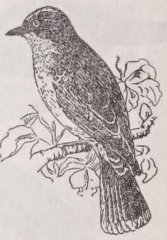
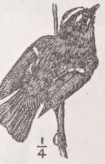
KING-BIRD, the Lanius tyrannus of Linnaeus, and the Tyrannus carolineηsis or T. pipiri of most later writers, a common and characteristic inhabitant of North America, ranging as high as 57° N. lat. or further, and westward to the Rocky Mountains, beyond which it goes to Oregon, Washington Territory, and British Columbia, though apparently not occurring in California. In Canada and the northern States of the Union it is a summer visitor, wintering in the south, but also reaching Cuba; and, passing through Central America, it has been found in Bolivia and eastern Peru. Both the scientific and common names of this species are taken from the way in which the cock will at times assume despotic authority over other birds, attacking them furiously as they fly, and forcing them to divert or altogether desist from their course. Yet it is love of his mate or his young that prompts this bellicose behaviour, for it is only in the breeding season that he indulges in it; but then almost every large bird that approaches his nest, from an Eagle downwards, is assaulted, and those alone that possess greater command of flight can escape from his repeated charges, which are accompanied by loud and shrill cries. Ou these occasions it may be that the King-bird displays the emblem of his dignity, which is commonly concealed; for, being otherwise rather plainly coloured—dark ashy-grey above and white beneath —the erectile feathers of the crown of the head, on being parted, form as it were a deep furrow, and reveal their base, which is of a bright golden-orange in front, deepening into scarlet, and then passing into silvery-white. This species seems to live entirely on insects, which it captures on the wing, and is in bad repute with bee-masters, though, according to Dr Coues, it ...“destroys a thousand noxious insects for every bee it eats.” It builds, often in an exposed situation, a rather large nest, coarsely constructed outside, but neatly lined with fine roots or grasses, and lays five or six eggs of a pale salmon colour, beautifully marked with blotches and spots of purple, brown, and orange, generally disposed in a zone near the larger end.
Nearly akin to the King-bird is the Petchary or Chicheree, so called from its loud and petulant cry, T. dominicensis, or T. griseus, one of the most characteristic and conspicuous birds of the West Indies, and the earliest to give notice of the break of day. In habits, except that it eats a good many berries, it is the very counterpart of its congener, and is possibly even more jealous of any intruder. At all events its pugnacity extends to animals from which it could not possibly receive any harm, and is hardly limited to any season of the year.
In several respects both of these birds, with several of their allies, resemble some of the Shrikes; but it must be clearly understood that the likeness is but of analogy, and that there is no near affinity between the two Families Laniidae and Tyrannidae, which belong to wholly distinct sections of the great Passerine Order; and, while the former is a comparatively homogeneous group, much diversity of form and habits is found among the latter. Similarly many of the smaller Tyrannidae bear some analogy to certain Muscicapidae, with which they were at one time confounded (see Flycatcher, vol. ix. p. 351); but the difference between them is deep seated. Nor is this all, for out of the seventy genera, or thereabouts, into which the Tyrannidae have been divided, comprehending perhaps three hundred and fifty species, all of which are peculiar to the New World, a series of forms can be selected which find a kind of parallel to a series of forms to be found in the other group of Passeres ; and the genus Tyrannus, though that from which the Family is named, is by no means a fair representative of it; but it would be hard to say which genus should be so accounted. The birds of the genus Muscisaxicola have the habits and almost the appearance of Wheatears; the genus Alectorurus calls to mind a Water-Wagtail; Euscarthmus may suggest a Titmouse, Elaiηea perhaps a Willow-Wren; but the greatest number of forms have no analogous bird of the Old World with which they can be compared; and, while the combination of delicate beauty and peculiar external form possibly attains its utmost in the long-tailed Milvulus, the glory of the Family may be said to culminate in the king of King-birds, Muscivvra regia. (a. n.)
[772 words — estimated reading time: 5 minutes]
KING-TIH CHIN, a town near Foo-leang Heen in the province of Keang-se, China, and the principal seat of the porcelain manufacture in that empire. Being situated on the south bank of the river Chang, it was in ancient times known as Chang-nan Chin, or “town on the south of the river Chang.” It is unwalled, and stretches along the bank of the river in a somewhat straggling way. The streets are narrow, and crowded with a population which is reckoned at a million, the vast majority of whom find employment at the porcelain factories. Since the Ch’in dynasty (557-589) this has been the great trade of the place, which was then called by its earlier name. In the reign of King-tih of the Sung dynasty (1004-1007) a manufactory was founded there for making vases and objects of art for the use of the emperor. Hence its adoption of its present title. Since the time of the Ming dynasty a magistrate has been specially appointed to superintend the factories and to despatch at regulated intervals the imperial porcelain to Peking. The town is situated on a vast plain surrounded by mountains, and boasts of three thousand porcelain furnaces. These constantly burning fires are the causes of frequent conflagrations, and at night give the city the appearance of a place on fire. The people are as a rule orderly, though they have on several occasions shown a hostile bearing towards foreign visitors. This is probably to be accounted for by a desire to keep their art as far as possible a mystery, and is after all only an extreme interpretation of the law which forbids strangers to lodge in the town. This feeling appears less unreasonable when it is remembered that the two kinds of earth of which the porcelain is made are not found at King-tih Chin, but are brought from K’i-mun in the ...neighbouring province of Gan-hwuy, and that there is therefore no reason why the trade should be necessarily maintained at that place. The two kinds of earth are known at pih-tun-tsze, which is a fine fusible quartz powder, and kaou-lin, which is not fusible, and which it is said gives strength to the ware (see Kaolin). Both materials are prepared in the shape of bricks at K’i-mun, and are brought down the Chang to the seat of the manufacture.
[408 words — estimated reading time: 3 minutes]
in Scripture, is a term of frequent occurrence, and variously applied. Thus we read of the kingdom of God, Psalm ciii, 19; Dan. iv, 3; or his universal empire and dominion over all creatures; in reference to which it is said, “Jehovah is a great God, and a great King above all gods,” Psalm xcv, 3. “His throne is established in the heavens, and his kingdom ruleth over all.” Again: we frequently read in the evangelists of the kingdom of heaven; a phrase, says Dr. Campbell, in which there is a manifest allusion to the predictions in which the dispensation of the Messiah was revealed by the prophets in the Old Testament, particularly by Daniel, who mentions it as “a kingdom which the God of heaven would set up, and which should never be destroyed,” Dan. ii, 44. The same prophet also speaks of it as a kingdom to be given, with glory and dominion over all people, nations, and languages, to one like unto the Son of man, Dan. vii, 13, 14. And the Prophet Micah, speaking of the same era, represents it as a time when Jehovah, having removed all the afflictions of his people, would reign over them in Mount Zion thenceforth even for ever, Micah iv, 6, 7. According to the prophecy of Daniel, this kingdom was to take place during the existence of the Roman empire, the last of the four great monarchies that had succeeded each other, Dan. ii, 44. And as it was set up by the God of heaven, it is, in the New Testament, termed “the kingdom of God,” or “the kingdom of heaven.” It was typified by the Jewish theocracy, and declared to be at hand by John the Baptist, and by Christ and his Apostles also in the days of his flesh; but it did not come with power till Jesus rose from the dead and sat down on the right hand of the Majesty on high, Acts ii, 32–37. Then was he ...most solemnly inaugurated, and proclaimed King of the New Testament church, amidst adoring myriads of attendant angels, and “the spirits of just men made perfect.” Then were fulfilled the words of Jehovah by the Psalmist David, “I have set my King upon my holy hill of Zion,” Psalm ii, 6. This is that spiritual empire to which he himself referred when interrogated before Pontius Pilate, and in reference to which he said, “My kingdom is not of this world,” John xviii, 36, 37. His empire, indeed, extends to every creature; for all authority is committed into his hands, both in heaven and on earth,” and he is head over all things to the church;” but his kingdom primarily imports the Gospel church, which is the subject of his laws, the seat of his government, and the object of his care; and, being surrounded with powerful opposers, he is represented as ruling in the midst of his enemies. This kingdom is not of a worldly origin, or nature, nor has it this world for its end or object. It can neither be promoted nor defended by worldly power, influence, or carnal weapons, but by bearing witness unto the truth, or by the preaching of the Gospel with the Holy Ghost sent down from heaven. Its real subjects are only those who are of the truth, and hear Christ’s voice; for none can enter it but such as are born from above, John iii, 3–5; nor can any be visible subjects of it, but such as appear to be regenerated, by a credible profession of faith and obedience. Its privileges and immunities are not of this world, but such as are spiritual and heavenly; they are all spiritual blessings in heavenly things in Christ Jesus, Ephesians i, 3.
[630 words — estimated reading time: 4 minutes]
KINGLET, a name applied in many books to the bird called by Linnaeus Motacilla regulus, and by most modern ornithologists B,egulus cristatus, the Golden-crested or Golden-crowned Wren of ordinary persons. This species is the type of a small group which has been generally placed among the Sylviidae or true Warblers, but by certain systematists it is referred to the Titmouse-Family, Paridae. That the Kinglets possess many of the habits and actions of the latter is undeniable, but on the other hand they are not known to differ in any important points of organization or appearance from the former—the chief distinction being that the nostril is covered by a single bristly feather directed forwards. The Golden-crested Wren is the smallest of British birds, its whole length being about 3 inches and a half, and its wing measuring only 2 inches from the carpal joint. Generally of an olive-green colour, the top of its head is bright yellow, deepening into orange, and bounded on either side by a black line, while the wing coverts are dull black, and some of them tipped with white, forming a somewhat conspicuous bar. The cock has a pleasant but weak song. The nest is a beautiful object, thickly felted of the softest moss, wool, and spiders’ webs, lined with feathers, and usually built under and near the end of the branch of a yew, fir, or cedar, supported by the interweaving of two or three laterally diverging and pendent twigs, and sheltered by the rest. The eggs are from six to ten in number, of a dull white sometimes finely freckled with reddish-brown. The species is particularly social, living for the most of the year in family-parties, and often joining bands of any species of-Titmouse in a common search for food. Though to be met with in Britain at all seasons, the bird ...in autumn visits the east coast in enormous flocks, apparently emigrants from Scandinavia, while hundreds perish in crossing the North Sea, where they are well known to the fishermen as “Woodcock’s Pilots.” A second and more local European species is the Fire-crested Wren, R. ignicapillus, easily recognizable by the black streak on each side of the head, before and behind the eye, as well as by the deeper colour of its crown. A third species, R. maderensis, inhabits the Madeiras, to which it is peculiar; and examples from the Himalayas and Japan have been differentiated as R. himalayensis and R. japonicus. North America has two well-known species, R. satrapa, very like the European R. ignicapillus, and the Ruby-crowned Wren, R. calendula, which is remarkable for a loud song that has been compared to that of a Canary-bird or a Sky-lark, and for having the characteristic nasal feather in a rudimentary or aborted condition. Under the name of R. modestus, or “Dalmatian Regulus” of many English authors, two very distinct species are now known to have been confounded, both belonging really to the group of Willow-Wrens, and having nothing to do with Regulus. One, which has occurred in Britain, is the Motacilla superciliosa of old or Phylloscopus superciliosus of modern authors, and is a native of northern Asia, visiting Europe nearly every year, and the other, also of Asiatic origin, is the Motacilla or Phylloscopus proτegulus. (a. n.)
[562 words — estimated reading time: 4 minutes]