RHIN Haut-, a department of France before 1871. See France, vol. ix. p. 508.
[14 words — estimated reading time: 1 minute]
RHIN Haut-, a department of France before 1871. See France, vol. ix. p. 508.
RHINE (Lat. Rhenus, Germ. Rhein, Fr. Rhin, Dutch Rhijn), the chief river of Germany and one of the most important in Europe, is about 800 miles in length and drains an area of 75,000 square miles. The distance in a direct line between its source in the Alps and its mouth in the German ocean is 460 miles. Its general course is north-north west, but it makes numerous deflexions and at one point is found running in a diametrically opposite direction. About 250 miles of its length are in Switzerland, 450 in Germany, and 100 in Holland; but the German half is in every respect so much the more important that it is no misnomer to call the Rhine a German river, even if the word German be confined to its modern political signification. The name Rhine, which is apparently of Celtic origin, is of uncertain import, but has been supposed to mean “flowing” or “clear.” The sources of the Rhine are found in the Swiss canton of Grisons, where the drainage of at least 150 glaciers unites to form its headwaters. Among these streams, all of which are termed Rhin in the Ladine dialect of the district, two are generally recognized as the main sources of the river, viz., the Vorder Rhein and the Hinter Rhein. The chief feeder of the former rises in the small Lake of Toma, situated on the south-east slope of the St Gotthard, at a height of 7690 feet above the sea and at no great distance from the source of the Rhone, which rises on the west side of the same mountain mass. It first flows to the east, receiving the waters of the Medelser Rhein and several other glacier streams, and after a course of about 45 miles unites with the Hinter Rhein at Reichenau. As far as Ilanz the Vorder Rhein is simply a mountain torrent, descending 1200 feet in the first 12 miles of its course. At Disentis, ...where it is joined by the Medelser Rhein, it is 15 feet wide, and at Ilanz it is about thrice as large. The Hinter Rhein has its cradle in the Rheinwald glacier, near the St Bernardino Pass, 7270 feet above the sea and 40 miles south of Reichenau. The Vorder Rhein contributes the greater volume of water to the joint stream, but the Hinter Rhein belongs to a more developed system.
Beyond Reichenau the united stream, 150 feet in width, bears the name of Rhine without any qualifying epithet. It is now navigable for rafts, and small boats begin to be seen a little further on, at Coire, where it turns to the north. On reaching the Lake of Constance the Rhine deposits the debris that it has brought down from its mountain sources, and the stream that emerges from the west end of the Untersee is of a clear deep green colour. Between the Lake of Constance and Basel the Rhine flows towards the west and practically forms the boundary between Germany and Switzerland. At Schaffhausen, in penetrating the barrier of the Jura, it forms the imposing falls of the Rhine, where it is precipitated over a ledge of rock in three leaps 50 or 60 feet in height. Near Lauterburg, where the river encounters the gneiss of the Black Forest, is a series of formidable cataracts, and about 15 miles lower down are the rapids of Rheinfelden. At Basel, which it reaches after a tortuous course of 250 miles, though it is only about a third of that distance from its source in a direct line, the Rhine turns once more to the north and enters Germany. Its breadth here is between 550 and 600 feet, while its surface now lies not more than 800 feet above the sea, showing that the river has made a descent of 6900 feet by the time it has traversed a third of its course. From Basel to Mainz the Rhine flows through a wide and shallow valley, bordered on the east and west by the parallel ranges of the Black Forest and the Vosges. Its banks are low and flat, and numerous islands occur. The tendency to divide into parallel branches has been curbed in the interests of navigation, and many windings have been cut off by leading the water into straight and regular channels. At Mannheim the river is nearly 1500 feet in width, and at Mainz, where it is diverted to the west by the barrier of the Taunus, it is still wider. It follows the new direction for about 20 miles, but at Bingen it again turns to the north and begins a completely new stage of its career, entering a narrow valley in which the enclosing rocky hills abut so closely on the river as often barely to leave room for the road and railway on the bank. This is the most beautiful part of the whole course of the river, abounding in the ruined castles, the romantic crags, the sunny vineyards, and the picturesque lateral ravines that have combined to make the Rhine so favourite a resort of lovers of natural beauty. At Coblentz the valley widens and the river is 1200 feet broad, but the hills close in again at Andernach, and this ravine-like part of its course cannot be considered as ending till below the Seven Mountains, where the river once more expands to a width of
1300-1600 feet. Beyond Bonn and Cologne the banks are again flat and the valley wide, though the hills on the right bank do not completely disappear till the neighbourhood of Düsseldorf. Further on the country traversed by the Rhine is perfectly level, and the current becomes more and more sluggish. On entering Holland, which it does below Emmerich, its course is again deflected to the west. Within Holland the banks are so low as to require at places to be protected by embankments against inundations. The river now loses its individuality in a number of separate branches, and the name of Rhine has often arbitrarily clung to the smaller arm after a bifurcation. Almost immediately after entering Holland the stream divides into two arms, the larger of which, carrying off about two-thirds of the water, diverges to the west, is called the Waal, and soon unites with the Maas. The smaller branch to the right retains the name of Rhine and sends off another arm, called the Yssel, to the Zuyder Zee. The Rhine now pursues a westerly course almost parallel with that of the Waal. At Wijk another bifurcation takes place, the broad Lek diverging on the left to join the Maas, while the “Kromme Rhijn” to the right is comparatively insignificant. Beyond Utrecht, where it is again diminished by the divergence of the Vecht to the Zuyder Zee, the river under the name of the “Oude Rhijn” or Old Rhine degenerates into a sluggish and almost stagnant stream, which requires the artificial aid of a canal and sluices in finding its way to the sea. In Roman times the Rhine at this part of its course seems to have been a full and flowing river, but by the 9th century it had lost itself in the sands of Katwijk, and it was not until the beginning of the l9th century that its way to the sea was re-opened. Though the name Rhine thus at last attaches to a very insignificant stream, the entire district between the Waal on one side and the Yssel on the other, the Insula Batαvorum of Caesar, in reality belongs to the delta of the famous river. See vol. xii. Plate I.
The Rhine is said to receive, directly or indirectly, the waters of upwards of 12,000 tributaries of all sizes. Leaving out of account the innumerable glacier streams that swell its volume above the Lake of Constance, the most important affluents to its upper course are the Wutach, the Alb, and the Wiese, descending on the right from the Black Forest, and the Aar, draining several Swiss cantons on the left. In the Upper Rhenish basin, between Basel and Mainz, the tributaries, though numerous, are mostly short and unimportant. The 111 and the Nahe on the left and the Neckar and the Main on the right are, however, notable exceptions. Before joining the Rhine the 111 runs almost parallel with it and at no great distance for upwards of 50 miles. In the narrow part of the valley, between Bingen and Cologne, the Rhine receives the waters of the Lahn and the Sieg on the right, and those of the Moselle (bringing with it the Saar) and the Ahr on the left. Still lower down, but before the Dutch frontier is reached, come the Ruhr and the Lippe on the right, and the Erft on the left. The numerous arms into which the Rhine branches in Holland have already been noticed.
The Rhine connects the highest Alps with the mud banks of Holland, and touches in its course the most varied geological periods; but the river valley itself is, geologically speaking, of comparatively recent formation. Rising amid the ancient gneiss rocks of the St Gotthard, the Rhine finds its way down to the Lake of Constance between layers of Triassic and Jurassic formation; and between that lake and Basel it penetrates the chalk barrier of the Jura. The upper Rhenish valley is evidently the bed of an ancient lake, the shores of which were formed by the gneiss and granite of the Black Forest on the one side and the granite and sandstone of the Vosges on the other. Within the valley all the alluvial deposits are recent. Between Bingen and Bonn the Rhine forces its way through a hilly and rocky district belonging to the Devonian formation. The contorted strata of slate and greywacke rock must have been formed at a period vastly anterior to that in which the lake of the upper valley managed to force an outlet through the enclosing barriers. Probably this section may be looked upon as the oldest portion of the river course proper, connecting the upper Rhenish lake with the primeval ocean at Bonn. In this district too, as has already been remarked, is the finest scenery of the Rhine, a fact due in great part to the grotesque shapes of the quartzose rocks, left denuded of the less durable slate and sandstone. All the strata intersected by the Rhine between Bingen and Bonn contain fossils of the same classes. The deposits of the actual valley here, belonging to the Miocene group of the Tertiary system, are older than the deposits either farther up or farther down the river; but they are contemporaneous with the basalts of the Rhine, which at Coblentz and in the peaks of the Seven Mountains also contribute to the scenic charm of the river. The very extensive pumice deposits at Neuwied and the lava and other volcanic rocks belong to a more recent epoch. Below Bingen the formations belong almost entirely to the Post-Tertiary period. Numerous extinct volcanoes rise near Neuwied. In the flatter parts of the valley occur large beds of loam and rubble, sometimes in terraces parallel with, but several hundred feet above, the river,—proving by their disposition and appearance that the valley has been formed by the action of water.
The Rhine has been one of the chief waterways of Europe from the earliest times; and, as its channel is not exposed to the danger of silting up like those of the Elbe and the Oder, it has always been comparatively easy to keep it open. The Romans exerted themselves to improve the lower navigation of the river, and appointed prefects of the Rhine to superintend the shipping and to exact the moderate dues imposed to keep the channel in repair. The Franks continued the same policy and retained a system of river-dues. Afterwards as the banks became parcelled out among a host of petty princelings, each of whom arrogated the right of laying a tax on passing vessels, the imposts became so prejudicial as seriously to hamper the development of the shipping. Many of the riparian potentates derived the bulk of their revenue from this source, and it is calculated that in the.l8th century the Rhine yielded a total revenue of £200,000, in spite of the comparatively insignificant amount of the shipping. The first proposal for a free Rhine was mooted by the French at the congress of Rastatt (1797-1799), but Holland, commanding the mouth of the river, placed every obstacle in the way of the suggestion. In 1831, on the separation of Holland and Belgium, the former had become more amenable to reason; and a system was agreed upon which practically gave free navigation to the vessels of the riverine states, while imposing a moderate tariff upon foreign ships. It was not, however, till 1869 that the last vestige of a toll disappeared and the river was thrown open without any restriction. The management of the channel and navigation is now vested in a Central Commission, meeting at Mannheim. The channel has been greatly improved, and in many places made more direct since the beginning of the present century,—large sums being annually spent in keeping it in order. Capacious river harbours have been formed at various points, about twenty-five of these being in Germany and eight or ten more in Holland. The total weight of the goods forwarded each year on the Rhine has of late amounted to nearly 1,000,000 tons, the chief articles being timber, coal, iron, agricultural produce, and manufactured goods of various kinds. The position of the liver is highly favourable for the development of its trade. It flows through the most populous regions of the continent of Europe, to discharge into one of the most frequented seas opposite Great Britain, and, besides serving as a natural outlet for Germany, Belgium, and Holland, is connected with a great part of central and southern France by the Rhine-Rhone and the Rhine-Marne Canals, and with the basin of the Danube by the Ludwigs-Canal.
The introduction of steam has greatly increased the shipping on the Rhine; and small steamers ply also on the Main, the Neckar, the Maas, and the Moselle. The first Rhine steamer was launched in 1817; and now the river is regularly traversed by upwards of a hundred, from the small tug up to the passenger saloon-steamer. The steamboat traffic has especially encouraged the influx of tourists, and the number of passing travellers may now be reckoned as between one and two millions annually. The river is navigable without in,teιτuρtion from Basel to its mouth, a distance of 550 miles, of which 450 lie within Germany. Above Spires, however, the river craft are comparatively small, but lower down vessels of 500 and 600 tons burden find no difficulty in plying. Between Basel and Strasburg the depth of water is sometimes not more than 3 feet; between Strasburg and Mainz it varies from 5 to 25 feet; while below Mainz it is never less than 9 or 10 feet. The deepest point is opposite the Luιiei Rock near St Goar, where it is 75 feet in depth; at Düsseldorf the depth is about 50 feet. Oue of the most interesting features of the Rhine navigation is afforded by the huge rafts of timber that are floated down the river. Single tree trunks sent down to the Rhine by the various tributaries are united into small rafts as they reach the main stream; and these again are fastened together to form one large raft about Andernach. Though not so large as formerly, these timber-rafts are still sometimes 400 or 500 feet in length, and are navigated by 200 to 400 men, who live in little huts on the raft, forming actual floating villages. On reaching Dort the rafts are broken up and sold, a single raft sometimes producing as much as £30,000. The voyage from Bingen to. Dort takes from one to six weeks, and the huge unwieldy structures require to be navigated with great care. The commerce carried on by the river itself is supplemented by the numerous railways, which skirt its banks and converge to its principal towns. Before the introduction of railways there were no permanent bridges across the Rhine below Basel; but now trains cross it at about a dozen different points in Germany and Holland.
The salmon fisheries of the Rhine, lying mainly between Bach-arach and St Goar, have long been famous; but their produce has been seriously diminished since the advent of the steamer. Pike, carp, and other white fish are also caught. A little gold is brought down by the Rhine from the Alps and the heights of the Black Forest, but not in sufficient amount to make its collection of economic value. The white wines of the Rhine are the finest in the world, though the palm in red wines must be given to the vineyards of Bordeaux. The vineyards lie mainly bet when Mainz and Bonn, a distance of 90 miles,—the choicest varieties of wine being produced in the Rheingau, a picturesque district on the right bank between Riidesheim and Biebrich, about 12 miles long and 5 broad. The well known brands Johannisberger, Steinberger, Marcobrunner, and Assmannshauser are all grown in this narrow compass. The valleys of the Neckar, the Moselle, the Nahe, and other tributaries of the Rhine also yield good wine; and the valley of the Ahr may be indicated as the northern limit of the wine culture. The total annual value of the Rhenish wines is about £2,400,000.
The long array of ancient and flourishing towns along its banks bear witness to the great importance of the river. These are most frequent in the upper Rhenish basin and again below Bonn, the places in the narrower part of the valley being generally more remarkable for their picturesque situation than for their commercial or political influence. Beyond the borders of Germany the only large towns on the Rhine are Basel in Switzerland, and Arnheim, Utrecht, and Leyden in Holland. Within Germany, as we trace the course of the river form south to north, we come successively to Spires, Mannheim, Mainz, Coblentz, Bonn, Cologne, Düsseldorf, and Wesel. Worms, which was formerly washed by the Rhine, lies about ∣ mile distant from the present course; and Strasburg, which lies on the 111, 2 miles from the Rhine, may also be reckoned as one of its towns.
Politically the Rhine has always played a great part; and it would require no great straining to write a history of this majestic river which would also be a history of the western half of continental Europe. The whole valley seems to have been originally occupied by Celtic tribes, who have left traces of their presence on the contents of tombs and in the forms of names (Moguutiacum or Mainz, Borbetomagus or Worms, &c.); but at the beginning of the historical period we find the Celts everywhere in retreat before the advancing Teutons. Probably the Teutonic pressure began as early as the 4th century before Christ, and the history of the next few hundred years may be summed up as the gradual substitution of a Germanic for a Celtic population along the banks of the Rhine. Its second historical period begins with the advent of the Romans, who stemmed the advancing Teutonic tide. Augustus and his successors took good care to fortify the Rhine carefully, and a large proportion of the Roman legions were constantly in garrison here. For two hundred years the Rhine formed the boundary between the Roman empire and the Teutonic hordes; and during that period the left or Roman bank made prodigious strides in civilization and culture. The wonderful Roman remains at Treves and elsewhere, the Roman roads, bridges, and aqueducts, are convincing proofs of what the Rhine gained from Roman domination. This Roman civilization was, however, destined to be swamped by the current of Teutonic immigration, which finally broke down the barriers of the Roman empire and overwhelmed the whole of the Rhenish district. Under Charlemagne, whose principal residence was in Aix-la-Chapelle, the culture of the Rhine valley again began to flourish, its results being still to be traced in the important architectural remains of this period. At the partition of the domains of Charlemagne in 843 a.d. the Rhine formed the boundary between Germany and the middle kingdom of Lotharingia; but by 870 it lay wholly within the former realm. For nearly eight hundred years it continued in this position, the frontier of the German empire coinciding more or less with the line of the Rhone. During the early Middle Ages the bank of the Rhine formed the most cultured part of Germany, basing its civilization on its Roman past. The Thirty Years’ War exercised a most prejudicial effect upon the district of the Rhine; and the peace of Westphalia gave France a footing on the left bank of the hitherto exclusively German river by the acquisition of Alsace. The violent seizure of...
RHINOCEROS a name applied by the ancients to an animal the most striking external peculiarity of which is certainly the horn growing above its nose (ρινόκερω?, nose-horn).
The various existing and extinct species are grouped into a family, Rhinocerotidae, which is a division of the Perissodactyle (odd-toed) section of the great order of Uηgulata or hoofed mammals, of which section the tapirs and horses are the only other surviving members (see Mammalia, vol. χv. p. 428).
The following are the general characters applicable to all the members of the family....
First, as regards dentition. Incisors variable, generally reduced in number and often quite rudimentary, and early deciduous. Canines, in existing species, absent. Molar series, consisting of the full number of four premolars and three molars above and below, all in contact and closely resembling each other, except the first, which is much smaller than the rest and often deciduous. The others gradually increasing in size up to the penultimate. The upper molars have a very characteristic pattern of crown, having a much-developed fiat or more or less sinuous outer wall, and two transverse ridges running obliquely inwards and backwards from it, terminating internally in conical eminences or columns, and enclosing a deep (middle) sinus between. The posterior sinus is formed behind the posterior transverse ridge, and is bounded externally by a backward continuation of the outer wall and behind by the cingulum. The anterior sinus is formed in the same manner, but is much smaller. The middle sinus is often intersected by vertical laminae (“combing plates ”) projecting into it from the anterior surface of the posterior transverse ridge or from the wall, the development of which is a useful guide in discriminating the species, especially those no longer existing and known only by the teeth and bones. The depressions between the ridges are not filled up with cementum as in the horse. The lower molars have the crown formed by a pair of crescents; the last has no third lobe or talon.
Head large, skull elongated, elevated posteriorly into a transverse occipital crest. No post-orbital processes or any separation between orbits and temporal fossae. Nasal bones large and stout, co-ossified, and standing out freely above the premaxillae, from which they are separated by a deep and wide fissure; the latter small, generally not meeting in the middle line in front, often quite rudimentary. Tympanies small, not forming a bulla. Brain cavity very small for the size of the skull. Vertebrae :—cervical, 7; dorsal, 19-20; lumbar, 3; sacral, 4; caudal, about 22. Limbs stout, and of moderate length. Three completely developed toes, with distinct broad rounded hoofs on each foot. Mammae two, inguinal. Eyes small. Ears of moderate size, oval, erect, prominent, placed near the occiput. Skin very thick, in many species thrown into massive folds. Hairy covering ∙ scanty. All existing species have one or two median horns on the face. When one is present it is situated over the conjoined nasal bones; when two, the hinder one is over the frontals. These horns, which are of a more or less conical form and usually recurved, and often grow to a great length (three or even four feet), are composed of a solid mass of hardened epidermic cells growing from a cluster of long dermal papillae. The cells formed on each papilla constitute a distinct horny fibre, like a thick hair, and the whole are cemented together by an intermediate mass of cells which grow up from the interspaces between the papillae. It results from this that the horn has the appearance of a mass of agglutinated hairs, which, in the newly growing part at the base, readily fray out on destruction of the softer intermediate substance; but the fibres differ from true hairs in growing from a free papilla of the derm, and not within a follicular involution of the same.
The Rhinocerotidae are all animals of large size, but of little intelligence, generally timid in disposition, though ferocious when attacked and brought to bay, using the nasal horns as weapons, by which they strike and toss their assailant. Their sight is dull, but their hearing and scent are remarkably acute. They feed on herbage, shrubs, and leaves of trees, and, like so many other large animals which inhabit hot countries, sleep the greater part of the day, being most active in the cool of the evening or even during the night. They are fond of bathing and wallowing in water or mud. None of the species have been domesticated. Animals of the group have existed in both the Old and New Worlds since the beginning of the Miocene period. In America they all became extinct before the end of the Pliocene period. In the Old World their distribution has become greatly restricted, being no longer found in Europe and North Asia, but only in Africa and in portions of the Indian and Indo-Malayan regions.
The existing species of rhinoceros are naturally grouped into three sections, which some zoologists consider of generic value.
I. Rhinoceros proper. The adults with a single large compressed incisor above on each side, and occasionally a small lateral one; below, a very small median, and a very large, procumbent, pointed lateral incisor. Nasal bones pointed in front. A single nasal horn. Skin very thick, and raised into strong, definitely arranged ridges or folds.
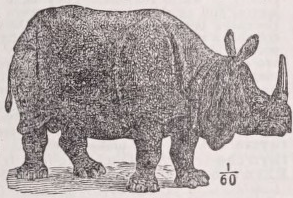
There are two well-marked species of one-horned rhinoceroses. (1) The Indian Rhinoceros, R. uηicomis of Lin-naeus, the largest and best known, from being the most frequently exhibited alive in England, is at present only met with in a wild state in the terai region of Nepal and Bhutan, and in the upper valley of the Brahmaputra or province of Assam, though it formerly had a wider range.
Roman shows, was of this species. It was sent from India to Emmanuel, king of Portugal, in 1513; and from a sketch of it, taken in Lisbon, Albert Dürer composed his celebrated but rather fanciful engraving, which was reproduced in so many old books on natural history. (2) The Javan Rhinoceros, R. sondaicus, Cuvier, is distinguished by smaller size, special characters of the teeth and skull, and different arrangement of the plications of the skin (as seen in the figures); the horn in the female appears to be very little developed, if not altogether absent. This has a more extensive geographical range, being found in the Bengal Sunderbans near Calcutta, Burmah, the Malay Peninsula, Java, Sumatra, and probably Borneo.
II. Ceratorhiηus. The adults with a moderate-sized compressed incisor above, and a laterally placed, pointed, procumbent incisor below, which is sometimes lost in old animals. Nasal bones narrow and pointed anteriorly. A well-developed nasal, and a small frontal horn separated by an interval. The skin thrown into folds, but these not so strongly marked as in the former section. The smallest living member of the family, the Sumatran Rhiroceros, R. sumatreηsis, Cuv., belongs to this group. Its geographical range is nearly the same as that of the Javan species, though not extending into Bengal; but it has been found in Assam, Chittagong, Burmah, the Malay Peninsula, Sumatra, and Borneo. It is possible that more than one species have been confounded under this designation, as two animals now living in the London Zoological Gardens present considerable differences of form and colour. One of them, from Chittagong, has been named by Sclater R. lasiotis, the Hairy-Eared Rhinoceros, but until an opportunity is afforded for anatomical examination, it is difficult to pronounce upon the value of the distinction.
III. Atelodus. In the adults, the incisors are quite rudimentary or entirely wanting. Nasal bones thick, rounded and truncated in front. Well-developed anterior and posterior horns in close contact. Skin without any definite permanent folds.
The two well-marked existing species are peculiar to the African continent.
1. The common Two-Horned Rhinoceros, R. bicomis, Linn., is the smaller of the two, with a pointed prehensile upper lip, and a narrow compressed deep symphysis of the lower jaw. It ranges through the wooded and watered districts of Africa, from Abyssinia in the north to the Cape Colony, but its numbers are yearly diminishing, owing to the inroads of European civilization, and especially of English sportsmen. It feeds exclusively upon leaves and branches of bushes and small trees, and chiefly frequents the sides of wood-clad rugged hills. Specimens in which the posterior horn has attained a length as great as or greater than the anterior have been separated under the name of R. keitloa, but the characters of these appendages are too variable to found specific distinctions upon. The twohorned African rhinoceros is far more rarely seen in menageries in Europe than either of the three Indian species, but one has lived in the gardens of the London Zoological Society since 1868. Excellent figures from life of this and the other species are published in the ninth volume of the Transactions of the society, from which the accompanying woodcuts are reduced.
2. BurchelΓs or the Square-Mouthed Rhinoceros (/?. simus), sometimes called the White Rhinoceros, though the colour (dark-slate) is not materially different from that of the last species, is the largest of the whole group, and differs from all the others in having a square truncated upper lip and a wide, shallow, spatulate symphysis to the lower jaw. In conformity with the structure of the mouth, this species lives entirely by browsing on grass, and is therefore more partial to open countries or districts where there are broad grassy valleys between the tracts of bush. It is only found in Africa south of the Zambesi, and of late years has become extremely scarce, owing to the persecutions of sportsmen; indeed, the time of its complete extinction cannot be far off. No specimen of this species has ever been brought alive to Europe. Mr Γ. C. Selous gives the following description of its habits from extensive personal observation :—
“The square-mouthed rhinoceros is a huge ungainly-looking beast, with a disproportionately large head, a large male standing 6 feet 6 inches at the shoulder. Like elephants and buffaloes they lie asleep during the heat of the day, and feed during the night and in the cool hours of early morning and evening. Their sight is very bad; but they are quick of hearing, and their scent is very keen; they are, too, often accompanied by rhinoceros birds, which, by running about their heads, flapping their wings, and screeching at the same time, frequently give them notice of the approach of danger. When disturbed they go off at a swift trot, which soon leaves all pursuit from a man on foot far behind; but if chased by a horseman they break into a gallop, which they can keep up for some distance. However, although they run very swiftly, when their size and heavy build is considered, they are no match for an average good horse. They are, as a rule, very easy to shoot on horseback, as, if one gallops a little in front of and on one side of them, they will hold their course, and come sailing past, offering a magnificent broadside shot, while under similar circumstances a prehensile-lipped rhinoceros will usually swerve away in such a manner as only to present his hind-quarters for a shot. When either walking or running, the square-mouthed rhinoceros holds its head very low, its nose nearly touching the ground. When a small calf accompanies its mother, it always runs in front and she appears to guide it by holding the point of her horn upon the little animal’s rump; and it is perfectly wonderful to note how in all sudden changes of pace, from a trot to a gallop or vice versa, the same position is always exactly maintained. During the autumn and winter months (i.e., from March to August) the square-mouthed rhinoceros is usually very fat; and its meat is then most excellent, being something like beef, but yet having a peculiar flavour of its own. The part in greatest favour among hunters is the hump, which, if cut off whole and roasted just as it is in the skin, in a hole dug in the ground, would, I think, be difficult to match either for juiciness or flavour.”— Proe. Zook Soc., 1881, p. 726
Extinct Species of Rhinoceros.— The family once contained many more species, which were far more widely distributed than at present. As in similar cases, our knowledge of them is as yet but fragmentary, though constantly augmenting, especially by discoveries made in the Tertiary deposits of North America, a region in which they all died out long ago, though, judging from the evidence at present available, this was the locality in which they first made their appearance. In the Eocene formations of the Rocky Mountains are found the remains of numerous modifications of the primitive Perissodactyle type, from which the rhinoceroses may have originated. In the Lower Miocene a form called Hyraeodxn by Leidy already presented many of the characteristics of the family, though, especially as regards the dentition, in a very generalized condition. The next stage of specialization is represented by Aeeratheriιιm, found in the Miocene of both Europe and America, which still, like the last, shows no sign of having possessed a nasal horn. It differed from the existing species also in having four toes on the anterior limb, instead of only three. At the same period forms occurred ODixera-theriwrn, Marsh) which show a pair of lateral tubercles on the nasal bones, apparently supporting horns side by side. These, however, soon disappeared and gave way in the Old World to species with one or two horns in the median line, a stage of development which apparently was never reached in America. In the Pliocene and Pleistocene of Europe and Asia numerous modifications of the existing types have been found. The present African two-horned type was represented in the Early Pliocene of Greece by R. pachy-gηathus, the skeleton of which is described by Gaudryas intermediate between the existing R. bieornis and R. simus. As many as three species were inhabitants of the British Isles, of which the best known is the Tichorhine or Woolly Rhinoceros, R. aηtiquitatis of Blumenbach, nearly whole carcases of which, with the thick woolly external covering, have been discovered associated with those of the mammoth, preserved in the frozen soil of the north of Siberia, and which, in common with some other extinct species, had a solid median wall of bone supporting the nasals, from which it is inferred that the horns were of a size and weight surpassing that of the modern species. The one-horned Indian type was well represented under several modifications (A. sivalensis, palaeindicus, &c. ), in the Pliocene deposits of the sub-Himalayan region, and forms more allied to the African bicorn species have also been found in India. R. schleirmacheri of the late European Miocenes was in some respects allied to the existing Sumatran rhinoceros, possessing incisor teeth and two horns. ( W. H. F. )