
Ending in a point; acuminated.
Word of the Day: Catachrestical
1. A military weapon consisting of a long wooden shaft or staff, with a flat steel head pointed; called the spear. This weapon was formerly used by infantry, but its use is now limited to officers, and it is called a sponton or spontoon. Its use among soldiers is superseded by the bayonet.
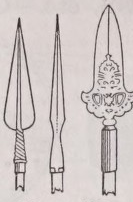
3. Among turners, the iron sprigs used to fasten any thing to be turned.
4. In ichthyology, a fish of the genus Esox, so named from its long shape or from the form of its snout. It is a fresh water fish, living in deep water and very voracious, but very palatable food.
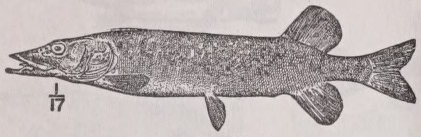
5. The pike the tyrant of the flood.
1. A foot soldier's weapon, consisting of a long wooden shaft or staff, with a pointed steel head. It is now superseded by the bayonet.
3. A hayfork.
4. A pick.
5. A pointed or peaked hill.
6. A large haycock.
Pike
Encyclopedia Britannica
PIKE, freshwater fishes generally distributed over the rivers and lakes of Europe, northern Asia, and North America, and forming a small family (Esocidae) of Soft-rayed Fishes. They are readily recognized by their elongate compressed body covered with small scales, a long head, long and spatulate snout, and very large mouth armed with strong and long teeth in the jaws and broad bands of smaller teeth on the palate and tongue. The teeth point backwards or can be depressed so as to offer no obstruction to any object entering the gape, but prevent its withdrawal in the opposite direction. The dorsal and anal fins are placed far back on the tail, thus greatly increasing the propelling power of the fish, and, although pike are bad swimmers and lead rather a sedentary than a roving life, they are excelled by no other freshwater fish in rapidity of motion when, by a single stroke of the tail, they dash upon their prey or dart out of reach of danger. In the Old World one species only is known (Esox lucius), which prefers lakes and sluggish reaches of rivers to strong currents or agitated waters. Its eastward range in northern Asia is not known; it extends into Lapland in the north and into central Italy and the vicinity of Constantinople in the south, but is absent in the Iberian Peninsula. The European species occurs also in North America, and is common in the eastern United States southwards to northern Ohio. But North America is tenanted by other species of pike besides, of which the largest is the Muskelunge or Maskinonge of the Great Lakes (Esox nobilior) ; it commonly attains to the large size which is exceptionally recorded of Esox lucius. The other American pike are of smaller size, and generally named “Pickerel”; but opinions as to the distinction of the species ...differ widely among American ichthyologists. The European pike, like its brethren, is the most voracious of freshwater fishes; it probably exceeds the shark, to which it has been compared by many writers, in the relative quantity of food it consumes. Ponds would soon be depopulated but for its cannibal propensities, no pike being safe from another of its own kind large enough to swallow it. To the young of water-fowl pike are most destructive, and large specimens will seize rats or rabbits when they take to the water, and are said to attack even foxes and small dogs. Individuals of from forty to fifty pounds are not scarce, but captures of much larger ones are on record. Pike are wholesome food, and much esteemed in inland countries,—the smaller (of 20 to 24 inches in length) being preferred to the larger individuals. They are prolific, and not easily exterminated in a water in which they have been once allowed to spawn. According to season and climate they spawn in April or May, and sometimes as early as February.
9th ed. Encyclopædia Britannica, vol. 19, p. 88
[487 words — estimated reading time: 3 minutes]
[487 words — estimated reading time: 3 minutes]
A pointed beard.
Pike-perch
Encyclopedia Britannica
PIKE-PERCH(Lucioperca), freshwater fishes closely allied to the perch, but with strong canine teeth standing between the smaller teeth of the jaws and palate. As indicated by the name, these fishes show some slight resemblance to the pike in their elongate body and head, and like that fish they are most dangerous enemies to other freshwater fishes. Their acclimatization therefore in waters intended for the culture of valuable food fishes is not advisable, though they compensate in some measure for their destructiveness by the excellent flavour of their flesh. In Europe two species occur, the more celebrated being the “Zander” of North Germany or “Schiel” of the Danube (Lucioperca sandra); strange to say, it is absent in the system of the Rhine. It prefers the quiet waters of large rivers and clear deep lakes, in which it reaches a weight of twenty-five or thirty pounds; it does not thrive in small and confined waters. The second European species (Lucioperca wolgensis) is limited to rivers in southern Russia and Hungary. In North America several pike-perches have been described, but in the most recent works only two are distinguished, viz., Lucioperca americana, which grows to a weight of twenty pounds, and the much smaller Lucioperca canadensis; both are abundant in the Canadian lakes and upper Mississippi, and the latter also in the Ohio.
9th ed. Encyclopædia Britannica, vol. 19, p. 89
[224 words — estimated reading time: 2 minutes]
[224 words — estimated reading time: 2 minutes]
1. Pointed; sharp.
1. The staff, or shaft, of a pike.
Height Roget’s Thesaurus §206
N. height, altitude, elevation, eminence, pitch, loftiness, sublimity, tallness, stature, procerity, prominence, colossus, giant, grenadier, giraffe, camelopard, mount, mountain, hill alto, butte, monticle, fell, knap, cape, headland, foreland, promontory, ridge, hog's back, dune, rising ground, vantage ground, down, moor, moorland, alp, uplands, highlands, heights &c. (summit), 210, knob, loma, pena, picacho, tump, knoll, hummock, hillock, barrow, mound, mole, steeps, bluff, cliff, craig, tor, peak, pike, clough, escarpment, edge, ledge, brae, dizzy height, tower, pillar, column, obelisk, monument, steeple, spire, minaret, campanile, turret, dome, cupola, skyscraper, pole, pikestaff, maypole, flagstaff, top mast, topgallant mast, ceiling, high water, high tide, flood tide, spring tide, altimetry, batophobia, satellite, spy-in-the-sky
V. be high, tower, soar, command, hover, hover over, fly over, orbit, be in orbit, cap, culminate, overhang, hang over, impend, beetle, bestride, ride, mount, perch, surmount, cover, overtop, stand on tiptoe, become high, grow higher, grow taller, upgrow, rise, send into orbit, render high, heighten
Adj. high, elevated, eminent, exalted, lofty, tall, gigantic, patagonian, towering, beetling, soaring, hanging, elevated, upper, highest, high reaching, insessorial, perching, upland, moorland, hilly, knobby, mountainous, alpine, subalpine, heaven kissing, cloudtopt, cloudcapt, cloudtouching, aerial, overhanging, incumbent, overlying, superincumbent, supernatant, superimposed, prominent &c. c, 250, tall as a maypole, tall as a poplar, tall as a steeple, lanky
Adv. on high, high up, aloft, up, above, aloof, overhead, airwind, upstairs, abovestairs, in the clouds, on tiptoe, on stilts, on the shoulders of, over head and ears, breast high, over, upwards, from top to bottom
Phr. e meglio cader dalle finistre che dal tetto
Sharpness Roget’s Thesaurus §253
N. sharpness, acuity, acumination, spinosity, point, spike, spine, spicule, spiculum, needle, hypodermic needle, tack, nail, pin, prick, prickle, spur, rowel, barb, spit, cusp, horn, antler, snag, tag thorn, bristle, adam's needle, bear grass, tine, yucca, nib, tooth, tusk, spoke, cog, ratchet, crag, crest, arete, cone peak, sugar loaf, pike, aiguille, spire, pyramid, steeple, beard, chevaux de frise, porcupine, hedgehog, brier, bramble, thistle, comb, awn, beggar's lice, bur, burr, catchweed, cleavers, clivers, goose, grass, hairif, hariff, flax comb, hackle, hatchel, heckle, wedge, knife edge, cutting edge, blade, edge tool, cutlery, knife, penknife, whittle, razor, razor blade, safety razor, straight razor, electric razor, scalpel, bistoury, lancet, plowshare, coulter, colter, hatchet, ax, pickax, mattock, pick, adze, gill, billhook, cleaver, cutter, scythe, sickle, scissors, shears, pruning shears, cutters, wire cutters, nail clipper, paper cutter, sword, bodkin, belduque, bowie knife, paring knife, bushwhacker, drawing knife, drawing shave, microtome, chisel, screwdriver blade, flint blade, guillotine, sharpener, hone, strop, grindstone, whetstone, novaculite, steel, emery
V. be sharp, taper to a point, bristle with, render sharp, sharpen, point, aculeate, whet, barb, spiculate, set, strop, grind, chip, cut
Adj. sharp, keen, acute, acicular, aciform, aculeated, acuminated, pointed, tapering, conical, pyramidal, mucronate, mucronated, spindle shaped, needle shaped, spiked, spiky, ensiform, peaked, salient, cusped, cuspidate, cuspidated, cornute, cornuted, cornicultate, prickly, spiny, spinous, spicular, thorny, bristling, muricated, pectinated, studded, thistly, briary, craggy, snaggy, digitated, two-edged, fusiform, dentiform, denticulated, toothed, odontoid, starlike, stellated, stelliform, sagittate, sagittiform, arrowheaded, arrowy, barbed, spurred, acinaciform, apiculate, apiculated, aristate, awned, awny, bearded, calamiform, cone-shaped, coniform, crestate, echinate, gladiate, lanceolate, lanciform, awl, awl-shaped, lance-shaped, awl-shaped, scimitar-shaped, sword-shaped, setarious, spinuliferous, subulate, tetrahedral, xiphoid, cutting, sharp edged, knife edged, sharp as a razor, keen as a razor, sharp as a needle, sharp as a tack, sharpened, set
Arms Roget’s Thesaurus §727
N. arm, arms, weapon, deadly weapon, armament, armaments, armature, panoply, stand of arms, armor, armory, apparatus belli, ammunition, powder, powder and shot, cartridge, ball cartridge, cartouche, fireball, "villainous saltpeter", dumdum bullet, explosive, gunpowder, guncotton, mercury fulminate, picrates, pentaerythritol tetranitrate, petn, high explosive, trinitrotoluene, tnt, dynamite, melinite, cordite, lyddite, plastic explosive, plastique, pyroxyline, sword, saber, broadsword, cutlass, falchion, scimitar, cimeter, brand, whinyard, bilbo, glaive, glave, rapier, skean, toledo, ferrara, tuck, claymore, adaga, baselard, lochaber ax, skean dhu, creese, kris, dagger, dirk, banger, poniard, stiletto, stylet, dudgeon, bayonet, sword-bayonet, sword-stick, side arms, foil, blade, steel, ax, bill, pole-ax, battle-ax, gisarme, halberd, partisan, tomahawk, bowie knife, ataghan, attaghan, yataghan, yatacban, assagai, assegai, good sword, trusty sword, naked sword, cold steel, club, mace, truncheon, staff, bludgeon, cudgel, life preserver, shillelah, sprig, hand staff, quarter staff, bat, cane, stick, knuckle duster, billy, blackjack, sandbag, waddy, gun, piece, firearms, artillery, ordnance, siege train, battering train, park, battery, cannon, gun of position, heavy gun, field piece, mortar, howitzer, carronade, culverin, basilisk, falconet, jingal, swivel, pederero, bouche a feu, petard, torpedo, mitrailleur, mitrailleuse, infernal machine, smooth bore, rifled cannon, armstrong gun, lancaster gun, paixhan gun, whitworth gun, parrott gun, krupp gun, gatling gun, maxim gun, machine gun, pompom, ten pounder, small arms, musket, musketry, firelock, fowling piece, rifle, fusil, caliver, carbine, blunderbuss, musketoon, brown bess, matchlock, harquebuss, arquebus, haguebut, pistol, postolet, petronel, small bore, breach-loader, muzzle-loader, revolver, repeater, minis rifle, enfield rifle, flobert rifle, westley richards rifle, snider rifle, martini-henry rifle, lee-metford rifle, lee- enfield rifle, mauser rifle, magazine rifle, needle gun, chassepot, wind gun, air gun, automatic gun, automatic pistol, escopet, escopette, gunflint, gun-lock, hackbut, shooter, shooting iron *, six-shooter, shotgun, uzzi, assault rifle, kalashnikov, bow, crossbow, balister, catapult, sling, battering ram, gunnery, ballistics, missile, bolt, projectile, shot, ball, grape, grape shot, canister shot, bar shot, cannon shot, langrel shot, langrage shot, round shot, chain shot, balista, ballista, slung shot, trebucbet, trebucket, bullet, slug, stone, brickbat, grenade, shell, bomb, carcass, rocket, congreve, congreve rocket, shrapnel, mitraille, levin bolt, levin brand, thunderbolt, pike, lance, spear, spontoon, javelin, dart, jereed, jerid, arrow, reed, shaft, bolt, boomerang, harpoon, gaff, eelspear, oxgoad, weet-weet, wommerah, cattle prod, chemical mace
Phr. en flute, nervos belli pecuniam infinitam
King James Bible KJV Bible
Berean Standard Bible BSB Bible
1 KJV and 0 BSB verses contain “Pike”
And troops of horsemen in array, encountering and running one against another, with shaking of shields, and multitude of pikes, and drawing of swords, and casting of darts, and glittering of golden ornaments, and harness of all sorts.