
A salutation or compliment of ceremony or respect. [Not in use.]
Word of the Day: Catachrestical
A salutation or compliment of ceremony in the east by word or act; an obeisance, performed by bowing very low and placing the right palm on the forehead.
Salamanca
Encyclopedia Britannica
SALAMANCA, a province of Spain, which until 1833 formed part of that of Leon, is bounded on the N. by Zamora and Valladolid, on the E. by Avila, on the S. by Caceres, and on the W. by Portugal. It has an area of 4940 square miles. The population in 1877 was 285,500; but by the year 1886 it was estimated that it had decreased to about 270,000. Salamanca belongs almost entirely to the basin of the Douro, its principal rivers being the Tormes, which follows the general slope of the province towards the north-west, and after a course of 135 miles flows into the Douro, which forms part of the north-west boundary; the Yeltes and the Agueda, also tributaries of the Douro; and the Alagon, an affluent of the Tagus. The northern part of the province is flat, and at its lowest point (on the Douro) is 488 feet above sea-level. The highest point (in the Sierra de Pena de Francia) is 5692 feet above the sea. The rainfall is irregular; but where it is plentiful the soil is productive and there are good harvests of wine, oil, hemp, and cereals of all kinds. The corn harvest is always good, rain or no rain. The principal wealth of the province consists in the forests of oak and chestnut, which cover the hills in its southern part. Sheep and cattle also find good pasturage there; and wool and merino of medium quality are grown. Gold is found in the streams, and iron, lead, copper, zinc, coal, and rock crystal in the hills, but owing to the difficulties of transport and other causes the mines are only partially developed. The manufactures of the province are few and mostly of a low class, intended for home consumption, such as frieze, coarse cloth, hats, and pottery. The cloth manufactories of Bejar turn out a material of superior quality. The tanning of hides is carried on pretty ...extensively, and cork and flour are exported via Santander and Barcelona. The province is traversed by a railway line to Portugal, passing Medina del Campo and Ciudad Rodrigo to Figueira da Foz. Administratively the province is divided into eight partidos judiciales, and it has 388 ayuntamientos; of these last only two besides Salamanca, the capital, have a population exceeding 5000,—Bejar (11,099) and Ciudad Rodrigo (6856). It is represented in the cortes by three senators and seven deputies. Apart from that of Leon the province has little history till the Peninsular War, when the battles of Ciudad Rodrigo, Fuentes de Oñoro, and Salamanca were fought on its soil.
SALAMANCA(Salmantica, Elmantica), the capital of the above province, lies on the banks of the Tormes, 172 miles north-west of Madrid by rail. The river is here crossed by a bridge 500 feet in length built on twenty-six arches, fifteen of which are of Roman origin, while the remainder date from the 16th century. The town was of importance in times as remote as 222 b.c., when it was captured by Hannibal from the Vettones; and it afterwards became under the Romans the ninth station on the Via Lata from Merida to Zaragoza. It passed successively under the rule of the Goths and the Moors, till the latter were finally driven out about 1055. The city is still much the same in outward appearance as when its tortuous streets were thronged with students. The university was naturally the chief source of wealth to the town, the population of which in the 16th century numbered 50,000. Its decay of course reacted on the townsfolk, but it fortunately also arrested the process of modernization, so that the city retains most of its old features and is now one of the most picturesque in Spain. The ravages of war alone have wrought serious damage, for the French in their defensive operations at the siege almost destroyed the western quarter. The ruins still remain, and give an air of desolation which is not borne out by the real condition of the inhabitants, however poverty-stricken they may appear. The magnificent Plaza Mayor, built by Andres Garcia de Quiñones at the beginning of the 18th century, and capable of holding 20,000 people to witness a bullfight, is one of the finest squares in Europe. It is surrounded by an arcade of ninety arches on Corinthian columns, one side of the square being occupied by the municipal buildings. The decorations of the façades are in the Renaissance style, and the plaza as a whole is a fine sample of plateresque architecture. But the old and new cathedrals (see below) are the chief objects of interest in the city.
In the Middle Ages the trade of Salamanca was not insignificant, and the stamped leather-work produced there is still sought after. Its manufactures are now of little consequence, and consist of china, cloth, and leather. The transport trade of the town is, however, of more importance, and shows signs of increasing. But any great revival can only take place when communication with the coast is considerably improved, a result which will no doubt be promoted by the recent opening of the line to the coast of Portugal. The population within the municipal boundaries in 1877 was 18,007, and in 1886 was estimated at about 20,000.
The old cathedral is a cruciform building of the 12th century, begun by Bishop Geronimo, the confessor of the Cid. Its style of architecture is that Late Romanesque which prevailed in the south of France, but the builder showed much originality in the construction of the dome, which covers the crossing of the nave and transepts. The inner dome is made to spring, not from immediately above the arches, but from a higher stage of a double arcade pierced with windows. The thrust of the vaulting is borne by four massive pinnacles, and over the inner dome is an outer pointed one covered with tiles. The whole forms a most effective and graceful group. On the vault of the apse is a fresco of Our Lord in Judgment by Nicolas Florentino. The reredos, which has the peculiarity of fitting the curve of the apse, contains fifty-five panels with paintings mostly by the same artist. There are many fine monuments in the south transept and cloister chapels. An adjoining building, the Capilla de Talavera, is used as a chapel for service according to the Mozarabic rite, which is celebrated there six times a year. On the north of and adjoining the old church stands the new cathedral, built from designs by Juan Gil de Ontañon. Begun in 1513 under Bishop Francisco de Bobadilla, but not finished until 1734, it is a notable example of the late Gothic and Plateresque styles. Its length is 340 feet and its breadth 160 feet. The interior is fairly Gothic in character, but on the outside the Renaissance spirit shows itself more clearly, and is fully developed in the dome. Everywhere the attempt at mere novelty or richness results in feebleness. The main arch of the great portal consists of a simple trefoil, but the label above takes an ogee line, and the inner arches are elliptical. Above the doors are bas-reliefs, foliage, &c., which in exuberance of design and quality of workmanship are good examples of the latest efforts of Spanish Gothic. The church contains paintings by Navarrete, Becerra, and Morales, and some overrated statues by Juan de Juni. The treasury is very rich, and amongst other articles possesses a custodia which is a masterpiece of goldsmith’s work, and a bronze crucifix, of undoubted authenticity, which was borne before the Cid in battle. The tower is too unsafe to allow of the ringing of its great bell, which weighs over 23 tons. The interest of Salamanca centred in its university, founded by Alfonso IX. about 1200 and for four centuries one of the chief seats of European learning. Of the university buildings the façade of the library (80,000 volumes, exclusive of MSS.) is a peculiarly rich example of late 15th-century Gothic. The cloisters are light and elegant; the grand staircase ascending from them has a fine balustrade of foliage and figures. The Colegio de Nobles Irlandeses, formerly Colegio de Santiago Apostol, was built in 1521 from designs by Ibarra. The double arcaded cloister is a fine piece of work of the best period of the Renaissance. The Jesuit College is an immense and ugly Renaissance building begun in 1614 by Juan Gomez de Mora. The Colegio Viejo, also called San Bartolomé, was rebuilt in the 18th century, and now serves as the governor’s palace. The convent of Santo Domingo, sometimes called San Esteban, shows a mixture of styles from the 13th century onwards. The church is Gothic with a plateresque façade of great lightness and delicacy. It is of purer design than that of the cathedral; nevertheless it shows the tendency of the period. The reredos, one of the finest Renaissance works in Spain, contains statues by Salvador Carmona, and a curious bronze statuette of the Virgin and Child on a throne of champlevé enamel of the 12th century. The chapter-house, built by Juan Moreno in 1637, and the staircase and sacristy arc good examples of later work. The convent of the Augustinas Recoletas, begun by Fontana in 1616, is in better taste than any other Renaissance building in the city. The church is rich in marble fittings and contains several fine pictures of the Neapolitan school, especially the Conception by Ribera over the altar. The convent of the Sancti Spiritu has a good door by Berruguete. There is also a rather effective portal to the convent of Las Duenas. The church of S. Marcos is a curious circular building with three eastern apses; and the churches of S. Martin and S. Matteo have good early doorways. Many of the private houses are untouched examples of the domestic architecture of the prosperous times in which they were built. Such are the Casa de las Conchas, the finest example of its period in Spain; the Casa de la Sal, with a magnificent courtyard and sculptured gallery; and the palaces of Maldonado, Monterey, and Espinosa.
9th ed. Encyclopædia Britannica, vol. 21, p. 203
[438 words — estimated reading time: 3 minutes]
[438 words — estimated reading time: 3 minutes]
1. An animal of the genus Lacerta or Lizard, one of the smaller species of the genus, not being more than six or seven inches in length. It has a short cylindrical tail, four toes on the four feet, and a naked body. The skin is furnished with small excrescences like teats, which are full of holes from which oozes a milky liquor that spreads over the skin, forming a kind of transparent varnish. The eyes are placed in the upper part of the head. The color is dark, with a bluish cast on the belly, intermixed with irregular yellow spots. This animal is oviparous, inhabits cold damp places among trees or hedges, avoiding the heat of the sun. The vulgar story of its being able to endure fire, is a mistake.
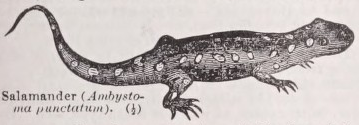
2. Salamander's hair or wool, a name given to a species of asbestos or mineral flax; I believe no long used.
1. Any one of numerous species of Urodela, belonging to Salamandra, Amblystoma, Plethodon, and various allied genera, especially those that are more or less terrestrial in their habits.
3. A culinary utensil of metal with a plate or disk which is heated, and held over pastry, etc., to brown it.
4. A large poker.
5. Solidified material in a furnace hearth.
Salamandra
Encyclopedia Britannica
SALAMANDRA. In the nomenclature of zoology this name designates a genus of animals belonging to the vertebrate class Amphibia. The genus was first defined under this name by Laurenti. It will be seen on referring to the taxonomic synopsis of the class given at the end of the article Amphibia that the genus Salamandra belongs to the first tribe Mecodonta of the fifth division Salamandrida. The diagnosis of the genus is as follows :—no fronto-squamosal arch in the skull; tongue large, adherent below, free at the sides and slightly so behind; toes five; tail cylindrical. There are three species, distinguished as follows :—(1) S. maculosa, Laurenti, tail not so long as rest of body, colour black with yellow spots; (2) S. atra, Laurenti, tail not so long as rest of body, colour uniform black; (3) S. caucasica, Waga, tail longer than rest of body. In all the species the body is plump and rounded, and there is no dorsal crest or fin; the head is depressed, its greatest width being at the angle of the jaws; the snout is rounded. The vent is a longitudinal slit, the borders of which in the male are slightly swollen. The skin is smooth and shining; at the junction of the head and neck is a pronounced fold of skin called the gular fold. The swollen patches of skin behind the tympana, caused by the presence of large cutaneous glands, and known as parotids, are well developed and exhibit the openings of the glands as distinct pores. Similar gland-openings form a series along either side of the body. In the first two species there is also a longitudinal series of warts on each side; these are wanting in S. caucasica. Depressions of the skin between the vertebrae are present, and are known as costal grooves. The palatine teeth-series are S-shaped, and the anterior ends of the two ...series do not meet. S. maculosa is the largest of the three species, attaining a length of 7 to 8½ inches. S. atra is about 4 1 / 3 and S. caucasica about 6 inches in length.
The genus is confined to the western sub-region of the palaearctic region, extending over almost the whole of Europe, especially the central and southern parts, and occurring also in Algiers and Syria. The spotted species is the commonest and most widely distributed, being found in nearly all parts of Germany, France, Italy, and Spain. The genus is entirely absent from the British Islands. The black salamander, S. atra, is confined to the Alps of Central Europe, and there only occurs between the limits of 2500 to 10,000 feet of altitude; it is found in the mountains of South Germany, France, Switzerland, and Austria. S. caucasica is only known from one specimen, which was obtained from the Caucasus and was sent to the Paris Museum by Dr Waga.
The food of Salamandra consists of worms and insects, and, like British frogs and toads, the animals can only exist in damp shady localities. As in all Salamandrida, the process of reproduction is commenced by a true copulation, which takes place in spring and summer. The seminal fluid is passed into the female cloaca, where it is received into a tube-shaped receptaculum seminis. The eggs are thus fertilized in the oviduct, but the development takes place under somewhat different conditions in the two species S. maculosa and S. atra. Both species are viviparous; in the former thirty to forty eggs undergo development in the oviducts at one time, and they are brought forth and deposited in stagnant or sluggishly-flowing water when they have reached a stage similar to that of adult Perennibranchiata, the newly-born larvae having long feather-like external gills and a length of 12 to 15 mm. (one-third to one-half an inch). After a period of aquatic life, the larvae pass through a metamorphosis: the limbs appear; the gill slits close up; and the young animals, having reached the adult condition, leave the water for a terrestrial life. In S. atra only the two lowest eggs which pass into the oviducts, one in the duct of each side, undergo development. The rest of the eggs fuse into a mass of yolk material and are devoured by the two developing larvae. In this way the larvae are provided with nutriment during the later stages of development, for in this species they are retained within the body of the mother until they have reached the air-breathing condition and are in all respects similar to the parents. This peculiarity in the process of reproduction bears an obvious relation to the physical conditions of the habitat of S. atra. In the elevated regions that the species inhabits stagnant and sluggish waters are wanting, and therefore the process of reproduction that occurs in S. maculosa is rendered impossible. The black Salamandra has become adapted to its environment (1) by the slight changes in colour and structure which distinguish it from the spotted, and (2) by a modification in its reproductive processes, which eliminates the aquatic stage of existence from the life-history of the individual. It is to be noted that the stage characterized by the presence of pinnate external gills is exhibited by the larva during its development in the oviduct, and the gills doubtless there perform their function. Fräulein von Chauvin made the experiment of taking the larvae of S. atra from the pregnant female when they were in the branchiate condition, and placing them in water to see if they would survive and pass through their metamorphosis under these circumstances. On one occasion the experiment was perfectly successful in the case of one specimen; the rest of the larvae died.
The tailed Amphibia of Europe have from the very earliest times down to the present day been almost universally known in popular language as salamanders, and identified in the popular mind with, the salamander of myth and fable. Besides the species of Salamandra there are, according to Boulanger (Brit. Mus. Cat., 1881), eighteen other species of Urodela in Europe, of which fourteen belong to the genus Triton ( q.v.). Chioglossa lusitanica, Bocage, is distinguished by having a tongue supported anteriorly by a protractile median pedicle and free everywhere else, and by having its tail cylindrical at the base but compressed at the end. It occurs in Spain and Portugal. Salamandrina perspicillata, Tschudi, occurs in Italy; like Chioglossa, it belongs to the Mecodonta and is distinguislied by the following characters :—tongue large, subtriangular, free everywhere except on anterior median line; toes four; tail slightly compressed; a strong bony fronto-squamosal arch. Spelerpes fuscus, Strauch, occurs in Italy and in France in the Alpes Maritimes.
9th ed. Encyclopædia Britannica, vol. 21, p. 204
[1,122 words — estimated reading time: 7 minutes]
[1,122 words — estimated reading time: 7 minutes]
1. Pertaining to or resembling a salamander; enduring fire.
Of, pertaining to, or resembling, a salamander; enduring fire.
Like or pertaining to the salamanders.
Salamis
Encyclopedia Britannica
SALAMIS, in modern times called by the people Κολούρι (a ring-shaped cake), and by purists Σ αλαμίς , is an island in the Saronic Gulf, off the coast of Attica, Greece. It is said to have been called in ancient times by other names,—Sciras, which associates it with the worship of Athena Sciras; Cychreia, which connects it with the Eleusinian cultus and the sacred serpent (Κυχρείδης ὄφις ) of Demeter; and Pityussa. There was a small stream, Bocarus or Bocalia, in the island. The city, which bore the same name as the island, was originally situated on the south coast opposite AEgina, but was afterwards transferred to a promontory on the east side nearer Athens. The transference corresponds to a total change in the political relations of Salamis. It was originally connected, not with Attica, but with AEgina and with Megara, the competitors of Athens in the struggle for supremacy in the Saronic Gulf. The most prominent heroes of the island, Telamon, Ajax, and Teucer, were AEacidae from Aegina. But about the end of the 7th century b.c. the war between Athens and Megara for the possession of Salamis was, under the guidance of Solon, determined in favour of Athens. A line of the Iliad (ii. 558) is said to have been interpolated by the Athenians in support of their claim to the island, while the Megarian version of the passage was quite different. The priestess of Athena Polias might not eat Attic cheese, but it was lawful for her to eat foreign or Salaminian cheese. Salamis, having come so late into the hands of the Athenians, retained, like Eleusis, more local independence than the other denies. The island remained subject to Athens in later history, except during the period 318 to 232 b.c., when it was abandoned to the Macedonian rule. The name ...of Salamis is famous chiefly on account of the great sea-fight, 480 b.c., in which the allied Greeks defeated the Persians under Xerxes. The battle took place beside the town of Salamis and the island of Psyttaleia, at the south-eastern end of the straits.
A city on the east coast of Cyprus, near the river Pediaeus, said to have been founded by the Salaminian Teucer, son of Telamon, was also called Salamis.
9th ed. Encyclopædia Britannica, vol. 21, p. 205
[376 words — estimated reading time: 3 minutes]
[376 words — estimated reading time: 3 minutes]
Salamis
Watson's Biblical & Theological Dictionary
once a famous city in the isle of Cyprus, opposite to Seleucia, on the Syrian coast; and as it was the first place where the Gospel was preached, it was in the primitive times made the see of the primate of the whole island. It was destroyed by the Saracens, and from the ruins was built Famagusta, which was taken by the Turks in 1570. Here St. Paul preached, A. D. 44, Acts xiii, 5.
Watson's Biblical & Theological Dictionary
[75 words — estimated reading time: 1 minute]
[75 words — estimated reading time: 1 minute]
A kind of blue sapphire brought from Ceylon.
No thesaurus entries found for "Salam".
King James Bible KJV Bible
Berean Standard Bible BSB Bible
1 KJV and 1 BSB verses contain “Salam”