
of Dominus
Word of the Day: Catachrestical
Dominic
Encyclopedia Britannica
DOMINIC, Sτ, founder of the Dominican order of monks, was born at Calahorra, a village of Old Castile, in 1170. His family name is said to have been Guzman, an illustrious name connected with many of the most honourable families in Spain. Little is known of his father and mother, but in the mediaeval legends his birth is surrounded with portents indicative of his future greatness. His mother dreamed she gave birth to a boy with a torch in his mouth, which set the world on fire. At his baptism a new sign was given. A starry radiance encircled the baptismal font. His followers delighted to recognize a similar radiance in his countenance, which drew all hearts to him. His childhood gave evidence of his future devotion and self-denial. He used to creep from his bed and prostrate himself on the hard boards. At seven years of age he quitted the paternal home for the house of his uncle, who was a churchman, and gave him his first lessons in divine things. At fifteen he went to the university of Palencia, afterwards translated to Salamanca, where it attained reputation as the most famous university in Spain. He applied himself to letters and philosophy, but above all to theology,—opening his mind, according to one of his biographers, to the true knowledge, and his ears to the doctrines, of Holy Scripture. Two stories are told of him at this time, showing the intensity of his character, and indicating the future zealot in behalf of religion and the church. He sold his clothes to feed the poor in a time of famine, and, to a woman who complained that her brother had been made a slave by the Moors, he offered himself to be given in exchange. His career as a student is obscure. He appears to have remained at the university for about ten years, and it is only in 1195, when he was ...twenty-five years of age, that he begins to emerge into notice. He is then one of the canons of Osma, under the guidance of a new and zealous bishop, wshose heart was full of extending the power of the church and reforming its abuses. He gradually became known by his fervour as a preacher and the severity of his austerities, although it was still nearly ten years later before the opportunity came for him to show his true character and abilities. In 1203 the bishop of Osma was delegated to negotiate the marriage of Alphonso VIII, of Castile with a Danish princess, and for this he undertook a journey to Denmark with Dominic as his companion. Accustomed to the obedience and reverence everywhere paid to the clergy in Spain, a very different spectacle presented itself to them as soon as they crossed the Pyrenees, and found themselves in the plains and cities of Languedoc. There a new spirit—half poetical and half spiritual—had sprung up in opposition to the church. The Provençal poets found much of their χ inspiration in a prevailing excitement at the worldly vices and corruptions of the clergy, as well as in the chivalric loves and gaieties of their time. And in addition to the poets there had arisen in this interesting and beautiful country multitudes of preachers of a new, more simple, and more liberal faith. Peter de Brueys and Henry the Deacon became the organs of popular indignation against the superstitious observances which the priests everywhere encouraged,—the worship of the cross, transubstantiation, prayers, alms, and oblations to the dead, and even infant baptism,—for, as in all such cases of popular movement, the church was attacked not merely in its abuses but in its essential rites and its very existence. The “Poor Men of Lyons” rejected the whole church system, and permitted women to officiate at the altars. The “Paulicians,” a sect of Manichaeans surviving from the 5th century, had spread from the East through the Greek provinces of Sicily and Italy, and settled amongst the other elements of disturbance in the south of France. “It was discovered,” as Gibbon says (c. 54), “that many thousand Catholics of every rank and of either sex had embraced the Manichaean heresy;” and the flames consumed twelve canons of Orleans supposed to be tainted with the heresy. “The same vicissitudes of martyrdom and revenge as had been displayed in the East were repeated in the 13 th century on the banks of the Rhone.” The result of all was a state of heretical insurrection and confusion sufficiently startling to men like St Dominic or even St Bernard, who has left us a description of what he himself observed—“Churches without people, the people without priests, priests without respect, Christians without Christ, holy places denied to be holy, the sacraments no longer sacred, and holy days without their solemnities.” (Quoted by Milman, Hist, of Latin Christianity, iv. 178.)
In such a country, and in such a state of things, St Dominic found his mission as a champion of the church añd a preacher of Catholic truth. Painfully impressed by what he saw on his journey to Denmark, he was so aroused by the spectacle of abounding heresy on his return that he resolved to devote himself to the conversion of the inhabitants, and the revival of the church in a land which appeared to him so given over to evil. The Pope had sent legates thither for the correction and repression of the heretics, but after a year’s labours they had met with no success, and were on their way back to report the failure of their mission at Rome. Dominic met with them on his journey, and, struck at once by their splendid retinue and their failure, he exclaimed,—“How can you expect success with all this secular pomp? These men cannot be touched by words without corresponding deeds. The heretics deceive them by their simplicity. You must throw aside all your splendour, and go forth, as the disciples of old, barefoot, without purse or scrip, to proclaim the truth.” He acted without delay on his own principle, and betook himself to the profession of a mendicant preacher. Even the legates were shamed for a time to follow in the wake of the enthusiastic Spaniard. But their enthusiasm did not last long, and Dominic w as left alone in his self-denying labours.
It is difficult to describe with any fidelity the character of St Dominic’s career, which his mediaeval biographers have enveloped in a haze of miraculous exaggeration. Apparently at first he confined himself in the main to moral and intellectual influences, preaching against the heretical errors, and inviting the heretics to conferences and reasonings. His modern biographer, Lacordaire, has even ventured to compare this early phase of his work with St Paul’s conferences with the Jews, and St Augustine’s expostulations w ith the Donatists and Manichaeans. His arguments were of course powerfully enforced by miraculous tokens when otherwise likely to fail of their purpose. Wherever he moved the glory of the supernatural ïnoved with him. Signs and portents, most of them too trivial and absurd for mention, gave emphasis to his preaching and triumph to his mission. But withal the success that awaited him as a preacher was disappointing; and the flames of war, kindled by the growing antagonism of the sects and the church, and fomented by the rival ambitions which are always at hand to make use of the fury of religious passion, soon swept over the country, and hid from view the figure of the missionary and the preacher. It was, as Milman says, a stubborn generation, which, besides preaching, argument, and miracles, needed the sword of Simon de Montfort to cure it of its heresies. The atrocious crusade known as the Albigensian war, the violent incident and picturesque display of character on both sides, the pleasant, vacillating, and humiliated Count Raymond, the intrepid and bloodthirsty Montfort,—all belong to history rather than to the life of Dominic. What part he really played in the war evades clear historical judgment. Did he share in its atrocities, as religious zealots in similar cases have often done, or did he mourn the interruption of his peaceful labours of conversion, and preach moderation to the conquerors, as well as penitence to the heretics? Facts fail us in the matter. All that is known is that he remained through all the friend of De Montfort, and obeyed the call to bless the marriage of his sons and the baptism of his daughter. This implies that the darker features of the crusade, and the conduct of its leader, awakened no such horror in him as they ought to have done; aud when to this is added the glory (!) claimed for him of instituting the Holy Inquisition, the light which is thus thrown upon his character is far from pleasing. It is in no spirit of apostolic mildness, certainly, that he at last left the country in 1217, after the death of De Montfort. “For many years,” he says, “I have spoken to you with tenderness, with prayers, and tears, but, according to the proverb of my country, where the benediction has no effect the rod may have much. Behold now we rouse up against you princes and prelates, nations and kingdoms, and many shall preach by the sword.” This was a poor gospel for a people already decimated by the armies of the church, and the preacher of it was certainly no apostle of peace. Full of enthusiasm, of eloquence, of dogmatic zeal, with a genius for combination and the great power of inspiring devotion in his followers, Dominic fails in the higher virtues of patience, magnanimity, reasonableness, and moderation. He is a prince of the church, but not a saint save in its official calendar.
On leaving Languedoc Dominic repaired to Rome, and spent the remainder of his life in the organization of his order, which received the papal sanction in 1216, and which, under his generalship, had extended in the course of five years throughout most of the countries of Europe. He died at Bologna in 1221, in the fifty-first year of his age. See Dominicans. (j. t.)
9th ed. Encyclopædia Britannica, vol. 7, p. 353
[1,706 words — estimated reading time: 10 minutes]
[1,706 words — estimated reading time: 10 minutes]
Dominica
Encyclopedia Britannica
DOMINICA, in French Dominique, a British West India island, the largest in the Leeward group of the Lesser Antilles, lying between the French islands of Martinique and Guadaloupe, 24 miles north of the former and about the same distance south of the latter, at the intersection of 15° 30' N. lat. by 6Γ 30' W. long. It has a length of 29 miles with a maximum breadth of 16, and its area is estimated at 291 square miles. The longer axis is formed by a chain of mountains, which attains in some parts a height of upwards of 5000 feet, and gives the whole island a strongly marked profile and great irregularity of surface. The results and symptoms of volcanic activity are abundant, in the shape of solfataras, emissions of subterranean vapours, and hot springs; and in the southern part of the island there exists a boiling lake of unascertained depth, in which the water is frequently projected 3 feet or more above the surface by the force of the ebullition. Besides a large number of minor rivulets, upwards of thirty streams of considerable size might be mentioned, and this abundance of natural irrigation develops great fertility in the rich volcanic soil. The hills are in many parts covered with valuable timber trees of the kinds commonly found in the West Indies; and the sugar-cane, coffee, cocoa, cotton, Indigo, oranges, plantains, and arrow-root are grown in the lowlands. The island is botanically remarkable for the great number of peculiar species which it possesses in comparison with the poverty in this respect of Guadaloupe, Martinique, Montserrat, and Antigua: as many as 24 are mentioned by Grisebach. Game is abundant; the fisheries on the coast are productive; and large quantities of honey and wax are furnished by the wild bees, which were originally introduced from ...Europe. The coasts of the island are not much indented, and the only anchorages of importance are Prince Rupert’s Bay aud Roseau, both on the west side. The total tonnage of the ships that annually enter and clear amounts to 18,018 tons, according to the average of the fifteen years from 1860 to 1874 inclusive; and of this total only 37 42 tons belong to foreign vessels. The imports in 1874 were valued at £56,714, and the exports of the same year at £67,720,—being a decrease since 1860 of £11,087 and £12,738 respectively. Since 1872 Dominica has formed part of the colony of the Leeward Islands, and sends its representatives to the general legislative council; but at the same time it retains its lieutenant-governor or president, a separate treasury, and its local legislature, consisting of seven elective members and seven nominees of the crown. In 1874 its public revenue amounted to £15,022, its expenditure to £17,456, and its debt to £4813. In common with the Virgin Islands it has attained complete religious equality by the abolition of the salaries paid from the public funds to the clergymen of the Church of England, who had a much smaller portion of the population under their jurisdiction than the Roman Catholic priests. Of the Carib aborigines there are no representatives; and the present inhabitants, numbering, according to the census of 1871, 27,178, consist mainly of descendants of the former negro slaves, with a certain number of Spanish and English families. The capital is Roseau, or Charlotteville, a fortified port near the southern end of the island, with about 5000 inhabitants. Dominica was so named on its discovery by Columbus in 1493, in commemoration of the date, which happened to be Sunday ( Dies Dominica ) the 3d of November. It was ceded to England by France at the Peace of Paris in 1763, was captured by the French in 1778, regained by the English in 1783, again seized by the French in 1802, and finally surrendered to Britain in 1814. It was in the neighbouring sea that Rodney obtained his victory over Count de Grasse in 1782.
9th ed. Encyclopædia Britannica, vol. 7, p. 354
[668 words — estimated reading time: 4 minutes]
[668 words — estimated reading time: 4 minutes]
1. That notes the Lords day or Sabbath. The dominical letter is the letter which, in almanacks, denotes the sabbath, or dies domini, the Lords day. The first seven letters of the alphabet are used for this purpose.
2. Noting the prayer of our Lord.
The Lords day.
1. Indicating, or pertaining to, the Lord's day, or Sunday.
2. Relating to, or given by, our Lord; as, the dominical (or Lord's) prayer.
The Lord's day or Sunday; also, the Lord's prayer.
or noun The Dominicans, or dominican Friars, are an order of religious or monks, called also Jacobins, or Predicants, preaching friars; an order founded about the year 1215.
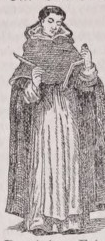
One of an order of mendicant monks founded by Dominic de Guzman, in 1215. A province of the order was established in England in 1221. The first foundation in the United States was made in 1807. The Master of the Sacred Palace at Rome is always a Dominican friar. The Dominicans are called also preaching friars, friars preachers, black friars (from their black cloak), brothers of St. Mary, and in France, Jacobins.
Dominicans
Encyclopedia Britannica
DOMINICANS, the name by which the disciples of St Dominic became known. The Dominican order was founded, as stated in the article on the founder, in 1216 by a bull of Honorius III. It conformed to the general rule of the Augustinians, but further embraced a rule of absolute poverty or mendicancy, in addition to the usual vows of chastity and obedience. Its members were supposed to be exclusively devoted to preaching and public instruction, and were described as mendicant or preaching friars. The order held its first chapter in the year 1220 at Bologna, under the presidency of its founder. It adopted as its insignia within the cloister a white robe and white hood, to which it added outside a black cloak, hence the popular name of black friars by which the Dominicans became known in England. The novitiate was for a year, and candidates were mainly recruited from the schools founded by the order, which became the nurseries of great preachers and great theologians. The order speedily extended itself through the whole Christian world, and popes, cardinals, and learned doctors sprang from it in numbers. Its preachers and teachers addressed all classes, invaded “the high places of the human intellect,” and were soon found, as Milman says, “disputing in the universities of Italy and Germany, in Cologne, Rome, and Oxford. Before long they were to claim two of the greatest luminaries of the prevalent philosophy, Albert the Great and Thomas Aquinas.”
9th ed. Encyclopædia Britannica, vol. 7, p. 354
[243 words — estimated reading time: 2 minutes]
[243 words — estimated reading time: 2 minutes]
1. The act of killing a master.
2. One who kills his master.
1. A schoolmaster; a pedagogue.
1. Sovereign or supreme authority; the power of governing and controlling.
2. The dominion of the Most High is an everlasting dominion Daniel 4:3 .
3. Power to direct, control, use and dispose of at pleasure; right of possession and use without being accountable; as the private dominion of individuals.
4. Territory under a government; region; country; district governed, or within the limits of the authority of a prince or state; as the British dominions.
6. Predominance; ascendant.
7. An order of angels.
8. Whether they be thrones, or dominions, or principalities, or powers. Colossians 1:16 .
9. Persons governed.
10. Judah was his sanctuary; Israel his dominion Psalms 114:2 .
1. Sovereign or supreme authority; the power of governing and controlling; independent right of possession, use, and control; sovereignty; supremacy.
2. Superior prominence; predominance; ascendency.
3. That which is governed; territory over which authority is exercised; the tract, district, or county, considered as subject; as, the dominions of a king. Also used figuratively; as, the dominion of the passions.
4. A supposed high order of angels; dominations. See Domination, 3.
Dominis
Encyclopedia Britannica
DOMINIS, Marc Antonio de (1566-1624), celebrated as a theologian and natural philosopher, was born in the island of Arbe, in 1566. He was educated in the order of the Jesuits at their college at Loretto, and afterwards studied at the university of Padua. He was employed for some time by the Jesuits as a teacher of rhetoric and mathematics, but he did not join the order. In 1596 he was appointed to the bishopric of Segni, and in 1602 he was raised to the archbishopric of Spalatro. His endeavours to reform the church soon after made him obnoxious to the papal authorities, and he was compelled to leave his native country. Having become acquainted with Bishop Bedell, whilst the latter was chaplain to Sir Henry Wotton, ambassador from James I. at Venice, he communicated to that prelate his treatise De Eepublica Ecclesiastica, which was afterwards (1617, 1620) published at London, with Bedell’s corrections. The main argument of the work was directed against the superiority of the bishop of Rome to other bishops. He came to England with Bedell, where he was received with great respect, and preached and wrote against the Roman Catholic religion. In 1619 he published at London Father Paul's History of the Council of Trent, with a dedication to King James. He was favourably received by the king, who bestowed on him the deanery of Windsor and other ecclesiastical preferments. But on the promotion of Pope Gregory XIV., who had been his schoolfellow and old acquaintance, he was deluded by Gondomar, the Spanish ambassador, into the hopes of procuring a cardinal’s hat, and thus of proving an instrument of great reformation within the church. Accordingly he returned to Rome in 1622, recanted his errors, and was at first well received; but he afterwards wrote letters to England ...recanting his recantation, and, these being intercepted, he was imprisoned by Pope Urban VIII., and died in 1624. There were suspicions that he had been poisoned. Being convicted of heresy after his death, his body was exhumed and burned, and the ashes were thrown into the Tiber. He is believed to have been the first to promulgate a true theory of the rainbow in a tract De radiis visus et lucis in vitris perspectivis et iride (Venice, 1611).
9th ed. Encyclopædia Britannica, vol. 7, p. 355
[382 words — estimated reading time: 3 minutes]
[382 words — estimated reading time: 3 minutes]
No thesaurus entries found for "domini".
King James Bible KJV Bible
Berean Standard Bible BSB Bible
74 KJV and 33 BSB verses contain “domini” — showing the first 20. Show all 80 verses (searchable)
And God said, Let us make man in our image, after our likeness: and let them have dominion over the fish of the sea, and over the fowl of the air, and over the cattle, and over all the earth, and over every creeping thing that creepeth upon the earth.
Then God said, “Let Us make man in Our image, after Our likeness, to rule over the fish of the sea and the birds of the air, over the livestock, and over all the earth itself and every creature that crawls upon it.”
And God blessed them, and God said unto them, Be fruitful, and multiply, and replenish the earth, and subdue it: and have dominion over the fish of the sea, and over the fowl of the air, and over every living thing that moveth upon the earth.
God blessed them and said to them, “Be fruitful and multiply, and fill the earth and subdue it; rule over the fish of the sea and the birds of the air and every creature that crawls upon the earth.”
And his brethren said to him, Shalt thou indeed reign over us? or shalt thou indeed have dominion over us? And they hated him yet the more for his dreams, and for his words.
“Do you intend to reign over us?” his brothers asked. “Will you actually rule us?” So they hated him even more because of his dream and his statements.
Out of Jacob shall come he that shall have dominion, and shall destroy him that remaineth of the city.
A ruler will come from Jacob and destroy the survivors of the city.”
Then he made him that remaineth have dominion over the nobles among the people: the LORD made me have dominion over the mighty.
Then the survivors came down to the nobles; the people of the LORD came down to me against the mighty.
But his father and his mother knew not that it was of the LORD, that he sought an occasion against the Philistines: for at that time the Philistines had dominion over Israel.
(Now his father and mother did not know this was from the LORD, who was seeking an occasion to move against the Philistines; for at that time the Philistines were ruling over Israel.)
David smote also Hadadezer, the son of Rehob, king of Zobah, as he went to recover his border at the river Euphrates.
David also defeated Hadadezer son of Rehob, king of Zobah, who had marched out to restore his dominion along the Euphrates River.
For he had dominion over all the region on this side the river, from Tiphsah even to Azzah, over all the kings on this side the river: and he had peace on all sides round about him.
For Solomon had dominion over everything west of the Euphrates—over all the kingdoms from Tiphsah to Gaza—and he had peace on all sides.
And Hezekiah hearkened unto them, and shewed them all the house of his precious things, the silver, and the gold, and the spices, and the precious ointment, and all the house of his armour, and all that was found in his treasures: there was nothing in his house, nor in all his dominion, that Hezekiah shewed them not.
And Jokim, and the men of Chozeba, and Joash, and Saraph, who had the dominion in Moab, and Jashubi-lehem. And these are ancient things.
Er the father of Lecah, Laadah the father of Mareshah and the clans of the linen workers at Beth-ashbea, Jokim, the men of Cozeba, and Joash and Saraph, who ruled in Moab and Jashubi-lehem. (These names are from ancient records.)
In his days the Edomites revolted from under the dominion of Judah, and made themselves a king.
In the days of Jehoram, Edom rebelled against the hand of Judah and appointed their own king.
But after they had rest, they did evil again before thee: therefore leftest thou them in the hand of their enemies, so that they had the dominion over them: yet when they returned, and cried unto thee, thou heardest them from heaven; and many times didst thou deliver them according to thy mercies;
But as soon as they had rest, they again did evil in Your sight. So You abandoned them to the hands of their enemies, who had dominion over them. When they cried out to You again, You heard from heaven, and You delivered them many times in Your compassion.
And it yieldeth much increase unto the kings whom thou hast set over us because of our sins: also they have dominion over our bodies, and over our cattle, at their pleasure, and we are in great distress.
Its abundant harvest goes to the kings You have set over us because of our sins. And they rule over our bodies and our livestock as they please. We are in great distress.
Dominion and fear are with him, he maketh peace in his high places.
“Dominion and awe belong to God; He establishes harmony in the heights of heaven.
Knowest thou the ordinances of heaven? canst thou set the dominion thereof in the earth?
Do you know the laws of the heavens? Can you set their dominion over the earth?