
A child. [Little used in English.]
Word of the Day: Catachrestical
1. A covered building used chiefly for storing grain, hay, and other productions of a farm. In the United States a part of the barn is often used for stables.
2. A child. [Obs.] See Bairn.
To lay up in a barn.
Barnabas
Encyclopedia Britannica
BARNABAS (∏Ni∏Γ">2) was the surname given by the apostles to Joses, “a Levite, of the country of Cyprus,” who, though like Paul not of the twelve, was with him recognized among the number of the apostles. The name (υloς τrαpακλ^σ∈ωs), translated ii son of consolation” in the authorized version (Acts iv. 36), would be better rendered a son of exhortation” or “of prophecy.” Barnabas is first mentioned in the Acts (iv. 36, 37) as having sold his land and laid the money at the apostles’ feet. He next appears as introducing Paul after his conversion to the other apostles (Acts ix. 27), from which a previous acquaintance has been iuferred. Subsequent notices record a year’s residence along with Saul at Antioch, where they “taught much people” (xi. 22-26), a visit to Jerusalem with contributions for the poorer brethren there (xi. 27-30), the ordination of Saul and Barnabas for the work to which they were called by the Holy Ghost (xiii. 2, 3), and a missionary journey of the two apostles to Cyprus and various cities of Asia Minor (xiii. xiv.) When the dissension arose as to the necessity of circumcision, Paul and Barnabas were sent to Jerusalem by the church at Antioch to consult the “apostles and elders” on the question (xv. 1-4). Soon after their return to Antioch they resolved to undertake a second missionary journey; but a difference arose between them in regard to the determination of Barnabas to take his sister’s son, John Mark, along with him. “The contention was so sharp between them” (xv. 39) that they separated, Barnabas and Mark going to Cyprus, while Paul and Silas went to Syria and Cilicia. No further account of the career of Barnabas is given in the New Testament, with the exception of one or two incidental allusions ...in St Paul’s epistles (1 Cor. ix. 6; Gal. ii. 1, 9, 13). Later writings and traditions have attempted to supply what is wanting in the Scriptural narrative, but they contain no facts that can be accepted as historically certain. According to Clement of Alexandria, Barnabas was one of the seventy disciples. Various accounts of still later date allege that he studied under Gamaliel along with Saul, that he suffered martyrdom at Cyprus, and that his body was discovered in the reign of the Emperor Zeno. He is also said to have been the founder and first bishop of the church at Milan. The festival of St Barnabas is held on the 11th of June.
BARNABAS, Epistle of, and Gospel of. See Apostolic Fathers and Gospels.
9th ed. Encyclopædia Britannica, vol. 3, p. 377
[424 words — estimated reading time: 3 minutes]
[424 words — estimated reading time: 3 minutes]
Barnabas
Watson's Biblical & Theological Dictionary
a disciple of Jesus Christ, and companion of St. Paul in his labours. He was a Levite, born in the isle of Cyprus. His proper name was Joses, to which the Apostles added Barnabas, signifying _the son of consolation_. He is generally considered one of the seventy disciples, chosen by our Saviour. He was brought up with Paul at the feet of Gamaliel. When that Apostle came to Jerusalem, three years after his conversion, Barnabas introduced him to the other Apostles, Acts ix, 26, 27, about A. D. 37. Five years afterward, the church at Jerusalem, being informed of the progress of the Gospel at Antioch, sent Barnabas thither, who beheld with great joy the wonders of the grace of God, Acts xi, 22, 24. He exhorted the faithful to perseverance. Some time afterward, he went to Tarsus, to seek Paul, and bring him to Antioch, where they jointly laboured two years, and converted great numbers; and here the disciples were first called Christians. They left Antioch A. D. 44, to convey alms from this church to that at Jerusalem. At their return they brought John Mark, the cousin of Barnabas. While they were at Antioch, the Holy Ghost directed that they should be separated for those labours among the Gentiles to which he had appointed them. They departed into Cyprus, where they converted Sergius Paulus, the pro-consul. They preached at Perga in Pamphylia without much success, by reason of the obstinacy and malice of the Jews; but being come to Iconium, they made many converts. Here the Jews stirred up a sedition, and obliged them to retire to Derbe and Lystra, in Lycaonia, where St. Paul curing one Æneas, who had been lame from his birth, the people of Lystra regarded them as gods; calling Barnabas, Jupiter; and Paul, Mercury; and would have sacrificed to them, which the two Apostles ...with great difficulty hindered: nevertheless, soon afterward, they were persecuted in this very city. Having revisited the cities through which they had passed, and where they had preached the Gospel, they returned to Antioch in Syria. In A. D. 51, Barnabas was sent with Paul from Antioch to Jerusalem, on occasion of disputes concerning the observance of legal rites, to which the Jews wished to subject the Gentiles. Paul and Barnabas were present in the council at Jerusalem, and returned immediately to Antioch. Peter, arriving there soon afterward, was led to countenance, in some degree, by his conduct, the observance of the Mosaic distinctions. Barnabas, too, (who, being by descent a Levite, might retain some former notions,) used the like dissimulation: but Paul reproved Peter and Barnabas with great freedom. Paul afterward determining to visit the churches in the isle of Cyprus, and in Asia Minor, Barnabas desired that John Mark might accompany them: but Paul objected, because Mark had left them on the first journey. Hereupon the two Apostles separated: Paul went toward Asia; and Barnabas, with Mark, to Cyprus. This is all we know certainly concerning Barnabas. There is extant among the writings of the fathers an epistle which is attributed to Barnabas; though, being without an inscription, it is not known to whom it professes to have been addressed. It was first published by Archbishop Usher, in Greek and Latin, and translated by Archbishop Wake, in his “Genuine Epistles of the Apostolical Fathers,” and has often been reprinted. That it is not the production of Barnabas, the companion of Paul, may be safely concluded from internal evidence; though it may have been written by some other person of the same name. There is also a tract which goes by the name of, “The Gospel of Barnabas,” still extant; from which Dr. White, at the end of his Bampton Lectures, has given extracts sufficiently copious to satisfy any impartial mind that it is spurious.
Watson's Biblical & Theological Dictionary
[637 words — estimated reading time: 4 minutes]
[637 words — estimated reading time: 4 minutes]
1. A shell which is often found on the bottoms of ships, rocks and timber, below the surface of the sea.
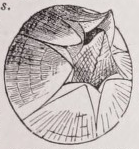
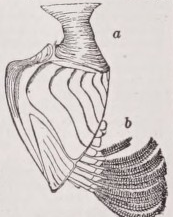
2. A species of goose, found in the northern seas, but visiting more southern climates in winter. The forehead and cheeks are white, but the upper part of the body and neck is black. Formerly, a strange notion prevailed, that these birds grew out of wood, or rather out of the barnacles attached to wood in the sea. Hence the name. It is written also Bernacle.
1. Any cirriped crustacean adhering to rocks, floating timber, ships, etc., esp. (a) the sessile species (genus Balanus and allies), and (b) the stalked or goose barnacles (genus Lepas and allies). See Cirripedia, and Goose barnacle.
3. An instrument for pinching a horse's nose, and thus restraining him.
Spectacles; -- so called from their resemblance to the barnacles used by farriers.
Barnard castle
Encyclopedia Britannica
BARNARD CASTLE, a market and manufacturing town and parish in the county of Durham, on the banks of the Tees, 246 miles from London. It consists of one main street, about a mile long, with a number of smaller ones branching off on each side. The principal building in the high street is the town-hall, an octagonal structure dating from 1747. St Mary’s church, built in the 12th century, and restored in 1871, contains some curious monuments; but the building of chief interest is the castle, from which the town derives its name, and which is the principal scene of Scott’s Rokeby. This ’ was founded in 1132 by Barnard Baliol, an ancestor of the competitor with Bruce for the Scottish crown, and was reduced to a ruinous condition by the siege of 1569, when it was defended for Queen Elizabeth by Sir George Bowes of Streatlam. The remains still extend over a space of more than six acres. A remarkable building, known as the Bowes’ Mansion and Museum, was in 1874 bequeathed to the town by a descendant of the gallant knight. It contains a valuable collection of works of art, and is one of the finest edifices of the kind in the kingdom. The principal manufactures of Barnard Castle are carpets, woollen cloth, and shoe-thread. The com-market is one of the largest in the north of England. A line joining the North-Eastern and the London and North Western Railways passes immediately to . the north of the town.. In the neighbourhood are Rokeby, Egglestone Abbey, Raby Castle, and Lartington Hall. (See Sir Walter Scott’s Rokeby, and Atkinson’s Handbook of Barnard Castle, 1874.)
9th ed. Encyclopædia Britannica, vol. 3, p. 378
[280 words — estimated reading time: 2 minutes]
[280 words — estimated reading time: 2 minutes]
Barnaul
Encyclopedia Britannica
BARNAUL, a town of Asiatic Russia, in the government of Tomsk, and capital of a circle to which it gives its name. It is situated in a wide plain which is bounded by offshoots of the Altai Mountains, and is built on both sides of the Barnaulka River at its confluence with the Ob, in lat. 53° 20 N., and long. 83° 26' E. It is the capital of an extensive mining district, and the seat of a board of administration. Besides its numerous smelting-furnaces, it possesses glassworks, a bell-foundry, and a mint; and it has also a library, an observatory, established in 1841, a mining school, a museum with a rich collection of mineral and zoological specimens, and a theatre, in addition to the governor’s residence, the barracks, and other buildings belonging to its civic organization. Barnaul was founded in 1730 by Akynthies Demidoff (to whose memory a monument has been erected), was raised to the rank of a town in 1771, and became capital of the circle in 1822. Population, 12,927.
9th ed. Encyclopædia Britannica, vol. 3, p. 378
[177 words — estimated reading time: 2 minutes]
[177 words — estimated reading time: 2 minutes]
Barnave
Encyclopedia Britannica
BARNAVE, Antoine Pierre Joseph Marie, one of the greatest orators and noblest actors and victims of the first French Revolution, was born at Grenoble in Dauphiny, October 22, 1761. He was of a Protestant family. His father was an advocate to the parliament of Grenoble, and his mother was a woman of high birth, superior ability, and noble character. He was at once thoughtful and passionate, studious and social, handsome in person and graceful in manners. He was brought up to the law, and at the age of twenty-two made himself favourably known by a discourse pronounced before the local parliament on the division of political powers. Dauphiny was one of the first of the provinces to feel the excitement of the coming revolution; and Barnave was foremost to give voice to the general feeling, in a pamphlet entitled Esprit des édits enregistrés militairement le 20 Mai 1788. He was immediately elected deputy, with his father, to the States of Dauphiny, and took a prominent part in their debates. A few months later he was transferred to a grander field of action. The States-general were convoked at Versailles for May z 5, 1789, and Barnave was chosen deputy of the Tiers Etat for his native province. He soon made an impression on the Assembly, and became the friend of most of the leaders of the popular party. He took part in the conferences on the claims of the three orders, drew up the first address to the king, and supported the proposal of Sieyès that the Assembly should declare itself National. Though a passionate lover of liberty, he knew that excess is the ruin of liberty, and maintained the necessity for the individual and for the community of both freedom and restraint. He hoped to secure the freedom of France and her monarchy at the 6ame time. But he was almost ...unawares borne away by the mighty currents of the time, and he took part in the attache on the monarchy, on the clergy, on church property, and on the provincial parliaments. With the one exception of the mighty Mirabeau, Barnave was the most powerful orator of the Assembly. On several occasions he stood in opposition to Mirabeau. After the fall of the Bastille he wished to save the throne. He advocated the suspensive veto, the system of two chambers, and the establishment of trial by jury in civil causes. His conflict with Mirabeau on the question of assigning to the king the right to make peace or war was one of the most striking scenes in the Assembly. About this time, after a vehement debate, he fought a duel with Cazalès, in which the latter was slightly wounded. About the close of October 1790 Barnave was called to the presidency of the Assembly. On the death of Mirabeau a few months later, Barnave paid a high tribute to his worth and public services, designating him the Shakespeare of oratory. On the arrest of the king and the royal family at Varennes, while attempting to escape from France, Barnave was one of the three appointed to conduct them back to Faris. On the journey he was deeply affected by the mournful fate of these royal persons, and resolved to do what he could to alleviate their sufferings. In one of his most powerful speeches he maintained the inviolability of the king’s person. His public career came to an end with the close of the Constituent Assembly, and he returned to Grenoble at the beginning of 1792. His sympathy and relations with the royal family, and his desire to check the downward progress of the Revolution, brought on him the suspicion and persecution of the more violent party. At the end of August 1792 he was arrested and imprisoned, and in November 1793 was transferred to Paris. The nobility of his character was proof against the assaults of suffering. “Better to suffer and to die,” he said, “than lose one shade of my moral and political character.” On November 28 he appeared before the Revolutionary Tribunal, in company with Duport-Dutertre, and two days later they both perished by the guillotine.
9th ed. Encyclopædia Britannica, vol. 3, p. 378
[696 words — estimated reading time: 4 minutes]
[696 words — estimated reading time: 4 minutes]
Barnes
Encyclopedia Britannica
BARNES, Aebert, a theologian of America, specially distinguished as a Biblical expositor, was born at Rome in the state of New York, 1st December 1798, and died at Philadelphia 24th December 1870. In 1820 he graduated at Hamilton College, and in the same year commenced his studies for the ministry at Princeton Theological Seminary. Soon after taking licence he was called to the Presbyterian church in Morristown, New Jersey, from which he was transferred to the pastoral charge of the first Presbyterian church of Philadelphia in 1830. In 1867 he was compelled to resign owing to failing health. Barnes held a prominent place in the New School branch of the Presbyterians, to which he had adhered on the division of the denomination. He was an eloquent preacher, but his wide-spread reputation rests chiefly on his expository works, which have probably had a larger circulation both in Europe and America than any others of their class. Of the well-known Notes on the New Testament it is said that more than a million volumes had been issued at the time of their author’s death. The Notes on Job, the Psalms, Isaiah, and Daniel, found scarcely less acceptance. Displaying little original critical power, their chief merit lies in the fact that they bring the results of the criticism of others within the reach of general readers. Barnes was the author of several other works of a practical and devotional kind....
BARNES, Joshua, an English scholar, born in 1654. In 1695 he was chosen queen’s professor of Greek, a language which he wrote and spoke with the utmost facility. One of his first publications was a whimsical tract, entitled Gerania, or a New Discovery of the Little Sort of People called Pygmies. Among his other works are a Life of Edward III., in which he introduces his hero making long and elaborate speeches; Sacred Poems; the Life of Oliver Cromwell the Tyrant; some dramatic pieces; a poetical paraphrase on the history of Esther, in Greek verse, with a Latin translation, &c. He also published editions of Euripides, Anacreon, and Homer’s Iliad and Odyssey, with notes and a Latin translation. He died in 1712.
9th ed. Encyclopædia Britannica, vol. 3, p. 379
[240 words — estimated reading time: 2 minutes]
[240 words — estimated reading time: 2 minutes]
Barnet
Encyclopedia Britannica
BARNET, or Chipping Barnet, a market-town in the county of Hertford, 11 miles from London, on the great northern road. Near it, in 1471, was fought the decisive battle between the houses of York and Lancaster, in which the great earl of Warwick fell. The parish church dates from the 15 th century, and the free school was founded by Elizabeth in 1573. The market, held on Monday, is large; and there are great cattle fairs. In the neighbourhood is the village of East Barnet, with a very ancient church. Population of parish in 1871, 3375.
9th ed. Encyclopædia Britannica, vol. 3, p. 379
[97 words — estimated reading time: 1 minute]
[97 words — estimated reading time: 1 minute]
Barneveldt
Encyclopedia Britannica
BARNEVELDT, Jan van Olden, Grand Pensionary of Holland, who played a great part and rendered the most signal services to his country in the long conflict with Philip II. of Spain, was born in 1547. He was a native of Amersfoort in the province of Utrecht, and could boast of a long line of noble ancestors. Endowed with superior abilities, he was educated for the profession of the law, and commenced practice as an advocate at the Hague in 1569. He sympathized deeply with his countrymen in their resolution to throw off the hated yoke of Spain, and served as a volunteer at the sieges of Haarlem and Leyden. In 1575 he married; and in the following year he was appointed to the honourable post of counsellor and chiefpensionary of Rotterdam. In 1585, when, in consequence of the assassination of the sagacious and resolute leader of the Dutch, and the general success of the Spaniards under the Prince of Parma, the cause of the patriots seemed almost hopeless, Barneveldt was chosen head of an embassy to Queen Elizabeth, to ask for her assistance and to offer her the sovereignty of the United Provinces. The queen agreed to give aid both in money and in men, but refused to accept the sovereignty. An expedition was sent under the command of Dudley, earl of Leicester, on whom the Dutch conferred supreme and absolute authority. Barneveldt was then raised to the high office of advocate-general of Holland and West Friesland. Dissatisfied and indignant at Leicester’s incompetence, arrogance, and mismanagement, he endeavoured to limit his powers. For this purpose he succeeded in persuading the States to appoint Maurice of Nassau, the young son of the late Prince of Orange, stadtholder and captain-general of Holland and Zealand, thus contributing to place in the highest position the man ...who was afterwards to become his great antagonist. Leicester was recalled at the close of 1586. In the course of a few years Barneveldt, by his prudence and energy in administration, succeeded in restoring order and materially improving the financial affairs of the States. He proposed to resign in 1592, but at the urgent entreaty of the States retained his post. In 1598 he was sent on an embassy to Henry IV. of France, the object of which was to strengthen and maintain the friendship of France and the United Provinces. In 1603, on the accession of James I. to the throne, Barneveldt was again sent to England as head of an embassy, and in conjunction with the French ambassador, Μ. de Rosny, afterwards duke of Sully, negotiated an arrangement for further assistance against the Spaniards. In 1607, having first insisted on and obtained a recognition of the independence of the Provinces, he began negotiations with Spain with a view to establish a truce. He had to contend against the opposition of the stadtholder and the army, and to suffer from unmerited popular suspicions of taking bribes from the Spanish court. But he triumphed over all difficulties, and on April 9, 1609, the famous twelve years’ truce was concluded. From this time Maurice was his sworn foe. The two men were leaders of two great political parties, and the struggle between them was embittered by the admixture of theological and ecclesiastical controversy. In the strife then going on between the Gomarites (the Calvinistic party) and the Arminians, Maurice sided with the former, while Barneveldt supported the latter. Maurice was aiming at the sovereign power; Barneveldt resolutely maintained the freedom of the republic. The clerical party, who looked up to Prince Maurice as their chief, were bent on getting the Calvinistic system established as the state religion, and on refusing to tolerate any other system; Barneveldt and the Arminians contended that each province should be free to adopt the form which it preferred. Barneveldt was the consistent champion of the supremacy of the civil authority, and “the prime minister of Protestantism” (Motley). The convocation of a National Synod was proposed by the party of the stadtholder and resisted by Barneveldt. When disturbances broke out against the Arminians, Maurice refused to suppress them, and disarmed the militia organized for the purpose by Barneveldt. The former now assumed the chief power. An interview took place on August 17,1618, between the advocate and the stadtholder; each adhered resolutely to his own views, and the meeting remained fruitless. Barneveldt, -with his friends Grotius and Hoo-gerbeets, was arrested and imprisoned on the 29th. In November following, in pursuance of the command of Prince Maurice, the famous Synod of Dort assembled. A few days later the trial of the prisoners began before a special. commission. The proceedings were illegal; the accusations against Barneveldt were fully disproved, but he was unjustly found guilty and sentenced to death. This sentence was unscrupulously confirmed by the clerical synod. It was a foregone conclusion, and Barneveldt had seen clearly that there was no hope for him. On the 14th of May 1619, just five days after the closing of the synod, the venerable statesman and patriot, then in his seventy-first year, was beheaded at the Hague. He met his fate without a word of regret, without a sign of fear. His calm courage and his tenderness of heart are attested by a letter, still extant, written to his wife a few hours before his execution. Besides his wife, Maria van Utrecht, Barneveldt left two sons and two daughters. Four years after their, father’s death the sons took part in a plot against Prince Maurice; one of them made his escape and entered the service of Spain, the other was arrested and beheaded.
9th ed. Encyclopædia Britannica, vol. 3, p. 379
[980 words — estimated reading time: 6 minutes]
[980 words — estimated reading time: 6 minutes]
Barnsley
Encyclopedia Britannica
BARNSLEY, or Black Barnsley, mentioned in Domesday Book as Bernesleye, a town and municipal borough in the West Riding of Yorkshire, 171 miles from London and about 11 north of Sheffield. It is situated on rising ground to the west of the River Dearne, in a district of considerable natural beauty. The manufacture of iron and steel, and the weaving of linen and other cloth, are the two principal industries; but there are also bleachfields, printfields, dyeworks, sawmills, cornmills, and malt-houses; and the manufacture of glass, needles, and wire is still carried on. The last-mentioned industry dates from the reign of James I., and was for a long time the staple of the place. There are large coal-fields in the neighbourhood, which, indeed, extend under the town; and these afford employment to considerable numbers. The coal is largely exported to London and Hull, for domestic and other purposes, the coke formed from it also being in great demand. Besides the means of communication afforded by several railway lines, Barnsley has the advantage of two canals, the one known as the Barnsley-and-Wakefield and the other as the Dearne and-Dove. Among the more important of its public buildings are the church of St Mary’s, St George’s (built in 1823), St John’s (1858), the county court (1861), and the bank (1861). There are a number of educational and benevolent institutions of some importance; the free grammar school dates from 1665, a subscription library was started in 1808, and a philosophical society was founded in 1828. In 1862 a handsome park of about 20 acres was presented to the town by the widow of Joseph Locke, M.P. About a mile from the town are the ruins of Monk Bretton, a Cluniae priory. Population in 1871, 23,021.
9th ed. Encyclopædia Britannica, vol. 3, p. 380
[303 words — estimated reading time: 2 minutes]
[303 words — estimated reading time: 2 minutes]
Barnstable
Encyclopedia Britannica
BARNSTABLE, a seaport town, and capital of the county of the same name, in the state of Massachusetts, North America. It is situated on the south side of a bay of the same name, which opens into Cape Cod Bay, and is 65 miles S.E. of Boston. The population, which is largely sea-faring, amounted in 1870 to 4793.
9th ed. Encyclopædia Britannica, vol. 3, p. 380
[60 words — estimated reading time: 1 minute]
[60 words — estimated reading time: 1 minute]
Barnstaple
Encyclopedia Britannica
BARNSTAPLE, a market and borough town of England, county of Devon, 40 miles N.W. of Exeter. It is situated on the River Taw, 6 miles from its mouth, but has always been considered a seaport. The stream, which is only navigable for small craft, is here crossed by an ancient stone bridge of 16 arches, and by a railway bridge on the Ilfracombe line. The town is handsome and well built; it was incorporated in the reign of Henry I., and has returned two members to parliament since the time of Edward I. The woollen trade, for which it was once famous, has now entirely declined; but it manufactures lace, sailcloth, and fishing-nets, and has extensive potteries, tanneries, sawmills, and foundries, while shipbuilding is also successfully carried on. The public buildings and institutions include a large church, a guildhall (1826), a music hall, a free grammar school, a literary institute, national and charity schools, an infirmary (1832), and a dispensary, and the finest market-place in the West of England. The poet Gay was born in the vicinity, and received his education at the grammar school here, which at an earlier period had numbered Bishop Jewel among its alumni. Population in 1871, 11,659. Barnstaple is a town of considerable antiquity, and was erected, it is said, by Athelstan into a borough. At the time of the Norman Conquest it numbered between forty and fifty burgesses. Joel of Totness, to whom it was transferred, built a castle and founded a priory of Cluniae monks. In 1588 the town was able to furnish three vessels against the Spanish Armada.
9th ed. Encyclopædia Britannica, vol. 3, p. 380
[270 words — estimated reading time: 2 minutes]
[270 words — estimated reading time: 2 minutes]
Abode Roget’s Thesaurus §189
N. abode, dwelling, lodging, domicile, residence, apartment, place, digs, pad, address, habitation, where one's lot is cast, local habitation, berth, diggings, seat, lap, sojourn, housing, quarters, headquarters, resiance|, tabernacle, throne, ark, home, fatherland, country, homestead, homestall, fireside, hearth, hearth stone, chimney corner, inglenook, ingle side, harem, seraglio, zenana, household gods, lares et penates, roof, household, housing, dulce domum, paternal domicile, native soil, native land, habitat, range, stamping ground, haunt, hangout, biosphere, environment, ecological niche, nest, nidus, snuggery, arbor, bower, &c. 191, lair, den, cave, hole, hiding place, cell, sanctum sanctorum, aerie, eyrie, eyry, rookery, hive, covert, resort, retreat, perch, roost, nidification, kala jagah, bivouac, camp, encampment, cantonment, castrametation, barrack, casemate, casern, tent, building, chamber, xenodochium, tenement, messuage, farm, farmhouse, grange, hacienda, toft, cot, cabin, hut, chalet, croft, shed, booth, stall, hovel, bothy, shanty, dugout, wigwam, pen, barn, bawn, kennel, sty, doghold, cote, coop, hutch, byre, cow house, cow shed, stable, dovecote, columbary, columbarium, shippen, igloo, iglu, jacal, lacustrine dwelling, lacuslake dwelling, lacuspile dwelling, log cabin, log house, shack, shebang*, tepee, topek, house, mansion, place, villa, cottage, box, lodge, hermitage, rus in urbe, folly, rotunda, tower, chateau, castle, pavilion, hotel, court, manor-house, capital messuage, hall, palace, kiosk, bungalow, casa, country seat, apartment house, flat house, frame house, shingle house, tenement house, temple, hamlet, village, thorp, dorp, ham, kraal, borough, burgh, town, city, capital, metropolis, suburb, province, country, county town, county seat, courthouse, ghetto, street, place, terrace, parade, esplanade, alameda, board walk, embankment, road, row, lane, alley, court, quadrangle, quad, wynd, close, yard, passage, rents, buildings, mews, square, polygon, circus, crescent, mall, piazza, arcade, colonnade, peristyle, cloister, gardens, grove, residences, block of buildings, market place, place, plaza, anchorage, roadstead, roads, dock, basin, wharf, quay, port, harbor, quarter, parish, assembly room, meetinghouse, pump room, spa, watering place, inn, hostel, hostelry, hotel, tavern, caravansary, dak bungalow, khan, hospice, public house, pub, pot house, mug house, gin mill, gin palace, bar, bar room, barrel house*, cabaret, chophouse, club, clubhouse, cookshop, dive, exchange, grill room, saloon, shebeen, coffee house, eating house, canteen, restaurant, buffet, cafe, estaminet, posada, almshouse, poorhouse, townhouse, garden, park, pleasure ground, plaisance, demesne, cage, terrarium, doghouse, pen, aviary, barn, stall, zoo
V. take up one's abode, inhabit
Phr. eigner hert ist goldes werth, "even cities have their graves", ubi libertas ibi patria, home sweet home
King James Bible KJV Bible
Berean Standard Bible BSB Bible
48 KJV and 54 BSB verses contain “Barn” — showing the first 20. Show all 58 verses (searchable)
Thus did your fathers, when I sent them from Kadesh-barnea to see the land.
This is what your fathers did when I sent them from Kadesh-barnea to inspect the land.
And your border shall turn from the south to the ascent of Akrabbim, and pass on to Zin: and the going forth thereof shall be from the south to Kadesh-barnea, and shall go on to Hazar-addar, and pass on to Azmon:
cross south of the Ascent of Akrabbim, continue to Zin, and go south of Kadesh-barnea. Then it will go on to Hazar-addar and proceed to Azmon,
And when we departed from Horeb, we went through all that great and terrible wilderness, which ye saw by the way of the mountain of the Amorites, as the LORD our God commanded us; and we came to Kadesh-barnea.
And just as the LORD our God had commanded us, we set out from Horeb and went toward the hill country of the Amorites, through all the vast and terrifying wilderness you have seen. When we reached Kadesh-barnea,
Likewise when the LORD sent you from Kadesh-barnea, saying, Go up and possess the land which I have given you; then ye rebelled against the commandment of the LORD your God, and ye believed him not, nor hearkened to his voice.
And when the LORD sent you out from Kadesh-barnea, He said, “Go up and possess the land that I have given you.” But you rebelled against the command of the LORD your God. You neither believed Him nor obeyed Him.
The LORD shall command the blessing upon thee in thy storehouses, and in all that thou settest thine hand unto; and he shall bless thee in the land which the LORD thy God giveth thee.
The LORD will decree a blessing on your barns and on everything to which you put your hand; the LORD your God will bless you in the land He is giving you.
Forty years old was I when Moses the servant of the LORD sent me from Kadesh-barnea to espy out the land; and I brought him word again as it was in mine heart.
And it went out to the south side to Maaleh-acrabbim, and passed along to Zin, and ascended up on the south side unto Kadesh-barnea, and passed along to Hezron, and went up to Adar, and fetched a compass to Karkaa:
proceeded south of the Ascent of Akrabbim, continued on to Zin, went over to the south of Kadesh-barnea, ran past Hezron up to Addar, and curved toward Karka.
And he said, If the LORD do not help thee, whence shall I help thee? out of the barnfloor, or out of the winepress?
He answered, “If the LORD does not help you, where can I find help for you? From the threshing floor or the winepress?”
Is the seed yet in the barn? yea, as yet the vine, and the fig tree, and the pomegranate, and the olive tree, hath not brought forth: from this day will I bless you.
Is there still seed in the barn? The vine, the fig, the pomegranate, and the olive tree have not yet yielded fruit. But from this day on, I will bless you.”
Whose fan is in his hand, and he will throughly purge his floor, and gather his wheat into the garner; but he will burn up the chaff with unquenchable fire.
His winnowing fork is in His hand to clear His threshing floor and to gather His wheat into the barn; but He will burn up the chaff with unquenchable fire.”
Let both grow together until the harvest: and in the time of harvest I will say to the reapers, Gather ye together first the tares, and bind them in bundles to burn them: but gather the wheat into my barn.
Let both grow together until the harvest. At that time I will tell the harvesters: First collect the weeds and tie them in bundles to be burned; then gather the wheat into my barn.’”
Whose fan is in his hand, and he will throughly purge his floor, and will gather the wheat into his garner; but the chaff he will burn with fire unquenchable.
His winnowing fork is in His hand to clear His threshing floor and to gather the wheat into His barn; but He will burn up the chaff with unquenchable fire.”