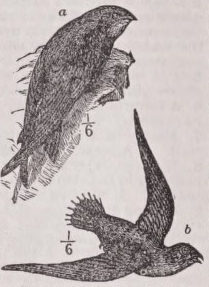
SWIFT, a bird so called from the extreme speed of its flight, which apparently exceeds that of any other British species, the Hirundo apus of Linnaeus and Cypselus apus or muramus of modern ornithologists, who have at last learned that it has only an outward resemblance but no near affinity to the Swallow (ante,p. 729) or its allies. Well known as a summer-visitor throughout the greater part of Europe, it is one of the latest to return from Africa, and its stay in the country of its birth is of the shortest, for it generally disappears from England very early in August, though occasionally to be seen for even two months later....
The Swift commonly chooses its nesting-place in holes under the eaves of buildings, but a crevice in the face of a quarry, or even a hollow tree, will serve it with the accommodation it requires. This indeed is not much, since every natural function, except sleep, oviposition, and incubation, is performed on the wing, and the easy evolutions of this bird in the air, where it remains for hours together, are the admiration of all who witness them. Though considerably larger than a Swallow, it can be recognized at a distance less by its size than by its peculiar shape. The head scarcely projects from the anterior outline of the pointed wings, which form an almost continuous curve, at right angles to which extend the body and tail, resembling the handle of the crescentic cutting-knife used in several trades, while the wings represent the blade. The mode of flight of the two birds is also unlike, that of the Swift being much more steady, and, rapid as it is, ordinarily free from jerks. The whole plumage, except a greyish-white patch under the chin, is a sooty black, but glossy above. Though its actual breeding-places are by no means numerous, its extraordinary speed and discursive habits make the Swift widely distributed; and throughout England scarcely a summer’s day passes without its being seen in most places. A larger species, C. melba or C. alpinus, with the lower parts dusky white, whieh has its home in many of the mountainous parts of central and southern Europe, has several times been observed in Britain, and two examples of a species of a very distinct genus, Acanthyllis (or Chaetura), which has its home in northern Asia, but regularly emigrates thence to Australia, have been obtained in England (Proc. Zool. Society, 1880, p. 1).
Among other peculiarities the Swifts, as long ago described (probably from John Hunter’s notes) by Home (Phil. Tran s., 1817, pp. 332 et seqq., pl. xvi.), are remarkable for the development of their salivary glands, the secretions of which serve in most species to glue together the materials of which the nests are composed, and in the species of the genus Collocalia form almost the whole substance of the structure. These are the “edible” nests so eagerly sought by Chinese epicures as an ingredient for soup, and their composition, though announced many years since by Home {ut supra), whose statement was confirmed by Bernstein {Act. Soc. Sc. Indo-Néerlandicae, iii. Art. 5, and Journ, fur Ornithologie, 1859, pp. 111-119), has of late been needlessly doubted in favour of the popular belief that they were made of some kind of sea-weed, Algae, or other vegetable matter collected by the birds. It may be hoped that the examination and analysis made by Mr J. R. Green {Journal of Physiology, vi. pp. 40-45) have settled that question for all time. These remarkable nests consist essentially of mucus, secreted by the salivary glands above mentioned, which dries and looks like isinglass. Their marketable value depends on their colour and purity, for they are often intermixed with feathers and other foreign substances. The Swifts that construct these “edible” nests form a genus Collocalia, of which the number of species is uncertain; but they inhabit chiefly the islands of the Indian Ocean from the north of Madagascar eastward, as well as many of the tropical islands of the Pacific so far as the Marquesas,—one species occurring in the hill-country of India. They breed in caves, to which they resort in great numbers, and occupy them jointly and yet alternately with Bats—the mammals being the lodgers by day and the birds by night.
The genus Cypselus, as noted by Willughby, with its American ally Panyptila, exhibits a form of pedal structure not otherwise observed among birds. Not only is the hind-toe constantly directed forwards, but the other three toes depart from the rule which ordinarily governs the number of phalanges in the Bird’s foot,—a rule which applies to even so ancient a form as Archseopteryx (see Birds, vol. iii. p. 728),—and in the two Cypseline genera just named the series of digital phalanges is 2, 3, 3, 3, instead of 2, 3, 4, 5, which generally obtains in the Class Aves. Other Swifts, however, do not depart from the normal arrangement, and the exception, remarkable as it is, must not be taken as of more value than is needed for the recognition of two sections or subgenera admitted by Mr Sclater in his monographical essay on the Family (Proc. Zool. Society, 1865, pp. 593-617). There seem to be about half a dozen good genera of Cypselidae, and from fifty to sixty species. Their geographical distribution is much the same as that of the Hirundinidae (cf. Swallow, ut supra); but it should be always and most clearly borne in mind that, though so like Swallows in many respects, the Swifts have scarcely any part of their structure which is not formed on a different plan; and, instead of any near affinity existing between the two groups, it can scarcely be doubted by any unprejudiced investigator that the Cypselidae not only differ far more from the Hirundinidae than the latter do from any other Family of Passeres, but that they belong to what in the present state of ornithology must be deemed a distinct Order of Birds—that which in the present series of articles has been called Picarae. That the relations of the Cypselidae to the Trochilidae (cf. Humming-Bird, vol, xii. pp. 357 sq.) are close, as has been asserted by L’Herminie and Nitzsch, Dr Burmeister and Prof. Huxley, is denied by Dr Shufeldt (Proc. Zool. Society, 1885, pp. 886-914), but the views of the last have since been controverted by Mr F. Lucas (Auk, 1886, pp. 444-451); (a. n.)
SWIFT, Jonathan (1667-1745), dean of St Patrick’s, the greatest satirist of his own or perhaps of any age, was born in Hoey’s Court, Dublin, November 30, 1667. Like Pope’s, his family was of Yorkshire origin; in the time of Charles I. the representative of one branch had obtained a peerage, which expired with him. The first of his own immediate ancestors known to us was a clergyman, rector of St Andrew’s, Canterbury, from 1569 to 1592, whose son succeeded him in that living, and whose grandson was the Rev. Thomas Swift, vicar of Goodrich in Herefordshire, renowned for his eccentricity, his mechanical ingenuity, and, above all, his stubborn devotion to Charles I. and the persecutions he underwent in consequence. Plundered thirty-six times, and ultimately ejected from his living, he died in 1658, leaving his thirteen children a small and greatly impoverished landed estate and the questionable advantage of a substantial claim on the gratitude of the restored sovereign. More fortunate than most ruined cavaliers, his eldest son Godwin soon obtained the attorney-generalship of the palatinate of Tipperary. This piece of good fortune naturally attracted other members of the family across the channel,—among them Jonathan, one of the youngest of nine brothers, but already husband of Abigail Ericke of Leicester, a lady of ancient descent and means more limited than his own. A student of law, but never called to the bar, Jonathan appears to have subsisted for some years on windfalls and casual employments. At length (1665) he became steward of the King’s Inns (answering to the Inns of Court in England), an office of small emolument. Two years afterwards he died suddenly, leaving an infant daughter and a widow pregnant with the future dean of St Patrick’s. So embarrassed had his circumstances been that, although considerable debts were owing to the estate, Mrs Swift was for the moment unable to pay the expense of his interment. Thus Swift’s first experience of life was that of a dependant on the charity of his uncles, more particularly of Godwin; and the inevitable bitterness of the situation was aggravated by the grudging manner in which the Tipperary official seemed to dole out his parsimonious help. In fact, the apparently prosperous relative was the victim of unfortunate speculations, and chose rather to be reproached with avarice than with imprudence. A virulent resentment became ingrained into the youth’s whole nature, and, though ultimately acquainted with the real state of the case, he never mentioned his uncle with kindness or respect. Other relatives did more to merit his regard. Yet he took no pride in his Irish connexions or nativity, and a singular adventure in his infancy seems to have afforded him a pretext for insinuating that he was really born in England. "When he was but two years old his nurse, a native of Whitehaven, was recalled to that town by an illness in her family. So attached had she become to her charge as to clandestinely carry him away with her, Mrs Swift was induced to consent to his remaining with her for a time, and the child spent three years in Cumberland. By his return his education had made considerable progress, and in the next year he was sent to the grammar school at Kilkenny. There can be no question as to the author of Gulliver having been a remarkable child, but unfortunately only one anecdote of his school-days has been preserved. It is the story, graphically narrated by himself, of his having once invested the whole of his pocket-money in the purchase of an old horse condemned to the knacker’s yard, his momentary triumph over his school-fellows, and his mortification on discovering the uselessness of his acquisition,—an anecdote highly characteristic of his daring pride and ambition, and from which, instead of the moral he professed to discover, he might have derived an augury of the majestic failure of his life.
In April 1682 Swift matriculated at Trinity College, Dublin, where he failed to distinguish himself, “By the ill-treatment of his nearest relations,” he says, meaning especially his uncle Godwin, “he was so discouraged and sunk in his spirits that he too much neglected his academic studies, for some part of which he had no great relish by nature; so that when the time came for taking his degree as bachelor of arts he was stopped of his degree for dulness and insufficiency, and at last hardly admitted in a manner little to his credit, which is called in that college speciali gratia, February 15, 1685.” The college roll, nevertheless, shows that the only subject in which Swift absolutely failed was natural philosophy, including mathematics, in which the future author of the Voyage to Laputa was hardly likely to excel, nor is it surprising that a student of fitful and unruly temperament should have performed his obligatory theme negligenter. His examination in Greek and Latin was satisfactory, and the extent of desultory information evinced by his writings seems to prove that he had always been an industrious reader. His mortification made him reckless, and he repeatedly underwent academic censure during the next three years, though it is not certain whether some of the records supposed to apply to him do not in fact relate to his cousin Thomas. In 1688 Swift quitted the university, and, after a brief residence with his mother at Leicester, entered the family of Sir William Temple at Moor Park, near Farnham, as he declares for the advantage of Temple’s conversation, but at least partly as an amanuensis. A distant relationship between his mother and Lady Temple appears to have recommended him to this post, which he found trying to his pride and independence. Temple was, as Swift admitted, “a man of sense and virtue,” but his temper was exclusive, his manners formal, and he had retired from public affairs from self-regard and over-fastidiousness. If he solaced his voluntary ostracism by a comparison with the elegant retirement and lettered ease of Cicero, it did not therefore occur to him to compare his obscure Irish secretary with the Roman orator’s amanuensis Tiro, who had, at least, invented shorthand. We, who know that in the patron’s place the dependant would have governed the nation, need not be surprised at finding, full twenty years afterwards, the iron of servitude still rankling in the latter’s haughty soul. He withdrew from Temple’s service on a pretext of ill health from May 1690 to August 1691, but returned, and undoubtedly made himself useful to his employer, who on one occasion rendered him the medium of a confidential communication to King William, who had consulted Temple on the bill for triennial parliaments, then sanctioned by both branches of the legislature. Swift did his best to enforce Temple’s arguments in favour of the measure, and was in after life wont to refer to the failure of his rhetoric as the most useful lesson his vanity had ever received. Struck, it would seem, rather by the physical than the mental endowments of the robust young Irishman, William offered him a troop of horse, a proposal which appears to have been subsequently commuted into a promise of church preferment. Swift had already (July 1692) proceeded to the degree of M.A. at Oxford, and the execution of his design to embrace the ecclesiastical profession was hastened by a quarrel with Temple, occasioned by the latter’s reluctance to contract any definite engagement to provide for him. Throwing up his employment, he passed (May 1694) over into Ireland, but found his views impeded by the refusal of all the bishops to ordain him without some certificate of the regularity of his deportment while in Temple’s family. Five months passed ere he could bring himself to solicit this favour from his old patron, which he ultimately did in a letter submissive in appearance, but charged to the full with smothered rage and intense humiliation. Forgiveness was easy to one in Temple’s place and of Temple’s disposition, and he not only despatched the requisite testimonials, but added a recommendation which obtained for Swift the living of Kilroot, in the diocese of Down and Connor (January 1695). His residence here was not fated to be of long duration. Temple, who knew his value and had not parted with him willingly, soon let him understand that a return was open to him, and Swift, whose resentment was cooled by time, and soothed by the acknowledgment of his value to his patron, readily complied (May 1696). He continued to reside with Sir William till the latter’s death in January 1699. No further disagreement troubled their intimacy, and Temple bequeathed Swift the charge of editing his writings, a laborious but not an unprofitable commission.
Macaulay has justly indicated the familiarity with public affairs acquired by Swift at Moor Park as one main cause of his subsequent distinction as a politician, and here too he laid the foundation of his literary renown. He is reported to have read regularly for eight hours every day; and we have his own authority for his having, as early as 1691, “written and burned, and written again, more on all manner of subjects than perhaps any man in England.” The only relics of these early days, however, belong to a species of composition in which he was little qualified to excel. He has, indeed, a name among the poets of England, but the merit of his verse is usually in the ratio of its approach to the sermo pedestris. Mistaking the nature of his powers, he must needs begin with Pindarics, and the result may be imagined. Yet his own simple account of his feelings while endeavouring composition proves that the mood was right though the channel was wrong, and that there was error as well as truth in his kinsman Dryden’s severe and unforgiven remark, “Cousin Swift, you will never be a poet.” Swift’s first prose composition betrayed his resentment. In the Battle of the Books (1697), a satirical contribution to the controversy on the comparative merits of the ancients and the moderns raised by Perrault, but with especial reference to the question of the genuineness of the letters of Phalaris, on which his patron Temple had taken the wrong side, Swift for the first and last time committed a plagiarism, and sought to conceal it by an untruth. It is undoubtedly adapted, though certainly improved from, De Callières’s Histoire Poétique de la Guerre nouvellement déclarée entre les Anciens et les Modernes. Here also his sarcasm for the first and last time recoiled upon himself. The satire against Dryden and Bentley wants, indeed, nothing but truth to be excellent; but the pictures of the former in his monstrous helmet aud the latter in his patchwork mail yield in ludicrousness to the idea of the author of the Pindaric Odes presuming to ridicule the author of Absalom and Achitophel, and the inglorious student of Trinity College, Dublin, challenging the first philologist of the age on a question of classical scholarship. It is, however, to his credit that his learning was greater than that of the other writers on his side and his pretensions less. Swift’s next literary labour was his edition of Temple’s posthumous works, already mentioned. They appeared with a dedication to King William, which was to have made the editor a prebendary. A petition to this effect miscarried, as he always believed, through the negligence or ill-will of the nobleman who undertook to present it. Be this as it may, he had become too important to be overlooked, and soon obtained the post of secretary and chaplain to Earl Berkeley, one of the lords justices of Ireland. The better half of this appointment, however, escaped him on his arrival in that country, his secretaryship being transferred to a Mr Bushe, who, when Lord Berkeley had at length an opportunity of recompensing Swift’s disappointment by the gift of the deanery of Derry, successfully exerted his influence in favour of another clergyman, who is asserted to have gained his interest by the judicious outlay of a thousand pounds. With bitter indignation Swift threw up his chaplaincy, but was ultimately reconciled to his patron by the presentation to the rectory of Agher, in Meath, with the united vicarages of Laracor and Rathbeggan. For the first time in his life he might now call himself his own master, and had an opportunity of exhibiting, free from suspicion of external constraint, that stern regard to duty which was not the least prominent feature of his character. In an age of general laxity—in a priest of an alien church, whose most energetic servants commonly succumbed to the mortifying conviction of their uselessness and the detestation they excited among the people for whom they laboured, the parishioners of Laracor found a clergyman whom they might have heard three times a week. The energy, however, which probably gained the respect, certainly failed to influence the convictions, of his Catholic flock. We have his own authority for reckoning his average congregation at “half a score”; and on one occasion his clerk Roger was his only auditor. In fact, his exertions in the pulpit were more meritorious than his achievements; he entirely lacked the fire, the self-oblivion, the expansive geniality of the orator. He himself characterized his discourses as “pamphlets,” and, if meant to imply their arid and argumentative character, the criticism is just. The author of the Tale of a Tub, which he had had by him since 1696 or 1698, must have felt conscious of powers capable of far more effective exercise; and his resolution to exchange divinity for politics must appear fully justified on a comparison of these inconclusive essays with another performance of the same period. The Discourse on the Dissensions in Athens and Rome (September 1700), written in the Whig interest, “without humour and without satire,” and intended as a dissuasive from the pending impeachment of Somers and three other noblemen, received the honour, extraordinary for the maiden publication of a young politician, of being generally attributed to Somers himself or to Burnet, the latter of whom found a public disavowal necessary. Three years and a half later appeared a more remarkable work. Clearness, cogency, masculine simplicity of diction, are conspicuous in the pamphlet, but true creative power told the Tale of a Tub. “Good God! what a genius I had when I wrote that book !” was his own exclamation in his latter years. It is, indeed, if not the most amusing of Swift’s satirical works, the most strikingly original, and the one in which the compass of his powers is most fully displayed. In his kindred productions he relies mainly upon a single element of the humorous,—logical sequence and unruffled gravity bridling in an otherwise frantic absurdity, and investing it with an air of sense. In the Tale of a Tub he lashes out in all directions. The humour, if less cogent and cumulative, is richer and more varied; the invention too, is more daringly original and more completely out of the reach of ordinary faculties. The supernatural coats and the quintessential loaf may be paralleled but cannot be surpassed; and the book is throughout a mine of suggestiveness, as, for example, in the anticipation of Carlyle’s clothes philosophy within the compass of a few lines. At the same time it wants unity and coherence, it attains no conclusion, and the author abuses his digressive method of composition and his convenient fiction of hiatuses in the original manuscript. The charges it occasioned of profanity and irreverence were natural, but groundless. There is nothing in the book inconsistent with Swift’s professed and real character as a sturdy Church of England parson, who accepted the doctrines of his church as an essential constituent of the social order around him, battled for them with the fidelity of a soldier defending his colours, and held it no part of his duty to understand, interpret, or assimilate them.
Before the publication of the Tale of a Tub, Swift had taken a step destined to exercise a most important influence on his life, by inviting two ladies to Laracor. Esther Johnson, a dependant of Sir William Temple’s (born in March 1681), whose acquaintance he had made in the latter’s family, and whom he has immortalized as “Stella,” came over with her chaperon, Mrs Dingley, and was soon permanently domiciled in his neighbourhood. The melancholy tale of Swift’s attachment will be more conveniently narrated in another place, and is only alluded to here for the sake of chronology. Meanwhile the sphere of his intimacies was rapidly widening. He had been in England for three years together, 1701 to 1704, and counted Pope, Steele, and Addison among his friends. The success of his pamphlet gained him ready access to all Whig circles; but already his confidence in that party was shaken, and he was beginning to meditate that change of sides which has drawn down upon him so much but such unjustifiable obloquy. The true state of the case may easily be collected from his next publications— The Sentiments of a Church of England Man, and On the Reasonableness of a Test (1708). The vital differences among the friends of the Hanover succession were not political, but ecclesiastical. From this point of view, Swift’s sympathies were entirely with the Tories. As a minister of the church he felt his duty and his interest equally concerned in the support of her cause; nor could he fail to discover the inevitable tendency of Whig doctrines, whatever caresses individual Whigs might bestow on individual clergymen, to abase the Establishment as a corporation. He sincerely believed that the ultimate purpose of freethinkers was to escape from moral restraints, and he had an unreasoning antipathy to Scotch Presbyterians and English Dissenters. One of his pamphlets, written about this time, contains his recipe for the promotion of religion, and is of itself a sufficient testimony to the extreme materialism of his views. Censorships and penalties are among the means he recommends. His pen was exerted to better purpose in the most consummate example of his irony, the Argument against Abolishing Christianity. About this time, too (November 1707), he produced his best poem, Baucis and Philemon, which, as he frankly tells us, owes very much to the corrections of Addison.
From February 1708 to April 1709 Swift was in London, urging upon the Godolphin administration the claims of the Irish clergy to the first-fruits and tenths (“Queen Anne’s bounty”), already granted to their brethren in England. His having been selected for such a commission shows that he was not yet regarded as a deserter from the Whigs, although the ill-success of his representations probably helped to make him one. By November 1710 he was again domiciled in London, and writing his Journal to Stella, that unique exemplar of a giant’s playfulness, “which was written for one person’s private pleasure and has had indestructible attractiveness for every one since.” In the first pages of this marvellously minute record of a busy life we find him depicting the decline of Whig credit and complaining of the cold reception accorded him by Godolphin, whose penetration had doubtless detected the precariousness of his allegiance. Within a few weeks he had become the lampooner of the fallen treasurer, the bosom friend of Oxford and Bolingbroke, and the writer of the Examiner, a journal established as the exponent of Tory views (November 1710). He was now a power in the state, the intimate friend and recognized equal of the first writers of the day, the associate of ministers on a footing of perfect cordiality and familiarity. “We were determined to have you,” said Bolingbroke to him afterwards; “you were the only one we were afraid of.” He gained his point respecting the Irish endowments; and, by his own account, his credit procured the fortune of more than forty deserving or undeserving clients. The envious but graphic description of his demeanour conveyed to us by Bishop Kennet attests the real dignity of his position no less than the airs he thought fit to assume in consequence. The cheerful, almost jovial, tone of his letters to Stella evinces his full contentment, nor was he one to be moved to gratitude for small mercies. He had it, in fact, fully in his own power to determine his relations with the ministry, and he would be satisfied with nothing short of familiar and ostentatious equality. His advent marks a new era in English political life, the age of public opinion, created indeed by the circumstances of the time, but powerfully fostered and accelerated by him. By a strange but not unfrequent irony of fate the most imperious and despotic spirit of his day laboured to enthrone a power which, had he himself been in authority, he would have utterly detested and despised. For a brief time he seemed to resume the whole power of the English press in his own pen and to guide public opinion as he would. His services to his party as writer of the Examiner, which he quitted in July 1711, were even surpassed by those which he rendered as the author of telling pamphlets, among which The Conduct of the Allies and Remarks on the Barrier Treaty (November and December 1711) hold the first rank. In truth, however, he was lifted by the wave he seemed to command. Surfeited with glory, the nation wanted a convenient excuse for relinquishing a burdensome war, which the great military genius of the age was suspected of prolonging to fill his pockets. The Whigs had been long in office. The High Church party had derived great strength from the Sacheverell trial. Swift did not bring about the revolution with which, notwithstanding, he associated his name. There seems no reason to suppose that he was consulted respecting the great Tory strokes of the creation of the twelve new peers and the dismissal of Marlborough (December 1711), but they would hardly have been ventured upon if The Conduct of the Allies and the Examiners had not prepared the way. A scarcely less important service was rendered to the ministry by his Letter to the October Club, artfully composed to soothe the impatience of Harley’s extreme followers. He had every claim to the highest preferment that ministers could give him, but his own pride and prejudice in high places stood in his way.
Generous men like Oxford and Bolingbroke cannot have been unwilling to reward so serviceable a friend, especially when their own interest lay in keeping him in England. Notwithstanding, therefore, some dubious expressions in Swift’s letters, natural to the deferred hope, we need not doubt their having actually used their best efforts to obtain for him the vacant see of Hereford. Swift, however, had formidable antagonists in the archbishop of York, whom he had scandalized, and the duchess of Somerset, whom he had satirized. Anne was particularly amenable to the influence of priestly and female favourites, and it must be considered a proof of the strong interest made for Swift that she was eventually persuaded to appoint him to the deanery of St Patrick’s, Dublin, vacant by the removal of Bishop Sterne to Dromore. It is to his honour that he never speaks of the queen with resentment or bitterness. In June 1713 he set out to take possession of his dignity, and encountered a very cold reception from the Dublin public. The dissensions between the chiefs of his party speedily recalled him to England. He found affairs in a desperate condition. The queen’s demise was evidently at hand, and the same instinctive good sense which had ranged the nation on the side of the Tories, when Tories alone could terminate a fatiguing war, rendered it Whig when Tories manifestly could not be trusted to maintain the Protestant succession. In any event the occupants of office could merely have had the choice of risking their heads in an attempt to exclude the elector of Hanover, or of waiting patiently till he should come and eject them from their posts; yet they might have remained formidable could they have remained united. To the indignation with which he regarded Oxford’s refusal to advance him in the peerage the active St John added an old disgust at the treasurer’s pedantic and dilatory formalism, as well as his evident propensity, while leaving his colleague the fatigues, to engross for himself the chief credit of the administration. Their schemes of policy diverged as widely as their characters: Bolingbroke’s brain teemed with the wildest plans, which Oxford might have more effectually dis countenanced had he been prepared with anything in their place. Swift’s endeavours after an accommodation were as fruitless as unremitting. His mortification was little likely to temper the habitual virulence of his pen, which rarely produced anything more acrimonious than the attacks he at this period directed against Burnet and his former friend Steele. One of his pamphlets against the latter (7‰ Public Spirit of the Whigs) was near involving him in a prosecution, some invectives against the Scots having proved so exasperating to the peers of that nation that they repaired in a body to the queen to demand the punishment of the author, of whose identity there could be no doubt, although, like all Swift’s writings, except the Proposal for the Extension of Religion, the pamphlet had been published anonymously. The immediate withdrawal of the offensive passage, and a sham prosecution instituted against the printer, extricated Swift from his danger.
Meanwhile the crisis had arrived, and the discord of Oxford and Bolingbroke had become patent to all the nation. Foreseeing, as is probable, the impending fall of the former, Swift retired to Upper Letcombe, in Berkshire, and there spent some weeks in the strictest seclusion. This leisure was occupied in the composition of his remarkable pamphlet, Free Thoughts an the State of Public Affairs, which indicates his complete conversion to the bold policy of Bolingbroke. The utter exclusion of Whigs as well as Dissenters from office, the remodelling of the army, the imposition of the most rigid restraints on the heir to the throne,—such were the measures which, by recommending, Swift tacitly admitted to be necessary to the triumph of his party. If he were serious, it can only be said that the desperation of his circumstances had momentarily troubled the lucidity of his understanding; if the pamphlet were merely intended as a feeler after public opinion, it is surprising that he did not perceive how irretrievably he was ruining his friends in the eyes of all moderate men. Bolingbroke’s daring spirit, however, recoiled from no extreme, and, fortunately for Swift, he added so much of his own to the latter’s MS. that the author was obliged to recall a production which might not improbably have cost him his liberty and his deanery. This incident but just anticipated the revolution which, after Bolingbroke had enjoyed a three days’ triumph over Oxford, drove him into exile and prostrated his party, but enabled Swift to perform the noblest action of his life. Almost the first acts of Bolingbroke’s ephemeral premiership were to order him a thousand pounds from the exchequer and despatch him the most flattering invitations. The same post brought a letter from Oxford, soliciting Swift’s company in his retirement; and, to the latter’s immortal honour, he hesitated not an instant in preferring the solace of his friend to the offers of St John. When, a few days afterwards, Oxford was in prison and in danger of his life, Swift begged to share his captivity; and it was only on the offer being declined that he finally directed his steps towards Ireland, where he was very ill received. The draft on the exchequer was intercepted by the queen’s death.
These four busy years of Swift’s London life had not been entirely engrossed by politics. First as the associate of Steele, with whom he quarrelled, and of Addison, whose esteem for him survived all differences, afterwards as the intimate comrade of Pope and Arbuthnot, the friend of Congreve and Atterbury, Parnell and Gay, he entered deeply into the literary life of the period. He was treasurer and a leading member of the Brothers, a society of wits and statesmen which recalls the days of Horace and Maecenas. He promoted the subscription for Pope’s Homer, contributed some numbers to the Tatler, Spectator, and Intelligencer, and joined with Pope and Arbuthnot in establishing the Scriblerus Club, writing Martinus Scriblerus, his share in which can have been but small, as well as John Bull, where the chapter recommending the education of all blue-eyed children in depravity for the public good must surely be his. His fugitive productions during this period are very numerous, and mostly distinguished not only by pungent wit but by overflowing animal spirits. The most celebrated are the cruel but irresistibly ludicrous satires on the astrologer Partridge, a man in fact respectable for his sincere belief in his art, and no mean writer. Many of his best poems belong to this period. A more laboured work, his Memorial to Harley, proposing the regulation of the English language by an academy, is chiefly remarkable as a proof of the deference paid to French taste by the most original English writer of his day. His History of the Last Four Years of Queen Anne is not on a level with his other political writings. To sum up the incidents of this eventful period of his life, it was during it that he lost his mother, always loved and dutifully honoured, by death; his sister had been estranged from him some years before by an imprudent marriage, which, though making her a liberal allowance, he never forgave.
The change from London to Dublin can seldom be an agreeable one. To Swift it meant for the time the fall from unique authority to absolute insignificance. All share in the administration of even Irish affairs was denied him; every politician shunned him; and his society hardly included a single author