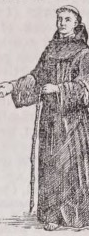
FRANCIS, St (1182-1226), a well-known saint of the Roman Catholic Church, the founder of the great order of Franciscans, was born at Assisi in the year 1182. His father was a trader in goods which he appears chiefly to have purchased in the south of France, to which he made frequent journeys; and his son was born during one of these journeys, and in consequence received from the grateful father on his return the name of Francesco. His mother had wished to call him, it is said, Giovanni or John. The youth grew up very much like any other boy of his class. He received but little learning from the priest of the parish, and does not seem to have manifested any special love for school instruction. He was by nature a merry-hearted and careless fellow, and developed early an inclination for fine clothes and street amusements with other boys of his class. His parents, indulgent to his gaieties, saw with pride the higher tastes and bright intelligence of their son, and would sometimes say to one another, “He is like the son of a prince.” The father formed expectations of α successful courtly career; but the mother, seeing more into the boy’s heart, would say to her neighbours, “If he lives like the son of a prince now, he shall hereafter be a child of God.”...
Soon a great change came to him. At the age of twenty-five Francis was seized with a severe illness. Reflections came to him on his sick-bed, and he rose from it an altered man. Henceforward, says one of his biographers, “he held that in contempt which he had hitherto held in admiration and love.” The ardour of his natural character flamed forth first in the idea of military devotion, and then in a consuming spirit of self-sacrifice for the good of others. All his love of amusement and worldly display disappeared. He began to speak of poverty as his bride; and the poor and the sick and the leper became the objects of his peculiar care. He would seek out the lepers, hitherto abhorred by him as by the popular feeling, and kiss them and minister to their wants. He made a pilgrimage to Rome, and in his enthusiasm for poverty flung all he had on the altar of St Peters, joined himself to a troop of beggars, and gave himself up to a wandering life of almsgiving and charity. His mother guessed something of the feelings that were struggling in her son’s heart; but his father, not unnaturally, was greatly concerned at his conduct. At last matters came to an open rupture between them; and the saint’s severance of the parental tie for the sake of his divine mission is a significant incident in his career with all his biographers. It happened in this wise. There was an old church or small chapel of the name of St Damian in the neighbourhood of Assisi which had fallen into ruins. The spot was a favourite one with the youthful enthusiast for meditation and prayer; and one day as he sat in meditation among the ruins he seemed to hear a voice saying to him clearly, “Francis, seest thou not that my house is in ruins; go and restore it for me.” To hear was to obey. The divine voice, as with some other enthusiasts, seemed to silence every other voice in his heart, even the voice of conscience. He returned home, saddled his horse, took a bale of his father’s goods, and repairing to Foligno he sold both horse and goods, and rushed to the priest of St Damian with the money to pay for the restoration of the church. The good priest was startled; his father heard with indignation of bis son’s conduct, and at length with blows and curses securely imprisoned him from any further freaks. But his father’s harshness overshot the mark. Released by the tenderness of his mother, and summoned to restore the goods he had taken away and renounce all his patrimonial rights, the popular feeling, which had previously sided with his father against him, now turned in the youth’s favour. The bishop, before whom the case finally came, discovered the youth’s vocation to a religious life, and induced him to restore the value of the goods to his father. The money had been all the while lying neglected amidst the ruins of the church. This accomplished, Francis renounced all dependence upon his father, and gave himself up to the profession of a religious mendicant, “I have but one, a Father in heaven, now,” he said. The people were melted to tears by his devotion, and the good bishop took him for a time under his own charge.
Gradually Francis found his full vocation, not only in a life of entire devotion and poverty for himself, but in founding an order of mendicants devoted to the service of the church. It was in the old scene of his earlier inspiration that the new idea came to him. Once more the divine voice was heard sounding in his ears: “Provide neither gold nor silver nor brass in your purses, nor scrip for your journey, neither two coats, nor yet staves.” This was about the year 1208 or 1209, when, therefore, the saint was about twenty-six years of age. He was henceforth a preacher as well as an exemplar of poverty. He essayed to reproduce the picture of the divine life on earth, having not where to lay his held, going about doing good, and preaching the gospel of the kingdom. “Sell all that thou hast, and give to the poor; then thou shalt have treasure in heaven.” Gradually there gathered round his cell, which he had fixed outside the town near a little church, the St Maria degli Angeli, better known as the Portiuncula, a band of disciples as enthusiastic as himself. “Fear not,” he said to them, “because you are small and seem foolish. Have confidence in the Lord who has vanquished the world. Some will receive you. Many proud will resist you. Bear all with sweetness and patience. Soon the wise and the noble will be with us. The Lord hath given me to see this. I have in my ears the sounds of the languages of all the people who will come to us,—French, Spaniards, Germans, English. The Lord will make us a great people, even to the end of the earth.”
In this insignificant manner was laid the foundation of the great Franciscan order. At first there were only seven, himself the eighth, but all were animated by the same spirit, and all followed the same rule of life. As he sent them forth he said, “Go and preach two and two. Preach peace and patience; tend the wounded: relieve the distressed; reclaim the erring; bless them wlιich persecute you, and pray for them that despitefully use you.” The gospel of divine poverty was proclaimed everywhere. The spirit of self-renunciation spread by-and-by like wildfire, and multitudes were added to the order day by day. It may seem to our modern imagination a fantastic dream, but the gospel of St Francis met a congenial root in the social and spiritual life of the 13th century, and rapidly grew into great results. The sanction and blessing of the papacy, however, were necessary to give the order ecclesiastical position and influence. Francis himself undertook a new journey to Rome, and suddenly appeared before the great Innocent III. as he was walking one day on the terrace of the Lateran. The startled pope dismissed the mean stranger with mingled pity and contempt; but the same night a vision came to him of the marvellous growth of a palm tree from meanness to magnificence; and, as he pondered the meaning of the vision, a divine whisper reached him that thus powerful on behalf of the church was to prove the poor man whose appearance had startled him. The natural conclusion followed. The poor man was recalled, his projects were submitted to the judgment of the Vatican, and the result was that the papal sanction was formally extended to the order,—a few years before the same sanction was given to the great rival order headed by the learned and noble Dominic. The founders of the two great mendicant orders are said to have met afterwards at Rome, and again at a great meeting of the Franciscans in 1219. St Dominic is credited with the most friendly greetings offered to his brother saint. “Thou art my companion; thy work and mine is the same.” It is said also that he looked with amazement at the second meeting on the remarkable fascination which the simple-minded Francis exerted over his followers. But it is difficult to know whether these reputed rapprochements of the great leaders were not an afterthought of their biographers, interested in promoting the idea of the friendliness of the two powers which were destined for a time to divide the influence of the church between them.
Francis founded an order of poor sisters as well as poor brothers, known by the name of Poor Claras or Clarisses. The origin of the sisterhood is encircled in a halo of romance, such as everywhere surrounds the footsteps of St Francis. Clara was a young lady of the neighbourhood, who, either attracted by the saint’s preaching, or enamoured of his life of poverty, or both, resolved to devote herself to self-sacrifice as he and his companions had done. He is said to have “poured into her ears the sweetness of Christ.” The result was that she forsook her home, fled to the Portiuncula, and, being first a member of the order, was then placed in a female convent. From this questionable beginning sprang the sisterhood nearly as famous in its history as the great brotherhood, and which survives till this day. There was a third order also sprung up in the course of the saint’s lifetime. So marvellous were the consequences of his preaching that whole populations, it is said, wished to devote themselves to consecrated poverty. But many, of course, had no real vocation to such a service, and Francis, visionary as he was, saw that the excesses of his system might prove its ruin. So he arranged to receive persons of this class into an order of what was called Tertiaries or Brethren of Penitence, who retained their social position and their customary employments in the world, while coming under general vows to abstain from worldly dissipations, such as the theatre, and otherwise to be scrupulous in all their conduct. Women were not admitted to this order without the consent of their husbands. Its members did not wear silk or other costly materials, but they had no special costume, and otherwise were at liberty. His conduct in this matter is sufficient to prove that, amidst all the apparently childlike enthusiasm of the saint, he possessed, as indeed cannot be doubted, no inconsiderable vein of shrewd discernment and of practical ability. This order was established in 1221.
Meanwhile Francis was unceasing in his personal labours. It is not easy to trace the chronology of his age or his adventures; but the same spirit of self-sacrifice, of burning ardour and spiritual industry, is everywhere conspicuous. He made long missionary journeys to Illyria, to Spain, and even to the East, to preach to the Mahometans. He gained access to the sultan, it is said, and proclaimed to him the gospel of poverty. He was for some time in the Holy Land, and everywhere he gained multitudes of disciples. The atmosphere of miracle everywhere accompanied him, and his fame was spread throughout Christendom. Whatever we may think of many events of his life, and impossible as it is now to disentangle the legendary thread of the supernatural from its more credible texture, there are many traits of the saint’s character which are in no sense doubtful, but show with a clear and life-like impress what sort of a man he was. He was passionately fond of all living things, and found his chief happiness in ministering to the needs of his fellowcreatures or the enjoyment of the lower creatures around him. His love for animals of all kinds was one of his most remarkable and winning features. Of the birds in the woods, the sheep in the fields, the ass on which he rode, the bees, the hares, the rabbits, he always spoke as his brothers and sisters. When the birds sang he said, “Our sisters, the birds, are pleasing God.” A little rabbit ran to him for protection; it was received into his bosom, as one of his biographers, the famous general of the order Bonaventura, says, “as if it had some hidden sense of the perfection of the father’s heart.” The very wolves, which all men were afraid to encounter, were tamed by him, and came like lambs and crouched at his feet. So at least it is related in one memorable case in the legends of the “Fioretti di San Francesco” (the “Little Flowers of St Francis,”—a collection of marvellous stories about the saint very popular in Italy to this day). There may be much in these stories that exceeds the limits of credibility; the amount of accurate fact lying beneath them can no longer be traced; but noue can hesitate to believe the beautiful depth of love which they reveal in the character of St Francis, and the fascination of personal influence which they show to have been possessed by him.
Connected with his love of nature and all living things was his poetry—for St Francis was not only saint but poet. The stream of Italian song, so soon to swell into the full volume of Dante (1265-1321), began to flow in the rugged but touching verse of the great preacher of Assisi. In him the troubadour inspiration, dying out in its original seat, was transmuted into a spiritual minstrelsy—hardly poetry, so imperfect is its form, but a lyrical cry, as Ozanam says (in his volume Les poètes franciscains, 1852), the first broken utterance of a new voice which was soon to fill the world. The most characteristic of his songs is a Cantico delle Creature (Song cf the Creation), which has been translated in Mrs Oliphant’s interesting life of the saint.
Marvellous as is the life of St Francis, the marvel that followed his death is more astonishing than any that marked his earthly career. It is said that when his naked body was visible after death, there was found upon it legibly impressed the marks of our Lord’s passion; and the sacred story is that one day as he prayed in the solitude of Mount Averno, near the sources of the Tiber and the Arno, there appeared to him the vision as of a seraph with the arms extended and the feet as if fixed to a cross; and as he thought in his heart what the vision might mean, there were revealed on his hands and feet the signs of nails as in the Crucified One. This is well known as the famous miracle of the Stigmata or wounds of our Lord. There seems to be no doubt that some such marks were found on the dead body of the saint, whatever explanation the phenomena may admit of. That there was anything really supernatural in the phenomena will be so readily discredited by the modern reader that it is unnecessary we should attempt any elaborate solution of the marvel. An interesting analysis of all the facts, and such historical explanation as they seem to admit of, will be found in Hase’s life of the saint, and an article, founded upon the analysis there given, in Good JΓords for 1867, p. 38 (“History of a Miracle”). St Francis, worn out by his many labours and consuming zeal, died on 4th October 1226.
“Of all saints,” says Milman {Hist, of Latin Christ., vol. iv. 268), “St Francis was the most blameless and gentle. He was emphatically the saint of the people,—of a poetic people like the Italians.” And to this day the name, the life, and the longsuffering of the popular saint live in the hearts of the poorer and devout Italians.
Of what may be called more or less original biographies of the saint there are in the well known Acta Sanctorum no fewer than three :—(1) The Life by Thomas of Celano (whose name is also associated with the composition of the famous Dies Tree), written only three years after the saint’s death; (2) the Life of the Tres Socii, three companions of the saint written in 1247; and, lastly, (3) the Life by Bonaventura, Platonic schoolman and general of the order in 1263. The works of the saint have been collected and edited by Job. de la Haye, S. Francisci Opera, 1739 sq. There is an elaborate biography by Malan, Hist, de S. François d'Assisi, 1841; and notices are also to be found in Helyot’s Hist, des Ordres Religieux, t. vii., and Butler’s Lives of the Saints. There are two recent lives, both of special interest, by the German divine, Hase, and by Mrs Oliphant in Macmillan’s Sunday Library series. See Franciscans. (j. t.) J
FRANCIS, St, of Paola (1416-1507), founder of the order of Minims (Ordo Minimorum Fratrum Eremitarum Fratris Francisci de Paula), was born of humble parentage at Paola in Calabria in the year 1416. His education appears to have made very little progress until he reached his thirteenth year, when, in accordance with a vow, he was taken by his father to the Franciscan convent of San Marco in Calabria. Here he learned to read, and distinguished himself by his austerities; but at the close of a probationary year he, for some reason that is not mentioned, left San Marco, and, after a pilgrimage to Assisi and Rome, retired to the neighbourhood of his native town, where in a cave by the sea-shore he gave himself wholly to a hermit life, after the example of the great St Francis, having no bed but the bare rock, and no other food than the herbs which he gathered in the neighbouring wood, or which were sometimes brought to him by his friends. In the course of time he was joined by some others like-minded with himself, and the building of a chapel in 1436 is generally considered as marking the first beginning of the Minimite order. At that time, however, and for many years afterwards, they were mere “Eremites of St Francis,” and did not claim to be distinguished from other Franciscans unless by a stricter fidelity to the common principles of the order. In eighteen years the little community had increased so much in numbers and in popularity that, with the help of a friendly neighbourhood, it was able to build a large church and monastery in 1454. In 1469, owing to reports which he had received, Pope Paul II. sent one of his chamberlains into Calabria to ascertain the actual condition of matters at Paola; the account brought back by him was highly favourable, and the result was that in 1474 the order of the Eremites was incorporated by a bull of Sixtus IV., and Francis appointed its first “corrector” or superior-general. In addition to the usual vows, there was a special rule, which pledged the members to the observance of a perpetual Lent Several new convents were founded in Calabria and Sicily during the following years; and the fame of Francis for sanctity and miraculous powers increased daily. When Louis XL.of France was seized with his last illness, he despatched a special message to beg of the holy man that he would come and restore him to health. Not until he had been commanded by Pope Sixtus IV. could Francis overcome his reluctance to undertake so long a journey on so doubtful an errand; and on his arrival at Plessis-lès-Tours, in April 1482, to the king’s entreaties for his intervention to prolong his life he simply replied that the lives of kings had their appointed limits, that God’s decree was unchangeable, and that for his Majesty nothing remained to be done but to resign himself to the divine will ; and prepare for death. At the request of Louis, Francis remained at Plessis; where he was treated with great respect by that sovereign, and also by his successor Charles VIII. In particular, the latter built two convents for the order, one near Plessis and another at Amboise; and on his triumphant arrival in Rome in 1495, he caused a third to be erected there. In 1501-2 a new and stricter constitution was granted to the order by Alexander VI., who at the same time conceded all the privileges and immunities enjoyed by the other mendicant orders, and bestowed, at the urgent request of Francis, the distinctive name of Minimi, which has ever since been retained. At the same time a lay order of Tertiaries was sanctioned, under a special rule. In 1506 the fourth vow (to observe a perpetual Lent) was made more definite and stringent in its character by Julius II. The death of Francis took place in his ninety-first year, at Plessis, on the 2d of April 1507. He was canonized by Leo X. in 1519,—his day in the calendar being April 2 (Duplex).
A graphic incidental notice of Francis occurs in the Memoirs of Philip de Comines (b. vi. c. 7), who says, “1 never saw any man living so holy, nor out of whose mouth the Holy Ghost did more manifestly speak.'* A brief sketch of his life occurs in the Breviarium Romanum ; and his miracles and prophecies are related at considerable length by the Bollandists. Reference may also be made to Butler’s Lives of the Saints. The order of Minims, called also Les Bons Hommes in France, Los Padres de la Vitoria in Spain, and Paulaner or Pauliner in Germany, never attained to any great prominence by the side of the great societies of Dominic and Francis of Assisi. Their cloisters never exceeded 450, and at present are very much fewer. The principal establishment is in Rome.
FRANCIS, St, of Sales (1567-1622), bishop of Geneva, and a well-known devotional writer of the Roman Catholic Church, was born at the Chateau de Sales, near Annecy in Savoy, in 1567. His father, known as Μ. de Boisy, was a Savoyard, seigneur, soldier, and diplomatist; his mother was also of a noble family and an heiress, the title de Boisy being derived from one of her hereditary possessions. Francis was their eldest son, born six years after marriage, and the child of many prayers. He received his education first at Annecy, then at the Jesuit College de Clermont in Paris, and for some time it seemed uncertain whether he should devote himself to law or the church. He studied jurisprudence, after leaving Paris, at Padua, became an advocate of the senate of Savoy, and seemed likely to gratify his father’s cherished ambition for his future career. But all the while Francis’s own inclinations were strongly towards the church. He had received the tonsure as early as 1578, while still a boy at Annecy, very much against his father’s wishes, and the spirit shown in this early manifestation of pious self-devotion never forsook him. Notwithstanding all his father’s remonstrances, he resolved to enter an ecclesiastical life; and, the office of provost or dean of Geneva becoming vacant, the dignity of this office, which was offered to him, was used as a temptation to secure the father’s consent. At length Μ. de Boisy gave way. Francis received holy orders (1593), and entered upon his duties as dean and preacher. He possessed great gifts as a preacher, and his fame soon spread through Savoy. His sermons were marked by great simplicity and persuasiveness. “The only real point of preaching, he said, “is the overthrow of sin and the increase of righteousness;” and the principle of this saying guided him in all his sermons. He preached constantly, and in the simplest and most touching and popular words he could find. His father failed to appreciate his style of preaching, as he had failed to understand his self-denial. “I never refused to preach,” Francis tells us, “on the principle of ‘ give to them that ask you.’ My dear father used to hear the bells ringing, and asked who preached. ‘Who but your son,’ was often the answer. One day he took me aside and said, ‘ Provost, you preach too often; even on week days the bells go, and it is always the same story, the provost, the provost! It used not to be so in my day. Sermons were much rarer. But then, to be sure, God knows those were something like sermons— full of learning, well got up, more Latin and Greek in one than you stick into a dozen.’” Francis, however, knew his own mind, and was not moved. “My test of the worth of a preacher,” he said, “is when his congregation go away saying not ‘ what a beautiful sermon,’ but ‘ I will do something.’” A man may set forth his own learning and eloquence in a fine sermon, but the true sign of success is when his words, induce people to leave off bad habits. And as he preached often, he preached briefly. “The more you say, the less people remember; the fewer your words, the greater their profit,” was his motto. “When a sermon is too long, the end makes one forget the middle, and the middle the beginning.”
Francis was plainly a man of some originality both of mind and character, and destined to become a power in the church to which he had so passionately devoted himself. Accordingly he soon became marked out for arduous work. Savoy was at this time greatly invaded by Calvinistic “heresies.” The neighbourhood of Geneva—a focus for the dissemination of Protestantism—and the political and military complications arising out of the hostile relations of the duke of Savoy and the king of France, all tended to the progress of Calvinism. Chablais had been invaded, and Protestant ministers long established at Thonon and other towns. For nearly sixty years in fact this region had been Protestant, and the people by express stipulation enjoyed the exercise of the Reformed religion. A missionary of apostolic fervour and courage was required to recover the lapsed district to the Catholic faith, and all eyes were turned to the young provost of Geneva as the only man fitted to grapple with the exigencies of the position. His father as usual was the obstacle. He entreated his son not to expose himself to the dangers of such a mission, but Francis felt the call within him, and calmly replied, “I cannot refuse to obey, ‘Wist ye not that I must be about my father’s business? ’” The result was that he gave himself for four years (1594-1598) to laborious and self-denying work in the district, often, it is said by his flattering biographers, preaching and administering the offices of his church at the peril of his life. His persuasive eloquence and the apostolic simplicity of his life were at first unsuccessful. The inhabitants of Chablais remained hardened in Protestanism. But more violent measures, some of them reflecting little honour on Francis, at length succeeded in reclaiming the district to the Catholic faith. His success in this work led the pope to believe that he might gain over Calvin’s celebrated successor, Theodore Beza; and lengthened conferences were held between the Protestant teacher and the Roman Catholic missionary, but without result. In 1598 Francis was appointed coadjutor bishop of Geneva, and became the official companion, as he had long been the warm friend of Claude de Garnier, the aged bishop who had fostered his talents and largely shaped his career. Some years after this, in 1602, he spent some time in France and especially in Paris, where his preaching attracted great crowds, and his influence was felt from the court of Henry IV. to the poor sisters at Port Royal. Before St Cyran became the spiritual leader of Angelique Arnaud and others of the devoted band which gathered around him, Francis had given a definite direction to her thoughts and aspirations. It is not the name of Angelique Arnaud, however, but that of another celebrated pietist, who was destined to be associated with Francis de Sales. Shortly after his succession to the bishopric by the death of his aged friend, he met at Dijon Madame de Chantal, a character of rare enthusiasm and devotion, whose spirit had been greatly chastened by the loss of her husband and child. She put herself under his direction, cut off her beautiful hair, and clothed herself as a religieuse. Her good works were incessant, and she became known as the “Sainte de Monthélon.” At length Francis prepared a mission for her. Submitting her saintly obedience to various tests, he intimated his decision that she was destined to establish an order for the relief of the sick and the poor, the only rules for which were to be “charity and the love of Jesus Christ.” The order was not fully established till 1610, but gradually acquired great influence. The relation of the saint to Madame de Chantal and other devout ladies has been much canvassed. There was a good deal of spiritual coquetry in it, and some of his letters to them contain doubtful sentiments; but there is no reason to doubt the purity of his character, and that his main object was to promote what he considered to be the interests of religion. He liked to be “surrounded by women,” but chiefly that he might influence them for the good of the church. In 1608 Francis published his best known and most valuable work, the Introduction à la Vie Dévote, the circulation of which was immense. He became famous through all the Catholic world. Henry IV. sought to tempt him by a French bishopric; but he remained true to the country of his birth, and the comparatively quiet and unambitious life he was able to continue there. Loving, as all men of his temperament and religious attractiveness more or less do, to impress the force of his mind and character upon others, he yet seems to have been honestly free from vulgar ambition. He was a true priest, and found ample gratification in the diffusion of the spiritual charm and potency which radiated from his character and writings. His apparent simplicity was one of the most powerful elements of the wide influence which he exerted. Both as a preacher and as a writer a certain overweening “sweetness” may be said to be his marked characteristic,—a sweetness at times not without duplicity and a taint of cold-blooded fanaticism. Possessing singular graces of character, he was yet above all things an ecclesiastic, and had few scruples in serving the interests of his order and church. Superior to the coarser aspirations and the more commonplace ambitions of his time, he was yet often a subtle politician in the guise of a saint; and if his animating aim was to rule hearts rather than possess for himself a great position, the means by which he sought to do so were in many cases more adroit than magnanimous. He died in the end of 1622, and was canonized in 1665.
In addition to the Introduction à la vic dévote already mentioned, which has been translated into all languages, St Francis de Sales published other works, especially a Traité de I Amour de Dieu. His complete works were published in 17 vols, in 1835. There are elaborate lives of St Francis in French by the Ablui Marsollicr and Loyau d’Amboise. There is also an interesting but rather highly coloured lifo of the saint (Lear’s Christian Biographies, 1877) by the writer of tho lives of Bossuet and Fénelon, who has likewise translated his Spiritual Letters. (J∙ T.)
FRANCIS, Sικ Philip (1740-1818), a conspicuous Whig politician and, even apart from his supposed connexion with the Letters of Junius, a powerful pamphleteer, was born in Dublin on the 22d of October 1740. He was the only son of Dr Philip Francis, a man of some literary celebrity in his time, who is still known by his translations of Horace, Aeschines, and Demosthenes. He received the first rudiments of an excellent education at a free school in Dublin, and afterwards.spent a year or two (1751-2) under his father’s roof at Skeyton rectory, Norfolk, with Edward Gibbon as a fellow-pupil. In March 1753 he entered St Paul’s school, London, where he remained for three years and a half, and became head boy. Here Henry Sampson Woodfall and Philip Rosenhagen were for some time his companions. In 1756, immediately on his leaving school, he was appointed to a junior clerkship in the secretary of state’s office by Mr Henry Fox (afterwards Lord Holland), with whose family Dr Francis was at that time on intimate terms; and this post he retained under the succeeding administration. In 1758 he was employed as secretary to General Bligh in the expedition against Cherbourg; and in the same capacity he accompanied the earl of Kinnoul on his special embassy to the court of Portugal in 1760. In 1761 he became personally known to Pitt, who, recognizing his ability and discretion, once and again made use of his services as private amanuensis. In 1762 he was appointed to a principal clerkship in the war office, and in the same year he married Miss Macrabie, the daughter of a retired London merchant. The union was not approved by his father, and led to some estrangement; but it does not appear to have been on the whole unhappy. The ten yeirs which followed are very obscure, and a long-continued and close scrutiny by numerous and skilful investigators has led to few definite results, beyond the certain conclusion that the events of this period in the life of Francis must have been such as to have wielded a singularly commanding influence over all his subsequent conduct and career. Comparatively humble in position, and somewhat straitened in means, he had few opportunities of mingling familiarly in the society of the great; but his official duties brought him into direct relations with many who were well versed in the politics of the time, while he all along enjoyed a peculiar intimacy with Calcraft, the rich army agent, who has been described as having been Chatham’s “wire-puller and political agent as well as informant.” Public events of great interest took place during these years. It was in 1763, for example, that the great constitutional questions arising out of the arrest of Wilkes began to be so sharply canvassed. It was natural that Francis, who from a very early age had been in the habit of writing occasionally to the newspapers, should be eager to take au active part in the discussion, though his position as a Government official made it necessity that his intervention should be carefully disguised. He is known to have written to the Public Ledger and Public Advertiser, as an advocate of the popular cause on many occasions about and after the year 1763; he frequently attended debates in both Houses of Parliament, especially when American questions were being discussed; and between 1769 and 1771 he is also known to have been favourable to the scheme in which Calcraft and others were engaged for the overturn of the Grafton Government and afterwards of that of Lord North, and for persuading or forcing Lord Chatham into power. In January 1769 the first of the Letters of Junius appeared, and the series was continued till January 21, 1772. They had been preceded by others under various signatures, which, however, are all attributed to one and the same hand. The authorship of these letters has been assigned to Francis on a variety of grounds, but it must be said that the evidence is still only of the circumstantial kind, and far from conclusive (see Junius). It ought to bo mentioned here that, so far as can be ascertained, no one of his intimate friends suspected him at the time to be Junius, and also that he himself in after life energetically denied the charge. There was, however, it must be added, every motive for concealment on his part, both at the time and afterwards, if he was indeed the writer of the Letters.
In January 1772 the office of deputy secretary in the war office became vacant, and the post was offered by Lord Barrington to Francis, wsho declined it. By a curious coincidence the last letter of Junius appeared on the very day in which Anthony Charnier was gazetted deputy secretary (January 21st). Two months afterwards Francis finally left the war office. “It is my own act,” he wrote to an intimate friend. “Be not alarmed for me. Everything is secure and as it should be !” In July of the same year he left England for a tour through France, Germany, and Italy, which lasted until the following December. On his return he was, according to an autobiographical fragment which has been preserved, contemplating emigration to New England, when, in June 1773, Lord North, on the recommendation of Lord Barrington, appointed him a member of the newly constituted supreme council of Bengal, at a salary of £10,000 per annum. Along with his colleagues Monson and Clavering he reached Calcutta in October 1774, and a long struggle with Warren Hastings immediately began. That struggle passed through three phases, during the first of which, until the death of Monson in 1776, Francis had the majority of votes in the council; afterwards, until the arrival of Wheler in December 1777, he was continually overborne; while, during the remaining three years, forces were more evenly balanced, Hastings having on the whole the preponderance. A dispute, more than usually embittered, led in August 1780 to a minute being delivered to the council board by Hastings, in which he stated that “he judged of the public conduct of Mr Francis by his experience of his private, which he had found to be void of truth and honour.” A duel was the consequence, in which Francis received a dangerous wound. Though his recovery was rapid and complete, he did not choose to prolong his stay abroad. He arrived in England in October 1781, and was received with little favour. Little is known of the nature of his occupations during the next two years, except that he was untiring in his efforts to procure first the recall and afterwards the impeachment of his hitherto triumphant adversary. It may be mentioned, as a curious coincidence at least, if nothing more, that the “bookseller’s edition 1 ’ of Junius, described on the title page as more complete than any yet published, appeared in 1783. In the same year Fox produced his India Bill, which led to the overthrow of the coalition Government. In the general election of April 1784 Francis was returned by the borough of Yarmouth, Isle of Wight, and his first appearance in the house was made in the folloλving July, when the financial affairs of the East India Company were under discussion. On this occasion he took an opportunity to disclaim every feeling of personal animosity towards Hastings. This did not prevent him, however,” on the return of the latter, in 1785, from doing all in his power to bring forward and support the charges which ultimately led to the impeachment resolutions of 1787. Although excluded by a majority of the House from the list of the managers of that impeachment, Francis was none the less its most energetic promoter, supplying his friends Burke and Sheridan with all the materials for their eloquent orations and burning invectives. At the general election of 1790 he was returned a member for Bletchingley. In common with all English politicians he found his attention very strongly called to the events which were then occurring in France; his sympathies were strongly with the revolutionary party, and he opposed in parliament all the measures of the Government against reformers and Jacobins at home. In 1793 he supported Mr (afterwards Lord) Grey’s motion for a return to the old constitutional system of representation, and so earned the title to be regarded as one of the earliest promoters of the cause of parliamentary reform. He rendered further services to the same cause by repeated vindications of the Society of the Friends of the People in the days of its unpopularity. The acquittal of Hastings in April 1795 again disappointed Francis of the governor-generalship, and in 1798 he had to submit to the additional mortification of a defeat in the general election. He was once more successful, however, in 1802, when he sat for Appleby, and it seemed as if the great ambitions of his life were about to be realized when the Whig party came into power in 1806. His disappointment was great when the governor-generalship was, owing to party exigencies, conferred on Sir Gilbert Elliot (Lord Minto); he declined, it is said, soon afterwards the government of the Cape, but accepted a knight companionship of the order of the Bath. Though re-elected for Appleby in 1806, he failed to secure a seat in the following year; and the remainder of his life was spent in comparative privacy. In 1814 he married his second wife, Miss Emma Watkins, who long survived him, and who has left voluminous manuscripts relating to his biography. He died on the 23d of December 1818.
Among the later productions of his pen were, besides the Plan of a Reform in the Election of the House of Commons, a pamphlet entitled Reflections on the Abundance of Paper in Circulation and the Scarcity of Specie (1810), and a Leiter to Earl Grey on the Policy of Great Britain and the Allies towards Norway (1814). His Memoirs, with Correspondence and Journals, commenced by the late Joseph Parkes, and. completed and edited by Mr Herman Merivale, were published in two volumes in 1867. They help the reader to form a tolerably vivid conception of the man, and show that in his domestic relations he was exemplary, and that he lived on terms of mutual affection with a wide circle of friends. They indicate at the same time, however, that he was far from incapable of vindictiveness, dissimulation, and treachery. His biographers are firmly convinced of his identity with Junius, and bring a great body of circumstantial proof in support of their belief.
[2,921 words — estimated reading time: 17 minutes]